Every night, when we look up at the stars, the sky appears peaceful. The darkness of space seems vast, silent, and untouched by human activity. For centuries, people viewed the heavens as a pristine frontier beyond the reach of earthly problems.
But that image is no longer entirely true.
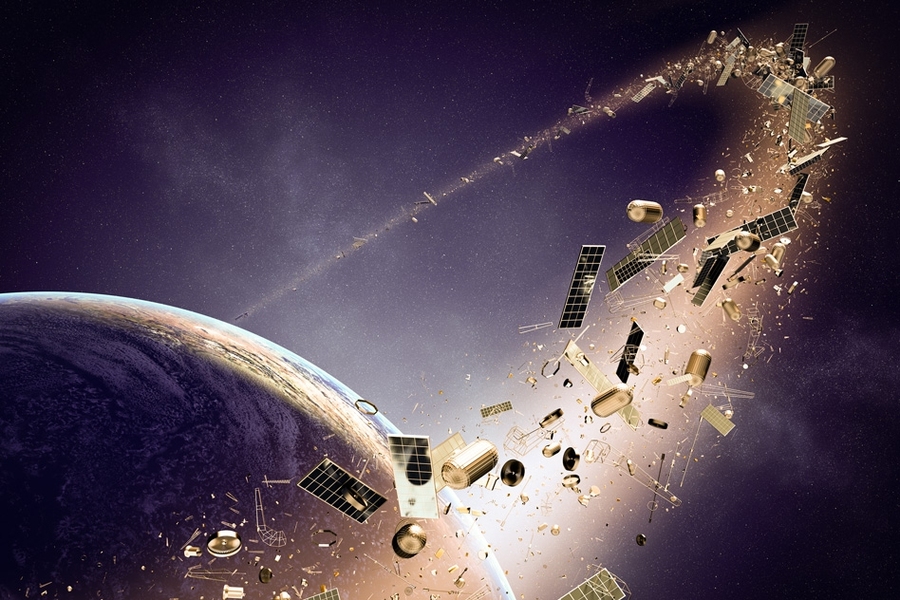
Hidden above our heads, circling Earth at incredible speeds, is an ever-growing cloud of human-made junk. Old satellites drift through orbit long after their missions have ended. Fragments from explosions and collisions race around the planet. Tiny paint flecks, broken bolts, discarded rocket stages, and shattered spacecraft pieces all share the same crowded environment.
Together, they form what scientists call space debris.
Space debris is one of the most significant challenges facing modern space exploration. Unlike pollution on Earth, this waste does not simply fall to the ground or disappear over time. Much of it remains in orbit for years, decades, or even centuries. Every new piece of debris increases the risk of collisions, threatening satellites, astronauts, and future missions.
The problem has grown steadily since the dawn of the Space Age. What began as a handful of rockets and satellites has evolved into a crowded orbital environment filled with thousands of active spacecraft and millions of pieces of debris.
Today, humanity faces an unusual challenge: cleaning up the space around our planet before the problem grows beyond control.
Understanding Space Debris
Space debris, sometimes called space junk, refers to any human-made object in Earth orbit that no longer serves a useful purpose.
These objects are not functioning satellites or operational spacecraft. Instead, they are remnants of past activities in space.
Some are large and easy to identify. Others are so tiny that they are nearly impossible to track.
Space debris includes defunct satellites, abandoned rocket stages, fragments from spacecraft explosions, pieces generated by collisions, and countless smaller objects created during decades of space operations.
Although these objects vary greatly in size, they share one important characteristic: they continue orbiting Earth even though they no longer have a mission.
This creates a growing problem because every piece of debris remains a potential hazard.
The Beginning of the Space Debris Problem
The story of space debris begins with the dawn of the Space Age.
In 1957, the Soviet Union launched Sputnik 1, the world’s first artificial satellite. This historic achievement marked the beginning of humanity’s journey into space.
At the time, few people worried about orbital pollution.
Space seemed unimaginably large.
The idea that Earth orbit could become crowded appeared almost impossible.
During the following decades, however, nations launched increasing numbers of satellites, scientific probes, military spacecraft, and communication systems.
Each launch left behind additional hardware.
Rocket stages were often abandoned after completing their tasks.
Old satellites remained in orbit after their missions ended.
Occasional explosions created clouds of fragments.
Slowly but steadily, debris began accumulating around Earth.
What initially seemed insignificant eventually became a major concern.
What Counts as Space Debris?
Many different objects fall under the category of space debris.
Large debris includes inactive satellites and spent rocket bodies.
Some abandoned satellites weigh several tons and continue circling Earth long after losing power or communication.
Rocket stages represent another major source of debris. Once they finish delivering payloads into orbit, these massive structures often remain in space.
Smaller debris includes broken fragments from collisions and explosions.
Even tiny objects can become dangerous because of their tremendous orbital speeds.
Among the most surprising forms of debris are paint chips, metal shards, insulation fragments, loose screws, and detached components from spacecraft.
Some debris pieces are smaller than a grain of sand.
Others are larger than buses.
Together, they form a complex and increasingly crowded orbital environment.
Why Objects Stay in Orbit
Many people wonder why space debris does not simply fall back to Earth.
The answer lies in orbital motion.
Objects in orbit are constantly falling toward Earth due to gravity. However, they are also moving sideways at such high speeds that they continually miss the planet.
This balance creates an orbit.
Imagine throwing a ball.
The harder you throw it, the farther it travels before hitting the ground.
If you could throw it fast enough, it would keep falling around Earth without ever reaching the surface.
That is essentially what happens with satellites and debris.
Depending on their altitude, some debris eventually reenters Earth’s atmosphere and burns up. Others remain in orbit for decades, centuries, or even longer.
The higher an object orbits, the longer it tends to stay there.
The Different Regions of Earth Orbit
Space debris exists throughout several orbital regions surrounding Earth.
Low Earth Orbit is the most crowded area.
This region extends from roughly 160 kilometers to about 2,000 kilometers above Earth’s surface.
Many satellites operate here because of its proximity to Earth.
The International Space Station also occupies this region.
Because so much activity occurs in Low Earth Orbit, it contains the largest concentration of debris.
Higher above Earth lies Medium Earth Orbit, home to various navigation satellites.
Farther still is Geostationary Orbit, where satellites match Earth’s rotation and appear fixed above specific locations.
Debris exists in all these regions, though the nature of the problem differs depending on altitude.
Some orbital zones have become particularly crowded, increasing the likelihood of collisions.
How Fast Does Space Debris Travel?
One of the most alarming aspects of space debris is its speed.
Objects in Low Earth Orbit typically travel at around 28,000 kilometers per hour.
At these velocities, even tiny fragments carry enormous kinetic energy.
A paint chip traveling at orbital speed can damage spacecraft surfaces.
A metal fragment only a few centimeters across can destroy a satellite.
A larger object can create catastrophic damage upon impact.
The danger comes not from the size of the object alone but from the incredible speed at which it moves.
In space, a collision resembles a high-speed explosion.
This is why even the smallest debris particles are taken seriously by engineers and mission planners.
The Growing Number of Satellites
The space debris problem has intensified because humanity is launching more satellites than ever before.
Modern society depends heavily on satellite technology.
Satellites support communication, navigation, weather forecasting, environmental monitoring, scientific research, national security, internet services, and countless other functions.
Recent years have seen the rise of massive satellite constellations designed to provide global internet coverage.
Thousands of new satellites have entered orbit.
Many more are planned.
These systems offer tremendous benefits but also increase orbital traffic.
More spacecraft mean more opportunities for accidental collisions, equipment failures, and debris generation.
Managing this increasingly crowded environment has become one of the central challenges of modern space operations.
Explosions in Space
Not all debris originates from collisions.
Many fragments result from explosions.
Historically, rocket stages and satellites sometimes exploded after completing their missions.
Residual fuel, battery malfunctions, and structural failures could trigger unexpected breakups.
When a spacecraft explodes, it can produce thousands of fragments.
Each fragment becomes a new piece of debris.
These fragments spread along orbital paths and may remain in space for years.
Many debris clouds observed today originated from events that occurred decades ago.
Because of this risk, modern spacecraft are often designed with measures intended to reduce the likelihood of post-mission explosions.
Satellite Collisions
One of the most dramatic sources of debris is satellite collisions.
For many years, scientists worried that an accidental collision between large spacecraft would generate enormous amounts of debris.
Those fears became reality in 2009.
A functioning communications satellite called Iridium 33 collided with the inactive Russian satellite Kosmos 2251.
The impact occurred at extremely high speed.
The collision shattered both satellites and produced thousands of trackable fragments along with countless smaller pieces.
The event highlighted the growing risks posed by orbital congestion.
It served as a warning that space debris was no longer merely a theoretical concern.
Anti-Satellite Tests and Debris
Some debris has been created intentionally.
Several nations have conducted anti-satellite weapon tests that destroy satellites in orbit.
These tests generate large numbers of fragments.
When a satellite is deliberately shattered, debris spreads throughout surrounding orbital regions.
Many fragments remain in space for years, creating hazards for other spacecraft.
Scientists and space agencies have expressed concern about such activities because they can significantly increase long-term debris levels.
A single destructive event can create thousands of dangerous objects.
The consequences may persist for decades.
The Kessler Syndrome
One of the most concerning concepts related to space debris is known as the Kessler Syndrome.
Proposed by NASA scientist Donald J. Kessler in 1978, the idea describes a potential chain reaction of collisions.
In this scenario, debris levels become so high that collisions generate additional debris.
That new debris causes more collisions.
Those collisions create even more debris.
The cycle continues, increasing the density of hazardous objects in orbit.
Eventually, certain orbital regions could become extremely difficult to use safely.
Although the Kessler Syndrome has not fully occurred, experts consider it a serious long-term risk.
Preventing such a scenario is one reason debris mitigation efforts are so important.
Why Space Debris Is Dangerous
Space debris threatens much more than satellites.
It poses risks to astronauts, scientific missions, commercial operations, and future exploration efforts.
A collision with even a small fragment can damage critical spacecraft systems.
Solar panels can be punctured.
Communication equipment can fail.
Protective shielding can be breached.
For crewed missions, debris presents an even greater concern.
Astronauts traveling outside spacecraft during spacewalks rely on protective suits that could be damaged by high-speed impacts.
Although the probability of such events remains relatively low, the consequences could be severe.
Every mission must carefully account for debris hazards.
Protecting the International Space Station
The International Space Station faces constant exposure to orbital debris.
Because it operates in Low Earth Orbit, it travels through regions containing numerous debris objects.
To protect the station, engineers continuously monitor nearby debris.
When tracking systems identify a potential collision risk, the station may perform avoidance maneuvers.
These maneuvers slightly alter its orbit to reduce danger.
The station also includes shielding designed to withstand impacts from small particles.
Despite these precautions, debris remains one of the most significant operational concerns for the station’s crews and managers.
Living and working in orbit requires constant vigilance.
Tracking Space Debris
Fortunately, scientists have developed sophisticated systems for monitoring orbital objects.
Ground-based radar installations track many debris pieces.
Optical telescopes help observe objects at higher altitudes.
Space agencies maintain catalogs containing information about thousands of objects.
These tracking systems allow operators to predict potential collisions and plan avoidance actions when necessary.
However, tracking becomes increasingly difficult as object size decreases.
Large debris can often be monitored effectively.
Tiny fragments, which may still cause serious damage, are much harder to detect.
This limitation remains one of the biggest challenges in orbital safety.
The Hidden Threat of Tiny Debris
Most people imagine large satellites when they think about space debris.
Yet some of the greatest risks come from objects too small to see.
A fragment only a few millimeters wide may seem insignificant.
In orbit, however, its extreme velocity transforms it into a dangerous projectile.
Spacecraft windows have occasionally been damaged by tiny debris impacts.
Protective surfaces show scars from countless microscopic collisions.
Because these fragments are often impossible to track individually, engineers must design spacecraft capable of surviving encounters with them.
The smallest debris may be invisible, but its effects are very real.
How Space Debris Affects Everyday Life
Space debris might seem like a distant problem affecting only astronauts and engineers.
In reality, its consequences can reach people on Earth.
Modern civilization relies heavily on satellites.
Communication networks, weather forecasting, navigation systems, financial transactions, disaster monitoring, and internet services all depend on spacecraft operating safely in orbit.
If debris damages satellites, these services could be disrupted.
A major increase in collisions could raise costs for satellite operators and complicate future missions.
Protecting orbital environments therefore helps protect technologies that billions of people use every day.
Can Space Debris Fall to Earth?
Some space debris eventually reenters Earth’s atmosphere.
As objects encounter atmospheric drag, they gradually lose altitude.
Many burn up completely due to intense heating during reentry.
This process creates bright streaks of light that resemble meteors.
Larger objects may survive partially intact and reach Earth’s surface.
Fortunately, Earth’s vast oceans and uninhabited regions greatly reduce the risk to people.
Documented injuries from falling space debris are extremely rare.
Nevertheless, agencies carefully monitor large reentries to assess potential hazards.
As the number of objects in orbit grows, managing reentry risks becomes increasingly important.
Cleaning Up Space
Given the scale of the problem, many scientists are exploring ways to remove debris from orbit.
The challenge is enormous.
Capturing an object traveling at orbital speeds requires advanced technology and precise navigation.
Several proposed solutions involve robotic spacecraft designed to rendezvous with debris.
Some concepts use nets, harpoons, robotic arms, or magnetic systems.
Others propose dragging debris into Earth’s atmosphere where it can burn up safely.
Experimental missions have demonstrated promising techniques, but large-scale cleanup remains difficult and expensive.
Still, interest in active debris removal continues growing.
Many experts believe cleanup efforts will eventually become necessary.
Preventing Future Debris
While removing existing debris is important, preventing new debris may be even more critical.
Modern space agencies and commercial operators increasingly follow debris mitigation guidelines.
Satellites are often designed to deorbit after completing their missions.
Unused fuel may be vented to reduce explosion risks.
Spacecraft operators carefully coordinate activities to minimize accidental fragmentation.
International organizations promote best practices for sustainable space operations.
These efforts aim to ensure that future generations can continue using space safely.
Prevention is often far easier than cleanup.
International Cooperation
Space debris is a global problem.
Orbital environments do not belong to any single nation.
Debris generated by one country can threaten satellites operated by another.
As a result, international cooperation plays a crucial role in addressing the issue.
Space agencies, governments, researchers, and private companies regularly share tracking data and develop common standards.
Organizations around the world work together to improve debris monitoring and promote responsible behavior in orbit.
The challenge requires collective action because no nation can solve it alone.
Space is a shared environment.
Its protection benefits everyone.
Space Debris Around Other Worlds
Although most discussions focus on Earth, debris concerns may eventually extend beyond our planet.
Human activity around the Moon is increasing.
Future lunar missions could create long-term orbital infrastructure.
As exploration expands, managing orbital environments around other celestial bodies may become important.
The lessons learned from Earth can help guide future activities elsewhere.
Avoiding debris problems from the beginning is far easier than solving them later.
Humanity has an opportunity to apply these lessons as it ventures deeper into space.
The Future of Orbital Sustainability
The future of space exploration depends on maintaining safe and sustainable orbital environments.
Humanity’s ambitions continue expanding.
New satellites launch every week.
Commercial space industries are growing rapidly.
Plans for lunar bases, Mars missions, and advanced space infrastructure are becoming increasingly realistic.
All of these goals depend on access to usable orbital space.
If debris levels continue rising unchecked, future missions could face greater risks and costs.
Conversely, effective management can ensure that orbit remains accessible for generations to come.
The decisions made today will shape the future of human activity in space.
Why the Problem Matters
Space debris is often described as an environmental issue, and for good reason.
Just as pollution affects Earth’s oceans, rivers, forests, and atmosphere, debris affects the space environment surrounding our planet.
The difference is that orbital pollution behaves differently.
It moves at extraordinary speeds.
It can persist for decades.
It threatens technologies that modern society depends upon.
Most importantly, every new piece of debris increases the complexity of the problem.
Addressing it requires foresight, cooperation, innovation, and responsibility.
The challenge is not simply technical.
It is also about stewardship.
Humanity must learn how to use space without permanently damaging it.
Conclusion
Space debris is the growing collection of inactive satellites, discarded rocket stages, collision fragments, and other human-made objects orbiting Earth. What began as a byproduct of early space exploration has evolved into one of the most important challenges facing modern spaceflight. Traveling at tremendous speeds, even tiny pieces of debris can damage spacecraft, threaten astronauts, and disrupt critical satellite services.
As satellite numbers continue rising, the risks associated with orbital junk increase as well. Scientists and engineers are working to track debris, prevent new pollution, develop cleanup technologies, and promote international cooperation. These efforts are essential for maintaining safe access to space.
The story of space debris is ultimately a reminder that exploration comes with responsibility. Humanity has transformed the region around Earth into a vital extension of civilization, supporting communication, navigation, science, and discovery. Protecting that environment is now one of the defining challenges of the Space Age. If we succeed, future generations will continue exploring the cosmos safely. If we fail, the growing cloud of orbital junk may become one of the greatest obstacles to our future among the stars.