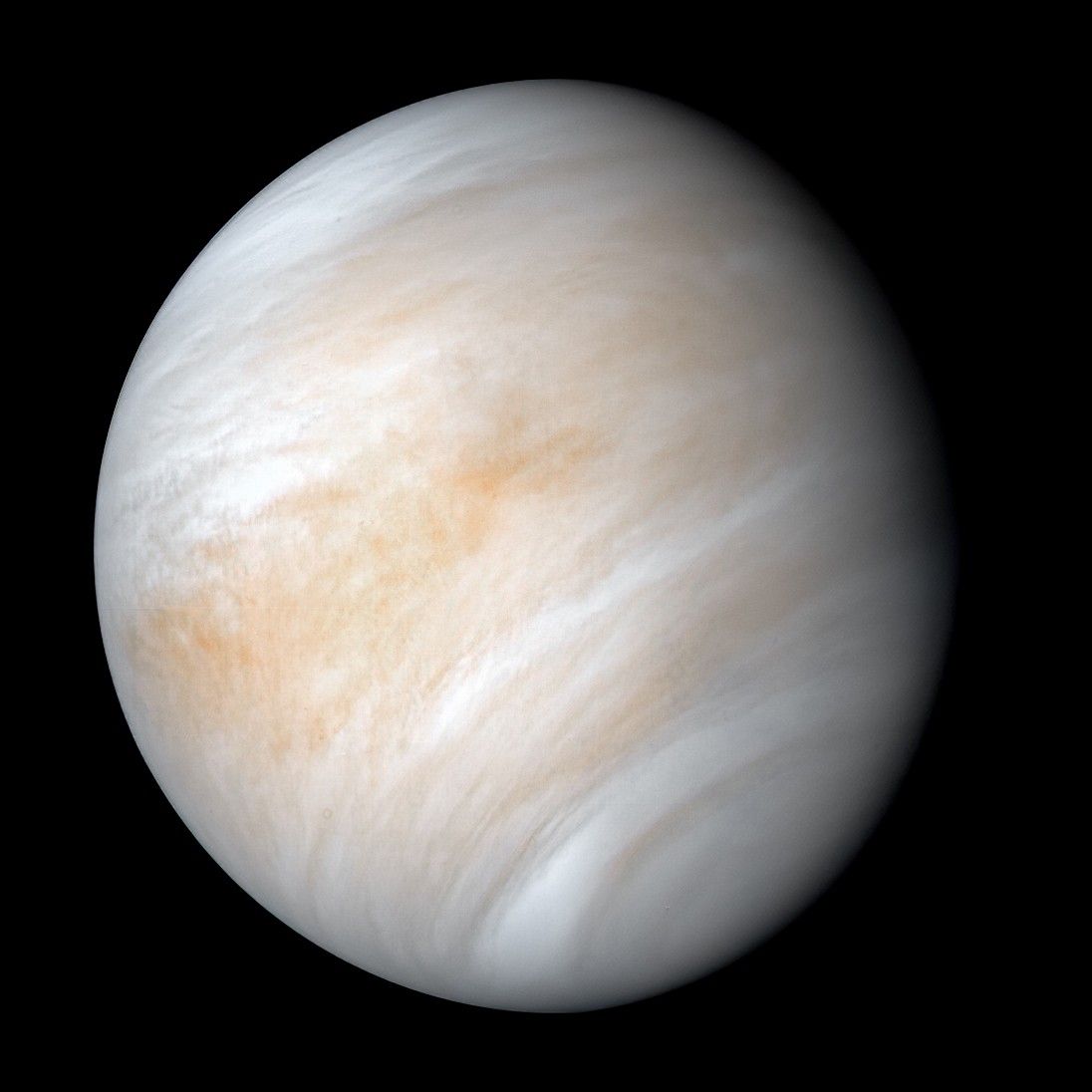
When we look up at the night sky, Venus often appears as a brilliant beacon shining near the horizon. It is the brightest planet visible from Earth and has fascinated humans for thousands of years. Ancient civilizations associated it with beauty, love, and divine power. Even today, Venus is sometimes called Earth’s twin because it is similar to our planet in size, mass, and composition.
But behind its beautiful appearance lies one of the most extreme environments in the Solar System.
The surface of Venus is hot enough to melt lead. Temperatures reach around 465 degrees Celsius (869 degrees Fahrenheit), making Venus even hotter than Mercury, despite Mercury being much closer to the Sun. The atmosphere is crushingly dense, with surface pressure about 90 times greater than Earth’s. Thick clouds of sulfuric acid permanently cover the planet, hiding its surface from ordinary view.
Scientists have spent decades trying to understand how a world so similar to Earth became so different.
The answer lies in one of the most dramatic climate processes known to science: the runaway greenhouse effect.
Venus is not merely another planet. It is a warning, a scientific mystery, and a fascinating example of how planetary climates can evolve in radically different directions. Understanding why Venus experienced a runaway greenhouse effect helps scientists understand not only the history of our neighboring planet but also the past, present, and future of Earth itself.
Venus: Earth’s Mysterious Twin
At first glance, Venus seems remarkably similar to Earth.
Its diameter is about 95 percent of Earth’s diameter. Its mass is roughly 81 percent of Earth’s mass. Both planets are rocky worlds formed from similar materials during the early history of the Solar System.
For many years, astronomers wondered whether Venus might even host life. Before spacecraft visited the planet, the thick cloud cover prevented direct observations of the surface. Some scientists imagined vast oceans hidden beneath the clouds. Others speculated about jungles or swamp-like landscapes.
Because Venus and Earth are so similar in size, many researchers expected them to have evolved in similar ways.
Instead, they discovered one of the greatest planetary contrasts imaginable.
Earth became a world filled with oceans, forests, ice caps, and life.
Venus became a scorching inferno.
This dramatic difference raises a profound question: what happened?
Understanding the Greenhouse Effect
To understand Venus, we first need to understand the greenhouse effect itself.
The greenhouse effect is a natural process that warms a planet’s surface.
When sunlight reaches a planet, some of that energy is absorbed by the surface. The warmed surface then emits heat in the form of infrared radiation.
If a planet has no atmosphere, much of that heat escapes directly into space.
However, certain gases in an atmosphere can absorb and re-emit infrared radiation. These gases trap some of the outgoing heat, warming the planet.
These are known as greenhouse gases.
On Earth, greenhouse gases include water vapor, carbon dioxide, methane, and nitrous oxide.
Without the greenhouse effect, Earth’s average surface temperature would be around minus 18 degrees Celsius. Instead, it is about 15 degrees Celsius.
In other words, life on Earth depends on a moderate greenhouse effect.
The greenhouse effect itself is not harmful.
The problem arises when it becomes excessive.
What Is a Runaway Greenhouse Effect?
A runaway greenhouse effect occurs when warming triggers processes that cause even more warming, creating a powerful feedback loop.
Imagine a planet warming slightly.
As temperatures rise, more water evaporates into the atmosphere.
Water vapor is a greenhouse gas, so it traps additional heat.
This additional heat causes even more evaporation.
The cycle repeats.
More heat leads to more water vapor.
More water vapor leads to more heat.
Eventually, the process spirals out of control.
Once this feedback becomes strong enough, the planet can undergo dramatic and irreversible climate changes.
Temperatures rise rapidly.
Oceans may evaporate.
The atmosphere becomes increasingly thick and heat-trapping.
The result is a planetary climate catastrophe.
Venus appears to be the Solar System’s most dramatic example of this process.
Venus Receives More Solar Energy
One major reason Venus developed a runaway greenhouse effect is its location.
Venus orbits much closer to the Sun than Earth does.
The average distance between Venus and the Sun is about 108 million kilometers.
Earth orbits at roughly 150 million kilometers.
Because Venus is closer, it receives nearly twice as much solar energy as Earth.
This difference may not sound enormous, but it has profound consequences.
The closer a planet is to its star, the more energy reaches its atmosphere and surface.
That additional energy likely played a critical role in Venus’s climatic evolution.
Scientists believe early Venus may have started with conditions somewhat similar to those of Earth.
But the stronger sunlight may have pushed Venus beyond a critical threshold.
Did Venus Once Have Oceans?
One of the most fascinating questions in planetary science is whether Venus once possessed liquid water.
Many researchers believe it did.
Computer models suggest that early Venus may have had substantial amounts of water. Some studies even indicate that oceans could have existed for hundreds of millions or perhaps billions of years.
The young Sun was slightly dimmer than it is today, which may have helped Venus remain cooler during its earliest history.
If this scenario is correct, ancient Venus might have looked surprisingly Earth-like.
Clouds may have drifted across blue skies.
Rain may have fallen.
Rivers may have carved valleys.
Oceans may have covered large regions of the planet.
The possibility is both exciting and heartbreaking.
A world that may once have been habitable eventually transformed into one of the most hostile environments in the Solar System.
The Role of Water Vapor
Water vapor played a crucial role in Venus’s transformation.
As Venus received more solar energy, temperatures gradually increased.
Warmer temperatures caused more water to evaporate.
The atmosphere became increasingly humid.
Because water vapor is an extremely effective greenhouse gas, it trapped additional heat.
That extra heat accelerated evaporation even further.
This created a positive feedback loop.
The process reinforced itself continuously.
The more water entered the atmosphere, the more warming occurred.
The more warming occurred, the more water entered the atmosphere.
Over immense spans of time, this feedback became increasingly powerful.
Eventually, Venus may have crossed a climatic tipping point.
Beyond that point, recovery became impossible.
The Moist Greenhouse Stage
Before a full runaway greenhouse develops, a planet may enter what scientists call a moist greenhouse state.
In this phase, large amounts of water vapor rise into the upper atmosphere.
Normally, Earth’s upper atmosphere remains relatively dry.
Venus likely became different.
As temperatures increased, water vapor reached higher altitudes.
Once water molecules reached the upper atmosphere, they became vulnerable to solar radiation.
Ultraviolet light from the Sun can split water molecules into hydrogen and oxygen.
This process is known as photodissociation.
The breakup of water molecules had enormous consequences for Venus’s future.
The Escape of Hydrogen
Hydrogen is the lightest element in the universe.
Once hydrogen atoms reached the upper atmosphere of Venus, many escaped into space.
Gravity could not hold them effectively.
Over millions and billions of years, enormous amounts of hydrogen drifted away forever.
This process effectively removed water from the planet.
Each escaping hydrogen atom represented a tiny piece of a lost ocean.
The oxygen left behind followed different paths.
Some reacted with rocks on the surface.
Some may have escaped into space through other processes.
The net result was devastating.
Venus steadily lost its water inventory.
Eventually, the planet became almost completely dry.
Scientists have found strong evidence supporting this scenario by studying the ratio of hydrogen isotopes in Venus’s atmosphere.
The measurements suggest that vast amounts of water disappeared over time.
Carbon Dioxide Takes Over
While water was disappearing, another greenhouse gas was becoming increasingly important.
Carbon dioxide.
Earth’s atmosphere contains only a small percentage of carbon dioxide.
Yet even that small amount significantly influences climate.
Venus is vastly different.
Its atmosphere consists of approximately 96 percent carbon dioxide.
This enormous concentration creates an extraordinarily powerful greenhouse effect.
How did Venus accumulate so much carbon dioxide?
The answer may lie partly in the absence of oceans.
On Earth, oceans play a crucial role in regulating carbon dioxide levels.
Carbon dioxide dissolves in seawater.
Marine organisms incorporate carbon into shells and skeletons.
Geological processes eventually lock carbon into rocks.
These mechanisms help remove carbon dioxide from the atmosphere.
Venus lost its water.
Without oceans, these carbon-removal processes largely disappeared.
Carbon dioxide remained in the atmosphere, where it continued trapping heat.
Why Earth Avoided the Same Fate
One of the most important questions scientists ask is why Earth avoided becoming another Venus.
Several factors appear to have helped.
Earth orbits farther from the Sun.
This reduced solar energy input may have kept temperatures below the runaway threshold.
Earth also possesses abundant liquid water.
Oceans help stabilize climate by absorbing heat and storing carbon dioxide.
Plate tectonics play another crucial role.
Earth’s tectonic activity continuously recycles carbon between the atmosphere, oceans, and rocks.
This long-term carbon cycle acts as a natural climate regulator.
Venus appears to lack Earth-like plate tectonics.
Without such mechanisms, carbon dioxide accumulated in the atmosphere.
The differences may seem subtle, but over billions of years they produced radically different outcomes.
The Crushing Atmosphere of Venus
Today, Venus possesses one of the densest atmospheres in the Solar System.
Standing on the surface would be like being nearly a kilometer underwater on Earth.
The atmospheric pressure is immense.
The atmosphere itself contributes significantly to the extreme greenhouse effect.
The dense carbon dioxide blanket absorbs and re-radiates heat with remarkable efficiency.
Very little thermal energy escapes to space.
As a result, the entire lower atmosphere remains extraordinarily hot.
Unlike Earth, where temperatures vary widely between regions and times of day, Venus maintains relatively uniform temperatures across much of the planet.
Its atmosphere effectively distributes heat everywhere.
Why Venus Is Hotter Than Mercury
Many people assume Mercury should be the hottest planet because it is closest to the Sun.
In reality, Venus is hotter.
This fact beautifully demonstrates the power of the greenhouse effect.
Mercury has almost no atmosphere.
As a result, heat escapes readily into space.
Temperatures on Mercury fluctuate dramatically between day and night.
Venus, despite receiving less sunlight than Mercury, traps heat so effectively that its surface remains consistently hotter.
The atmosphere acts like a gigantic insulating blanket.
This comparison reveals that atmospheric composition can be more important than distance from the Sun when determining planetary temperatures.
The Sulfuric Acid Clouds
One of Venus’s most distinctive features is its global cloud cover.
These clouds consist primarily of sulfuric acid droplets.
They reflect a large percentage of incoming sunlight back into space.
At first glance, this seems like it should cool the planet.
And indeed, the clouds do reduce some solar heating.
However, the greenhouse effect occurring beneath the clouds is so powerful that the cooling influence cannot compensate.
The atmosphere remains overwhelmingly dominated by carbon dioxide.
The result is a planet that reflects much sunlight yet still maintains incredibly high surface temperatures.
This combination makes Venus both bright and deadly.
Evidence From Space Missions
Much of what we know about Venus comes from spacecraft.
Beginning in the twentieth century, robotic missions transformed our understanding of the planet.
Soviet Venera landers achieved one of the greatest engineering feats in space exploration by surviving briefly on Venus’s surface.
The conditions were so extreme that most landers lasted only minutes to a few hours before failing.
Nevertheless, they returned invaluable data and images.
Later missions mapped the surface using radar, penetrated the thick cloud cover, and analyzed atmospheric composition.
These observations confirmed the extraordinary density of the atmosphere, the abundance of carbon dioxide, and the extreme temperatures.
They also strengthened the case for a runaway greenhouse history.
What the Surface Reveals
The surface of Venus tells a story of immense geological activity.
Volcanic plains cover much of the planet.
Large lava flows stretch across vast regions.
Gigantic volcanic structures dominate the landscape.
Some scientists believe volcanic eruptions may have contributed significant amounts of carbon dioxide to the atmosphere.
If volcanic activity released greenhouse gases faster than they could be removed, atmospheric warming would intensify.
Recent research even suggests that Venus may still possess active volcanoes today.
If true, the planet remains geologically alive.
Its climate and geology may still be interacting in important ways.
The Climate Feedback Loops
Runaway greenhouse effects are driven by feedback loops.
Venus experienced several powerful feedback mechanisms.
Water vapor amplified warming.
Higher temperatures increased atmospheric humidity.
Water loss eliminated important climate-regulating processes.
Carbon dioxide accumulated.
The atmosphere became denser.
Heat trapping intensified.
Each process reinforced the others.
Together, they created a chain reaction that transformed the planet.
Once these feedbacks became strong enough, reversing them became virtually impossible.
The climate system crossed a threshold beyond which runaway warming dominated.
Lessons for Earth
Whenever Venus is discussed, an important question inevitably arises.
Could Earth experience a runaway greenhouse effect?
Based on current scientific understanding, Earth is not believed to be at immediate risk of becoming another Venus.
The conditions required for a true Venus-like runaway greenhouse are far more extreme than those produced by present-day human activities.
However, Venus still offers important lessons.
It demonstrates the immense power of greenhouse gases.
It shows how planetary climates can change dramatically.
It reminds us that atmospheres are dynamic systems capable of evolving over time.
Studying Venus helps scientists better understand climate processes on Earth and on planets around other stars.
The lesson is not that Earth will suddenly become Venus.
The lesson is that climate matters.
Planetary history can be shaped by atmospheric change.
Venus and the Search for Habitable Worlds
The study of Venus has become increasingly important in the search for life beyond Earth.
Astronomers have discovered thousands of planets orbiting distant stars.
Many lie within regions known as habitable zones, where liquid water might exist.
But Venus serves as a cautionary example.
A planet’s location alone does not determine habitability.
Atmospheric composition is equally important.
Two planets may begin with similar characteristics yet evolve in dramatically different directions.
Understanding Venus helps scientists identify which distant worlds may truly support life.
It also helps them recognize signs of runaway greenhouse processes elsewhere in the galaxy.
Could Venus Ever Be Habitable Again?
The idea of transforming Venus into a habitable world has fascinated scientists and science-fiction writers alike.
Unfortunately, the challenge would be enormous.
The atmosphere contains vast quantities of carbon dioxide.
Surface temperatures remain extreme.
Water is almost entirely absent.
Changing these conditions would require technological capabilities far beyond anything humanity currently possesses.
Nevertheless, some researchers have proposed imaginative concepts involving atmospheric modification or floating habitats high above the clouds.
Interestingly, conditions about 50 kilometers above Venus’s surface are much milder than conditions on the ground.
At those altitudes, temperatures and pressures become surprisingly Earth-like.
While a habitable Venus remains a distant dream, the discussion highlights how extraordinary the planet’s climate truly is.
The Ongoing Mystery of Venus
Although scientists understand much more about Venus today than they once did, important questions remain.
Exactly how much water did Venus originally possess?
How long did potential oceans survive?
When did the runaway greenhouse effect become unstoppable?
What role did volcanism play?
How active is Venus today?
Future missions may provide answers.
New spacecraft planned by various space agencies aim to study the atmosphere, surface, and geological history of Venus in unprecedented detail.
Each mission promises new insights into one of the Solar System’s most fascinating worlds.
Conclusion
Venus is often called Earth’s twin, yet it evolved into a world that could hardly be more different. Beneath its brilliant appearance lies a planet where temperatures exceed 465 degrees Celsius, atmospheric pressure crushes anything that lands on the surface, and thick clouds hide a landscape shaped by intense heat and volcanic activity.
The primary reason for this transformation is the runaway greenhouse effect. Receiving more sunlight than Earth, Venus likely experienced increasing evaporation of water. Water vapor amplified warming, leading to even more evaporation. As water reached the upper atmosphere, sunlight broke it apart, allowing hydrogen to escape into space. Over time, the planet lost its oceans. Without water to help regulate carbon dioxide, greenhouse gases accumulated until the atmosphere became overwhelmingly dominated by carbon dioxide.
The result was a self-reinforcing cycle of warming that transformed Venus into the hottest planet in the Solar System.
Yet Venus is more than a planetary disaster. It is a scientific treasure. It teaches us how climates evolve, how atmospheres shape worlds, and how seemingly small differences can lead to dramatically different outcomes over billions of years.
Every time scientists study Venus, they learn not only about a neighboring planet but also about Earth, climate, habitability, and the fragile balance that allows life to exist. In many ways, Venus stands as both a warning and a wonder—a reminder that the story of a planet can be written by its atmosphere, and that understanding that story helps us better understand our own place in the universe.