When most people imagine the asteroid belt, they picture a dangerous region of space packed with countless giant rocks crashing into one another. Popular movies often show spacecraft weaving through dense fields of tumbling asteroids, narrowly avoiding catastrophic collisions at every turn. It is an exciting image, full of drama and danger.
The reality, however, is far different—and in many ways, even more fascinating.
The asteroid belt is one of the most important regions in our Solar System. Located between Mars and Jupiter, it contains millions of rocky objects that serve as ancient leftovers from the birth of the planets. These celestial bodies are not merely space debris. They are time capsules, preserving clues from more than 4.5 billion years ago when the Solar System was still forming.
Scientists study the asteroid belt because it offers a glimpse into a distant past that no human could ever witness directly. Every asteroid carries information about the materials that existed before Earth became a world filled with oceans, mountains, forests, and life.
Far from being a chaotic junkyard, the asteroid belt is a carefully structured region shaped by gravity, collisions, and billions of years of cosmic evolution.
Understanding the asteroid belt means understanding part of our own origin story.
Where Is the Asteroid Belt?
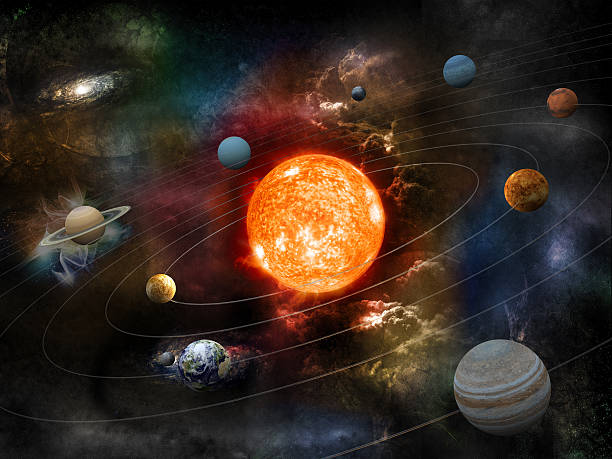
The asteroid belt occupies a vast region between the orbits of Mars and Jupiter.
Mars orbits the Sun at an average distance of about 228 million kilometers, while Jupiter travels much farther away at approximately 778 million kilometers. Between these two planets lies a broad zone populated by rocky and metallic objects of various sizes.
This region stretches across hundreds of millions of kilometers.
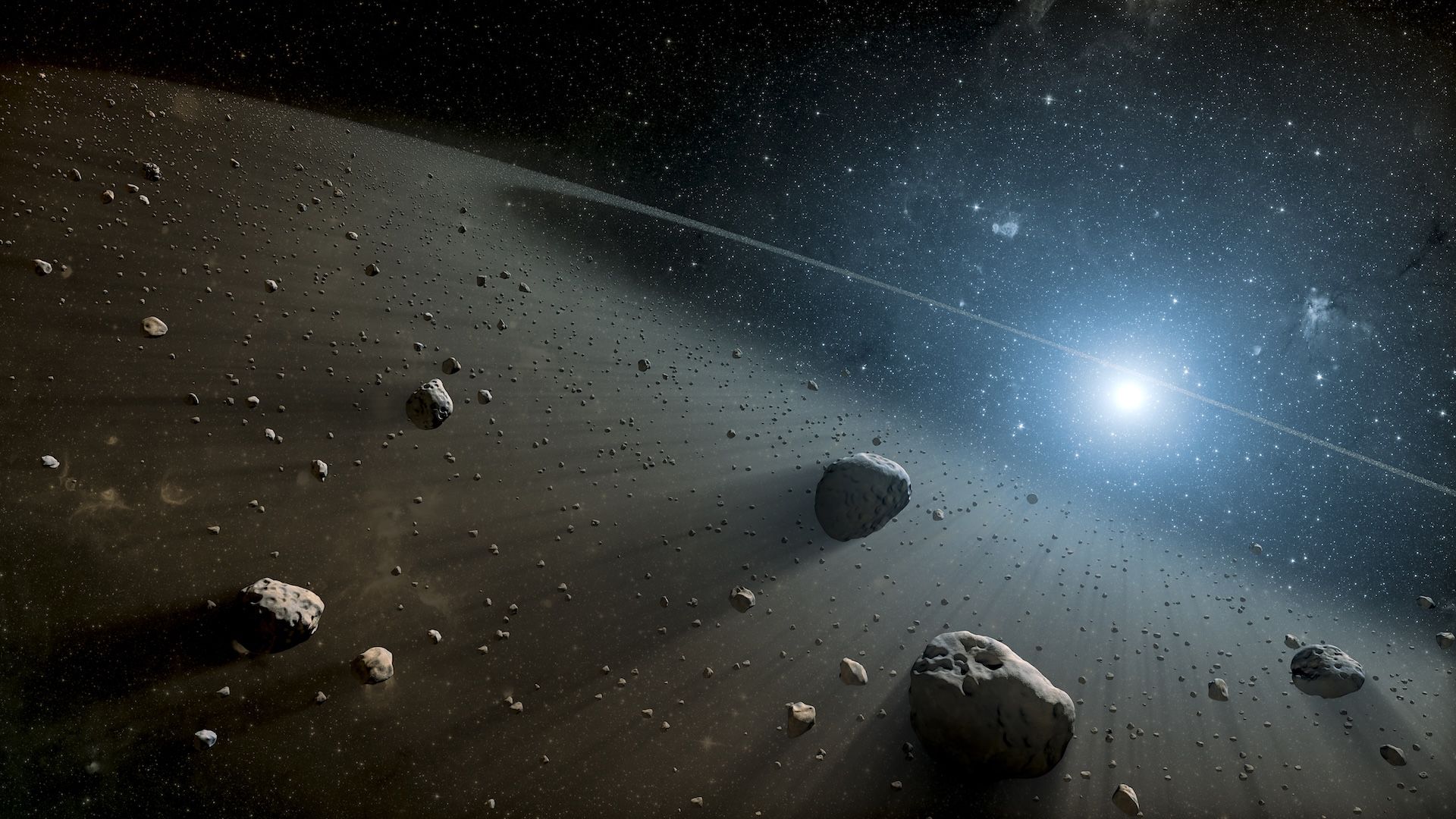
Although it is called a “belt,” the asteroid belt is not a solid ring. Instead, it resembles an enormous volume of space containing countless individual objects moving along their own paths around the Sun.
Each asteroid follows its own orbit. Some travel in nearly circular paths, while others have slightly more elongated trajectories. Together, they create a complex and dynamic environment that has existed for billions of years.
From a distance, the asteroid belt might appear crowded. In reality, it is surprisingly empty.
The Biggest Misconception About the Asteroid Belt
Perhaps the greatest myth about the asteroid belt comes from science fiction.
Movies often depict spacecraft navigating through tightly packed clusters of giant rocks. Asteroids seem close enough to touch, forcing pilots to dodge them constantly.
The real asteroid belt looks nothing like this.
The average distance between large asteroids is enormous. In many areas, objects may be separated by hundreds of thousands or even millions of kilometers.
If you were standing on an asteroid, you probably would not see another asteroid nearby with your naked eye.
Spacecraft have traveled through the asteroid belt multiple times without difficulty. Missions such as those launched by NASA and other space agencies have crossed the region safely because the chances of hitting an asteroid are extremely low.
The belt contains many objects, but space itself is unimaginably vast.
The asteroids are scattered throughout a huge volume rather than packed together.
This reality often surprises people because the truth is far less dramatic than Hollywood’s version. Yet it also reveals something profound about the scale of the Solar System.
Space is mostly empty.
The Discovery of the Asteroid Belt
The story of the asteroid belt begins with a mystery.
During the eighteenth century, astronomers noticed a curious pattern in the spacing of planetary orbits. Some researchers suspected that a planet might exist between Mars and Jupiter.
A search began.
In 1801, Italian astronomer Giuseppe Piazzi discovered a small object moving against the background stars. He named it Ceres.
At first, many believed Ceres was the missing planet.
However, additional discoveries soon followed.
Astronomers found Pallas, Juno, and Vesta.
It became clear that this region did not contain a single hidden planet. Instead, it hosted numerous smaller objects.
As telescope technology improved, astronomers discovered more and more of them.
Eventually, scientists realized they had uncovered an entirely new population of Solar System bodies.
The asteroid belt had entered human knowledge.
How the Asteroid Belt Formed
To understand the asteroid belt, we must travel back approximately 4.6 billion years.
At that time, the Solar System did not yet exist as we know it. Instead, there was a vast cloud of gas and dust called the solar nebula.
Gravity gradually pulled this material together.
At the center, the Sun formed.
Around the young Sun, countless particles collided and stuck together. Tiny grains became larger clumps. These clumps grew into planetesimals—small building blocks of planets.
In many regions, planetesimals continued merging until they became full-sized planets.
Something different happened between Mars and Jupiter.
Scientists believe the immense gravitational influence of Jupiter disrupted the process of planetary formation.
Jupiter was becoming enormous, eventually growing into the largest planet in the Solar System.
Its gravity repeatedly disturbed the objects forming nearby.
Instead of combining into a planet, many planetesimals experienced collisions, orbital disruptions, and gravitational interference.
As a result, a complete planet never formed in this region.
The leftovers became the asteroid belt.
In a sense, the asteroid belt is a collection of unfinished planetary building blocks.
Is the Asteroid Belt the Remains of a Destroyed Planet?
For many years, a popular idea suggested that the asteroid belt was once a planet that exploded.
It is an appealing story.
Imagine a world shattered by some ancient catastrophe, leaving fragments scattered across space.
Unfortunately, the evidence does not support this scenario.
The total mass of all objects in the asteroid belt is surprisingly small. In fact, if every asteroid were combined into a single body, it would contain only a tiny fraction of Earth’s mass.
This amount is far too little to represent the remains of a large planet.
Furthermore, the compositions of asteroids vary significantly. They do not appear to originate from one single world.
Modern research strongly indicates that the asteroid belt consists of material that never became a planet in the first place.
Rather than being the ruins of a lost world, it is more accurately described as a planetary construction project that was never completed.
How Many Asteroids Are There?
The asteroid belt contains an astonishing number of objects.
Scientists estimate that millions of asteroids larger than one kilometer exist within the belt.
There are also countless smaller rocks, fragments, dust particles, and debris.
Not all asteroids are equal in size.
Some are little more than boulders.
Others are hundreds of kilometers across.
The largest object, Ceres, measures approximately 940 kilometers in diameter and is now classified as a dwarf planet.
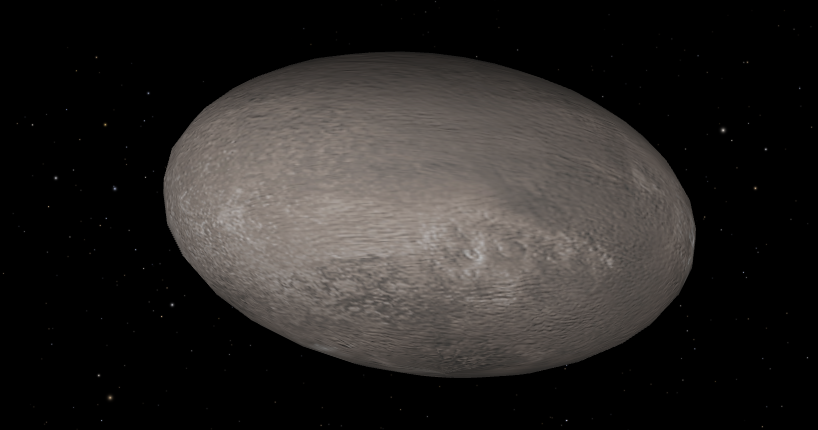
Many other large asteroids exist as well, including Vesta, Pallas, and Hygiea.
Despite these impressive numbers, the total mass of the asteroid belt remains relatively small compared to the planets.
Most of its material is concentrated in a handful of large bodies.
Meet Ceres: The Queen of the Asteroid Belt
Among all the objects in the asteroid belt, Ceres stands apart.
Discovered in 1801, it remains the largest body in the region.
Today, astronomers classify Ceres as a dwarf planet rather than an asteroid.
Its nearly spherical shape distinguishes it from many smaller asteroids.
Ceres contains roughly one-third of the entire asteroid belt’s mass.
This remarkable object has become a major focus of scientific research.
Observations suggest that Ceres contains significant amounts of water ice beneath its surface.
Some studies even indicate the possible presence of salty liquid reservoirs in its past.
Bright spots observed by spacecraft attracted worldwide attention and were eventually linked to deposits of reflective salts.
Ceres demonstrates that asteroid belt objects can be far more complex than simple rocks drifting through space.
Vesta: A Window Into Planetary Formation
Another fascinating world within the asteroid belt is Vesta.
Unlike many asteroids, Vesta appears to have undergone internal differentiation.
This means that when it was young, its interior partially melted and separated into layers.
In some ways, Vesta resembles a miniature planet.
It possesses a crust, mantle-like regions, and evidence of ancient volcanic activity.
Massive impacts have left enormous scars across its surface.
One collision created a gigantic crater near its south pole.
Fragments blasted away from Vesta eventually reached Earth as meteorites.
Scientists have studied these meteorites extensively, providing valuable information about conditions during the Solar System’s earliest history.
Vesta serves as a bridge between small asteroids and fully developed planets.
What Are Asteroids Made Of?
Asteroids are not all identical.
Scientists classify them into several categories based on their composition.
Some are rich in carbon and dark organic materials.
Others contain abundant silicate rocks.
Still others possess significant metallic content, including iron and nickel.
These differences reveal important information about the early Solar System.
Different materials formed at different distances from the Sun.
By studying asteroid compositions, researchers can reconstruct aspects of ancient planetary formation.
Some asteroids may preserve materials that have remained largely unchanged for billions of years.
These primitive objects are especially valuable because they offer direct access to conditions that existed before the planets fully formed.
Collisions in the Asteroid Belt
Although the asteroid belt is mostly empty space, collisions do occur.
Over billions of years, asteroids occasionally strike one another.
Some impacts are gentle enough to create craters.
Others are powerful enough to shatter entire bodies.
These collisions have shaped the belt’s evolution.
Many smaller asteroids are actually fragments produced by ancient impacts.
Scientists can identify asteroid families—groups of objects sharing similar orbital characteristics and compositions.
These families often represent the remains of larger parent bodies that broke apart long ago.
Every collision contributes to the ongoing story of destruction and creation within the asteroid belt.
Asteroid Families and Cosmic Genealogy
Imagine tracing your family tree back through generations.
Astronomers do something similar with asteroids.
By analyzing orbital paths and physical characteristics, scientists can identify related groups.
These asteroid families likely originated from common ancestors.
A large asteroid experiences a major collision.
The impact creates numerous fragments.
Over time, these fragments spread out but continue traveling in related orbits.
Millions or even billions of years later, researchers can still recognize their shared heritage.
These cosmic family trees help scientists reconstruct ancient events that shaped the Solar System.
Jupiter’s Powerful Influence
No discussion of the asteroid belt is complete without mentioning Jupiter.
The giant planet dominates the region gravitationally.
Its immense mass profoundly affects asteroid orbits.
Certain orbital distances experience special gravitational relationships called resonances.
In these regions, Jupiter’s repeated gravitational tugs can destabilize asteroid trajectories.
Some areas become depleted of asteroids.
These gaps are known as Kirkwood gaps.
Jupiter’s influence has helped shape the belt for billions of years.
Without Jupiter, the asteroid belt might look completely different today.
In fact, the giant planet may be the primary reason the belt exists at all.
The Asteroid Belt and Earth
At first glance, the asteroid belt seems far removed from life on Earth.
Yet the connection is surprisingly deep.
Some asteroids occasionally leave the belt due to gravitational interactions.
Their orbits change.
A few eventually cross Earth’s path.
When fragments enter Earth’s atmosphere, they become meteors.
If pieces survive to reach the ground, they are called meteorites.
Many meteorites found on Earth originated in the asteroid belt.
These space rocks provide scientists with physical samples of ancient Solar System material.
Through them, researchers can study events that occurred billions of years before Earth became habitable.
In this sense, pieces of the asteroid belt regularly arrive on our planet.
Did Asteroids Help Create Life?
One of the most intriguing scientific questions concerns the role asteroids may have played in life’s origins.
Early Earth experienced frequent impacts.
Many asteroids contained water-rich minerals and organic molecules.
Some researchers believe these impacts may have delivered important ingredients for life.
Water is essential for biology.
Complex carbon-based molecules are fundamental building blocks of living systems.
If asteroids helped transport such materials to Earth, they may have contributed to the conditions that eventually allowed life to emerge.
Although scientists continue debating the details, the possibility is profoundly fascinating.
The asteroid belt may have influenced not only planetary formation but also the story of life itself.
Space Missions to the Asteroid Belt
Modern spacecraft have transformed our understanding of asteroids.
For centuries, these objects appeared as tiny points of light through telescopes.
Today, we have visited them directly.
NASA’s Dawn mission achieved one of the most remarkable accomplishments in planetary exploration.
The spacecraft orbited both Vesta and Ceres, providing detailed images and scientific measurements.
These observations revealed complex geological features, evidence of past activity, and surprising diversity among asteroid belt objects.
Other missions have studied asteroids throughout the Solar System, collecting data that helps scientists understand their composition and history.
Each mission uncovers new surprises.
Asteroid Mining: The Future of Space Resources?
Asteroids are attracting attention for another reason.
Some contain valuable materials.
Metal-rich asteroids may hold enormous quantities of iron, nickel, platinum, and other resources.
Water-rich asteroids could provide supplies for future space exploration.
Water can support human life and can also be separated into hydrogen and oxygen for rocket fuel.
As technology advances, some experts believe asteroid mining could become economically viable.
The concept remains largely theoretical today.
Significant engineering and financial challenges must be overcome.
Yet the idea highlights the growing importance of asteroids in humanity’s future beyond Earth.
The Asteroid Belt in Popular Culture
The asteroid belt has become a familiar setting in science fiction.
Movies, television shows, novels, and video games often portray it as a dangerous frontier.
Space pirates hide among the rocks.
Explorers search for treasure.
Spacecraft perform daring maneuvers through crowded fields of debris.
These portrayals are usually exaggerated.
The real asteroid belt is far more spacious and less dramatic.
Nevertheless, these stories capture something important.
The asteroid belt represents mystery.
It represents exploration.
It represents a region where ancient secrets still wait to be uncovered.
Could a New Planet Ever Form There?
Given enough time, could the asteroid belt eventually become a planet?
The answer is probably no.
Jupiter’s gravitational influence continues disrupting the region.
Collisions often break objects apart rather than allowing them to merge.
The amount of available material is also relatively small.
Conditions that might have supported planetary growth existed billions of years ago.
Those opportunities have largely passed.
The asteroid belt remains a collection of leftovers from an earlier era.
Its future is likely to involve gradual evolution rather than dramatic planetary formation.
Why Scientists Love the Asteroid Belt
To scientists, the asteroid belt is much more than a collection of rocks.
It is a historical archive.
Each asteroid preserves evidence from the Solar System’s infancy.
Unlike Earth, many asteroids have experienced relatively little geological change.
They remain close to their original state.
Studying them allows researchers to investigate questions about planetary formation, chemical evolution, water delivery, and the origins of life.
The asteroid belt is one of the few places where we can examine materials dating back to the very beginning of our cosmic neighborhood.
It is a museum of ancient worlds suspended in space.
The Emotional Connection to Ancient Space Rocks
There is something deeply moving about the asteroid belt.
These objects have been traveling around the Sun for billions of years.
They existed before Earth had oceans.
They existed before continents formed.
They existed before dinosaurs, mammals, or humans appeared.
They are survivors from a time almost beyond imagination.
When scientists analyze an asteroid sample or examine a meteorite fragment, they are touching material older than any mountain, ocean, or living organism on Earth.
These ancient rocks connect us directly to the earliest chapter of our Solar System’s story.
They remind us that our world emerged from a much larger cosmic process.
Conclusion
The asteroid belt is far more than a collection of debris between Mars and Jupiter. It is a vast and ancient region containing the leftover building blocks of planetary formation. Shaped by gravity, collisions, and billions of years of evolution, it preserves a record of the Solar System’s earliest history.
Contrary to popular myths, the asteroid belt is not a crowded obstacle course filled with constantly colliding rocks. Instead, it is a mostly empty expanse populated by millions of objects spread across enormous distances. Within this region lie remarkable worlds such as Ceres and Vesta, each offering unique insights into the processes that created planets.
The asteroid belt tells a story of opportunities interrupted. A planet might have formed there, but Jupiter’s immense gravity altered the outcome. The result was a cosmic archive filled with clues about the origins of Earth and the other planets.
Today, scientists continue exploring this remarkable region through telescopes, spacecraft, meteorite studies, and advanced computer models. Every discovery adds another piece to the puzzle of how our Solar System came to be.
In the end, the asteroid belt is not merely a collection of ancient rocks. It is a bridge to the distant past, a record of cosmic beginnings, and a reminder that even the smallest objects in space can hold some of the biggest secrets in the universe.