When people first look at Jupiter through a telescope, they are often amazed by its immense size. The giant planet dominates the outer Solar System with its colorful cloud bands, powerful storms, and famous Great Red Spot. Yet Jupiter has another remarkable feature that often receives less attention: its enormous family of moons.
For centuries, Jupiter’s moons have fascinated astronomers. What began as the discovery of four tiny points of light near the planet has grown into one of the most extraordinary stories in planetary science. Today, astronomers know that Jupiter possesses more moons than anyone once imagined possible. Some are giant worlds with oceans hidden beneath ice. Others are volcanic landscapes unlike anything on Earth. Many are small, irregular bodies that may have been captured by Jupiter’s powerful gravity billions of years ago.
The question seems simple: How many moons does Jupiter have?
The answer, however, opens a door into a much larger story about exploration, discovery, and the incredible complexity of our Solar System.
Jupiter: The King of Planets
Before understanding Jupiter’s moons, it helps to appreciate the planet they orbit.
Jupiter is the largest planet in the Solar System. It is so massive that more than 1,300 Earths could fit inside it. Its gravity dominates the region beyond the asteroid belt, influencing countless objects throughout the Solar System.
Unlike Earth, Jupiter is a gas giant. It has no solid surface on which a person could stand. Instead, it consists mostly of hydrogen and helium, the same elements that make up the Sun.
Jupiter’s enormous mass gives it an incredibly strong gravitational pull. This powerful gravity is one reason the planet has accumulated such a large collection of moons.
In many ways, Jupiter resembles a miniature solar system. Just as planets orbit the Sun, dozens of moons orbit Jupiter.
Some scientists even describe Jupiter’s moon system as a planetary system within a planetary system.
So, How Many Moons Does Jupiter Have?
As of 2026, astronomers have confirmed that Jupiter has 95 known moons.
This number may continue to change as new discoveries are made. Advances in telescope technology allow scientists to detect increasingly smaller objects orbiting the giant planet.
Some of Jupiter’s moons are large and well-studied. Others are tiny, irregular bodies only a few kilometers across.
The total count has steadily increased over the years because astronomers continue identifying new moons and confirming their orbits.
A century ago, scientists knew only a handful.
Today, the number has grown dramatically.
And it may grow further in the future.
This ongoing process highlights an important truth about science: our understanding of the universe is constantly evolving.
The Discovery That Changed Astronomy Forever
The story of Jupiter’s moons begins in 1610.
An Italian astronomer named Galileo Galilei pointed a telescope toward Jupiter and noticed something extraordinary.
Near the planet were several small points of light.
At first, Galileo assumed they were stars.
However, after observing them over multiple nights, he realized they were moving around Jupiter.
This discovery was revolutionary.
Until then, many people believed everything in the heavens revolved around Earth.
Galileo had found objects orbiting another world.
This provided powerful evidence supporting the idea that Earth was not the center of the universe.
The four moons Galileo discovered became known as the Galilean moons.
More than four centuries later, they remain among the most fascinating worlds in the Solar System.
The Four Galilean Moons
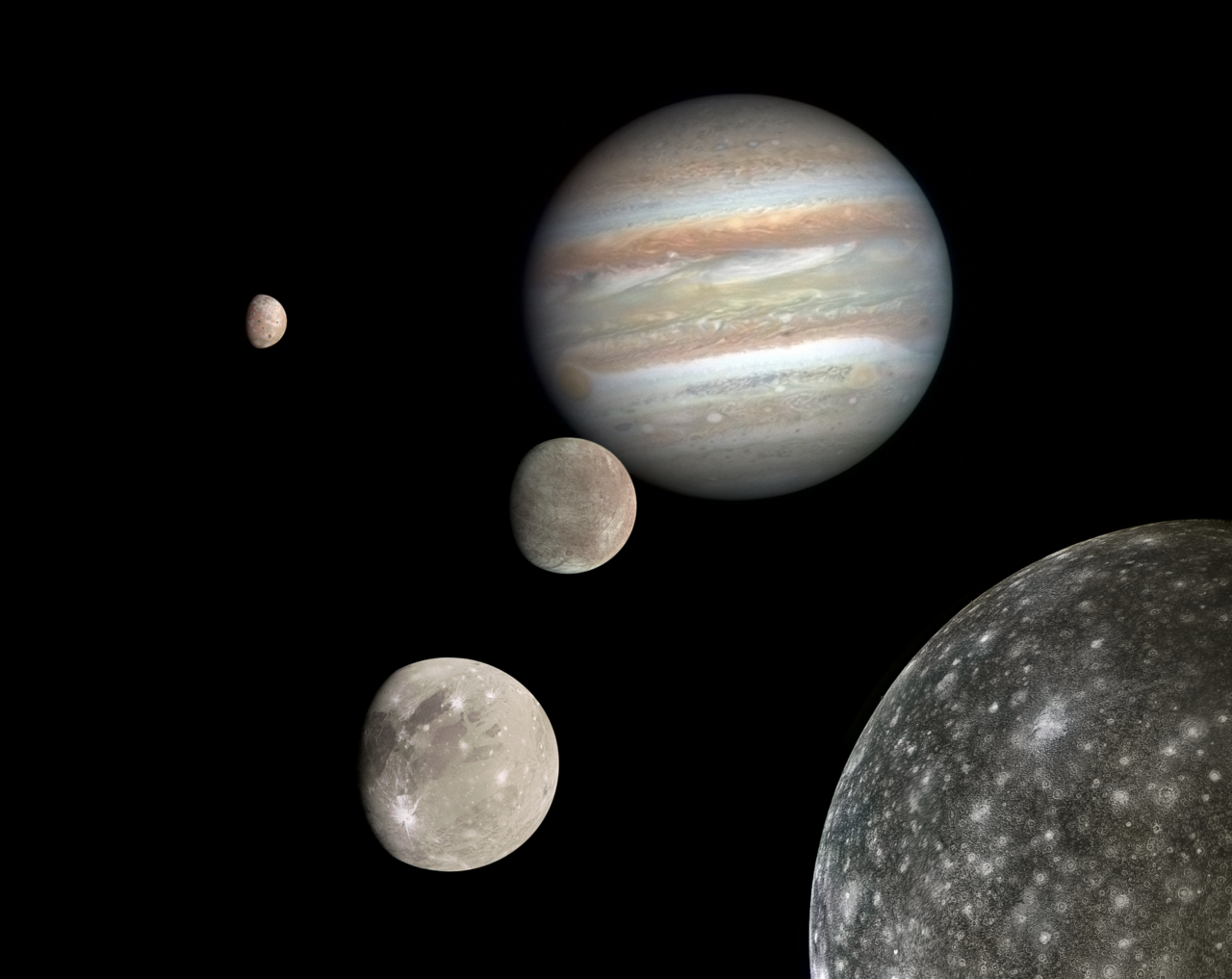
The Galilean moons are Io, Europa, Ganymede, and Callisto.
These four moons account for almost all the mass within Jupiter’s moon system.
They are not merely moons in the ordinary sense.
Each is a unique world with its own history, geology, and mysteries.
Together, they transformed our understanding of what moons can be.
Io: The Most Volcanic World in the Solar System
Among Jupiter’s moons, Io stands out as one of the strangest places ever discovered.
At first glance, its colorful surface appears almost artistic. Shades of yellow, orange, red, black, and white cover the landscape.
These colors result from sulfur compounds produced by intense volcanic activity.
Io is the most volcanically active world known in the Solar System.
Hundreds of active volcanoes constantly reshape its surface.
Some eruptions send material hundreds of kilometers into space.
The reason for this extraordinary activity lies in Jupiter’s immense gravity.
As Io orbits the giant planet, gravitational forces continuously stretch and squeeze the moon.
This process generates tremendous internal heat.
The result is a world that never truly rests.
Volcanoes erupt, lava flows spread, and the surface changes constantly.
Io demonstrates that moons can be dynamic, living worlds rather than frozen, inactive objects.
Europa: A Moon That May Harbor Life
If Io is the most dramatic moon, Europa may be the most intriguing.
Europa’s surface is covered by a vast shell of ice.
Cracks and ridges stretch across the frozen landscape like scars.
For decades, scientists wondered what might lie beneath.
Evidence gathered by spacecraft suggests that beneath Europa’s icy crust exists a global ocean of liquid water.
This hidden ocean may contain more water than all of Earth’s oceans combined.
The possibility is astonishing.
Where there is liquid water, scientists naturally ask whether life might also exist.
Europa has become one of the leading candidates in the search for extraterrestrial life.
Its ocean may contain the ingredients necessary for living organisms.
Although no evidence of life has yet been found, Europa remains one of the most exciting destinations in planetary exploration.
Future missions hope to study the moon in unprecedented detail.
Ganymede: The Giant Among Moons
Ganymede holds an impressive record.
It is the largest moon in the Solar System.
In fact, Ganymede is larger than the planet Mercury.
If it orbited the Sun independently, it might easily be classified as a planet.
Ganymede possesses features rarely found on moons.
One of the most remarkable is its magnetic field.
It is the only moon known to generate its own substantial magnetic field.
Scientists believe a liquid metallic core deep within the moon powers this phenomenon.
Like Europa, Ganymede may also contain subsurface oceans hidden beneath layers of ice.
Its surface displays a fascinating mixture of dark ancient regions and lighter, younger terrain.
Studying Ganymede helps scientists understand how large icy worlds evolve over billions of years.
Callisto: The Ancient Survivor
Callisto presents a very different appearance.
Unlike Io’s volcanic plains or Europa’s icy cracks, Callisto is heavily cratered.
Its surface records billions of years of impacts.
Looking at Callisto is like looking back in time.
Many regions have remained largely unchanged since the early Solar System.
Because it has experienced relatively little geological activity, ancient features remain preserved.
Scientists view Callisto as a valuable archive of Solar System history.
The moon may also possess a hidden ocean beneath its surface.
Although less dramatic than Europa, Callisto remains an important target for research.
Its ancient landscape contains clues about the violent era when planets and moons were forming.
Beyond the Galilean Moons
While the four Galilean moons attract most attention, they represent only a small fraction of Jupiter’s moon family.
The majority of Jupiter’s moons are much smaller.
Many are irregularly shaped objects that resemble asteroids rather than traditional moons.
These bodies often follow unusual orbits.
Some travel in the same direction as Jupiter’s rotation.
Others orbit in the opposite direction.
Many have elongated and tilted paths around the planet.
Their strange movements suggest fascinating origins.
Captured Visitors
Scientists believe many of Jupiter’s smaller moons were not born alongside the planet.
Instead, they may have originated elsewhere in the Solar System.
At some point billions of years ago, Jupiter’s gravity likely captured these objects.
Once trapped, they became permanent members of Jupiter’s growing moon system.
This process helps explain why many small moons possess unusual orbital characteristics.
Rather than forming in a neat, orderly disk around Jupiter, they arrived from different locations and under different circumstances.
Each captured moon represents a survivor from the chaotic early Solar System.
Why Jupiter Has So Many Moons
Jupiter’s enormous collection of moons is closely tied to its immense gravity.
As the largest planet in the Solar System, Jupiter exerts a powerful gravitational influence.
During the Solar System’s formation, this gravity allowed Jupiter to gather large amounts of material.
Some of that material eventually became moons.
Later, Jupiter’s gravity continued capturing wandering objects that passed nearby.
The result is a diverse moon system unlike any other.
Its population includes giant worlds, icy oceans, volcanic landscapes, and countless smaller bodies.
Jupiter’s gravity essentially acts as a cosmic collector.
Over billions of years, it assembled an extraordinary family of satellites.
How New Moons Are Found
Finding Jupiter’s smaller moons is surprisingly difficult.
Large moons such as Europa and Ganymede are relatively easy to detect.
Tiny moons are another matter entirely.
Many are extremely faint.
They reflect little sunlight and appear as tiny specks against the darkness of space.
Astronomers use powerful telescopes and advanced imaging techniques to identify them.
After a possible moon is discovered, scientists must carefully track its motion.
Repeated observations are necessary to confirm that the object truly orbits Jupiter.
This process can take months or even years.
Only after sufficient evidence is collected does a new moon receive official recognition.
The Ever-Changing Moon Count
The number of known Jovian moons has increased dramatically over time.
When Galileo made his discovery, only four moons were known.
As telescopes improved, additional moons were found.
The twentieth century brought more discoveries.
The twenty-first century accelerated the pace even further.
Modern digital imaging systems can detect objects far smaller than earlier astronomers could observe.
Because of these advances, the official moon count continues to evolve.
Future telescopes may reveal even more moons hiding in Jupiter’s vast gravitational domain.
Some scientists suspect numerous tiny moons remain undiscovered.
The Role of Spacecraft
Much of what we know about Jupiter’s moons comes from spacecraft missions.
Telescopes provide valuable observations, but spacecraft can study moons up close.
NASA’s Voyager Program transformed our understanding of Jupiter in 1979.
The Voyager probes revealed active volcanoes on Io and provided detailed images of the Galilean moons.
Later, the Galileo Mission spent years orbiting Jupiter and investigating its moons.
Galileo discovered compelling evidence for hidden oceans beneath Europa and other icy moons.
More recently, the Juno Mission has continued exploring the Jovian system.
Each mission has expanded our understanding of these distant worlds.
Europa and the Search for Alien Life
Among all of Jupiter’s moons, Europa generates perhaps the greatest excitement.
The possibility of life beneath its ice captures the imagination of scientists and the public alike.
Life on Earth exists in some remarkably extreme environments.
Organisms thrive near deep-sea hydrothermal vents, beneath Antarctic ice, and in harsh deserts.
These discoveries suggest life may be more adaptable than once believed.
If Europa possesses liquid water, energy sources, and the right chemical ingredients, life might have emerged there.
Even simple microbial life would be one of the greatest discoveries in human history.
The search continues.
Future missions aim to investigate Europa’s ocean and assess its habitability.
A Miniature Solar System
Jupiter’s moons are so diverse that they resemble a miniature version of the Solar System itself.
Io resembles a volcanic world shaped by internal heat.
Europa is an ocean world hidden beneath ice.
Ganymede is a giant moon with its own magnetic field.
Callisto preserves ancient impact scars.
Smaller moons resemble captured asteroids.
Each world tells a different story.
Together, they offer a laboratory for understanding planetary processes across a wide range of environments.
Few locations in the Solar System provide such diversity within a single system.
The Influence of Jupiter on Its Moons
Life near Jupiter is not easy.
The giant planet’s gravity constantly affects its moons.
Tidal forces stretch and compress them.
These forces generate heat within some moons, driving geological activity.
Jupiter also possesses an immense magnetic field.
This field traps charged particles and creates intense radiation.
Some moons experience powerful radiation environments that would be dangerous to humans.
The interactions between Jupiter and its moons create a dynamic and ever-changing system.
Nothing exists in isolation.
Every moon is influenced by the giant planet it orbits.
Naming Jupiter’s Moons
Most of Jupiter’s larger moons have names from mythology.
Many are associated with figures connected to the Roman god Jupiter, who corresponds to the Greek god Zeus.
This naming tradition dates back centuries.
As more moons were discovered, astronomers continued drawing names from mythology.
With dozens of moons requiring names, mythology provided a rich source of possibilities.
Today, Jupiter’s moon system contains names drawn from various mythological traditions connected to Jupiter’s legendary relationships and descendants.
Could Jupiter Gain More Moons?
In theory, Jupiter could capture additional objects in the future.
However, such events are likely rare.
The Solar System today is far less chaotic than it was billions of years ago.
Most potential capture opportunities occurred during the Solar System’s early history.
Nevertheless, collisions, orbital changes, and gravitational interactions continue shaping Jupiter’s moon system.
Some moons may have originated from larger bodies that broke apart long ago.
Others may eventually collide with each other or be ejected from their current paths.
The story of Jupiter’s moons is still unfolding.
What Jupiter’s Moons Teach Us About Planet Formation
Studying Jupiter’s moons provides insights far beyond the Jovian system.
These moons preserve clues about how planets and satellites form.
They help scientists understand gravitational interactions, internal heating, geological activity, and the evolution of planetary systems.
Observations of exoplanets around distant stars suggest that giant planets may be common throughout the galaxy.
If those planets possess moon systems similar to Jupiter’s, then worlds like Europa or Ganymede may exist in vast numbers across the universe.
In this sense, Jupiter serves as a nearby laboratory for understanding countless other planetary systems.
Future Exploration
The future of Jupiter exploration looks promising.
New missions are being designed to study the giant planet and its moons in unprecedented detail.
Scientists hope to investigate Europa’s ocean, map Ganymede’s magnetic field, analyze surface chemistry, and search for signs of habitability.
Advanced instruments will reveal details invisible to previous generations of explorers.
Each mission brings humanity closer to answering profound questions about life, planetary evolution, and the nature of the Solar System.
The moons of Jupiter remain among the most compelling destinations in space exploration.
Conclusion
So, how many moons does Jupiter have?
As of 2026, astronomers have confirmed 95 moons orbiting the giant planet. This remarkable number reflects Jupiter’s immense gravitational power and its long history of collecting and capturing objects throughout the Solar System.
Yet the true significance of Jupiter’s moons extends far beyond their number. These worlds include the volcanic chaos of Io, the hidden ocean of Europa, the giant realm of Ganymede, and the ancient landscape of Callisto. Together with dozens of smaller moons, they form one of the most fascinating planetary systems known to science.
Each moon tells a unique story. Some reveal the violence of planetary formation. Others hint at environments where life might exist beyond Earth. Many preserve secrets from the earliest days of the Solar System.
More than four centuries after Galileo first spotted four tiny lights beside Jupiter, the giant planet continues to surprise us. New discoveries emerge, new questions arise, and the count of known moons may continue to grow.
In the vast darkness of space, Jupiter’s moons remind us that even within our own Solar System, extraordinary worlds are waiting to be explored.