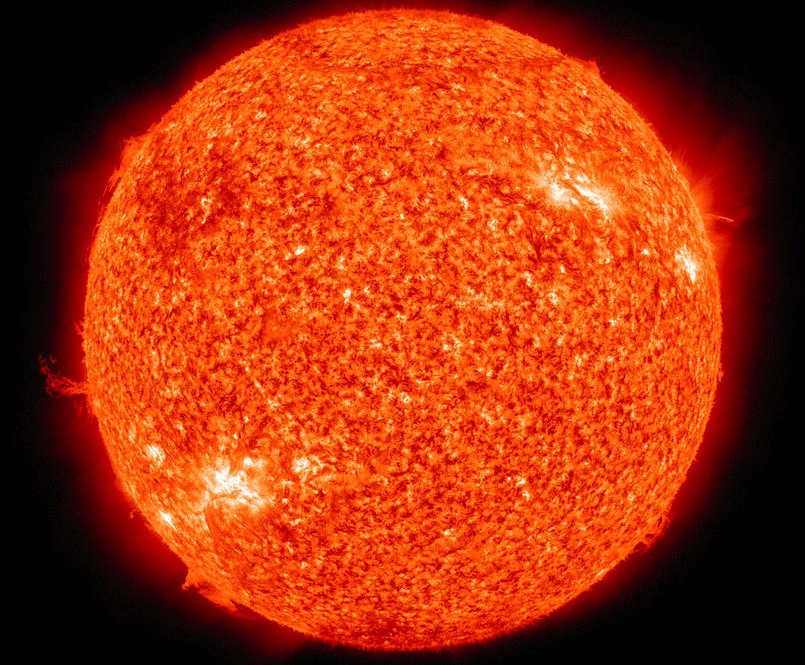
Every morning, the Sun rises without fail. It warms our planet, lights our skies, and makes life on Earth possible. Because it has shone for every human who has ever lived, it feels permanent—almost eternal.
But the Sun is not immortal.
Like every star in the universe, the Sun was born, it is growing older, and one day it will die. Although that may sound alarming, there is no reason to worry. The Sun still has billions of years of life ahead of it, and humanity is not in any immediate danger.
Understanding how long the Sun will live is one of astronomy’s greatest achievements. By studying stars throughout the Milky Way and applying the laws of physics, scientists have reconstructed the Sun’s past and predicted its distant future with remarkable confidence.
The story of the Sun is not just about a single star. It is also the story of Earth, the Solar System, and ultimately ourselves.
How Old Is the Sun Today?
The Sun formed about 4.6 billion years ago from a giant cloud of gas and dust known as a molecular cloud.
Gravity slowly pulled this enormous cloud together. As more material gathered in the center, pressure and temperature increased dramatically. Eventually, the core became so hot that hydrogen atoms began fusing into helium.
That moment marked the birth of the Sun.
Scientists know its age by studying radioactive elements in the oldest meteorites, which formed at nearly the same time as the Solar System. These ancient rocks provide one of the most accurate cosmic clocks available.
Although 4.6 billion years sounds unimaginably old, the Sun is actually considered a middle-aged star.
What Keeps the Sun Alive?
The Sun shines because of a process called nuclear fusion.
Deep inside its core, temperatures reach about 15 million degrees Celsius (27 million degrees Fahrenheit). Under these extreme conditions, hydrogen atoms collide with such tremendous force that they combine to form helium.
This fusion releases enormous amounts of energy.
That energy slowly travels outward through the Sun before escaping into space as sunlight and heat. Every second, the Sun converts roughly 600 million tons of hydrogen into helium. During this process, about 4 million tons of matter are transformed directly into energy according to Albert Einstein’s famous equation:
E = mc²
This incredible engine has powered the Sun for billions of years.
How Long Is the Sun Expected to Live?
The Sun’s total lifetime is expected to be around 10 billion years.
Since it is already about 4.6 billion years old, astronomers estimate that it has approximately 5 billion years of stable life remaining.
That means the Sun is nearly halfway through its main stage of existence.
Compared with humans, it is like someone in middle age—experienced, stable, and still with a long future ahead.
What Is the Main Sequence?
Most stars spend the majority of their lives in a stage called the main sequence.
During this period, nuclear fusion steadily converts hydrogen into helium inside the core. The inward pull of gravity is perfectly balanced by the outward pressure created by fusion.
This balance keeps the star stable.
The Sun has been in the main sequence since shortly after its birth and will remain there for about another five billion years.
Most of the stars visible in the night sky are also in this long-lasting stage.
Is the Sun Changing Right Now?
Although the Sun appears constant, it is slowly changing.
Every second, it becomes slightly brighter than before.
Over billions of years, this gradual increase adds up.
Scientists estimate that the young Sun was about 70 percent as bright as it is today. As hydrogen continues turning into helium, the core slowly contracts and becomes hotter. This increases the rate of fusion, making the Sun more luminous over time.
The changes are far too slow for humans to notice, but they have major consequences over geological timescales.
What Will Happen to Earth Before the Sun Dies?
Long before the Sun reaches the end of its life, Earth will become increasingly difficult for life.
In roughly 1 billion years, the Sun is expected to be about 10 percent brighter than it is today.
That small increase may sound insignificant, but it would dramatically affect Earth’s climate.
Higher temperatures could trigger a runaway greenhouse effect. Oceans would gradually evaporate, water vapor would accumulate in the atmosphere, and the planet would become increasingly hostile to complex life.
Eventually, Earth’s surface may become too hot to support liquid water.
Life, as we know it today, would struggle to survive.
What Happens When the Sun Runs Out of Hydrogen?
After about 10 billion years of life, the Sun’s hydrogen fuel in its core will become largely exhausted.
Without enough hydrogen fusion in the core, gravity will begin compressing the center.
As the core contracts, temperatures rise even further.
Meanwhile, hydrogen fusion continues in a shell surrounding the core.
This extra energy causes the Sun’s outer layers to expand dramatically.
The Sun will leave the main sequence and enter a completely new stage of evolution.
The Sun Will Become a Red Giant
One of the most dramatic events in the Sun’s future is its transformation into a red giant.
During this stage, the Sun will swell enormously.
Its diameter may grow to more than 200 times its current size.
If placed where today’s Sun is, its outer atmosphere could extend close to Earth’s present orbit.
Although the Sun’s surface will actually become cooler than it is now, its enormous size means it will radiate far more total energy.
The sky from Earth—if Earth still existed in recognizable form—would be breathtaking and terrifying.
The Sun would dominate the heavens like an enormous glowing red sphere.
Will the Sun Swallow Earth?
This is one of astronomy’s most fascinating questions.
Scientists are still refining their calculations, but current research suggests two possibilities.
Earth may be engulfed as the Sun expands into its red giant phase.
Alternatively, Earth’s orbit could gradually move outward because the Sun will lose mass through powerful stellar winds. Even if Earth escapes being physically swallowed, the planet would almost certainly become completely uninhabitable.
Its oceans would disappear.
Its atmosphere would be severely altered or lost.
Its surface would become intensely hot.
Whether Earth survives physically or not, it would no longer resemble the blue world we know today.
What Happens After the Red Giant Stage?
Eventually, temperatures inside the Sun’s core will become high enough to begin fusing helium into carbon and oxygen.
Unlike much larger stars, however, the Sun is not massive enough to fuse heavier elements such as iron.
After the helium fuel is exhausted, the Sun will shed its outer layers into space.
These expanding clouds of glowing gas will create one of the universe’s most beautiful sights.
The Sun Will Create a Planetary Nebula
Despite its name, a planetary nebula has nothing to do with planets.
Early astronomers gave it this name because these glowing clouds appeared somewhat similar to planets through small telescopes.
In reality, they are shells of gas expelled by dying stars.
As ultraviolet radiation from the Sun’s remaining core illuminates these gases, they will glow with brilliant colors.
This beautiful cosmic cloud may remain visible for tens of thousands of years before gradually dispersing into interstellar space.
Some of the material released by the Sun will eventually become part of future stars and planets.
In this way, even dying stars help create new worlds.
The Sun’s Final Form
After its outer layers drift away, only the Sun’s incredibly dense core will remain.
This object is called a white dwarf.
Although about the size of Earth, it will contain roughly half the Sun’s original mass.
A single teaspoon of white dwarf material would weigh many tons on Earth.
Initially, the white dwarf will be extremely hot.
However, because nuclear fusion has ended, it will no longer generate new energy.
Over billions and eventually trillions of years, it will slowly cool and fade.
Far into the future, after an unimaginably long time, it may become what astronomers call a black dwarf—a cold, dark stellar remnant. However, the universe itself is not yet old enough for any black dwarfs to exist today.
Why Doesn’t the Sun Explode Like a Supernova?
Massive stars often end their lives in spectacular supernova explosions.
The Sun will not.
The reason is simple: it does not have enough mass.
Stars typically need to be at least about eight times the Sun’s mass to undergo the kind of core collapse that produces a supernova.
Instead of exploding violently, the Sun will experience a much gentler ending.
Its death will be quiet compared with the dramatic explosions that create neutron stars or black holes.
Could the Sun Die Earlier Than Expected?
Current scientific evidence suggests that the Sun’s future is very predictable.
The laws of stellar evolution are supported by observations of millions of stars at different stages of life.
Astronomers can see young stars forming, middle-aged stars like the Sun, red giants nearing the ends of their lives, planetary nebulae, and white dwarfs scattered throughout our galaxy.
Because we observe stars of many ages, we can reconstruct the entire life cycle of stars similar to the Sun with high confidence.
Unexpected events could occur, but there is no known mechanism that would cause the Sun to suddenly burn out or disappear anytime soon.
How Scientists Know the Sun’s Future
Astronomers cannot watch one star evolve over billions of years.
Instead, they observe countless stars across the universe.
Some stars are just being born.
Others closely resemble today’s Sun.
Some have already become red giants.
Others exist as white dwarfs.
By combining these observations with physics, computer simulations, and laboratory measurements of nuclear reactions, scientists have developed detailed models of stellar evolution.
These models successfully explain what we observe throughout the universe.
The Sun’s Legacy
The Sun has already shaped the history of our planet.
Its energy drives Earth’s climate, powers photosynthesis, influences weather, and supports nearly every ecosystem.
The carbon in our bodies, the oxygen we breathe, and the elements that make up our planet all owe their existence to ancient stars that lived and died long before the Sun was born.
One day, the Sun itself will return some of its material to the galaxy, contributing to future generations of stars and planets.
In a very real sense, stars recycle the building blocks of the universe.
A Star With Billions of Years Still Ahead
It is natural to wonder about the fate of the Sun because it is the center of our Solar System and the source of nearly all life on Earth.
Yet there is reassuring news in the science.
The Sun is remarkably stable.
It has shone for about 4.6 billion years, and it is expected to continue shining for roughly another 5 billion years before entering the final stages of its life.
Its eventual transformation into a red giant, the creation of a glowing planetary nebula, and its quiet retirement as a white dwarf are all part of the natural life cycle shared by countless stars across the universe.
Far from being a reason for fear, the Sun’s story is a reminder that even stars have lifetimes. They are born, they evolve, and they eventually fade away, leaving behind the raw materials for new stars, new planets, and perhaps new forms of life. The Sun’s journey is not just the story of a star—it is one chapter in the never-ending story of the universe itself.