Imagine traveling farther than Earth, beyond Mars, past Jupiter and Saturn, beyond the icy realm of Uranus and Neptune. Continue through the distant region where Pluto circles the Sun. Travel even farther through a vast wilderness of frozen objects known as the Kuiper Belt. Then keep going.
Millions, then billions of kilometers pass beneath your spacecraft. The Sun becomes little more than an exceptionally bright star. The familiar planets disappear into darkness. Space grows colder and emptier than anything humans have ever experienced.
Yet even there, at the farthest reaches of the Solar System, you have not reached the end.
Surrounding our planetary neighborhood is a mysterious realm known as the Oort Cloud, an enormous shell of frozen objects that may extend nearly halfway to the nearest star. It is one of the largest structures associated with our Solar System and perhaps its most elusive frontier.
No human spacecraft has ever reached it. No telescope has directly photographed it. No person has ever seen one of its icy bodies up close.
And yet astronomers are convinced it exists.
The Oort Cloud is a place of darkness, silence, and extreme cold. It is thought to contain countless frozen remnants left over from the birth of the Solar System more than 4.5 billion years ago. These ancient objects have remained largely unchanged since the age when the planets themselves were forming.
In a sense, the Oort Cloud is a gigantic cosmic time capsule. Hidden within its icy depths may be clues to the earliest chapter of our Solar System’s story.
Understanding the Oort Cloud means exploring one of the greatest mysteries in astronomy—a frozen frontier that marks the boundary between our cosmic home and the vast ocean of interstellar space.
The Edge of the Solar System Is More Complicated Than It Seems
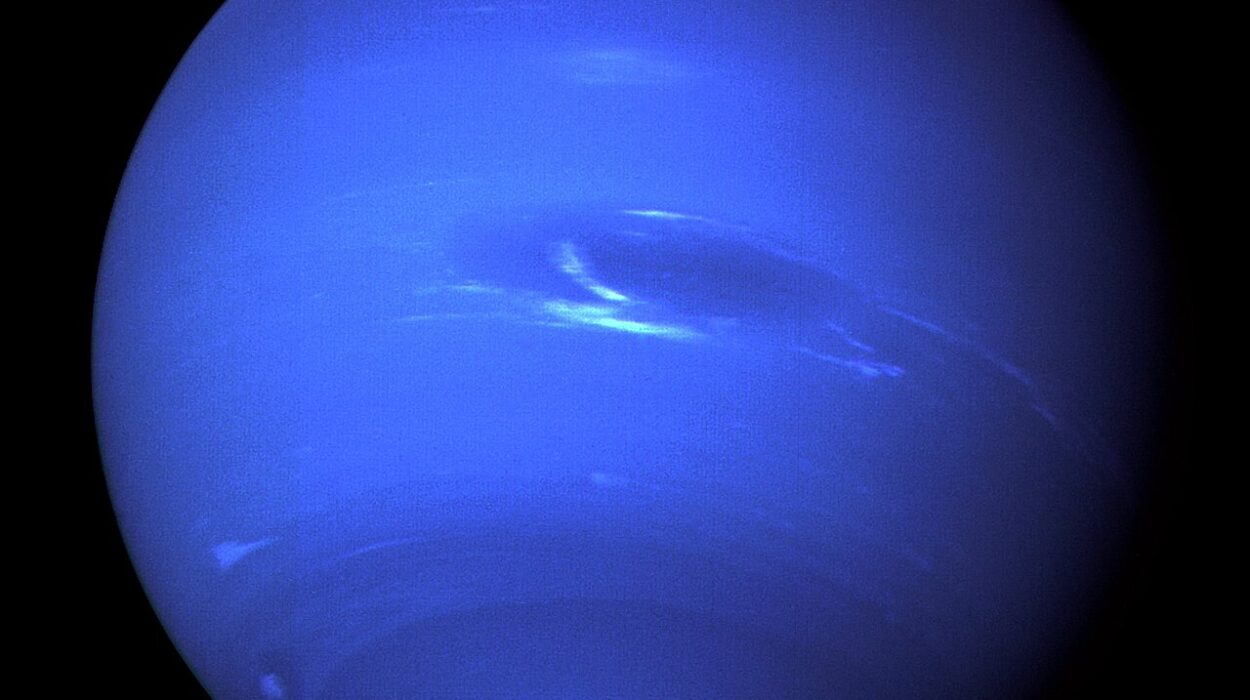
Most people imagine the Solar System as a collection of planets orbiting the Sun. In this picture, Neptune represents the outer edge.
Reality is far more complex.
The Solar System extends well beyond Neptune. Beyond the known planets lie enormous regions filled with icy debris, dwarf planets, comets, and ancient remnants from the Solar System’s formation.
One of these regions is the Kuiper Belt, where objects such as Pluto reside.
Even farther out lies the scattered disk, a region populated by icy bodies following highly elongated orbits.
Beyond these distant territories lies something even larger and stranger.
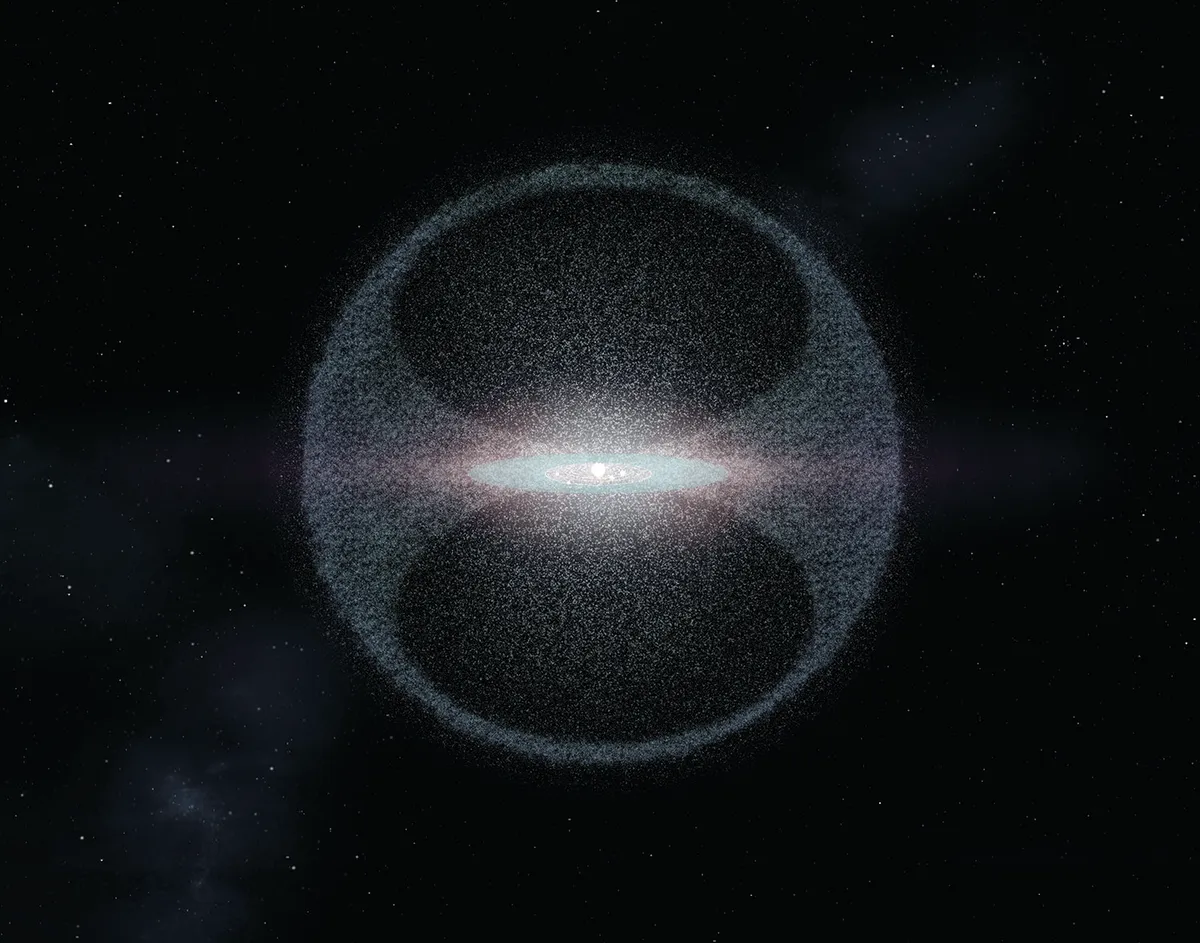
The Oort Cloud is believed to form a vast spherical shell surrounding the entire Solar System.
Unlike the planets, which orbit within a relatively flat plane, the Oort Cloud extends in every direction. If it exists as astronomers believe, it surrounds the Sun like an immense cosmic bubble.
This makes it fundamentally different from the familiar planetary system we usually imagine.
Who Proposed the Oort Cloud?
The Oort Cloud is named after the Dutch astronomer Jan Oort.
In 1950, Oort was studying long-period comets—comets that take thousands or even millions of years to orbit the Sun.
These comets posed a puzzle.
Many of them appeared to arrive from extremely distant regions of space. Their orbits suggested they originated far beyond the known planets.
The question was obvious.
Where were these comets coming from?
After analyzing their trajectories, Oort proposed that the Solar System was surrounded by an enormous reservoir of icy objects.
Most of the time these objects remained undisturbed in deep space. Occasionally, however, gravitational influences would send one toward the inner Solar System.
When that happened, people on Earth would observe it as a long-period comet.
Oort’s idea elegantly explained the observations.
More than seventy years later, astronomers still consider his hypothesis the best explanation for the origins of long-period comets.
What Exactly Is the Oort Cloud?
The Oort Cloud is believed to be a gigantic collection of icy bodies orbiting the Sun at extraordinary distances.
These objects are thought to consist primarily of frozen water, methane, ammonia, carbon dioxide, and other volatile compounds.
Unlike planets, they are generally small.
Some may be only a few kilometers across. Others could be much larger.
The total number of objects in the Oort Cloud may be astonishing.
Scientists estimate there could be billions or even trillions of icy bodies scattered throughout the region.
Despite these huge numbers, the objects are spread across such an enormous volume of space that they remain extremely far apart.
If you could somehow stand on one Oort Cloud object, the nearest neighboring object might be millions of kilometers away.
The region is not crowded.
It is vast beyond ordinary comprehension.
How Far Away Is the Oort Cloud?
The scale of the Oort Cloud is almost impossible to visualize.
Earth orbits the Sun at a distance of about 150 million kilometers, a unit astronomers call one astronomical unit, or AU.
Neptune orbits at roughly 30 AU.
Pluto’s average distance is around 39 AU.
The Kuiper Belt extends beyond that.
The inner boundary of the Oort Cloud is believed to begin thousands of AU from the Sun.
Its outer boundary may reach as far as 100,000 AU or more.
At such distances, sunlight becomes incredibly faint.
Imagine moving the Sun farther and farther away until it resembles just another bright star in the sky.
That is the environment of the Oort Cloud.
Some estimates suggest the cloud extends nearly halfway to Proxima Centauri, our nearest stellar neighbor.
The sheer size of this region makes it one of the largest structures associated with our Solar System.
Why We Have Never Seen the Oort Cloud
One of the most fascinating aspects of the Oort Cloud is that it has never been directly observed.
Astronomers believe it exists, but no telescope has captured a clear image of it.
Why?
The answer lies in distance and darkness.
Oort Cloud objects are incredibly far away.
They are also extremely small.
These frozen bodies reflect very little sunlight.
By the time sunlight reaches them and bounces back toward Earth, the signal becomes extraordinarily weak.
Even the most powerful telescopes currently available struggle to detect such distant and faint objects.
As a result, astronomers rely on indirect evidence.
The strongest evidence comes from the behavior of long-period comets.
Their orbits strongly suggest they originate from a distant spherical reservoir of icy bodies.
The Oort Cloud remains one of the few major structures in astronomy that scientists accept despite never having directly observed it.
A Cosmic Time Capsule
One reason astronomers are fascinated by the Oort Cloud is that its objects are likely ancient.
Very ancient.
Most of them probably formed during the earliest stages of Solar System history.
More than 4.5 billion years ago, the Sun emerged from a giant cloud of gas and dust.
Around the young Sun, countless particles collided and merged.
Some eventually became planets.
Others became moons, asteroids, and comets.
Many small icy bodies were left over.
These leftovers preserve information about conditions that existed when the Solar System was still young.
Unlike planets, which underwent dramatic geological changes, many Oort Cloud objects may have remained largely unchanged for billions of years.
Studying them is like opening a time capsule from the birth of the Solar System.
How the Oort Cloud Formed
Astronomers believe the Oort Cloud was created during a chaotic era in Solar System history.
In the early days, the giant planets—Jupiter, Saturn, Uranus, and Neptune—were still forming.
Their immense gravity constantly influenced nearby objects.
Many icy bodies formed closer to the Sun than their current positions.
Some were pulled inward.
Others collided with planets.
Many were completely ejected from their original locations.
A large number were thrown outward by gravitational interactions with the giant planets.
Instead of escaping entirely into interstellar space, some remained weakly bound to the Sun.
Over millions of years, these scattered objects accumulated in distant orbits.
The result was the enormous spherical cloud we call the Oort Cloud.
In this sense, the cloud represents cosmic debris left behind after the construction of the planetary system.
The Inner and Outer Oort Cloud
Scientists often divide the Oort Cloud into two regions.
The inner Oort Cloud is believed to lie closer to the Sun.
Its objects may orbit in a somewhat flattened distribution.
This region is sometimes called the Hills Cloud after astronomer Jack Hills, who proposed its existence.
Beyond it lies the outer Oort Cloud.
This is the vast spherical shell commonly associated with the Oort Cloud concept.
Objects in the outer region orbit the Sun from every possible direction.
This spherical shape helps explain why long-period comets arrive from seemingly random parts of the sky.
Unlike planets, whose orbits are mostly aligned, Oort Cloud comets can appear from almost anywhere.
The Birthplace of Long-Period Comets
The Oort Cloud is best known as the suspected birthplace of long-period comets.
These are comets that require more than 200 years to complete an orbit around the Sun.
Some take thousands of years.
Others require hundreds of thousands or even millions of years.
Most spend nearly all of their existence in deep darkness.
Then something disturbs them.
A passing star, a gravitational interaction, or the influence of the Milky Way’s tidal forces may alter their orbits.
The object begins a long fall toward the Sun.
For the first time in ages, sunlight warms its frozen surface.
Ice begins turning directly into gas.
Dust and gas stream outward.
A glowing coma forms around the nucleus.
A magnificent tail stretches across space.
What was once an invisible frozen object becomes one of the most spectacular sights in the night sky.
Many famous comets may have originated in the Oort Cloud.
Visitors From the Deep Freeze
Every long-period comet tells a story.
Some began their journey before human civilization existed.
Others started moving toward the inner Solar System before the construction of the pyramids.
Many may have begun their inward migration before the emergence of modern humans.
By the time these objects become visible from Earth, they have traveled unimaginable distances.
Their appearance offers scientists a rare opportunity.
Each comet carries material preserved since the Solar System’s earliest days.
Studying these visitors helps researchers investigate ancient conditions that no longer exist elsewhere.
In a very real sense, every long-period comet is a messenger from the frozen frontier.
The Extreme Environment of the Oort Cloud
Life in the Oort Cloud would be unlike anything found on Earth.
Temperatures are extraordinarily low.
Sunlight is incredibly weak.
The Sun itself would appear merely as a brilliant star rather than a dominant presence in the sky.
There is no atmosphere.
No liquid water.
No familiar landscapes.
Most objects spend billions of years drifting silently through darkness.
The environment is so cold that volatile compounds remain frozen solid.
Water ice becomes as hard as rock.
Chemical processes occur at extremely slow rates.
Time seems almost suspended.
The Oort Cloud is one of the most isolated environments associated with our Solar System.
The Influence of Passing Stars
Although the Oort Cloud is distant, it is not completely isolated.
Nearby stars occasionally pass close enough to influence it.
The Milky Way is constantly in motion.
Stars orbit the galactic center, changing their positions over time.
As stars pass through the Sun’s cosmic neighborhood, their gravity can slightly disturb Oort Cloud objects.
Most disturbances are minor.
Occasionally, however, a passing star may alter the orbits of large numbers of icy bodies.
Some may be sent inward toward the planets.
Others may be ejected entirely from the Solar System.
These interactions help shape the long-term evolution of the Oort Cloud.
The Gravity of the Milky Way
One surprising influence on the Oort Cloud comes from the galaxy itself.
The Milky Way exerts gravitational forces known as galactic tides.
Although these forces are weak compared with the Sun’s gravity, they become important at extreme distances.
Over millions of years, galactic tides can gradually modify the orbits of Oort Cloud objects.
This process helps send comets toward the inner Solar System.
It also contributes to maintaining the cloud’s overall structure.
The Oort Cloud exists not only under the influence of the Sun but also within the gravitational environment of an entire galaxy.
Could the Oort Cloud Contain Dwarf Planets?
Most discussions focus on small icy bodies, but some researchers suspect larger objects may exist there as well.
Theoretical models suggest that dwarf-planet-sized worlds could inhabit the distant cloud.
Finding such objects would be extraordinarily difficult.
Even relatively large bodies would appear faint because of their enormous distance.
Yet the possibility is intriguing.
There may be undiscovered worlds drifting in darkness at the edge of our Solar System.
Some could be larger than Pluto.
Others might possess unusual histories reflecting the chaotic era of planetary formation.
For now, these possibilities remain speculative.
The Oort Cloud continues to guard its secrets.
The Mysterious Object Sedna
One object has attracted particular attention in discussions of the Oort Cloud.
The dwarf planet candidate Sedna follows an extraordinarily elongated orbit.
At its closest approach, Sedna remains far beyond Neptune.
At its most distant point, it travels much farther into deep space.
Its unusual orbit suggests it may belong to a transitional region between the scattered disk and the inner Oort Cloud.
Sedna provides an intriguing clue about the structure of the Solar System’s outermost regions.
It may represent one of the first known members of a vast population yet to be discovered.
Could There Be Hidden Planets?
The enormous distances involved have encouraged speculation about undiscovered planets.
Some astronomers have suggested that a distant planet could influence the orbits of objects in the outer Solar System.
This idea has led to discussions about a hypothetical world often called Planet Nine.
Evidence remains uncertain.
No such planet has been directly observed.
Yet the possibility highlights how little we know about the Solar System’s distant frontier.
The Oort Cloud lies in a realm where many mysteries remain unsolved.
Human Spacecraft and the Journey Outward
Humanity has never reached the Oort Cloud.
The most distant spacecraft ever launched are the two Voyager probes.
Voyager 1 and Voyager 2 have traveled farther than any previous human-made objects.
Even so, they remain far closer to the Sun than the estimated location of the Oort Cloud.
At their current speeds, reaching the inner Oort Cloud could require hundreds of years.
Traveling through the entire cloud would take far longer.
The vastness of the region reveals just how small humanity’s explorations have been compared with the true scale of our cosmic neighborhood.
The Boundary Between Systems
The Oort Cloud occupies a fascinating position in astronomy.
It is part of the Solar System.
Yet it also lies near the threshold of interstellar space.
Objects in the outermost cloud are only weakly bound to the Sun.
A sufficiently strong gravitational disturbance could remove them entirely.
Similarly, some objects from other star systems may occasionally enter our Solar System.
This means the Oort Cloud may serve as a transitional zone between stellar systems.
It is not merely the edge of our neighborhood.
It is a bridge between stars.
What Future Discoveries May Reveal
Future telescopes will likely improve our understanding of the Oort Cloud.
New surveys may discover additional distant objects like Sedna.
Advanced observatories could detect faint bodies previously hidden from view.
Improved computer models may refine estimates of the cloud’s size and population.
Some scientists even dream of future spacecraft missions designed specifically to explore the outermost reaches of the Solar System.
Although such missions remain technologically challenging, they are not impossible.
One day humanity may send explorers toward this frozen frontier.
The discoveries could transform our understanding of Solar System history.
Why the Oort Cloud Matters
At first glance, the Oort Cloud may seem remote and irrelevant.
After all, it lies unimaginably far away.
Yet it plays an important role in understanding our cosmic origins.
The cloud preserves material from the Solar System’s formation.
It helps explain the origins of long-period comets.
It reveals how giant planets shaped the early Solar System.
It demonstrates the influence of passing stars and galactic tides.
Most importantly, it reminds us that our Solar System is far larger and more complex than it first appears.
The familiar planets represent only a small part of a much grander structure.
Conclusion
The Oort Cloud is one of the most mysterious and awe-inspiring regions associated with our Solar System. Existing far beyond the planets and even beyond the Kuiper Belt, it is thought to be a vast spherical reservoir of frozen objects left over from the birth of the Sun and planets more than 4.5 billion years ago.
Although no telescope has directly observed it, the evidence supporting its existence is compelling. The behavior of long-period comets strongly suggests that an enormous cloud of icy bodies surrounds our Solar System at extraordinary distances. This frozen frontier likely contains billions or even trillions of ancient objects, preserving clues about the earliest chapter of our cosmic history.
The Oort Cloud represents more than a distant collection of ice and rock. It is a reminder of how much remains unknown. Beyond the familiar planets lies a realm almost untouched by exploration, a place where darkness, silence, and time itself seem to stretch across billions of years.
As technology advances and our understanding of the universe deepens, the Oort Cloud will continue to capture the imagination of astronomers and dreamers alike. It stands as the outer frontier of our Solar System—a vast, frozen wilderness waiting to reveal the secrets it has guarded since the dawn of the Sun.