For most of our lives, the Sun follows a predictable routine. It rises in the east, climbs across the sky, and sets in the west. Day after day, year after year, it appears dependable and unchanging. Then, on rare occasions, something extraordinary happens. The daylight begins to fade. Shadows become strangely sharp. Birds fall silent. Temperatures drop. People look upward wearing protective glasses, and the Moon slowly takes a bite out of the Sun.
If conditions are exactly right, the sky transforms into something almost supernatural. Day briefly becomes night. Stars appear. The Sun’s magnificent outer atmosphere glows around a black disk suspended in the heavens.
This is a solar eclipse, one of the most breathtaking events in nature.
For ancient civilizations, solar eclipses were often terrifying. Many cultures interpreted them as omens, warnings, or battles among gods. Today, scientists understand precisely why solar eclipses occur. Yet even with all our knowledge, witnessing one remains an emotional experience. Knowing the science does not diminish the wonder. In many ways, it enhances it.
A solar eclipse is not magic. It is geometry. It is the result of an extraordinary cosmic alignment involving the Sun, the Moon, and Earth. Yet this simple explanation hides a remarkable truth. Solar eclipses are possible only because of a series of astonishing coincidences that make our planet unique.
To understand how solar eclipses work, we must take a journey through space, explore the motions of Earth and the Moon, and discover the delicate geometry that occasionally turns daytime into darkness.
Understanding the Players in the Eclipse
Every solar eclipse involves three celestial bodies.
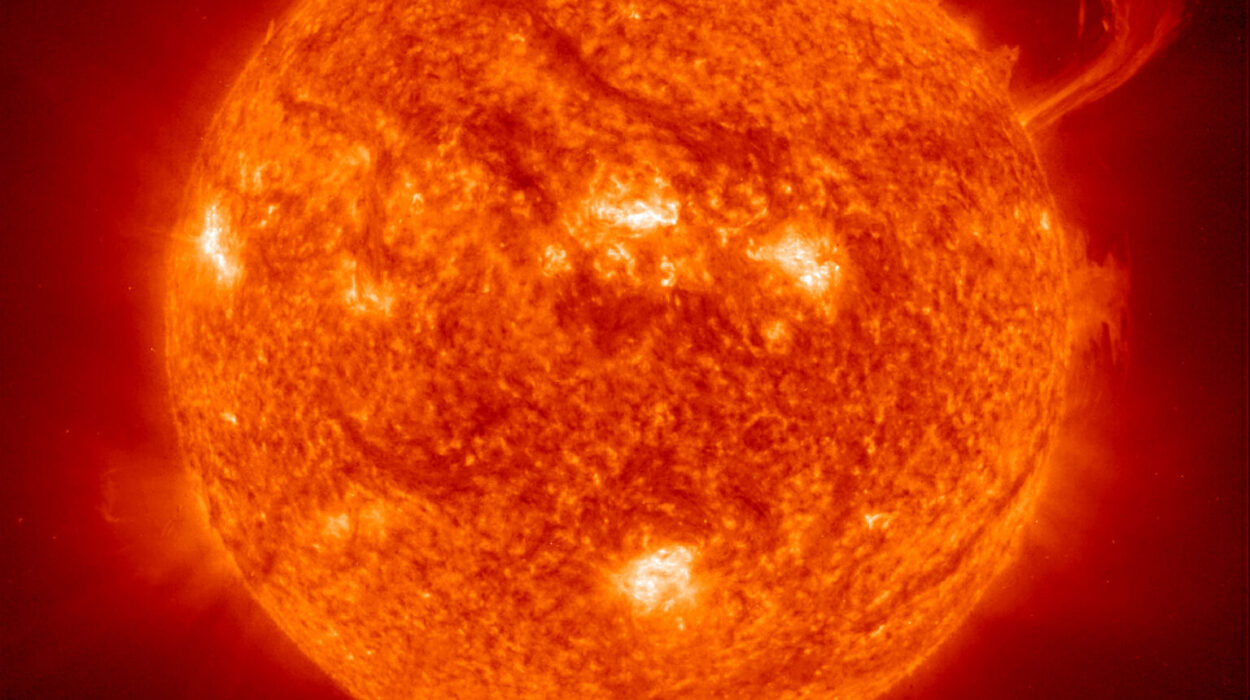
The first is the Sun, the enormous star at the center of our solar system. The Sun contains more than 99 percent of all the mass in the solar system and provides the light and heat that make life on Earth possible.
The second is Earth, our home planet. Earth travels around the Sun once every year while rotating on its axis every twenty-four hours.
The third is the Moon, Earth’s natural satellite. The Moon orbits Earth approximately once every 27.3 days.
Although these three objects are constantly moving, their movements are usually not perfectly aligned. Most of the time, the Moon passes above or below the Sun from our perspective.
But occasionally, the geometry becomes just right.
When the Moon moves directly between Earth and the Sun, it blocks some or all of the Sun’s light. This event is called a solar eclipse.
The concept sounds simple, but the details reveal an extraordinary cosmic dance.
Why the Moon Can Cover the Sun
At first glance, it seems impossible that the Moon could block the Sun.
The Sun is gigantic. Its diameter is about 1.39 million kilometers. The Moon’s diameter is only about 3,474 kilometers.
The Sun is roughly 400 times larger than the Moon.
So how can the Moon possibly cover it?
The answer lies in distance.
The Sun is about 150 million kilometers from Earth. The Moon is only about 384,400 kilometers away.
Remarkably, the Sun is also about 400 times farther away than the Moon.
Because of this near-perfect ratio, both objects appear almost the same size in our sky.
This is one of the most fascinating coincidences in astronomy.
From Earth’s perspective, the Moon and Sun each occupy roughly half a degree of the sky.
As a result, when the Moon passes directly in front of the Sun, it can cover the solar disk almost perfectly.
Without this coincidence, total solar eclipses would not exist.
The Moon’s Shadow
When sunlight strikes the Moon, the Moon casts a shadow into space.
During a solar eclipse, this shadow reaches Earth.
The shadow has two main parts.
The darkest central region is called the umbra. Anyone standing within the umbra experiences a total solar eclipse because the Sun is completely blocked.
Surrounding the umbra is a larger, lighter region called the penumbra. People within the penumbra see only part of the Sun covered.
The Moon’s shadow is surprisingly small when it reaches Earth.
Although Earth is much larger than the Moon, the area experiencing totality is often only a few hundred kilometers wide.
This means that most people on Earth do not witness a total eclipse during any given event.
The shadow races across Earth’s surface at incredible speeds, creating a moving path of darkness.
Why Solar Eclipses Don’t Happen Every Month
The Moon passes between Earth and the Sun during every new moon.
You might therefore expect a solar eclipse every month.
But that does not happen.
The reason involves the tilt of the Moon’s orbit.
The Moon’s orbital path around Earth is tilted by about five degrees relative to Earth’s orbit around the Sun.
Because of this tilt, the Moon usually passes slightly above or below the Sun as seen from Earth.
Most months, the alignment is close but not perfect.
The Moon’s shadow misses Earth entirely.
A solar eclipse occurs only when a new moon happens near one of the points where the Moon’s orbit crosses Earth’s orbital plane.
These crossing points are known as nodes.
Only when the Sun, Moon, and Earth align near a node can a solar eclipse occur.
This requirement makes eclipses relatively rare.
The Perfect Alignment
Imagine trying to line up three moving objects across millions of kilometers of space.
The alignment must be incredibly precise.
The Moon must be in its new moon phase.
It must also be positioned near an orbital node.
Earth must be located in exactly the right place in its yearly journey around the Sun.
Even tiny deviations can prevent an eclipse from occurring.
When all conditions come together, the result is one of nature’s most spectacular events.
The precision required highlights the elegance of celestial mechanics.
The motions of the Sun, Earth, and Moon are governed by gravity and orbital physics, creating patterns that scientists can predict centuries into the future.
Partial Solar Eclipses
Not every solar eclipse is total.
The most common type is a partial solar eclipse.
In a partial eclipse, the Moon covers only part of the Sun.
Observers see what looks like a dark bite taken out of the solar disk.
The amount covered can vary greatly.
Sometimes only a tiny portion of the Sun disappears.
Other times, most of the Sun is hidden.
Even when a large fraction of the Sun is covered, daylight usually remains surprisingly bright.
Our eyes are so sensitive to sunlight that even a small visible portion produces significant illumination.
Partial eclipses are fascinating, but they do not create the dramatic darkness associated with total eclipses.
Total Solar Eclipses
A total solar eclipse occurs when the Moon completely covers the Sun.
This is one of the most awe-inspiring sights in nature.
As totality approaches, the environment begins to change.
Daylight grows dimmer.
Temperatures often drop.
Animals behave differently.
The landscape takes on an eerie appearance.
Then the last bright edge of the Sun vanishes.
Suddenly, the sky darkens dramatically.
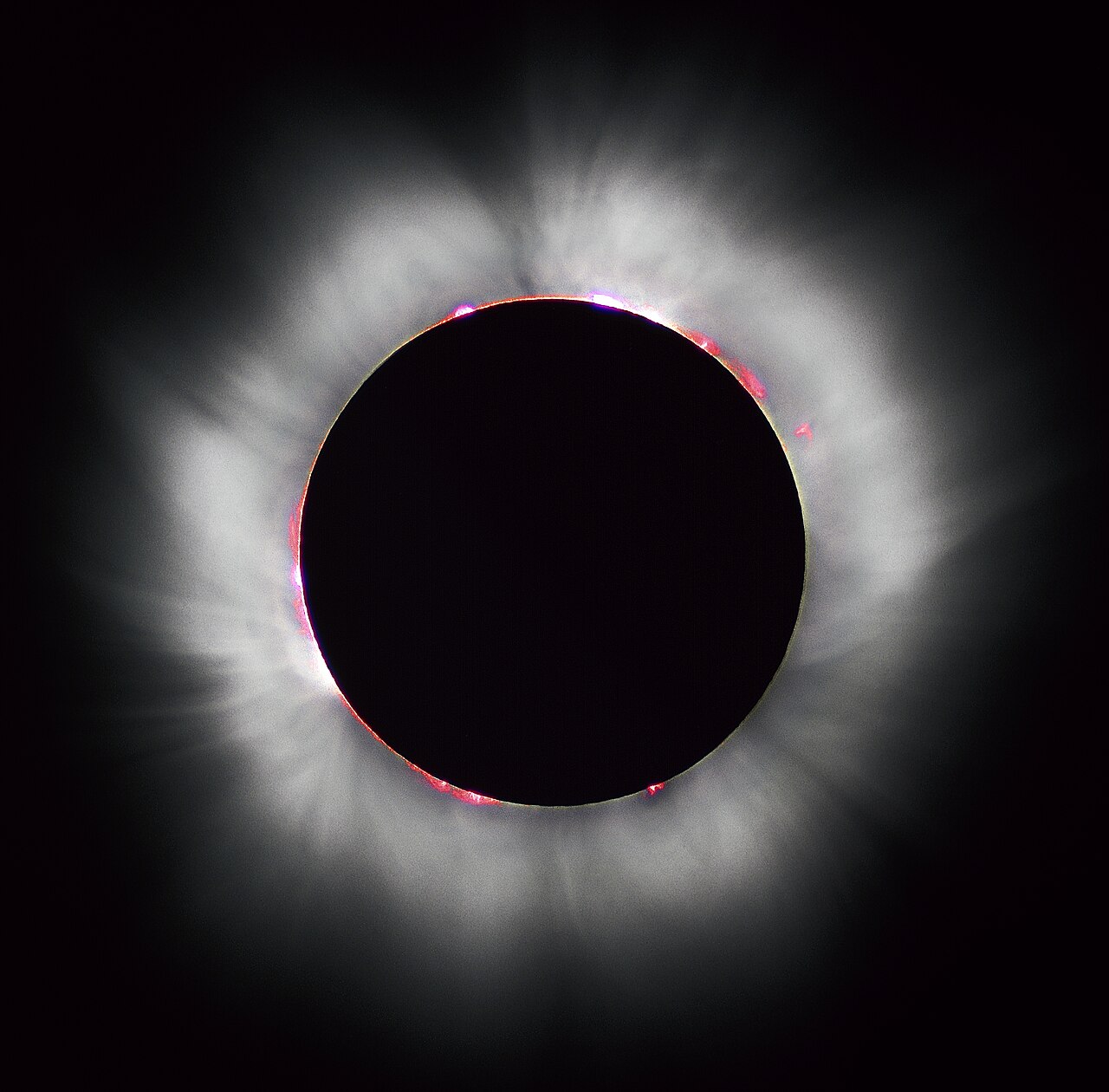
The Sun’s brilliant surface disappears, revealing the faint outer atmosphere known as the corona.
For a few minutes, observers stand inside the Moon’s umbra, experiencing one of the rarest and most beautiful astronomical events on Earth.
Many people describe their first total eclipse as life-changing.
Photographs cannot fully capture the experience.
The vastness of the sky, the sudden darkness, and the glowing corona create an emotional impact that often surprises even scientists.
The Sun’s Hidden Corona
The corona is one of the greatest rewards of a total eclipse.
Normally, the Sun’s intense brightness overwhelms this faint outer atmosphere.
During totality, however, the corona becomes visible.
It appears as delicate white streamers extending millions of kilometers into space.
The corona is made of extremely hot ionized gas known as plasma.
Remarkably, it is much hotter than the Sun’s visible surface.
Scientists are still investigating exactly why this occurs.
The corona reveals the influence of the Sun’s magnetic field, producing intricate shapes and patterns.
Before the invention of specialized instruments called coronagraphs, total eclipses provided the only opportunity to study the corona directly.
Even today, eclipses remain valuable scientific events.
Annular Solar Eclipses
Not all eclipses produce total darkness.
The Moon’s orbit around Earth is not perfectly circular.
Sometimes the Moon is slightly closer to Earth.
At other times, it is slightly farther away.
When the Moon is farther away, it appears smaller in the sky.
If an eclipse occurs during this period, the Moon cannot completely cover the Sun.
Instead, a bright ring remains visible around the Moon’s edge.
This event is called an annular eclipse.
The word “annular” comes from the Latin word for ring.
Observers see what is often called a “ring of fire.”
Although annular eclipses are spectacular, they do not produce totality because some sunlight remains visible throughout the event.
Hybrid Eclipses
One of the rarest eclipse types is the hybrid eclipse.
A hybrid eclipse changes between annular and total along different sections of its path.
Because Earth’s surface is curved, some locations experience totality while others experience an annular eclipse.
Hybrid eclipses are uncommon and represent one of the most complex forms of eclipse geometry.
They demonstrate how subtle variations in distance and perspective can dramatically affect what observers see.
The Path of Totality
One phrase frequently appears whenever astronomers discuss total solar eclipses: the path of totality.
This is the narrow corridor across Earth’s surface where the Moon completely covers the Sun.
Only observers within this path experience totality.
Moving even a short distance outside the path can dramatically change the view.
Someone standing inside the path may witness complete darkness and the corona.
Someone only a few kilometers away may see merely a partial eclipse.
Because the path is narrow, total solar eclipses are relatively rare at any specific location.
A single city may wait hundreds of years between total eclipses.
This rarity adds to their allure.
The Diamond Ring Effect
Just before totality begins and immediately after it ends, observers may see one of the most famous eclipse phenomena.
A tiny point of sunlight shines along the edge of the Moon while the corona surrounds it.
The result resembles a brilliant diamond attached to a glowing ring.
This is known as the diamond ring effect.
It occurs because sunlight is still shining through a small valley on the Moon’s rugged surface.
The sight lasts only moments but is unforgettable.
Many eclipse photographs capture this dramatic stage.
Baily’s Beads
Closely related to the diamond ring effect are Baily’s beads.
These appear as multiple points of sunlight shining through valleys and gaps along the Moon’s edge.
Instead of a continuous line of light, observers see a string of bright beads.
The effect is named after English astronomer Francis Baily, who described it in detail during the nineteenth century.
Baily’s beads reveal that the Moon’s surface is not perfectly smooth.
Mountains and craters shape the final moments before totality.
The Strange World During Totality
One of the most fascinating aspects of a total eclipse is how the environment changes.
Temperatures may fall noticeably.
Winds can shift.
Birds sometimes return to their nests.
Insects may begin nighttime behavior.
Flowers that respond to sunlight can start closing.
Humans often react emotionally.
Some people cheer.
Others cry.
Many stand in stunned silence.
The sudden transition from day to night creates an experience unlike anything else in nature.
For a brief moment, the familiar world feels transformed.
How Ancient People Explained Eclipses
Before the science of astronomy developed, solar eclipses often inspired fear.
The sudden disappearance of the Sun seemed deeply unsettling.
Many cultures created stories to explain the phenomenon.
Some believed a giant creature was swallowing the Sun.
Others imagined celestial battles between supernatural beings.
In parts of ancient Asia, dragons were said to devour the Sun.
Some cultures made loud noises to scare away the creature responsible.
Elsewhere, eclipses were interpreted as warnings from the gods.
These beliefs were understandable.
Without knowledge of orbital mechanics, a solar eclipse appeared mysterious and unpredictable.
The development of astronomy gradually replaced mythological explanations with scientific understanding.
How Scientists Learned to Predict Eclipses
One of humanity’s greatest achievements was learning to predict eclipses.
Ancient astronomers noticed that eclipses followed repeating cycles.
Over time, they identified patterns that allowed future eclipses to be anticipated.
One important cycle is called the Saros cycle.
After approximately eighteen years, eleven days, and eight hours, the Sun, Earth, and Moon return to nearly the same geometric arrangement.
As a result, similar eclipses occur again.
Modern astronomy uses precise measurements and computer models to predict eclipses with extraordinary accuracy.
Scientists can determine the exact time, location, and duration of eclipses decades or even centuries in advance.
Eclipses and Scientific Discovery
Solar eclipses have contributed significantly to science.
During the nineteenth century, scientists studying eclipses discovered helium.
The element was first detected in the Sun before it was identified on Earth.
A total solar eclipse also played a crucial role in confirming Einstein’s theory of general relativity.
In 1919, astronomers measured how starlight bent around the Sun during an eclipse.
The observations matched Einstein’s predictions and helped establish relativity as one of the foundations of modern physics.
Eclipses continue providing opportunities to study the Sun’s atmosphere and other astronomical phenomena.
Why Total Solar Eclipses Are Temporary
Totality never lasts very long.
The maximum possible duration is a little over seven minutes.
Most total eclipses are considerably shorter.
The reason is simple.
The Moon’s shadow is constantly moving.
Earth rotates.
The Moon orbits Earth.
Both bodies travel through space at tremendous speeds.
As a result, the shadow sweeps across Earth’s surface rather than remaining stationary.
The fleeting nature of totality makes it even more precious.
Observers often spend years planning for an event that lasts only a few minutes.
Will Total Solar Eclipses Last Forever?
One surprising fact about eclipses is that they are temporary on a cosmic timescale.
The Moon is slowly moving away from Earth.
Each year, it drifts outward by about 3.8 centimeters.
This change is extremely gradual, but over millions of years it becomes significant.
As the Moon moves farther away, it appears slightly smaller in the sky.
Eventually, it will no longer be able to completely cover the Sun.
At that point, total solar eclipses will disappear from Earth.
Future observers millions of years from now may witness only annular eclipses.
We happen to live during a remarkable period when total eclipses are still possible.
The Remarkable Coincidence of the Sun and Moon
Among all known planets in our solar system, Earth appears uniquely positioned to experience total solar eclipses of this kind.
The apparent sizes of the Sun and Moon are astonishingly similar.
This coincidence has fascinated scientists and philosophers alike.
There is no known physical law requiring this arrangement.
It simply happens to be true.
If the Moon were significantly smaller, total eclipses would never occur.
If it were significantly larger, the corona would be more difficult to observe.
The balance is almost perfect.
This cosmic coincidence helps create one of nature’s most spectacular sights.
Watching a Solar Eclipse Safely
Although solar eclipses are beautiful, they must be viewed carefully.
Looking directly at the Sun can damage the eyes.
This danger exists even during a partial eclipse because enough sunlight remains visible to harm retinal tissue.
Special eclipse glasses or approved solar filters are required for safe viewing.
The only exception occurs during the brief period of totality when the Sun’s bright surface is completely covered.
Once sunlight reappears, eye protection becomes necessary again.
Safe viewing allows people to enjoy the event without risk.
Why Solar Eclipses Continue to Inspire Us
Despite centuries of scientific understanding, solar eclipses retain their emotional power.
Part of their appeal comes from rarity.
Part comes from beauty.
Part comes from the profound realization that we are witnessing celestial mechanics in action.
The Sun, Moon, and Earth are performing a cosmic alignment that can be predicted with mathematics yet still feels miraculous when experienced firsthand.
An eclipse connects us to generations of humans who stood beneath the same darkened sky.
Ancient observers saw mystery.
Modern observers see orbital geometry.
Yet both experience wonder.
Conclusion
Solar eclipses occur when the Moon passes directly between Earth and the Sun, casting its shadow across our planet. This seemingly simple event depends on an extraordinary geometric alignment involving three celestial bodies moving through space with remarkable precision. The interplay of distance, orbital motion, and perspective creates one of the most spectacular phenomena visible from Earth.
Whether partial, annular, hybrid, or total, every solar eclipse reveals something profound about the workings of the universe. These events demonstrate the predictability of nature while simultaneously inspiring awe and emotion. They remind us that our world is part of a larger cosmic system governed by elegant physical laws.
Perhaps the most remarkable aspect of a solar eclipse is that it transforms abstract astronomy into a personal experience. For a few unforgettable moments, people can watch the mechanics of the solar system unfold above their heads. The Moon’s shadow races across Earth, the Sun’s hidden corona emerges, and daylight yields to darkness.
It is a rare geometry of Sun, Moon, and Earth—a fleeting alignment that turns the sky into a living lesson in astronomy and a breathtaking reminder of humanity’s place in the cosmos.