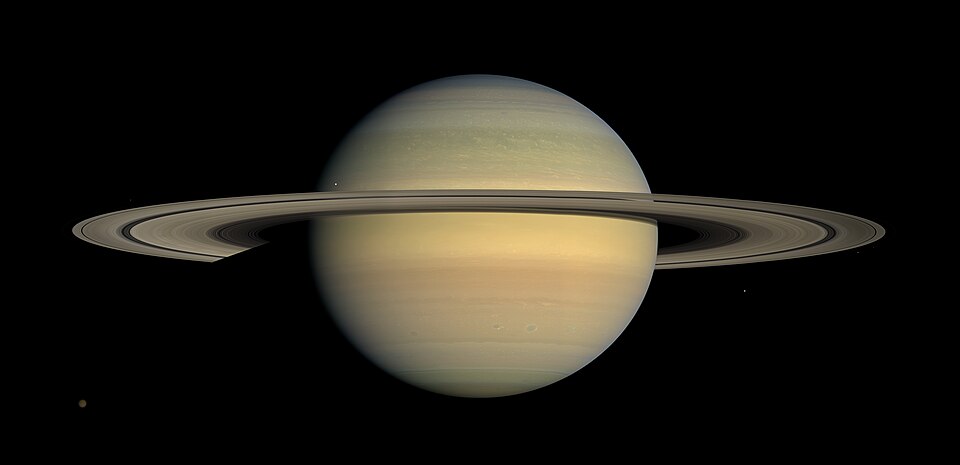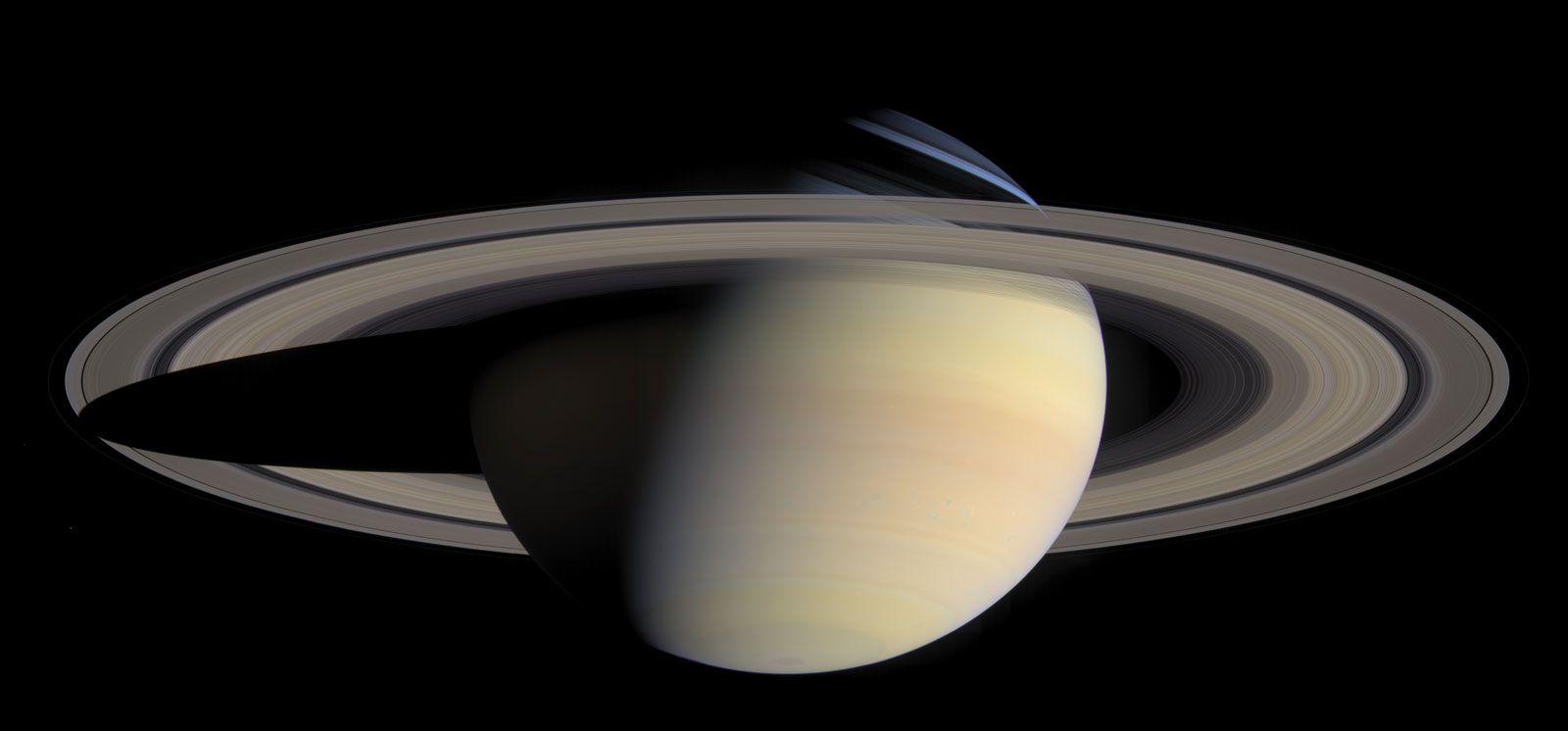
Few sights in the Solar System inspire as much wonder as Saturn and its magnificent rings. Even through a small telescope, Saturn appears unlike any other planet. Instead of standing alone in the darkness of space, it is surrounded by an enormous system of bright, elegant rings that seem almost unreal. For centuries, astronomers and skywatchers have been captivated by this cosmic masterpiece. The rings are so beautiful that they often look like something deliberately designed rather than naturally formed.
Yet behind their beauty lies a story of surprisingly complex physics. Saturn’s rings are not solid structures. They are not giant discs floating around the planet. Instead, they are made of countless icy particles, each following its own orbit around Saturn. Together, these particles create one of the most intricate and dynamic systems known in planetary science.
The rings appear calm and graceful from afar, but up close they are a place of constant motion. Ice fragments collide, moons shape ring edges through gravity, invisible waves ripple through the material, and tiny particles migrate under the influence of sunlight and magnetic forces. The rings are a laboratory where astronomers can study gravity, orbital mechanics, collisions, and planetary evolution on a grand scale.
Understanding Saturn’s rings means understanding some of the most important laws of physics that govern the universe. It also means exploring one of the Solar System’s greatest mysteries: how these rings formed, how old they are, and how long they will survive.
Saturn: The Ringed Giant
Saturn is the sixth planet from the Sun and the second-largest planet in the Solar System after Jupiter. It belongs to the group known as the gas giants, worlds composed primarily of hydrogen and helium rather than rock and metal.
Saturn is enormous. More than 760 Earths could fit inside its volume. Yet despite its size, Saturn is surprisingly low in density. If a bathtub large enough existed, Saturn would theoretically float in water.
The planet is famous for its rings, but Saturn itself is fascinating. Its atmosphere contains powerful storms, fierce winds, and intricate cloud patterns. Deep beneath the visible clouds, pressures and temperatures rise dramatically.
Still, what truly distinguishes Saturn from every other planet is its spectacular ring system. Although all four giant planets possess rings, Saturn’s are by far the largest, brightest, and most complex.
When people imagine Saturn, they usually imagine the rings first.
The Discovery of Saturn’s Rings
Before the invention of the telescope, Saturn appeared as little more than a bright point of light in the night sky.
Everything changed in 1610 when Galileo Galilei observed Saturn through one of the earliest telescopes. What he saw confused him.
Galileo noticed strange structures attached to the planet. However, his telescope lacked sufficient power to reveal the true nature of the rings. He described Saturn as having “ears” or side appendages.
A few years later, those appendages seemed to disappear entirely.
Galileo was puzzled.
What he did not realize was that Saturn’s rings are extremely thin. As Saturn moved in its orbit, Earth occasionally viewed the rings edge-on. During these periods, the rings became nearly invisible.
The mystery remained unsolved until 1655, when Christiaan Huygens proposed the correct explanation. He suggested that Saturn was surrounded by a thin ring that did not touch the planet.
This remarkable insight transformed astronomy.
The strange appendages were not moons or protrusions. They were an entirely new type of planetary structure.
What the Rings Actually Are
At first glance, Saturn’s rings look like giant solid discs.
In reality, they are made of countless individual particles orbiting Saturn.
These particles range in size from tiny dust grains to chunks of ice as large as houses or even mountains. Most consist primarily of water ice, giving the rings their bright appearance.
Imagine crushing a glacier into trillions of pieces and spreading those fragments across hundreds of thousands of kilometers around a planet. That image comes closer to reality than the idea of a solid ring.
Every particle travels around Saturn according to the laws of gravity and motion.
Each follows its own path.
Each moves at its own speed.
Together, these countless particles create the illusion of continuous rings.
The result is one of nature’s most extraordinary examples of order emerging from chaos.
Why the Rings Are So Bright
One reason Saturn’s rings are so visually striking is their composition.
The rings contain enormous amounts of water ice.
Ice reflects sunlight extremely well. Fresh ice can reflect much more light than rock or dust.
When sunlight strikes Saturn’s rings, much of that light bounces back into space.
This high reflectivity makes the rings visible across vast distances.
Their brightness also provides important clues about their history.
If the rings were very old, scientists might expect them to become increasingly contaminated by dark dust and debris over billions of years.
Instead, the rings remain remarkably bright.
This observation has fueled ongoing debates about their age.
The Main Ring System
Although Saturn’s rings often appear as a single structure, they are divided into several major regions.
These regions were assigned letters based on the order in which they were discovered rather than their distance from Saturn.
The brightest and most prominent sections are known as the A Ring, B Ring, and C Ring.
Between the A and B Rings lies a broad gap called the Cassini Division.
This division appears dark when viewed from Earth, creating the impression that the ring system has been split into separate bands.
Closer examination reveals that the Cassini Division is not completely empty. It simply contains far fewer particles than neighboring regions.
Beyond the main rings lie additional structures that are thinner, fainter, and often more difficult to observe.
Together, these rings create a vast and highly organized system stretching hundreds of thousands of kilometers across space.
A Surprisingly Thin Structure
One of the most astonishing facts about Saturn’s rings is how thin they are.
The rings extend outward over enormous distances, yet their vertical thickness is remarkably small.
In many places, the thickness is measured in tens of meters rather than kilometers.
To appreciate this, imagine a sheet of paper enlarged until it spans an entire city while retaining roughly the same relative thickness.
That comparison still underestimates the extreme proportions of Saturn’s rings.
From a distance, the rings appear massive and substantial.
Up close, they resemble an extraordinarily thin cosmic disk made of orbiting ice particles.
Their thinness results from countless collisions between particles.
These collisions gradually reduce vertical motions, causing most particles to settle into a flat plane around Saturn.
The Physics of Orbiting Particles
To understand Saturn’s rings, it is necessary to understand orbital motion.
Every ring particle is constantly falling toward Saturn because of gravity.
However, the particles are also moving sideways at tremendous speeds.
The combination of these motions creates stable orbits.
Rather than crashing into Saturn, the particles continually fall around the planet.
This same principle keeps Earth’s Moon in orbit and allows artificial satellites to circle Earth.
An important consequence of orbital mechanics is that particles closer to Saturn move faster than particles farther away.
This might seem counterintuitive.
Many people imagine the outer parts of a rotating system moving faster.
In planetary orbits, the opposite is true.
Inner particles complete their orbits more quickly because Saturn’s gravitational pull is stronger at smaller distances.
This difference in orbital speeds creates many of the fascinating structures observed within the rings.
A World of Constant Collisions
Although the rings appear peaceful from afar, they are actually a place of constant activity.
Particles frequently collide with one another.
Fortunately, these collisions are usually gentle rather than catastrophic.
Many ring particles move in similar directions and at similar speeds.
As a result, collisions often involve relatively low velocities.
These interactions help maintain the rings’ thin structure.
They also redistribute energy and momentum throughout the system.
Over time, collisions influence particle sizes, shapes, and orbital paths.
The rings behave almost like a giant fluid, despite being composed of countless solid objects.
This combination of solid particles and fluid-like behavior makes ring physics particularly fascinating.
Gravity as a Sculptor
Gravity is the master architect of Saturn’s rings.
The planet’s immense gravitational field controls the overall structure of the system.
At the same time, nearby moons exert their own gravitational influence.
These interactions create an astonishing variety of patterns.
Some regions contain sharp edges.
Others exhibit waves, gaps, spirals, and braided structures.
Many of these features arise because gravitational forces repeatedly nudge ring particles in specific ways.
The rings are therefore not static objects.
They are dynamic environments continuously shaped by gravitational interactions.
In many respects, the rings resemble a giant cosmic artwork being endlessly redrawn by invisible forces.
The Role of Saturn’s Moons
Saturn possesses more than a hundred known moons, and many play important roles in shaping the rings.
Some moons orbit outside the rings.
Others orbit within gaps.
Still others travel nearby.
These moons exert gravitational forces that influence ring particles.
Certain moons act as “shepherd moons.”
Their gravity helps confine ring material and maintain sharply defined ring edges.
Without these shepherding effects, ring particles would gradually spread out and blur many ring structures.
The relationship between moons and rings is one of the most beautiful examples of gravitational choreography in the Solar System.
Tiny worlds and tiny ice particles interact across vast distances, creating patterns visible from millions of kilometers away.
The Mystery of Ring Gaps
One of the most striking features of Saturn’s rings is the presence of gaps.
Some are narrow.
Others are wide enough to be easily observed from Earth.
At first, these gaps seem mysterious.
Why would certain regions contain fewer particles?
The answer often involves orbital resonances.
A resonance occurs when ring particles and a moon repeatedly align in a regular pattern.
During each alignment, the moon exerts a small gravitational pull.
Individually, these tugs are weak.
Repeated millions of times, however, they become powerful.
Particles can gradually be pushed out of specific regions, creating gaps.
This process demonstrates how tiny influences can produce dramatic large-scale effects over long periods.
Waves Moving Through the Rings
The rings are not motionless collections of particles.
They contain waves.
These waves resemble ripples spreading across a pond after a stone is thrown into the water.
However, ring waves are driven primarily by gravity.
Moons can generate spiral density waves that propagate through ring material.
In these regions, particles become alternately crowded together and spread apart.
Scientists can study these waves to learn about ring structure and particle behavior.
Remarkably, some waves even reveal information about Saturn itself.
Oscillations deep within the planet can influence the rings, allowing researchers to use the rings as a giant detector for Saturn’s internal vibrations.
In a sense, the rings can help scientists “listen” to the hidden interior of the planet.
The Roche Limit and Ring Formation
One of the most important concepts in ring physics is the Roche limit.
This boundary marks the distance within which a large object held together only by gravity may be torn apart by a planet’s tidal forces.
Tidal forces arise because gravity becomes weaker with distance.
The side of an object closer to Saturn experiences a stronger gravitational pull than the far side.
If an object ventures too close, these differences can overwhelm its self-gravity.
The object may break apart.
The resulting debris can spread into a ring system.
Many scientists believe the Roche limit plays a crucial role in explaining why rings exist around planets.
Material inside this region struggles to form large moons.
Instead, it often remains dispersed as orbiting particles.
How Did Saturn’s Rings Form?
The origin of Saturn’s rings remains one of planetary science’s greatest mysteries.
Several competing theories exist.
One possibility is that a moon wandered too close to Saturn and was torn apart by tidal forces.
Its fragments then spread into orbit, forming the rings.
Another possibility involves collisions.
A moon or comet may have been shattered by a violent impact, producing enormous amounts of debris.
Some researchers suggest the rings could be remnants from the era when Saturn itself formed billions of years ago.
Others argue they may be surprisingly young, perhaps only a few hundred million years old.
Data from spacecraft have provided valuable clues, but the debate remains unresolved.
The true origin of the rings is still one of the Solar System’s most intriguing unanswered questions.
The Cassini Mission Revolution
Our understanding of Saturn’s rings changed dramatically thanks to the Cassini–Huygens spacecraft.
Launched in 1997, Cassini arrived at Saturn in 2004 and spent more than thirteen years studying the planet, its moons, and its rings.
The mission delivered an extraordinary wealth of information.
Cassini photographed intricate ring structures in stunning detail.
It observed waves, clumps, moon interactions, and countless previously unknown features.
The spacecraft revealed that the rings are far more dynamic and complex than scientists had imagined.
Its observations transformed Saturn’s rings from a beautiful astronomical curiosity into one of the richest natural laboratories in planetary science.
Ring Rain: Saturn Eating Its Rings
One of Cassini’s most surprising discoveries involved a phenomenon known as ring rain.
Tiny particles from the rings gradually spiral toward Saturn.
As they interact with the planet’s magnetic field, charged particles move into the atmosphere.
In a sense, Saturn is slowly consuming its own rings.
This process means the rings are not permanent.
They are gradually losing material.
Scientists estimate that ring rain may eventually cause the rings to disappear entirely.
Although this process occurs over immense timescales, it highlights an important reality.
The rings are temporary.
Even the most beautiful structures in the Solar System are subject to change.
The Future of Saturn’s Rings
Will Saturn always possess rings?
Probably not.
Current evidence suggests the rings are gradually evolving.
Material is continually lost through ring rain and other processes.
Collisions alter particle distributions.
Gravitational interactions reshape structures.
Over millions or hundreds of millions of years, the rings may become much less prominent.
Eventually, they could disappear altogether.
Future observers might see Saturn as a planet with faint rings or perhaps none at all.
This possibility adds a poignant dimension to the rings’ beauty.
We may be living during a special era when Saturn’s rings are especially visible and spectacular.
Why Saturn’s Rings Matter
At first glance, Saturn’s rings might seem like a niche topic relevant only to astronomers.
In reality, they help answer fundamental questions about the universe.
The rings provide a natural laboratory for studying gravity, orbital motion, and collisions.
Processes occurring within the rings resemble phenomena found elsewhere in the cosmos.
The formation of planets around young stars, the behavior of galactic disks, and the dynamics of countless astronomical systems involve similar physical principles.
By studying Saturn’s rings, scientists gain insights that extend far beyond Saturn itself.
The rings help reveal how complex structures emerge and evolve throughout the universe.
The Emotional Power of the Rings
Scientific explanations alone do not fully capture why Saturn’s rings fascinate people.
Part of their appeal is emotional.
The rings remind us that nature can be both elegant and mysterious.
They transform a distant planet into something unforgettable.
For many people, seeing Saturn through a telescope for the first time is a life-changing experience.
The tiny image floating in the eyepiece suddenly becomes real.
What once seemed like a textbook illustration appears before their eyes.
The rings create an immediate sense of connection to the wider universe.
They remind us that extraordinary wonders exist beyond Earth.
A Cosmic Balance Between Order and Chaos
Perhaps the most remarkable aspect of Saturn’s rings is the balance they represent.
At the level of individual particles, the system appears chaotic.
Trillions of ice fragments move independently.
Collisions occur constantly.
Gravitational influences compete.
Yet from a distance, all this complexity creates extraordinary order.
The rings form graceful bands that appear almost perfectly designed.
This contrast reflects a broader theme throughout nature.
Simple physical laws can produce astonishing beauty.
The rings are not guided by intelligence or intention.
They emerge naturally from gravity, motion, and time.
And yet they create one of the most breathtaking sights in the Solar System.
Conclusion
Saturn’s rings are far more than decorative features surrounding a giant planet. They are vast systems of orbiting ice particles governed by the fundamental laws of physics. Every particle follows a path shaped by gravity, collisions, resonances, and the influence of Saturn’s many moons. Together, these countless icy fragments create structures of remarkable complexity and beauty.
The rings have challenged astronomers for centuries, from Galileo’s first confusing observations to the detailed investigations conducted by the Cassini spacecraft. Despite tremendous progress, important mysteries remain. Scientists still debate exactly how the rings formed, how old they are, and how long they will survive.
What makes Saturn’s rings truly extraordinary is that they combine scientific importance with visual wonder. They are both a natural laboratory and a cosmic masterpiece. Through them, we can observe gravity at work, study the dynamics of orbital systems, and glimpse processes that occur throughout the universe.
At the same time, the rings remind us of something deeply human: our desire to understand the beautiful and mysterious things we see in the sky. Their shining arcs of ice continue to inspire curiosity, imagination, and awe. And as long as Saturn circles the Sun with its magnificent rings, it will remain one of the most captivating worlds in the Solar System.