When most people imagine a galaxy, they picture a graceful cosmic pinwheel spinning through space or a giant glowing oval packed with stars. These images come from the two most famous galaxy types: spirals and ellipticals. They are beautiful, organized, and predictable. Their shapes seem almost artistic, as if nature carefully designed them according to a blueprint.
But the universe does not always follow neat patterns.
Scattered across the cosmos are galaxies that appear chaotic, messy, and strangely shaped. Some look like torn clouds of stars. Others resemble cosmic splatters, distorted fragments, or glowing patches without any obvious structure. They seem to ignore the rules that govern their more orderly cousins.
These unusual systems are known as irregular galaxies.
For a long time, astronomers viewed them as oddities—galactic misfits that did not fit comfortably into the established categories of the universe. Yet as our understanding of the cosmos has grown, scientists have realized that irregular galaxies are far more important than they first appeared. These seemingly disorganized collections of stars contain clues about galaxy evolution, cosmic collisions, star formation, and even the history of the early universe.
Irregular galaxies remind us that the cosmos is not always neat and symmetrical. Sometimes the most fascinating stories are written in disorder.
Understanding What a Galaxy Is
Before exploring irregular galaxies, it helps to understand what a galaxy actually is.
A galaxy is a vast gravitationally bound system containing stars, gas, dust, dark matter, planets, and countless other objects. Galaxies can contain millions, billions, or even trillions of stars.
Our own home, the Milky Way, is a galaxy containing hundreds of billions of stars. The Sun is only one of them.
Galaxies are among the largest structures in the universe. They are cosmic cities of stars, connected and held together by gravity over enormous distances.
For much of the twentieth century, astronomers classified galaxies according to their appearance. Most fell into a few major categories.
Spiral galaxies possess elegant arms winding outward from a central bulge. Elliptical galaxies appear as smooth, rounded collections of stars. Lenticular galaxies occupy a middle ground between these two forms.
Yet some galaxies stubbornly refused classification.
They lacked spiral arms.
They lacked a smooth elliptical shape.
They often looked distorted, fragmented, or completely chaotic.
These became known as irregular galaxies.
What Is an Irregular Galaxy?
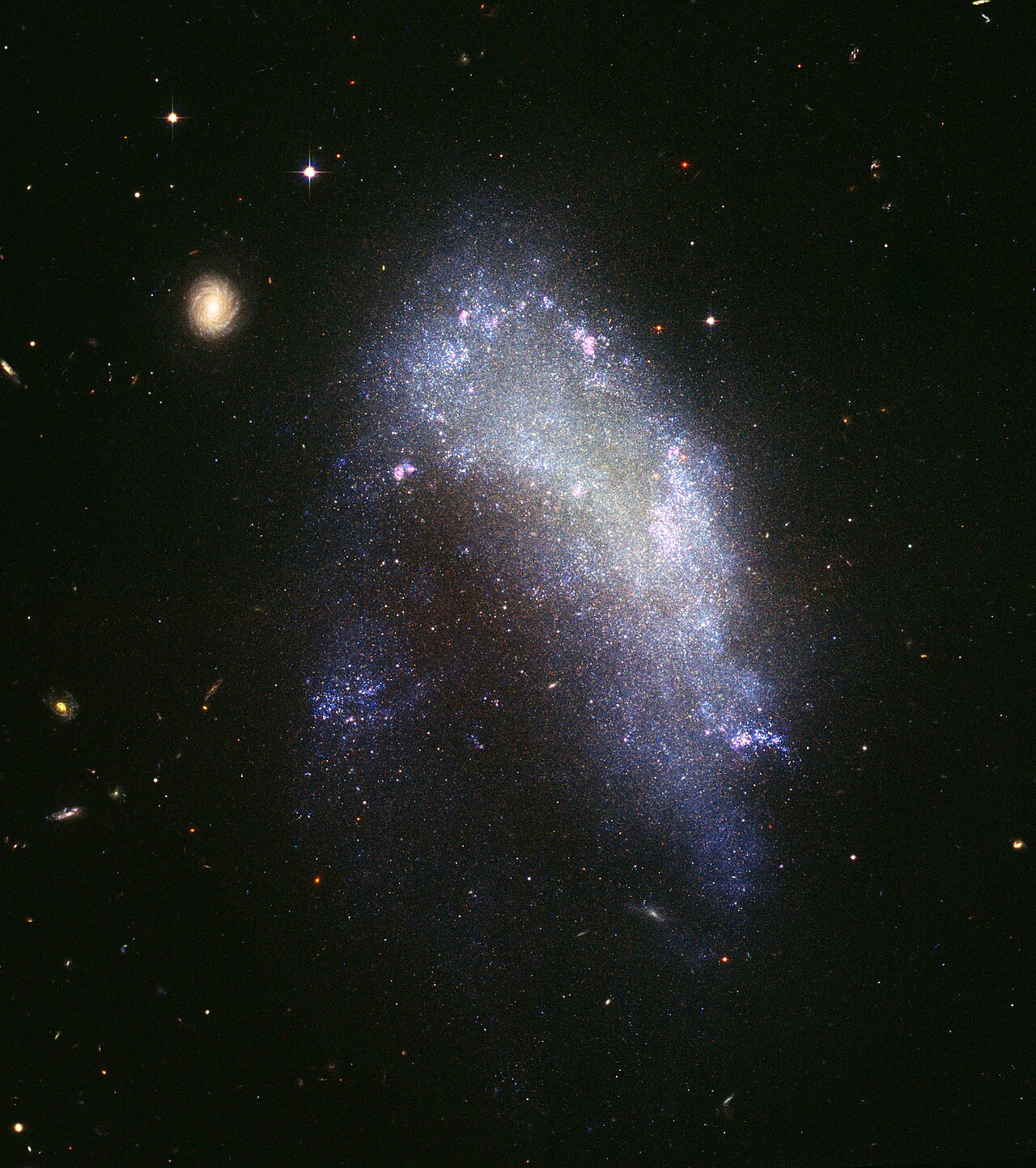
An irregular galaxy is a galaxy that does not fit into the traditional spiral or elliptical classifications.
Rather than displaying a clear and organized structure, irregular galaxies often appear asymmetrical and shapeless. Their stars, gas, and dust may be distributed unevenly, creating forms that seem random and unpredictable.
This does not mean irregular galaxies are disorganized in a physical sense. Gravity still governs them. Stars still orbit within them. Physical laws still operate normally.
The term “irregular” simply describes their appearance.
Imagine looking at clouds in the sky. Some clouds may form recognizable shapes, while others appear scattered and chaotic. Irregular galaxies are somewhat similar. They possess structure, but not the obvious patterns seen in other galaxy types.
Their unusual appearances can result from several different causes, including gravitational interactions, galaxy collisions, intense star formation, or incomplete development.
The Discovery of Irregular Galaxies
The story of irregular galaxies is closely tied to humanity’s growing understanding of the universe.
Before the twentieth century, astronomers did not even know that galaxies beyond the Milky Way existed. Many believed fuzzy objects seen through telescopes were simply nebulae located within our galaxy.
This view changed dramatically during the 1920s when observations revealed that many of these objects were actually entire galaxies located far beyond the Milky Way.
As astronomers began cataloging galaxies, they noticed recurring patterns.
In 1926, the famous astronomer Edwin Hubble introduced a classification system known as the Hubble sequence. Galaxies were grouped according to their appearance.
Most fit neatly into spiral or elliptical categories.
However, some galaxies resisted classification. Their strange forms did not match any standard pattern.
Hubble eventually created a separate category for these unusual objects: irregular galaxies.
What initially seemed like a small group of oddities later proved to represent an important part of the galactic population.
Why Are Irregular Galaxies Irregular?
One of the most fascinating questions about these galaxies is why they look the way they do.
The answer is not always the same.
Some irregular galaxies were likely born with their unusual structures. Others may once have been organized systems that became distorted through gravitational interactions.
Galaxies are not isolated islands floating peacefully through space. They constantly interact with neighboring galaxies.
Gravity reaches across enormous distances.
When galaxies pass near one another, their mutual gravitational pull can stretch, twist, and reshape them.
Stars themselves rarely collide because of the vast distances separating them, but entire galaxies can become dramatically altered by these encounters.
A previously elegant spiral galaxy may lose its structure after repeated interactions.
A small galaxy may become distorted by a larger neighbor.
A violent merger between galaxies can produce chaotic forms lasting billions of years.
In many cases, irregular galaxies are cosmic survivors of turbulent histories.
The Two Main Types of Irregular Galaxies
Astronomers generally divide irregular galaxies into two broad categories.
The first type includes galaxies that genuinely lack a recognizable structure. These systems appear chaotic without obvious evidence of external disturbance.
The second type includes galaxies that show signs of distortion caused by interactions or collisions. Their unusual shapes often result from gravitational forces acting upon them.
Although these categories help scientists organize observations, nature does not always fit perfectly into neat boxes. Many galaxies display characteristics of both groups.
The universe often prefers complexity over simplicity.
Small but Important
Many irregular galaxies are relatively small compared to giant spiral and elliptical galaxies.
Some contain only a few billion stars, while large spiral galaxies may contain hundreds of billions.
Because of their smaller sizes, irregular galaxies are often classified as dwarf galaxies.
Yet small does not mean unimportant.
In fact, dwarf irregular galaxies may be among the most common types of galaxies in the universe.
Their modest size makes them particularly sensitive to environmental influences. Interactions that might only slightly affect a large galaxy can dramatically reshape a smaller one.
As a result, irregular galaxies provide valuable laboratories for studying how galaxies evolve over time.
Rich in Gas and Dust
One defining characteristic of many irregular galaxies is their abundance of gas and dust.
These materials serve as the raw ingredients for creating new stars.
While some older galaxies have exhausted much of their star-forming material, many irregular galaxies still possess large reservoirs of hydrogen gas.
This makes them active sites of star birth.
Within dense clouds of gas and dust, gravity causes matter to collapse inward. As these regions become denser, temperatures rise until nuclear fusion ignites.
A new star is born.
Because irregular galaxies often contain large quantities of star-forming material, they can produce stars at surprisingly high rates.
Some are experiencing intense bursts of star formation that light up the galaxy with brilliant young stars.
Starburst Activity in Irregular Galaxies
Certain irregular galaxies undergo periods known as starbursts.
During a starburst, stars form far more rapidly than normal.
Imagine a quiet town suddenly experiencing a construction boom where buildings appear everywhere at once. A starburst galaxy behaves similarly, except it is creating stars rather than buildings.
Massive young stars shine intensely, producing enormous amounts of ultraviolet radiation.
These stars burn through their fuel quickly and often end their lives as supernova explosions.
As a result, starburst regions can become some of the brightest parts of a galaxy.
Many irregular galaxies are famous for their extraordinary star-forming activity.
Studying these regions helps astronomers understand how stars formed throughout cosmic history.
The Large Magellanic Cloud
One of the most famous irregular galaxies visible from Earth is the Large Magellanic Cloud.
Located about 163,000 light-years away, it orbits the Milky Way as a satellite galaxy.
Visible from the Southern Hemisphere without a telescope, the Large Magellanic Cloud appears as a faint glowing patch in the night sky.
Despite being relatively small compared to the Milky Way, it contains billions of stars and remarkable regions of star formation.
Its most famous feature is the Tarantula Nebula, one of the most active stellar nurseries known.
Within this enormous cloud of gas and dust, thousands of stars are forming, offering astronomers a spectacular opportunity to observe stellar birth.
The Large Magellanic Cloud demonstrates that irregular galaxies can be among the most dynamic places in the cosmos.
The Small Magellanic Cloud
Companion to the Large Magellanic Cloud is the Small Magellanic Cloud.
This smaller irregular galaxy also orbits the Milky Way and has interacted gravitationally with both its larger companion and our own galaxy.
These interactions have helped shape its unusual appearance.
Streams of gas connect the two Magellanic Clouds, evidence of a long and complex relationship.
Astronomers believe tidal forces generated by these interactions have significantly influenced their evolution.
The Small Magellanic Cloud serves as a nearby example of how gravitational encounters can reshape galaxies.
Galaxy Collisions and Cosmic Chaos
To human intuition, galaxy collisions sound catastrophic.
Images of destruction immediately come to mind.
In reality, galaxy collisions are both violent and surprisingly gentle.
Because stars are separated by enormous distances, direct stellar collisions are extremely rare. Instead, gravity gradually reshapes the galaxies involved.
As galaxies pass through one another, gravitational forces pull stars, gas, and dust into new configurations.
Long tidal tails may stretch across hundreds of thousands of light-years.
Clouds of gas can compress, triggering intense star formation.
Spiral structures may become distorted or completely erased.
The result can be an irregular galaxy with a shape unlike anything that existed before the encounter.
These collisions play a major role in shaping the galactic landscape of the universe.
Irregular Galaxies in the Early Universe
When astronomers peer into deep space, they are also looking back in time.
Because light takes time to travel, distant galaxies appear as they existed billions of years ago.
Observations from powerful telescopes reveal that irregular galaxies were far more common in the early universe than they are today.
Young galaxies often appeared clumpy, chaotic, and rapidly evolving.
This makes sense because the early universe was a busy place.
Galaxies were smaller.
Collisions occurred more frequently.
Structures had not yet settled into stable forms.
Many of today’s magnificent spiral and elliptical galaxies may have begun life looking irregular.
Studying irregular galaxies therefore provides a glimpse into the universe’s youth.
Dark Matter and Irregular Galaxies
Like all galaxies, irregular galaxies appear to contain large amounts of dark matter.
Dark matter remains one of the greatest mysteries in modern astronomy.
It does not emit, absorb, or reflect light, making it invisible to telescopes.
Yet its gravitational effects are unmistakable.
Stars in galaxies often move too quickly to be held together by visible matter alone.
Something unseen must provide additional gravitational pull.
Dark matter appears to supply that missing mass.
Irregular galaxies are particularly useful for studying dark matter because many contain relatively little ordinary matter compared to their total mass.
Their motions can reveal important clues about the hidden structure of the universe.
The Colors of Irregular Galaxies
One of the most visually striking aspects of irregular galaxies is their color.
Many appear blue.
This blue coloration comes primarily from young, massive stars.
These stars are extremely hot and emit large amounts of blue and ultraviolet light.
Because irregular galaxies often experience active star formation, they contain many young stars that dominate their appearance.
In contrast, older galaxies frequently appear yellow or reddish because their populations are dominated by cooler, aging stars.
The blue glow of many irregular galaxies tells a story of ongoing creation.
They are places where stars are still being born in abundance.
How Scientists Study Irregular Galaxies
Modern astronomers use a variety of tools to investigate irregular galaxies.
Optical telescopes reveal stars and visible structures.
Radio telescopes detect hydrogen gas that fuels future star formation.
Infrared instruments peer through dust clouds to observe hidden regions.
Space telescopes eliminate atmospheric interference and provide remarkably detailed images.
Spectroscopy allows scientists to determine chemical compositions, temperatures, and motions.
By combining information from multiple wavelengths, researchers can construct a comprehensive picture of how irregular galaxies function.
Each observation adds another piece to a vast cosmic puzzle.
The Life Cycle of an Irregular Galaxy
Not all irregular galaxies remain irregular forever.
Galaxies evolve.
Over billions of years, interactions, mergers, and internal processes can dramatically alter their appearances.
An irregular galaxy may gradually settle into a more organized form.
Conversely, a spiral galaxy may become irregular after a major collision.
Galactic evolution is an ongoing process rather than a fixed state.
The appearance we observe today represents only a snapshot in an immensely long story.
In this sense, irregular galaxies remind us that the universe is constantly changing.
Nothing remains exactly the same forever.
Why Irregular Galaxies Matter
At first glance, irregular galaxies may seem less impressive than majestic spirals or giant ellipticals.
Yet they play an essential role in understanding the cosmos.
They help scientists study galaxy formation.
They reveal the effects of gravitational interactions.
They provide laboratories for observing star formation.
They offer insights into dark matter.
They preserve clues about conditions in the early universe.
Without irregular galaxies, our picture of cosmic evolution would be incomplete.
Sometimes the exceptions teach us more than the rules.
The Beauty of Cosmic Imperfection
Humans often associate beauty with symmetry.
We admire balanced architecture, orderly patterns, and harmonious shapes.
Yet nature frequently demonstrates another kind of beauty—the beauty of imperfection.
Irregular galaxies embody this idea on a cosmic scale.
Their asymmetrical forms tell stories of collisions, growth, survival, and transformation.
Each distorted arm, glowing cloud, and scattered cluster of stars reflects a unique history written over billions of years.
No two irregular galaxies look exactly alike.
Each is a cosmic individual.
In their apparent disorder, they reveal the dynamic nature of the universe.
What Irregular Galaxies Teach Us About the Universe
Perhaps the greatest lesson irregular galaxies offer is that the universe is not static.
The cosmos is alive with change.
Galaxies grow, collide, merge, and evolve.
Stars are born and die.
Structures form and dissolve.
The elegant spiral galaxies we admire today were not always so orderly, and they may not remain that way forever.
Irregular galaxies capture moments of transformation.
They show the universe in motion rather than at rest.
They reveal cosmic evolution as an ongoing process rather than a completed masterpiece.
In doing so, they deepen our understanding of how the universe became what it is today.
Conclusion
Irregular galaxies are the cosmic misfits that refuse to conform to traditional galactic categories. Unlike spirals with graceful arms or ellipticals with smooth shapes, irregular galaxies display chaotic, asymmetrical structures shaped by interactions, collisions, intense star formation, or unique evolutionary histories. Though often smaller than their more famous counterparts, they are among the most important objects in astronomy.
Rich in gas, dust, and young stars, irregular galaxies serve as active laboratories where astronomers can study stellar birth, galactic evolution, dark matter, and the history of the universe itself. Nearby examples such as the Large and Small Magellanic Clouds provide invaluable opportunities to observe these processes in detail.
Far from being mere cosmic oddities, irregular galaxies offer some of the clearest evidence that the universe is dynamic, evolving, and endlessly creative. Their unusual shapes preserve the stories of ancient encounters and ongoing transformations. In their beautiful disorder, they remind us that nature does not always follow simple patterns—and that some of the most fascinating chapters of the cosmic story are written by the galaxies that refuse to fit in.