On a clear night, when we look up at the stars, it is easy to imagine the universe as a place filled with glittering spiral galaxies like our own Milky Way. Popular images from powerful telescopes often showcase magnificent cosmic pinwheels with elegant arms winding outward through space. These spiral galaxies capture our imagination because they appear dynamic, vibrant, and full of activity.
Yet many of the universe’s largest and most massive galaxies look nothing like this.
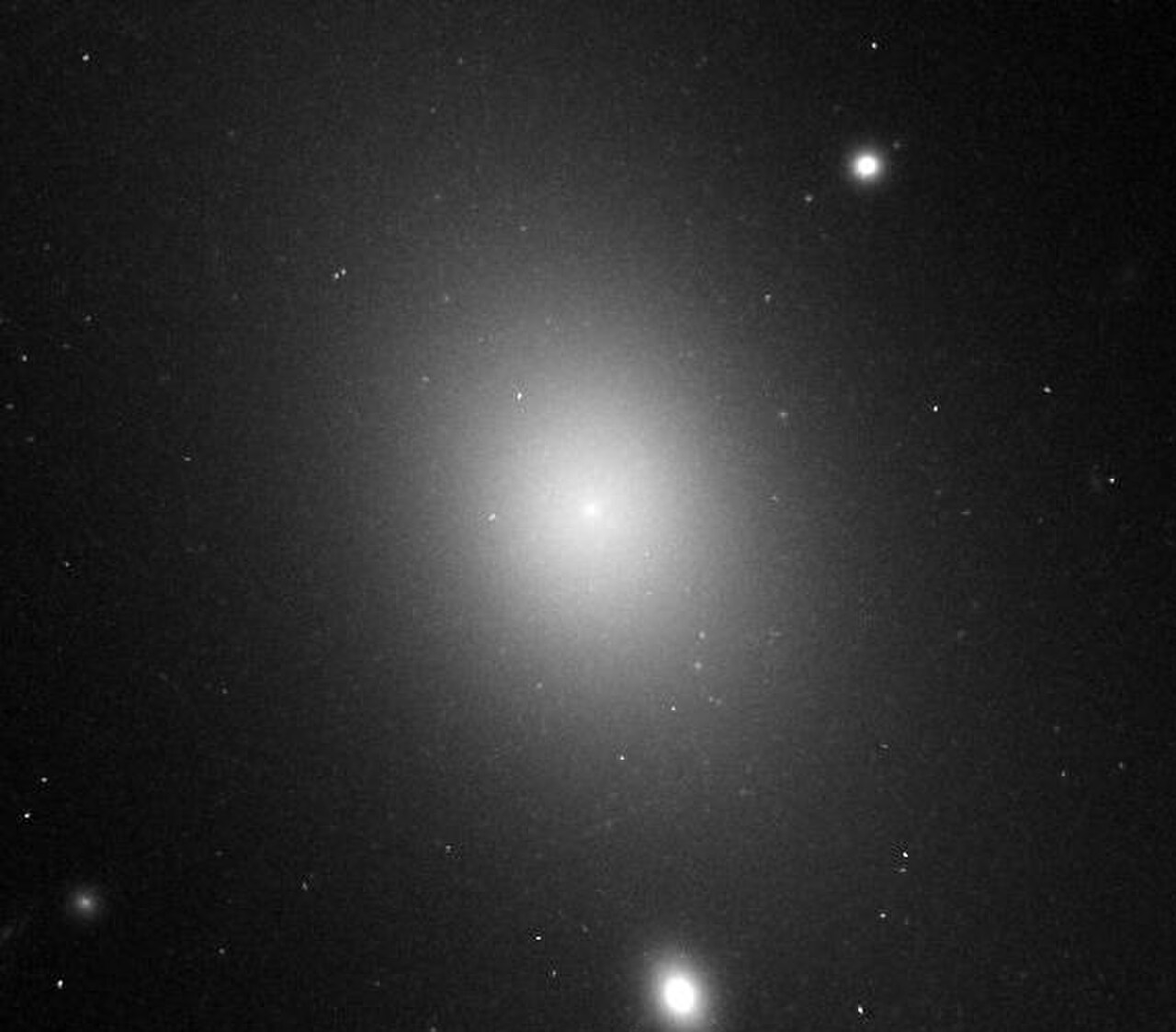
They are smooth. Rounded. Quiet. Sometimes they resemble glowing footballs or giant cosmic eggs suspended in darkness. They lack dramatic spiral arms, bright lanes of gas, and obvious regions where stars are actively forming. To an untrained eye, they may even appear somewhat plain compared to their spiral cousins.
These are elliptical galaxies.
Although they often look simple, elliptical galaxies are among the most fascinating objects in the cosmos. They contain trillions of stars, enormous amounts of dark matter, and some of the largest black holes ever discovered. Many of them are ancient survivors from the universe’s distant past, carrying clues about how galaxies formed and evolved over billions of years.
Astronomers sometimes describe them as the “elder statesmen” of the galaxy population. While younger galaxies bustle with stellar births and dramatic cosmic events, elliptical galaxies often seem calmer, older, and more mature.
But appearances can be deceiving.
Behind their smooth glow lies a story of violent collisions, colossal mergers, ancient stars, and cosmic evolution on a scale almost impossible to comprehend.
Understanding elliptical galaxies is like reading the biography of the universe itself.
What Exactly Is an Elliptical Galaxy?
An elliptical galaxy is a type of galaxy characterized by its smooth, rounded, or elongated shape and its relatively simple appearance.
Unlike spiral galaxies, elliptical galaxies do not possess visible spiral arms. They also contain far less cold gas and dust, which means they generally produce very few new stars.
Most of the stars inside an elliptical galaxy are old. Many formed billions of years ago during earlier periods of intense star formation.
Because these galaxies lack large amounts of gas and dust, they often appear yellowish or reddish rather than blue. The blue color seen in many galaxies usually comes from young, hot, massive stars. Since elliptical galaxies have fewer young stars, their older stellar populations dominate the light they emit.
At first glance, an elliptical galaxy may seem like a simple glowing cloud. However, it actually contains enormous numbers of stars orbiting through space in complex ways.
Rather than moving in organized circular patterns like stars in a spiral galaxy, stars in elliptical galaxies often travel along many different paths and directions.
This chaotic stellar motion contributes to the galaxy’s rounded shape.
The Discovery of Different Galaxy Types
For much of human history, galaxies were not recognized as separate systems at all.
Before the twentieth century, astronomers viewed many galaxies as faint “spiral nebulae” whose true nature remained mysterious.
Everything changed as telescopes improved.
Observations eventually revealed that these objects were not clouds inside the Milky Way. Instead, they were enormous star systems located far beyond our own galaxy.
As astronomers began studying galaxies in greater detail, they noticed that galaxies came in different forms.
Some possessed beautiful spiral structures.
Others looked irregular and chaotic.
Still others appeared smooth and rounded.
In the 1920s, the astronomer Edwin Hubble developed a classification system for galaxies. His famous “tuning fork” diagram organized galaxies according to their shapes.
Elliptical galaxies occupied one branch of this classification scheme.
Although modern astronomy has moved beyond some aspects of Hubble’s original ideas, his classification remains widely used today.
Why Are They Called Elliptical Galaxies?
The name comes directly from their appearance.
When viewed through a telescope, these galaxies often resemble ellipses rather than circles.
Some appear nearly spherical.
Others are stretched into elongated shapes.
Astronomers classify elliptical galaxies using a system that reflects how elongated they appear.
A nearly round galaxy occupies one end of the scale, while a highly stretched galaxy occupies the other.
However, appearances can be misleading.
Because galaxies exist in three dimensions, the shape we observe depends partly on our viewing angle.
A galaxy that appears round from one perspective may look more elongated from another.
Determining a galaxy’s true structure therefore requires careful observation and analysis.
The Smooth Appearance of Elliptical Galaxies
One of the defining characteristics of elliptical galaxies is their smoothness.
Unlike spiral galaxies, which display distinct arms, dust lanes, and star-forming regions, elliptical galaxies often look remarkably uniform.
Their brightness gradually decreases from the center outward.
There are no obvious patterns or dramatic structures.
This smooth appearance reflects the distribution of stars throughout the galaxy.
Over billions of years, gravitational interactions have mixed stellar orbits together, creating a relatively even and featureless glow.
Yet beneath that calm exterior lies incredible complexity.
An elliptical galaxy may contain hundreds of billions—or even trillions—of stars.
Each star follows its own path through the galaxy.
Together, these countless motions create the smooth appearance we observe from afar.
The Giants of the Cosmic World
Some elliptical galaxies rank among the largest objects in the universe.
While spiral galaxies can certainly become massive, the biggest galaxies known are often giant ellipticals.
These colossal systems reside at the centers of galaxy clusters, where hundreds or even thousands of galaxies gather under the influence of gravity.
The largest elliptical galaxies can stretch across millions of light-years.
They may contain many times more stars than the Milky Way.
Imagine combining dozens of large galaxies into a single enormous structure.
That is the scale astronomers encounter when studying some giant ellipticals.
These cosmic giants dominate their environments.
Their immense gravitational influence shapes the motions of neighboring galaxies and affects the evolution of entire galaxy clusters.
A Home for Ancient Stars
If galaxies had personalities, elliptical galaxies would likely be considered the elders of the cosmos.
Most stars within these galaxies are extremely old.
Many formed more than ten billion years ago.
As a result, elliptical galaxies provide astronomers with valuable information about the early universe.
When researchers study these ancient stellar populations, they effectively look back into cosmic history.
The oldest stars preserve clues about conditions that existed shortly after galaxies first began forming.
These stellar fossils help scientists reconstruct events that occurred billions of years before Earth even existed.
In a sense, elliptical galaxies function as giant archives of cosmic memory.
Why Elliptical Galaxies Look Red
Color plays an important role in astronomy.
Different colors reveal information about temperature, age, and composition.
Young galaxies with active star formation often appear blue because they contain many hot, massive stars.
These stars burn brightly but live relatively short lives.
Elliptical galaxies, by contrast, contain mostly older stars.
Older stellar populations tend to emit more red and yellow light.
Consequently, elliptical galaxies often display warm golden, orange, or reddish hues.
This color difference provides a visual clue about a galaxy’s evolutionary stage.
When astronomers observe a reddish elliptical galaxy, they know they are looking at a system where star formation largely ended long ago.
The Missing Ingredient: Cold Gas
One of the biggest differences between elliptical and spiral galaxies involves gas.
Stars form from giant clouds of cold gas and dust.
Without sufficient gas, new stars cannot easily emerge.
Spiral galaxies contain abundant reservoirs of cold gas.
Their spiral arms act as stellar nurseries where new stars continually form.
Elliptical galaxies generally lack these resources.
Most of their original gas has either been consumed, expelled, or heated to temperatures too high for efficient star formation.
As a result, stellar birth rates remain extremely low.
This is one reason astronomers often describe elliptical galaxies as “red and dead.”
The phrase sounds dramatic, but it simply means that star formation has largely ceased.
The galaxy still contains vast numbers of stars.
It just is not producing many new ones.
How Stars Move Inside Elliptical Galaxies
The motions of stars provide another important distinction.
In spiral galaxies, stars generally orbit in a relatively organized disk.
Most move in roughly the same direction around the galactic center.
Elliptical galaxies operate differently.
Their stars travel along a wide variety of paths.
Some move one way.
Others move another.
Their orbits create a more randomized pattern.
Imagine a swarm of bees buzzing in many directions rather than a group of runners circling a track.
This complex stellar motion helps maintain the galaxy’s rounded structure.
The result is a system that appears stable despite lacking the orderly rotation seen in spiral galaxies.
The Violent Origins of Elliptical Galaxies
For many years, astronomers wondered how elliptical galaxies formed.
Today, evidence strongly suggests that many originate through galactic mergers.
Galaxies are not isolated islands.
They frequently interact with one another.
Over billions of years, gravity pulls galaxies together.
When two large galaxies collide, the event unfolds over immense timescales.
Stars rarely crash directly into each other because of the enormous distances separating them.
Instead, gravitational forces reshape the entire structure of both galaxies.
The collision scrambles stellar orbits, disrupts spiral patterns, and triggers powerful bursts of star formation.
Eventually, the galaxies merge into a single larger system.
The resulting galaxy often possesses the smooth, rounded appearance characteristic of an elliptical galaxy.
In this sense, elliptical galaxies can be viewed as the descendants of ancient cosmic collisions.
Galactic Cannibalism
The growth of giant elliptical galaxies sometimes involves a process dramatically known as galactic cannibalism.
Large galaxies can gradually absorb smaller neighbors.
As small galaxies approach, gravitational forces tear them apart.
Their stars become incorporated into the larger galaxy.
This process may continue for billions of years.
Over time, a giant elliptical galaxy can accumulate material from dozens or even hundreds of smaller galaxies.
Each merger leaves subtle traces within the galaxy’s structure.
Astronomers search for these clues to reconstruct a galaxy’s evolutionary history.
Every elliptical galaxy has a story written across billions of years of mergers and interactions.
Supermassive Black Holes at Their Centers
Nearly every large galaxy appears to host a supermassive black hole at its center.
Elliptical galaxies are no exception.
In fact, some of the largest known black holes reside inside giant elliptical galaxies.
These black holes can contain billions of times the mass of the Sun.
Their gravitational influence extends across enormous distances.
Although black holes themselves emit no light, material falling toward them can release tremendous amounts of energy.
Some elliptical galaxies host active galactic nuclei powered by feeding black holes.
These regions become among the brightest objects in the universe.
The relationship between black holes and galaxies remains one of astronomy’s most fascinating mysteries.
Evidence suggests that galaxies and their central black holes evolve together, influencing each other’s growth over cosmic time.
Elliptical Galaxies and Dark Matter
Visible stars tell only part of the story.
Like most galaxies, elliptical galaxies appear embedded within enormous halos of dark matter.
Dark matter cannot be seen directly because it does not emit, absorb, or reflect light.
Yet its gravitational effects reveal its presence.
Without dark matter, many galaxies would not behave as observed.
Stars would move differently.
Galactic structures would evolve differently.
The universe itself would look dramatically different.
By studying the motions of stars in elliptical galaxies, astronomers can estimate how much dark matter surrounds them.
These investigations provide important clues about one of the greatest unsolved mysteries in modern science.
The Role of Elliptical Galaxies in Galaxy Clusters
Galaxy clusters represent some of the largest gravitationally bound structures in the universe.
Within these clusters, elliptical galaxies often dominate.
The central galaxy in a large cluster is frequently a giant elliptical.
These galaxies may have grown through repeated mergers over billions of years.
As cluster members interact and collide, material accumulates in the center.
The result can be an enormous elliptical galaxy surrounded by hundreds of smaller companions.
Studying these systems helps astronomers understand how large-scale structures evolved throughout cosmic history.
The Hot Gas Between the Stars
Although elliptical galaxies contain little cold gas, many possess large quantities of hot gas.
This gas reaches temperatures of millions of degrees.
At such extreme temperatures, it emits X-rays rather than visible light.
Space-based observatories can detect this radiation and map the distribution of hot gas.
These observations reveal that elliptical galaxies are more dynamic than they initially appear.
The hot gas interacts with black holes, dark matter, and stellar populations in complex ways.
Understanding these interactions remains an active area of astronomical research.
Star Formation in Elliptical Galaxies
For many years, astronomers assumed that elliptical galaxies had completely stopped producing stars.
Modern observations reveal a more nuanced picture.
While star formation rates are generally low, some elliptical galaxies continue to create small numbers of new stars.
Others may experience brief periods of renewed activity after acquiring fresh gas through mergers.
These discoveries remind scientists that galaxies rarely fit perfectly into simple categories.
Nature often proves more complicated than expected.
Even aging giant galaxies can occasionally surprise researchers.
The Largest Elliptical Galaxies Ever Found
Some elliptical galaxies are truly staggering in scale.
Among the largest known examples are the giant galaxies occupying cluster centers.
These systems can contain trillions of stars.
Their diameters may extend far beyond the size of ordinary galaxies.
The light from some giant ellipticals has traveled hundreds of millions of years before reaching Earth.
When astronomers observe these galaxies, they witness cosmic structures of almost unimaginable proportions.
The sheer size of these systems challenges our ability to comprehend the scale of the universe.
Elliptical Galaxies in the Early Universe
Modern telescopes allow astronomers to peer deep into the past.
Because light requires time to travel, distant galaxies appear as they existed billions of years ago.
Observations suggest that massive elliptical galaxies formed surprisingly early in cosmic history.
Some already existed when the universe was only a few billion years old.
This finding raises important questions.
How did such enormous galaxies assemble so quickly?
What processes fueled their rapid growth?
Researchers continue investigating these mysteries using increasingly powerful telescopes and computer simulations.
Each discovery helps refine our understanding of galaxy evolution.
The Future of the Milky Way
One of the most fascinating connections to elliptical galaxies involves our own future.
The Milky Way is currently a spiral galaxy.
However, it is on a collision course with the Andromeda Galaxy.
The merger will not occur anytime soon. It is expected to happen roughly four to five billion years from now.
When the two galaxies finally combine, their structures will undergo dramatic transformation.
Many astronomers believe the resulting galaxy will resemble a giant elliptical galaxy.
If this prediction is correct, our descendants—if any exist—may someday inhabit a galaxy very different from the one we see today.
The Milky Way itself could become one of the universe’s aging giants.
Observing Elliptical Galaxies
For amateur astronomers, elliptical galaxies offer rewarding targets.
Many appear as soft, glowing patches through backyard telescopes.
Unlike spiral galaxies, whose details may require large instruments to observe, elliptical galaxies often display their characteristic shapes even under modest magnification.
One famous example is the giant elliptical galaxy Messier 87.
This galaxy gained worldwide attention when astronomers captured the first image of a black hole’s shadow in its central region.
Observing such objects creates a powerful connection between humanity and the larger universe.
The faint glow reaching our eyes began its journey millions of years ago.
Why Elliptical Galaxies Matter
Elliptical galaxies are far more than simple collections of stars.
They are records of cosmic history.
Their ancient stellar populations preserve evidence from the early universe.
Their massive black holes reveal clues about galactic evolution.
Their mergers help explain how galaxies grow.
Their dark matter halos provide insight into invisible components of the cosmos.
Every elliptical galaxy tells a story spanning billions of years.
By studying them, astronomers gain a deeper understanding of how the universe became what it is today.
The Silent Giants of Cosmic Time
There is something poetic about elliptical galaxies.
They do not possess the dramatic spiral arms that often dominate astronomy photographs.
They rarely showcase dazzling regions of active star formation.
They seem quiet compared to younger galaxies bursting with new life.
Yet their apparent calm conceals a turbulent past.
Most have survived ancient collisions, absorbed neighboring galaxies, and witnessed countless generations of stars come and go.
They are cosmic elders carrying memories from an earlier age of the universe.
Their reddish glow reflects not weakness but longevity.
Their smooth appearance reflects stability earned through billions of years of evolution.
They are not inactive relics.
They are monuments to cosmic history.
Conclusion
Elliptical galaxies are among the most impressive and important structures in the universe. Characterized by their smooth shapes, old stellar populations, and enormous masses, they represent a mature stage in galactic evolution. Unlike spiral galaxies rich in gas and active star formation, elliptical galaxies are often dominated by ancient stars that formed billions of years ago.
Many of these galaxies originated through dramatic mergers and collisions that transformed once-separate systems into unified giants. Today they host some of the largest black holes known, reside at the centers of galaxy clusters, and provide critical clues about dark matter, galaxy formation, and the history of the cosmos.
Though they may appear calm and featureless from a distance, elliptical galaxies are anything but simple. They are survivors of cosmic upheaval, guardians of ancient starlight, and living records of the universe’s past.
As astronomers continue exploring the heavens with ever more powerful instruments, these aging giants will remain essential to understanding one of humanity’s greatest questions: how the universe evolved from a sea of primordial matter into the magnificent cosmic landscape we see today.