On a clear night, far from city lights, the sky reveals thousands of stars scattered across the darkness. To the naked eye, they seem like isolated points of light, each shining alone in the vast expanse of space. Yet appearances can be deceiving. Our Sun is just one star among hundreds of billions in the Milky Way. The Milky Way itself is only one galaxy among trillions in the observable universe. And even our galaxy is not wandering through space by itself.
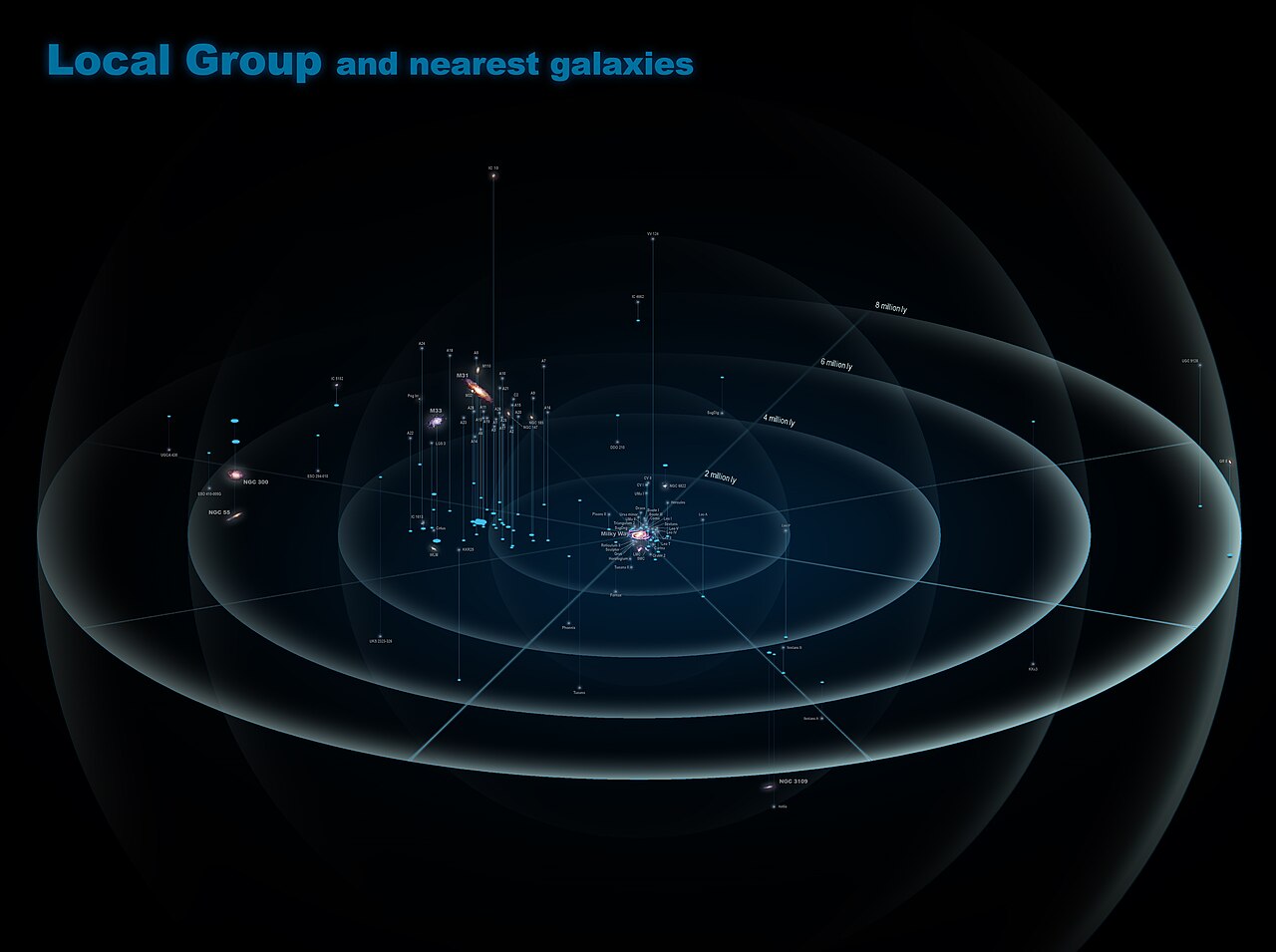
The Milky Way belongs to a cosmic family known as the Local Group—a collection of galaxies bound together by gravity, traveling through the universe as a giant galactic neighborhood.
The Local Group is our home on an intergalactic scale. It is where Earth resides, where our galaxy evolved, and where some of the most fascinating cosmic interactions are taking place. It contains giant spiral galaxies, tiny dwarf galaxies, streams of stars torn from ancient encounters, mysterious dark matter halos, and evidence of events that have unfolded over billions of years.
Understanding the Local Group helps us understand where we fit into the universe. It provides a bridge between studying individual galaxies and exploring the largest structures in the cosmos. It also offers a glimpse into our future, including a dramatic galactic collision that will transform the night sky billions of years from now.
The story of the Local Group is ultimately a story about connection. Even in the seemingly endless emptiness of space, galaxies gather together, influence one another, and share a common destiny.
Discovering Our Place in the Universe
For most of human history, people believed the Milky Way represented the entire universe.
Ancient civilizations gazed at the glowing band of light stretching across the sky and created myths to explain it. The true nature of the Milky Way remained unknown until the invention of telescopes allowed astronomers to explore the heavens in greater detail.
Even then, the scale of the universe was difficult to grasp.
In the nineteenth century, astronomers observed faint cloudy objects called nebulae. Some scientists suspected these mysterious objects might be distant “island universes” beyond the Milky Way, while others believed they were simply part of our own galaxy.
The debate continued until the early twentieth century.
Everything changed when Edwin Hubble studied variable stars in the Andromeda Galaxy. His observations revealed that Andromeda was far outside the Milky Way.
The universe suddenly became much larger than anyone had imagined.
Astronomers soon realized that galaxies themselves were not isolated. Many existed in groups and clusters. The Milky Way and Andromeda belonged to a small collection of neighboring galaxies held together by gravity.
This collection became known as the Local Group.
What Exactly Is the Local Group?
The Local Group is a gravitationally bound collection of galaxies that includes the Milky Way, Andromeda, and dozens of smaller galaxies.
It spans roughly 10 million light-years across, although most of its mass is concentrated within a smaller region.
A light-year is the distance light travels in one year—about 9.46 trillion kilometers. This means the Local Group occupies an enormous volume of space, far beyond anything humans can truly visualize.
Despite its immense size, the Local Group is considered relatively small by cosmic standards.
Some galaxy clusters contain hundreds or even thousands of galaxies. Yet the Local Group is particularly important because it is the region of the universe we know best.
Every galaxy we study within the Local Group provides clues about how galaxies form, evolve, and interact.
In a sense, the Local Group serves as our cosmic laboratory.
A Family Bound by Gravity
Gravity is the force that holds the Local Group together.
Galaxies are not simply scattered randomly through space. Their mutual gravitational attraction creates a loose but stable structure.
Imagine a collection of cities connected not by roads but by invisible gravitational threads. Each galaxy moves under the influence of every other galaxy around it.
These interactions occur on timescales of millions and billions of years.
The galaxies of the Local Group orbit common centers of mass, exchange material through gravitational encounters, and occasionally merge with one another.
Although space between galaxies appears empty, gravity continuously shapes their motions.
Without gravity, the Local Group would not exist.
The Milky Way: Our Galactic Home
The most familiar member of the Local Group is the Milky Way.
This magnificent spiral galaxy contains hundreds of billions of stars, vast clouds of gas and dust, countless planets, and a supermassive black hole at its center.
The Milky Way spans roughly 100,000 light-years across, although some estimates suggest it may be even larger.
Our Solar System lies about 27,000 light-years from the galactic center, located within one of the galaxy’s spiral arms.
For most of human history, we had no idea we lived inside such an enormous structure.
Today, astronomers understand that the Milky Way is one of the dominant galaxies within the Local Group.
Its gravitational influence extends far beyond its visible disk, thanks largely to an enormous halo of dark matter surrounding it.
The Milky Way is not only our home galaxy—it is one of the key architects of our galactic neighborhood.
Andromeda: The Giant Next Door
If the Milky Way is our home city, the Andromeda Galaxy is the neighboring metropolis.
Located about 2.5 million light-years away, Andromeda is the largest galaxy in the Local Group.
On exceptionally dark nights, it can actually be seen with the naked eye as a faint fuzzy patch in the sky.
The light reaching our eyes from Andromeda began its journey long before humans existed in their modern form.
Looking at Andromeda means looking deep into the past.
Like the Milky Way, Andromeda is a spiral galaxy containing hundreds of billions of stars.
For decades, astronomers have studied Andromeda to understand how galaxies similar to our own evolve.
What makes Andromeda especially fascinating is that it is moving toward us.
Rather than drifting away, as many distant galaxies do because of cosmic expansion, Andromeda and the Milky Way are being pulled together by gravity.
Their eventual meeting is one of the most dramatic future events known in astronomy.
The Triangulum Galaxy
The third-largest member of the Local Group is the Triangulum Galaxy.
Although smaller than both the Milky Way and Andromeda, it remains an impressive galaxy in its own right.
Triangulum contains tens of billions of stars and exhibits beautiful spiral structure.
Astronomers continue to investigate whether Triangulum may eventually participate in the future interactions between the Milky Way and Andromeda.
Like many galaxies in the Local Group, Triangulum offers important clues about galactic evolution.
Its relatively undisturbed appearance provides a contrast to galaxies that have experienced more dramatic mergers and encounters.
The Many Dwarf Galaxies
While giant galaxies attract most of the attention, the Local Group is actually dominated by dwarf galaxies.
These small galaxies contain far fewer stars than the Milky Way or Andromeda. Some possess only a few million stars, while others contain even fewer.
At first glance, dwarf galaxies might seem insignificant.
In reality, they are crucial to understanding cosmic history.
Many dwarf galaxies are believed to resemble the building blocks from which larger galaxies formed.
Over billions of years, giant galaxies grew by absorbing smaller companions.
Evidence of these ancient mergers remains visible today.
Streams of stars stretching across the sky reveal the remains of dwarf galaxies torn apart by gravitational forces.
The Local Group contains dozens of known dwarf galaxies, and astronomers continue discovering more.
Some are satellites of the Milky Way.
Others orbit Andromeda.
Still others travel through the Local Group more independently.
The Hidden Universe of Dark Matter
One of the most surprising discoveries about the Local Group is that most of its mass is invisible.
Stars, planets, gas, and dust account for only a small fraction of the total mass.
The majority appears to exist in the form of dark matter.
Dark matter does not emit, absorb, or reflect light. It cannot be seen directly.
Yet its gravitational effects are unmistakable.
Galaxies rotate too quickly to be held together by visible matter alone.
Their motions reveal the presence of vast quantities of unseen mass.
Every major galaxy in the Local Group appears to reside within a huge dark matter halo.
These halos overlap and interact, shaping the overall structure of the group.
Without dark matter, the Local Group would look very different.
In fact, it might not exist at all in its current form.
The Cosmic Web and the Local Group
The Local Group is not isolated from the rest of the universe.
It is part of a much larger structure known as the cosmic web.
On the largest scales, galaxies are arranged in enormous filaments separated by vast cosmic voids.
The universe resembles a gigantic three-dimensional network.
The Local Group sits within one of these larger structures.
Nearby galaxy groups and clusters exert gravitational influences upon us.
Our galactic neighborhood participates in motions involving structures millions of light-years away.
Understanding the Local Group therefore helps astronomers understand how galaxies fit into the broader architecture of the cosmos.
A Neighborhood in Motion
One common misconception is that galaxies remain fixed in space.
In reality, everything in the Local Group is moving.
The Milky Way rotates.
Andromeda rotates.
Dwarf galaxies orbit larger galaxies.
Entire galaxies travel through space under the influence of gravity.
These motions are incredibly slow from a human perspective but significant over cosmic timescales.
If we could watch the Local Group evolve in a time-lapse movie lasting billions of years, we would see galaxies dancing around one another, colliding, merging, and transforming.
The universe is far more dynamic than it appears.
Ancient Galactic Cannibalism
Galaxies grow through mergers.
The Milky Way itself bears scars from ancient encounters.
Over billions of years, our galaxy has absorbed numerous smaller galaxies.
Astronomers have identified stellar streams and unusual star populations that likely originated in long-destroyed companions.
These remnants are cosmic fossils.
They preserve evidence of events that occurred billions of years ago.
Andromeda shows similar signs of past mergers.
Its structure reveals a turbulent history involving multiple galactic collisions.
In the Local Group, galactic cannibalism is not unusual.
It is one of the primary mechanisms through which galaxies evolve.
The Future Collision of the Milky Way and Andromeda
Perhaps the most famous event associated with the Local Group is the future collision between the Milky Way and Andromeda.
Current observations indicate that Andromeda is approaching us at roughly 110 kilometers per second.
Although that sounds fast, the enormous distance between the galaxies means the collision will not occur for approximately 4 to 5 billion years.
When it finally happens, the event will unfold gradually over hundreds of millions of years.
Contrary to popular imagination, individual stars are unlikely to collide directly.
The distances between stars are simply too large.
Instead, gravitational interactions will distort both galaxies.
Their spiral structures will stretch and twist.
Massive streams of stars will be flung into space.
Eventually, the two galaxies will merge into a single larger galaxy.
Astronomers sometimes call this future system “Milkomeda.”
The night sky experienced by any future observers on Earth—or whatever worlds exist then—would be spectacular beyond imagination.
What Will Happen to the Solar System?
People often wonder whether the collision will threaten Earth.
The answer is probably not.
The Solar System is unlikely to experience a direct encounter with another star.
However, its position within the merged galaxy may change significantly.
The Sun could be pushed into a different orbit around the galactic center.
The appearance of the night sky would transform dramatically.
Huge arcs of stars, glowing gas clouds, and the approaching Andromeda Galaxy would dominate the heavens long before the final merger.
By the time the collision occurs, however, the Sun itself will be nearing the end of its life.
Earth’s future may be shaped more by solar evolution than by galactic interactions.
The Role of Gas and Star Formation
Galaxies are not composed solely of stars.
Enormous clouds of gas fill interstellar space.
These clouds serve as the raw material for new stars.
Throughout the Local Group, star formation continues today.
Dense regions of gas collapse under gravity, creating newborn stars.
Massive stars eventually explode as supernovae, enriching surrounding gas with heavier elements.
Those elements later become part of new stars, planets, and potentially living organisms.
This cycle of birth, death, and rebirth has operated for billions of years.
The atoms in our bodies were forged through processes occurring in ancient generations of stars within galaxies like those of the Local Group.
Black Holes in the Local Group
Most major galaxies contain supermassive black holes at their centers.
The Milky Way hosts one known as Sagittarius A*.
Andromeda possesses an even larger central black hole.
These objects exert powerful gravitational influences on their surrounding environments.
Despite their intimidating reputation, supermassive black holes help astronomers understand galactic evolution.
Their growth appears closely linked to the growth of their host galaxies.
Studying black holes across the Local Group provides valuable insights into this relationship.
Searching for Life Beyond the Milky Way
The Local Group raises fascinating questions about extraterrestrial life.
The Milky Way contains billions of potentially habitable planets.
Andromeda likely contains billions more.
The same is true for Triangulum and many smaller galaxies.
If life arises elsewhere in the universe, it may already exist somewhere within our galactic neighborhood.
The distances involved are staggering.
Even the nearest major galaxy lies millions of light-years away.
Direct exploration remains far beyond current technological capabilities.
Yet the possibility remains one of the most profound questions in science.
The Local Group may contain countless worlds, each with its own story.
How Astronomers Study the Local Group
Astronomers use a variety of techniques to study nearby galaxies.
Powerful telescopes observe stars, gas clouds, and stellar populations.
Spectroscopy reveals chemical compositions and motions.
Space telescopes provide views unobstructed by Earth’s atmosphere.
Computer simulations help reconstruct past interactions and predict future evolution.
Because Local Group galaxies are relatively nearby, astronomers can study individual stars within them.
This level of detail is impossible for many more distant galaxies.
As a result, the Local Group serves as an invaluable laboratory for testing theories about the universe.
Why the Local Group Matters
The Local Group may seem tiny compared with the observable universe, but its scientific importance is enormous.
It allows researchers to investigate galaxy formation in unprecedented detail.
It helps reveal the role of dark matter.
It provides evidence of cosmic evolution spanning billions of years.
It offers a glimpse into our future through the approaching Andromeda collision.
Most importantly, it helps answer one of humanity’s oldest questions: Where do we belong?
The Local Group provides part of that answer.
Earth belongs to the Solar System.
The Solar System belongs to the Milky Way.
The Milky Way belongs to the Local Group.
And the Local Group belongs to the vast cosmic web that stretches across the universe.
A New Perspective on Home
When people think of home, they usually imagine a house, a neighborhood, or perhaps a country.
Astronomy invites us to think on a much larger scale.
Home can also mean a planet orbiting an ordinary star.
It can mean a spiral galaxy filled with hundreds of billions of suns.
It can even mean a collection of galaxies spanning millions of light-years.
The Local Group is our cosmic neighborhood.
Every human who has ever lived, every civilization, every dream, every triumph, and every heartbreak has unfolded within a tiny corner of one galaxy inside this remarkable collection.
Yet despite its immense size, the Local Group is only a small fragment of a universe filled with wonders beyond imagination.
Conclusion
The Local Group is far more than a collection of nearby galaxies. It is the galactic neighborhood we call home, a vast gravitational family containing the Milky Way, Andromeda, Triangulum, and dozens of smaller galaxies. Bound together by gravity and shaped by billions of years of cosmic history, it offers a unique window into the processes that build and transform galaxies.
Within the Local Group, stars are born, galaxies merge, black holes grow, and dark matter silently shapes the structure of space. Ancient collisions have left visible scars across the heavens, while future encounters promise dramatic transformations still billions of years away.
Perhaps the most inspiring aspect of the Local Group is the perspective it provides. It reminds us that our world is part of something far larger than everyday experience suggests. Earth is not isolated. We are connected to a galaxy, a galactic neighborhood, and ultimately a universe whose scale and beauty continue to challenge our imagination.
The next time you look up at the night sky, remember that beyond the stars visible to your eyes lies an entire family of galaxies traveling together through the cosmos. The Local Group is our address in the universe—a vast, dynamic, and awe-inspiring neighborhood that has been our home for billions of years.