Black holes are among the strangest objects in the universe. They can contain the mass of a star—or millions or billions of stars—compressed into an extraordinarily small region of space. Their gravity can become so strong that, beyond a boundary called the event horizon, nothing can escape, not even light.
Yet a black hole is not simply a cosmic vacuum cleaner. It does not automatically pull in everything around it. From far enough away, a black hole behaves gravitationally much like any other object with the same mass. What makes black holes unusual is what happens when matter gets extremely close to them.
Because black holes themselves do not emit or reflect light, astronomers usually find them by studying what they do to nearby stars, gas, light, and even spacetime itself. That has turned black holes from a mathematical possibility into some of the best-studied extreme objects in modern astrophysics.
What is a black hole?
A black hole is a region of space containing an enormous amount of mass in a very compact volume, creating an extreme gravitational field.
The defining feature is the event horizon. This is the boundary around a black hole beyond which escape is impossible. It is not a solid surface like the surface of a planet or star. Instead, it marks a point of no return: once something crosses it, it cannot send light or any other signal back to the outside universe.
The name can be misleading. A black hole is not literally an empty hole punched through space. It is an object—or, more precisely, a region of spacetime—created by the extreme concentration of mass and energy.
The black part of the name comes from the fact that light cannot escape from inside the event horizon. Since ordinary telescopes detect objects by collecting light, a black hole by itself is invisible.
But its surroundings can be spectacularly bright.
Why does gravity become so strong?
Gravity depends on mass and distance. Every object with mass produces gravity, from a grain of dust to a galaxy.
A black hole becomes extraordinary because a large amount of mass has been compressed into a very small region. As the mass becomes more concentrated, the gravitational field close to the object becomes increasingly extreme.
One useful way to think about the event horizon is in terms of escape velocity—the speed required to get away from an object’s gravitational pull.
Earth’s escape velocity is about 11 kilometers per second. A rocket does not need to keep accelerating forever; once it reaches the appropriate conditions, it can escape Earth’s gravity.
For a black hole, the required escape speed at the event horizon reaches the speed of light. Since nothing can travel faster than light, there is no possible escape route from inside that boundary.
Einstein’s general theory of relativity gives a deeper description. Rather than treating gravity simply as a force, it describes mass and energy as changing the geometry of spacetime. A black hole represents an extreme distortion of that geometry.
What is inside a black hole?
This is one of the biggest unanswered questions in physics.
Classical general relativity predicts that matter collapsing to form a black hole can reach a singularity, a region where the theory predicts quantities such as density and spacetime curvature become arbitrarily extreme.
But a singularity may not represent a literal physical point of infinite density. Instead, it may signal that general relativity is being pushed beyond the conditions where it can provide a complete description.
Physicists do not yet have a fully tested theory that combines gravity with quantum mechanics in the extreme environment inside a black hole. As a result, scientists cannot yet give a complete physical account of what happens at the deepest interior.
The event horizon itself is much better understood than whatever lies beyond it.
The main parts of a black hole
A black hole does not necessarily have all the dramatic features shown in illustrations. The essential feature is the event horizon, while structures such as accretion disks and jets depend on the black hole’s surroundings.
The event horizon
The event horizon is the boundary of no return.
It is not a physical shell. Nothing special has to be sitting there to create a surface. Instead, it is a boundary in spacetime that separates events capable of sending signals to the outside universe from those that cannot.
For a nonrotating black hole, the size of this boundary is described by the Schwarzschild radius. The more massive the black hole, the larger its event horizon.
The singularity
In classical general relativity, continued gravitational collapse leads toward a singularity.
Scientists know that this prediction cannot yet be considered a complete description of nature because quantum physics becomes important at extremely small scales. A future theory of quantum gravity may reveal what actually replaces the classical singularity.
The accretion disk
Many black holes are surrounded by gas and dust. As this material loses energy and spirals inward, it can form a flattened, rotating structure called an accretion disk.
The material in the disk can become extremely hot. Collisions, friction-like processes, magnetic effects, and gravitational energy release can cause the disk to radiate across a wide range of wavelengths, including X-rays.
This is one of the main reasons black holes can be detected even though the black holes themselves are dark.
Jets
Some actively feeding black holes launch narrow jets of particles traveling at speeds approaching that of light.
These jets can extend far beyond the immediate neighborhood of the black hole and emit radiation that astronomers can detect. They are especially prominent around some supermassive black holes powering active galaxies and quasars.
Importantly, the jets are not streams of material escaping from inside the event horizon. They originate in the region around the black hole, where magnetic fields and rapidly moving plasma can channel material outward.
How do black holes form?
Black holes can form through different processes, depending on their mass and environment.
Stellar-mass black holes form from collapsing stars
One of the best-established ways to create a black hole begins with a massive star.
Stars spend much of their lives producing energy through nuclear fusion in their cores. Eventually, sufficiently massive stars can reach a stage where their cores can no longer support themselves against gravity.
The core collapses. In some cases, the collapse leaves behind a black hole while the star’s outer layers are expelled in a powerful stellar explosion.
The exact outcome depends on the star’s mass, composition, and other details of its evolution. Not every massive star necessarily leaves a black hole.
The resulting black holes are called stellar-mass black holes.
Black holes can grow
A black hole does not have to remain at the mass it had when it formed.
It can gain mass when gas falls into it. Black holes can also merge with other black holes. These processes can gradually produce more massive black holes.
The growth of black holes is particularly important for understanding how the enormous black holes at the centers of galaxies came to exist.
The different types of black holes
Astronomers generally divide black holes into three main categories based on mass: stellar-mass, intermediate-mass, and supermassive. A fourth category—primordial black holes—is hypothetical. The boundaries between categories are approximate rather than rigid.
Stellar-mass black holes
These black holes typically have masses ranging from several times the mass of the Sun to dozens of solar masses.
They can form from the collapse of massive stars and can also grow through mergers and accretion.
Astronomers have discovered stellar-mass black holes in binary systems, where a black hole and another star orbit each other. Gas pulled from the companion can form a hot accretion disk and produce detectable X-rays.
Stellar-mass black holes can also reveal themselves when two black holes collide and merge, producing gravitational waves.
Intermediate-mass black holes
Between stellar-mass and supermassive black holes lies a long-sought middle category: intermediate-mass black holes, generally thought to span roughly hundreds to tens of thousands of solar masses, with the precise range depending on the classification used.
These objects are particularly interesting because they could help explain how relatively small black holes eventually became the supermassive black holes found in galaxies.
Finding definitive examples has been difficult. Astronomers have identified candidates in dense star clusters and other environments, but confirming their masses and ruling out alternative explanations can be challenging.
Supermassive black holes
At the opposite extreme are supermassive black holes, with masses ranging from hundreds of thousands to billions of times the mass of the Sun.
They are found at the centers of most large galaxies, including our own Milky Way.
The Milky Way’s central black hole is called Sagittarius A*, or Sgr A*. It has a mass of about four million Suns.
Some supermassive black holes become extraordinarily luminous when large amounts of gas fall toward them. These active galactic nuclei can produce enormous amounts of radiation, and some appear as quasars when viewed from Earth.
One of the enduring mysteries is how supermassive black holes became so massive, particularly because observations show that some existed surprisingly early in cosmic history. Their rapid growth remains an active area of research.
Primordial black holes
Primordial black holes are a hypothetical population that, if they exist, would have formed from unusually dense regions of the early universe rather than from collapsing stars.
Scientists have proposed that they could have a wide range of masses, including masses much smaller than stellar-mass black holes. So far, primordial black holes have not been established as an observed population.
They remain interesting partly because their possible existence could connect black-hole physics with conditions in the very early universe.
How do astronomers find something that is invisible?
This sounds like a contradiction, but astronomers rarely need to see a black hole directly.
They look for its effects.
A black hole can influence the motion of nearby stars, pull gas from a companion star, heat surrounding material, bend passing light, and produce gravitational waves during a merger. Each effect provides a different way to infer that a black hole is present.
Watching stars orbit an invisible object
One of the strongest methods is to observe stars moving around something that cannot be seen.
Near the center of the Milky Way, astronomers have tracked stars orbiting an extremely compact, massive, invisible object. Their motions provide compelling evidence for Sagittarius A*.
The important clue is not simply that the stars move. It is the combination of their speeds, orbits, and the enormous mass concentrated in a very small region.
Detecting X-rays from hot gas
A black hole itself does not emit X-rays from inside its event horizon.
But gas falling toward it can become extremely hot. Material in an accretion disk can reach temperatures high enough to produce intense X-ray radiation. Space telescopes can detect that radiation and use it to study the system.
This method has been especially useful for finding stellar-mass black holes in binary systems.
Watching a star get torn apart
Sometimes a star passes too close to a black hole.
The black hole’s gravity pulls more strongly on the side of the star facing it than on the far side. This difference in gravitational force is called a tidal force.
If the encounter is close enough, the star can be stretched and torn apart in an event known as a tidal disruption event. Some of the resulting material can then fall toward the black hole and produce a powerful flare of radiation.
This provides astronomers with another dramatic way to identify otherwise invisible black holes.
What happens if you fall toward a black hole?
The answer depends partly on the black hole’s mass.
As you approach a black hole, gravity becomes stronger and the difference in gravitational pull between different parts of your body can become enormous.
This difference is what produces tidal forces.
Spaghettification
If the tidal forces become strong enough, an object can be stretched lengthwise while being compressed in other directions.
The informal term for this is spaghettification.
The effect happens because the part of an object closer to the black hole experiences a stronger gravitational pull than the part farther away. The difference grows as the object approaches the black hole.
For a relatively small stellar-mass black hole, tidal forces near the event horizon can be extreme.
For a supermassive black hole, the event horizon is much farther from the central region, and the tidal forces at the horizon can be comparatively weaker. An object could therefore cross the event horizon of a sufficiently massive black hole without immediately experiencing the dramatic stretching often shown in popular illustrations.
That does not make the journey safe. Farther inside, the tidal forces become increasingly extreme.
What would an observer see near the event horizon?
Black holes create unusual effects on light and time because gravity strongly affects spacetime.
Light traveling near a black hole can be bent. This phenomenon, called gravitational lensing, can distort the appearance of objects behind or around the black hole.
The extreme bending of light also helps produce the characteristic visual appearance associated with black-hole observations.
Time is affected as well. According to general relativity, clocks in stronger gravitational fields run differently relative to clocks farther away. This effect becomes extreme near a black hole.
An observer falling toward the event horizon and a distant observer can therefore describe the same journey differently.
For the falling observer, crossing the horizon of a sufficiently large black hole need not involve encountering a physical wall or surface. From the distant observer’s perspective, however, signals from the falling object become increasingly delayed and redshifted as the object approaches the horizon.
These differences arise from the way spacetime and light behave in strong gravity.
Why doesn’t everything get sucked into a black hole?
One of the most persistent misconceptions about black holes is that they behave like cosmic vacuum cleaners.
They do not.
A black hole’s gravitational influence at a given distance depends on its mass, just as the gravitational influence of any other object does.
Imagine, for example, replacing the Sun with a black hole having exactly the same mass. Earth’s orbit would not suddenly change simply because the central object had become a black hole. The Sun would disappear as a source of light and heat, but the gravitational attraction at Earth’s orbital distance would remain essentially the same.
The danger would come from the loss of sunlight and heat, not from Earth being instantly swallowed.
A black hole can capture matter that comes sufficiently close, but objects can also orbit black holes just as they orbit stars and other massive objects.
Can a black hole swallow a whole galaxy?
Not in the simple way science-fiction stories sometimes suggest.
Supermassive black holes can strongly influence the regions around the centers of their galaxies, especially when they are actively feeding. Their accretion can produce enormous amounts of energy, and their jets can extend over vast distances.
But most of a galaxy’s stars are nowhere near the black hole’s event horizon.
A galaxy is also not held together simply because of its central black hole. The galaxy’s overall gravitational structure involves enormous amounts of matter spread across a vast region.
Supermassive black holes are nevertheless important to galaxy evolution. Astronomers continue to investigate how black holes and their host galaxies influence one another over cosmic time.
What happens to matter that falls into a black hole?
Before matter crosses the event horizon, it can produce enormous amounts of observable activity.
Gas may form an accretion disk. It can collide, heat up, radiate energy, and spiral inward. Magnetic fields can shape the flow and, under some conditions, help launch jets.
But once matter crosses the event horizon, no information carried by ordinary signals can return to the outside.
This creates a fundamental observational boundary.
Astronomers can study what happens outside and near the horizon with increasingly sophisticated instruments. They cannot simply point a telescope through the horizon and see what is happening inside.
Exactly what happens to matter at the deepest interior remains unknown.
Black holes can collide
Black holes do not always exist alone.
Two black holes can orbit one another, gradually lose orbital energy through gravitational radiation, and spiral closer together. Eventually they can merge into a single larger black hole.
The merger produces gravitational waves—ripples in spacetime that travel outward at the speed of light.
In 2015, the Laser Interferometer Gravitational-Wave Observatory, or LIGO, made the first direct detection of gravitational waves from a black-hole merger. The observation opened an entirely new way of studying the universe.
Unlike ordinary astronomy, gravitational-wave astronomy does not depend on collecting light. It allows scientists to detect violent movements of massive objects through the distortions they create in spacetime.
Black-hole mergers have since become an important source of information about the population, masses, spins, and environments of black holes.
The first image of a black hole
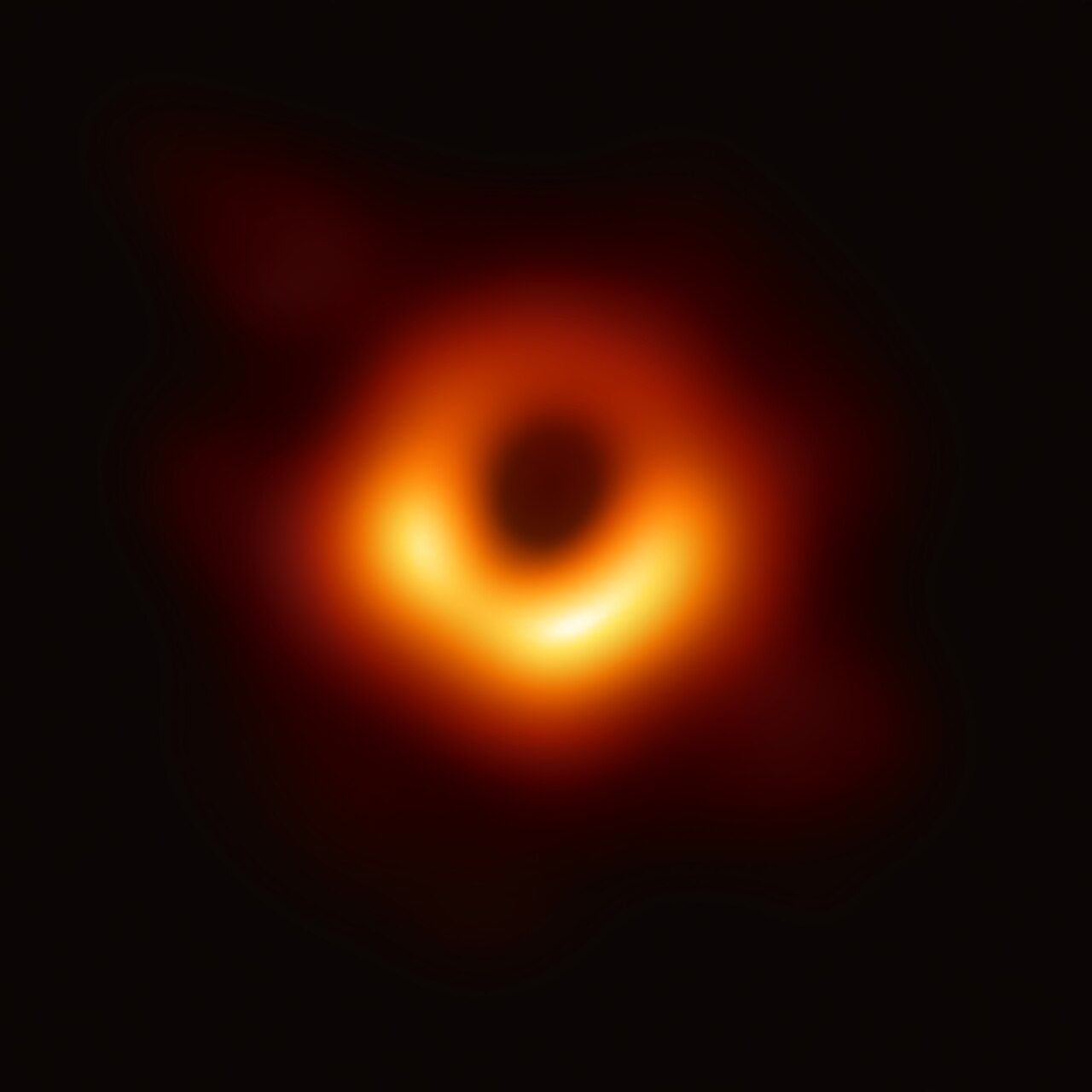
In 2019, the Event Horizon Telescope collaboration released the first image of a black hole’s shadow.
The target was the supermassive black hole at the center of the galaxy Messier 87, commonly called M87*. The image did not show the black hole itself glowing. Instead, it revealed a bright ring of emission from hot material around a dark central region associated with the black hole’s shadow.
The observation was possible because the Event Horizon Telescope is not a single conventional telescope. It is a global network of radio observatories working together as an Earth-sized virtual telescope.
The result gave the public an unprecedented visual representation of a prediction that had previously been accessible mainly through equations, simulations, and indirect observations.
Astronomers later produced an image of Sagittarius A*, the black hole at the center of the Milky Way, using the same general technique.
What is a black hole’s shadow?
A black hole’s shadow is not simply the event horizon photographed like the surface of a dark ball.
The intense gravity of a black hole bends light around it. Light from hot material near the black hole can therefore be redirected in ways that produce a bright ring surrounding a darker central region.
The exact appearance depends on the black hole’s mass, spin, the geometry of the surrounding material, and the viewing angle.
This makes the shadow useful scientifically. Its size and shape provide information about the black hole and the extreme gravitational environment surrounding it.
Do black holes rotate?
Yes.
Black holes can have angular momentum, meaning they can rotate.
A rotating black hole is described by the Kerr solution of general relativity. Its rotation changes the structure of the surrounding spacetime.
Near a rotating black hole is a region called the ergosphere, where spacetime itself is dragged around by the black hole’s rotation. This effect is known as frame dragging.
Rotation can also influence the behavior of matter and magnetic fields around the black hole and is relevant to the formation of powerful relativistic jets.
Astronomers can estimate black-hole spin through observations of the material and radiation around black holes, although measuring spin precisely can be difficult.
What is Hawking radiation?
Black holes are not necessarily completely eternal.
In the 1970s, physicist Stephen Hawking showed that when quantum effects are taken into account, black holes should emit a very faint form of thermal radiation, now called Hawking radiation.
This has a remarkable consequence: a black hole can gradually lose mass.
For large astrophysical black holes, the predicted radiation is extraordinarily weak. Their temperatures are far below those of their surroundings, so Hawking radiation is not something astronomers expect to observe directly from ordinary stellar-mass or supermassive black holes.
But the idea has enormous importance for theoretical physics because it connects gravity, quantum mechanics, thermodynamics, and information.
The black hole information problem
Hawking radiation leads to one of the deepest puzzles in modern physics.
Quantum mechanics suggests that information about a physical system should not simply disappear. Yet if matter falls into a black hole and the black hole eventually evaporates through Hawking radiation, what happens to the information contained in that matter?
This is known as the black hole information problem.
Physicists have proposed many possible solutions, involving ideas about quantum entanglement, horizons, spacetime, and the fundamental structure of gravity. There is still no universally accepted experimental answer.
The problem matters because solving it could reveal something profound about how gravity and quantum mechanics fit together.
How massive can a black hole become?
There is no single known maximum mass that applies to every possible black hole.
Stellar black holes can have masses of several to dozens of Suns. Supermassive black holes can reach millions or billions of solar masses. NASA lists TON 618 among the most massive observed black holes, with an estimated mass of about 66 billion Suns.
The growth of the most massive black holes is one of the major questions in astronomy.
A black hole can gain mass through accretion and mergers, but scientists are still working to understand how some enormous black holes became so massive when the universe was relatively young.
Could there be tiny black holes?
The equations of physics do not forbid black holes with very small masses.
Primordial black holes are one proposed possibility. They could have formed from density fluctuations in the early universe rather than from collapsing stars.
If very small primordial black holes exist, they could have quite different properties from the stellar and supermassive black holes astronomers normally study.
So far, however, primordial black holes remain hypothetical. Astronomers continue to search for possible evidence of them because their discovery would have major implications for cosmology and fundamental physics.
What happens when two black holes merge?
The process begins with two black holes orbiting each other.
As they move, the system emits gravitational waves. Energy carried away by those waves causes the orbit to shrink. The black holes move faster and closer together until they finally merge.
The newly formed black hole then settles into a stable state.
The merger can release an enormous amount of energy in gravitational waves. For a brief period, the gravitational-wave signal can reveal the properties of the black holes with remarkable precision.
Unlike a supernova, however, a black-hole merger does not necessarily produce a bright flash of ordinary light. Whether electromagnetic radiation accompanies a merger depends on the environment around the black holes.
Can a black hole destroy a star without swallowing it?
Yes.
A star does not have to cross the event horizon to be destroyed.
If it passes sufficiently close to a black hole, tidal forces can become strong enough to tear the star apart. The star’s material can be stretched into a long stream, with some of it potentially becoming bound to the black hole and forming an accretion disk.
These events, called tidal disruption events, allow astronomers to study black holes that might otherwise remain difficult to detect.
They are also a vivid reminder that the most important action around a black hole often happens outside its event horizon.
Black holes and quasars
Some of the brightest objects in the distant universe are powered by supermassive black holes.
When enormous amounts of gas fall toward a supermassive black hole, the resulting accretion disk can release tremendous energy. Such systems can become active galactic nuclei, with the most luminous examples appearing as quasars.
The light from quasars can travel across billions of light-years before reaching Earth.
That makes them useful not only for studying black holes but also for studying the distant universe itself. Their radiation can reveal information about gas between galaxies and conditions in the early cosmos.
Why are supermassive black holes found at galaxy centers?
Astronomers have strong evidence that supermassive black holes occupy the centers of most large galaxies.
The reason for this apparent connection is still being investigated.
Black holes can influence their surroundings through gravity, radiation, outflows, and jets. At the same time, the gas and stars in a galaxy provide material that can contribute to black-hole growth.
This creates a long-term relationship between a galaxy and the black hole at its center.
Scientists are still trying to determine exactly how that relationship developed and how much influence each has had on the other’s evolution.
Sagittarius A*: the black hole at the heart of the Milky Way
Our galaxy has its own supermassive black hole.
It is called Sagittarius A*, or Sgr A*, and has a mass of roughly four million Suns.
Sgr A* is much less active than the supermassive black holes powering bright quasars. Nevertheless, it provides an extraordinarily valuable laboratory for studying gravity.
Astronomers observe stars orbiting close to the galactic center and monitor radiation from hot gas near the black hole.
The region is difficult to study because it lies behind dense clouds of material from our perspective, but observations across infrared, radio, X-ray, and other wavelengths have gradually revealed its environment.
What would happen if the Sun became a black hole?
If the Sun could somehow be replaced by a black hole with exactly the same mass, Earth’s orbit would not suddenly collapse inward.
The gravitational field at Earth’s distance would be essentially unchanged because the mass would be unchanged. Earth would continue along nearly the same orbit.
But the situation would become catastrophically cold because there would no longer be sunlight to warm Earth.
This thought experiment illustrates an important point: being a black hole does not automatically make an object more gravitationally powerful than another object of the same mass. The extraordinary gravitational effects occur because black-hole mass can be packed into an extremely compact region.
Are black holes dangerous to Earth?
There is no evidence that a black hole is approaching the solar system.
More importantly, a black hole would not suddenly begin sucking in Earth from a great distance. Like every other massive object, it would exert gravity according to its mass and distance.
For a black hole to seriously disrupt Earth’s orbit, it would have to come sufficiently close.
The black holes astronomers routinely study are generally extremely far away, and the supermassive black hole at the center of the Milky Way is tens of thousands of light-years from Earth.
Why black holes matter to modern physics
Black holes occupy a unique place in science because they bring together some of the most successful—and most difficult—ideas in physics.
General relativity predicts their existence and describes how gravity behaves around them. Quantum mechanics becomes essential when scientists ask what happens at the smallest scales and what ultimately happens to black-hole information. Thermodynamics enters through black-hole temperature and entropy.
Observations now provide several independent ways to test these ideas: electromagnetic radiation from accretion disks, stellar orbits, gravitational lensing, black-hole shadows, tidal disruption events, and gravitational waves.
At the same time, the deepest questions remain open.
Scientists still do not know exactly what replaces the classical singularity, how the earliest supermassive black holes grew so quickly, whether intermediate-mass black holes are common, whether primordial black holes exist, or how information behaves in a fully quantum description of black holes.
Those unanswered questions are not gaps that make black-hole science uncertain. They are the frontier of a field in which theory and observation are increasingly able to meet at some of the most extreme environments the universe provides.