Few ideas in modern astronomy capture the imagination quite like the event horizon.
The phrase itself sounds mysterious, almost poetic. It evokes images of dark cosmic abysses, invisible boundaries, and journeys into places from which there is no return. It is a concept that sits at the edge of science and wonder, challenging our understanding of reality itself.
Imagine standing on the shore of a vast ocean at night. Beyond the horizon, the sea disappears into darkness. You know something exists beyond your view, but you cannot see it. Now imagine a horizon far stranger than any found on Earth—a boundary in space where gravity becomes so powerful that not even light can escape.
That boundary is known as an event horizon.
Event horizons are most famously associated with black holes, the enigmatic objects that have fascinated scientists and dreamers for generations. They represent a point beyond which information can no longer reach the outside universe. Cross this invisible line, and every possible path leads inward.
But what exactly is an event horizon? Why does it exist? What would happen if someone approached one? Can we actually observe it? And why has this concept become one of the most important ideas in modern physics?
The answers take us on a journey through gravity, space, time, relativity, and some of the deepest mysteries of the cosmos.
Understanding the Nature of Black Holes
To understand an event horizon, we first need to understand black holes.
A black hole is a region of space where gravity becomes extraordinarily strong. Its gravitational pull is so intense that nothing moving slower than light can escape once it gets too close.
Black holes form when massive stars exhaust their nuclear fuel and collapse under their own gravity. The star’s core becomes compressed into an incredibly small region, concentrating enormous amounts of mass into a tiny volume.
According to modern physics, gravity depends on mass. The more mass an object contains, the stronger its gravitational influence.
When enough mass becomes packed into a sufficiently small area, gravity can become so extreme that escape becomes impossible.
This is where the event horizon enters the story.
The Simple Definition of an Event Horizon
An event horizon is the boundary surrounding a black hole beyond which nothing can escape—not even light.
It marks the point where the escape velocity becomes equal to the speed of light.
Escape velocity is the speed required to break free from an object’s gravitational pull.
On Earth, rockets must reach a speed of about 11.2 kilometers per second to escape Earth’s gravity.
The Sun has a much higher escape velocity because it contains far more mass.
For a black hole, the escape velocity at the event horizon reaches the speed of light itself.
Since nothing can travel faster than light according to our current understanding of physics, anything crossing the event horizon becomes trapped forever.
This is why the event horizon is often called the “point of no return.”
Why Light Cannot Escape
One of the most remarkable features of an event horizon is that even light cannot escape.
At first, this might seem strange.
Light has no mass.
How can gravity affect something without mass?
The answer lies in Einstein’s understanding of gravity.
According to classical physics, gravity acts as a force pulling objects together.
However, Einstein’s theory of general relativity introduced a more profound picture.
Mass and energy bend space and time.
Objects move along paths determined by this curvature.
Light follows these curved paths as well.
Near a black hole, spacetime becomes so dramatically warped that every possible path leads inward once the event horizon is crossed.
Light is not being pulled back like a thrown ball.
Instead, the geometry of spacetime itself prevents escape.
The future points only inward.
The Birth of the Idea
The roots of the event horizon concept stretch back centuries.
In the eighteenth century, long before modern relativity, some scientists wondered whether gravity could become strong enough to trap light.
At the time, light was thought to consist of particles.
If gravity could pull on these particles, perhaps sufficiently massive objects could prevent them from escaping.
These early ideas were intriguing but incomplete.
The true breakthrough came in the early twentieth century with the work of Albert Einstein.
His theory of general relativity transformed our understanding of gravity.
Soon after Einstein published his equations, physicist Karl Schwarzschild discovered a mathematical solution describing how spacetime behaves around a spherical mass.
This solution revealed the existence of a critical boundary surrounding extremely compact objects.
Today, that boundary is recognized as the event horizon.
Why It Is Called an Event Horizon
The name “event horizon” comes from the way it separates events that can affect outside observers from those that cannot.
In physics, an event is simply something that happens at a particular place and time.
Suppose an astronaut sends a radio signal.
That signal is an event.
If the astronaut remains outside the event horizon, the signal can travel outward and eventually reach distant observers.
However, once the astronaut crosses the event horizon, any future signals become trapped.
The events occurring beyond the horizon can no longer influence the outside universe.
In this sense, the horizon forms a boundary between observable events and hidden ones.
An Invisible Boundary
One of the most surprising facts about an event horizon is that it is invisible.
Unlike a planet’s surface, it is not made of matter.
Unlike a wall, it offers no physical resistance.
There is no glowing line in space announcing its presence.
It is simply a mathematical boundary defined by gravity and spacetime geometry.
An astronaut approaching a sufficiently large black hole might not notice crossing it.
There would be no sudden impact.
No cosmic barrier.
No flashing warning sign.
The event horizon exists as a property of spacetime itself.
This makes it one of the strangest features in all of physics.
The Schwarzschild Radius
Every black hole possesses a characteristic size known as the Schwarzschild radius.
This radius defines the location of the event horizon for a non-rotating black hole.
The Schwarzschild radius depends entirely on mass.
A larger mass creates a larger event horizon.
For example, if Earth somehow became compressed into a sphere roughly the size of a marble, it would become a black hole.
Its event horizon would have a radius of only about nine millimeters.
The Sun would need to be compressed into a sphere approximately three kilometers in radius.
These examples illustrate how incredibly dense black holes are.
Their immense mass occupies remarkably small regions of space.
Falling Toward an Event Horizon
Imagine an astronaut drifting toward a black hole.
What would happen?
At first, the astronaut might notice little difference from approaching any massive object.
Gravity would gradually increase.
The black hole would appear larger in the sky.
However, as the astronaut gets closer, increasingly strange effects emerge.
Time itself begins behaving differently.
According to general relativity, strong gravity affects the flow of time.
Clocks closer to massive objects run more slowly relative to clocks farther away.
This phenomenon is known as gravitational time dilation.
Near an event horizon, time dilation becomes extreme.
To a distant observer, the astronaut appears to move more and more slowly.
The closer the astronaut gets to the horizon, the slower they seem to progress.
Eventually, they appear frozen near the edge.
The Strange Perspective of the Astronaut
While outside observers see the astronaut slowing down, the astronaut experiences something very different.
From their perspective, time flows normally.
Their heartbeat continues.
Their watch ticks as usual.
They cross the event horizon after a finite amount of personal time.
This creates one of relativity’s most fascinating effects.
Different observers can disagree dramatically about what occurs near a black hole.
Both perspectives are valid within their respective frames of reference.
Reality near an event horizon is far stranger than our everyday intuition suggests.
Why Distant Observers Never See the Crossing
A remarkable consequence of relativity is that distant observers never actually see an object cross the event horizon.
Instead, the object’s image becomes increasingly dim and redshifted.
Redshift occurs because light loses energy while escaping strong gravitational fields.
Its wavelength stretches toward the red end of the spectrum.
As the astronaut approaches the horizon, emitted light becomes progressively redder and weaker.
Eventually, the light fades beyond detectability.
The astronaut effectively disappears from view.
To outside observers, it seems as though the astronaut never quite reaches the horizon.
Yet from the astronaut’s perspective, the crossing occurs normally.
Inside the Event Horizon
What happens after crossing the event horizon?
This question remains one of the most intriguing in science.
General relativity predicts that once inside the horizon, every possible future path leads toward the black hole’s center.
Escaping becomes impossible.
Moving outward becomes as impossible as moving backward in time.
The astronaut inevitably approaches a region called the singularity.
A singularity represents a point where current physical theories break down.
Density, curvature, and gravitational effects become mathematically infinite.
Most physicists suspect that a more complete theory combining gravity and quantum mechanics will eventually replace this picture.
For now, the true nature of what lies deep inside a black hole remains unknown.
Event Horizons and Rotating Black Holes
Not all black holes are simple.
Most real black holes rotate.
A rotating black hole possesses a more complicated structure than a non-rotating one.
Its event horizon remains present, but additional regions appear nearby.
One particularly fascinating region is the ergosphere.
Within the ergosphere, spacetime itself becomes dragged around by the black hole’s rotation.
This phenomenon, known as frame dragging, causes space and time to swirl like water around a whirlpool.
Objects inside the ergosphere cannot remain stationary relative to distant stars.
They are forced to move along with spacetime’s rotation.
These effects create some of the most extreme environments in the universe.
Supermassive Black Holes and Their Event Horizons
The largest event horizons belong to supermassive black holes.
These enormous objects reside at the centers of many galaxies, including the Milky Way.
The Milky Way’s central black hole is known as Sagittarius A*.
It contains roughly four million times the mass of the Sun.
Some supermassive black holes are far larger, reaching billions of solar masses.
Their event horizons can span distances greater than entire planetary systems.
Ironically, crossing the horizon of a supermassive black hole may be less immediately dangerous than crossing that of a smaller one.
The gravitational gradient near the horizon is often gentler because the horizon lies farther from the singularity.
The Concept of Spaghettification
One of the most famous black hole phenomena is spaghettification.
This dramatic term refers to the stretching effect caused by tidal forces.
Gravity weakens with distance.
Therefore, the side of an object closer to a black hole experiences stronger gravity than the far side.
If this difference becomes large enough, the object stretches.
For a human falling into a small black hole, the feet would experience stronger gravity than the head.
The resulting tidal forces could pull the body into a long, thin shape resembling spaghetti.
Near certain supermassive black holes, however, this process may not occur until well after crossing the event horizon.
Can We See an Event Horizon?
Since light cannot escape from beyond the event horizon, observing one directly is impossible.
However, astronomers can observe its effects.
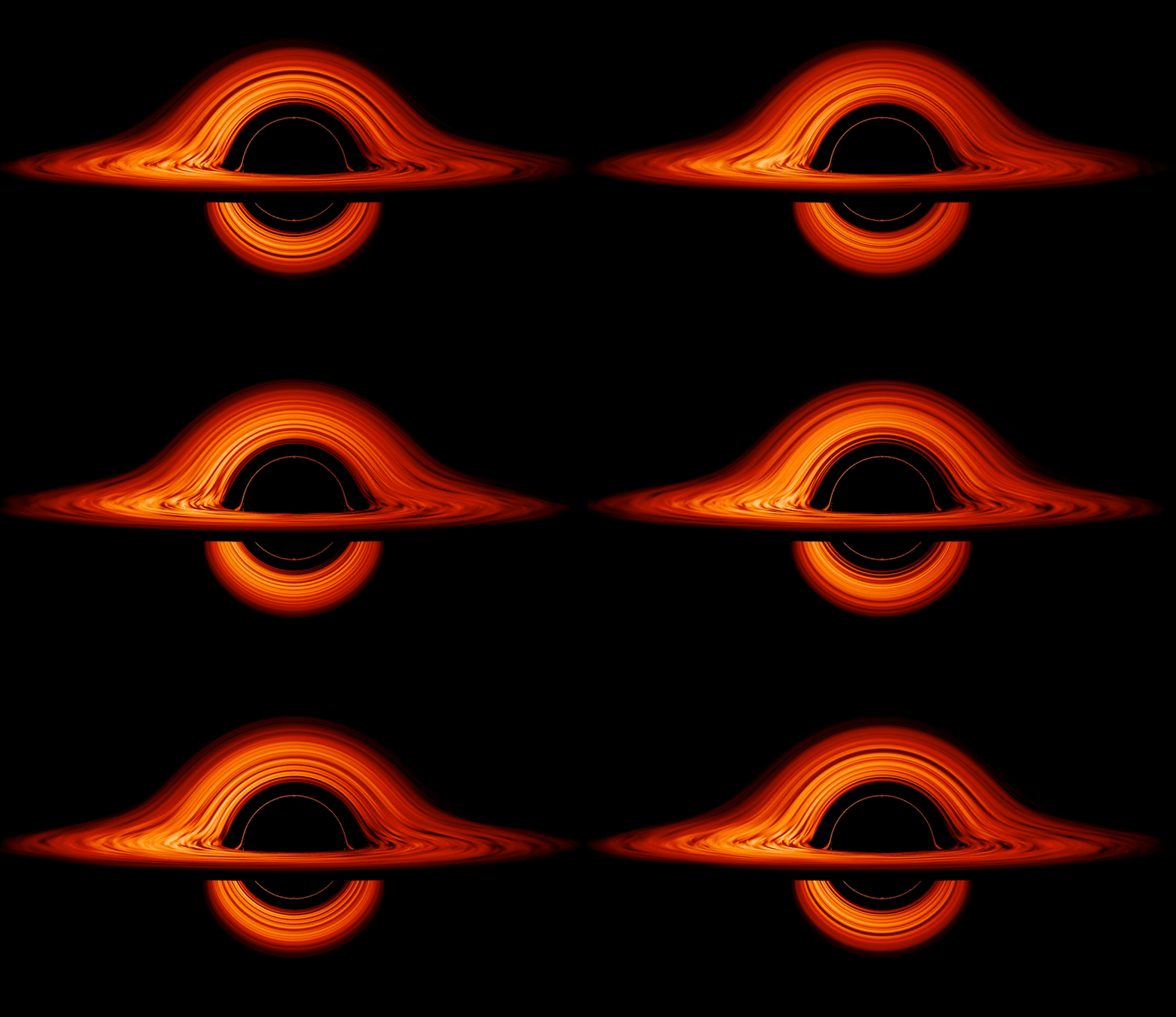
Matter falling toward a black hole often forms an accretion disk—a swirling structure of hot gas and dust.
As material spirals inward, it heats to extraordinary temperatures and emits intense radiation.
The event horizon creates a dark shadow against this glowing background.
In 2019, humanity achieved a historic milestone.
The Event Horizon Telescope Collaboration released the first image of a black hole’s shadow.
The image showed the supermassive black hole in the galaxy Messier 87.
Although it was not a direct photograph of the event horizon itself, it provided compelling evidence for its existence.
The Event Horizon Telescope
Capturing an image of a black hole required an extraordinary scientific effort.
No single telescope on Earth possesses sufficient resolution.
Scientists therefore linked radio observatories around the globe into a virtual Earth-sized instrument.
This network became known as the Event Horizon Telescope.
By combining data from multiple locations, researchers achieved unprecedented observational power.
The resulting image represented one of the greatest achievements in modern astronomy.
For the first time, humanity glimpsed the shadow cast by an event horizon.
A concept once confined to equations became something we could actually observe.
Hawking Radiation and the Event Horizon
In the 1970s, physicist Stephen Hawking introduced a revolutionary idea.
According to quantum theory, event horizons may not be completely black.
Quantum fluctuations near the horizon can produce a faint form of radiation now known as Hawking radiation.
Over incredibly long timescales, this radiation could cause black holes to lose mass.
Eventually, a black hole might evaporate entirely.
This discovery connected quantum mechanics, thermodynamics, and gravity in a profound way.
It also raised deep questions about information and the nature of reality.
The Information Paradox
One of the greatest unsolved problems involving event horizons is the black hole information paradox.
Quantum mechanics suggests that information cannot truly be destroyed.
Yet objects falling into a black hole appear to disappear permanently.
If the black hole later evaporates through Hawking radiation, what happens to the information it contained?
Does it vanish?
Is it somehow preserved?
Does it emerge encoded within the radiation?
Physicists have debated these questions for decades.
The paradox remains one of the most important clues pointing toward a future theory of quantum gravity.
Event Horizons Beyond Black Holes
Although event horizons are most famous in connection with black holes, similar concepts appear elsewhere in physics.
The expanding universe itself possesses horizons.
Certain regions of space are so distant that light emitted today may never reach us because cosmic expansion continually increases the distance.
In a sense, these regions lie beyond a cosmological horizon.
Some theoretical models even suggest analog event horizons can be created in laboratory systems.
These analogs allow scientists to study horizon-like behavior under controlled conditions.
Such experiments may help uncover new insights into the nature of gravity and spacetime.
Event Horizons in Popular Culture
Few scientific ideas have captured public imagination as powerfully as the event horizon.
They appear frequently in novels, films, television series, and video games.
Writers often portray them as gateways to other dimensions, portals through time, or entrances to unknown realms.
While these portrayals are usually fictional, they reflect the genuine mystery surrounding black holes.
Event horizons symbolize the ultimate boundary of knowledge.
They represent places where familiar rules seem to break down.
The blend of scientific reality and cosmic mystery makes them irresistible to storytellers.
Why Event Horizons Matter
Event horizons are far more than curious astronomical features.
They occupy a central position in modern physics.
They test our understanding of gravity.
They challenge our ideas about time.
They force us to confront the relationship between quantum mechanics and relativity.
They raise profound questions about information, causality, and the structure of reality itself.
Many of the greatest unsolved mysteries in science converge at the edge of an event horizon.
Understanding these boundaries may ultimately lead to a deeper understanding of the universe.
The Emotional Power of the Point of No Return
There is something deeply human about the idea of an event horizon.
It represents a threshold.
A boundary between the known and the unknown.
A line beyond which familiar experience can no longer guide us.
Throughout history, humanity has been fascinated by horizons.
Ancient sailors wondered what lay beyond distant seas.
Explorers crossed mountains and deserts seeking unseen worlds.
Astronomers turned their eyes toward the stars.
The event horizon is perhaps the ultimate horizon.
It marks the edge of what can be observed, communicated, and understood.
Even our best theories struggle to describe what lies beyond.
In that sense, event horizons are not merely astronomical objects.
They are symbols of the limits of knowledge and the endless human desire to push beyond those limits.
Conclusion
An event horizon is the invisible boundary surrounding a black hole where gravity becomes so powerful that nothing—not even light—can escape. It marks the ultimate point of no return, separating events that can influence the outside universe from those forever hidden within. Predicted by Einstein’s theory of general relativity, event horizons reveal the extraordinary ways gravity can warp space and time.
Far from being simple boundaries, event horizons lie at the heart of some of the deepest mysteries in physics. They challenge our understanding of time, information, quantum mechanics, and the nature of reality itself. Observations such as those made by the Event Horizon Telescope have transformed them from theoretical concepts into observable features of the cosmos.
As science continues to explore black holes and the strange realms surrounding them, event horizons remain among the most fascinating frontiers in the universe. They stand as reminders that even in an age of remarkable discovery, there are still places where mystery begins, where certainty ends, and where the cosmos invites us to keep asking questions.