On a clear night, far from city lights, the sky can reveal some of nature’s most breathtaking wonders. Among them are comets—glowing celestial visitors that seem to appear out of nowhere, stretch luminous tails across the heavens, and then vanish for years, decades, or even millennia. For thousands of years, people looked upon comets with awe, fear, and fascination. Ancient civilizations often saw them as omens from the gods, signs of disaster, or messages from the heavens.
Today, science has revealed that comets are not supernatural messengers. They are real objects traveling through our solar system, carrying clues about the earliest days of planetary formation. Yet knowing what they are has not made them any less fascinating. In fact, understanding the science behind comets makes them even more remarkable.
Often called “dirty snowballs,” comets are frozen leftovers from the birth of the solar system. They are cosmic time capsules that have preserved ancient material for billions of years. When one of these icy objects journeys toward the Sun, it transforms dramatically, developing a glowing atmosphere and magnificent tails that can stretch millions of kilometers through space.
The sight of a bright comet reminds us that the solar system is not a static place. It is a dynamic and evolving environment filled with moving worlds, ancient debris, and spectacular celestial events. Every comet carries a story that began long before Earth was fully formed.
What Exactly Is a Comet?
A comet is a small celestial body made primarily of ice, dust, rock, and frozen gases. Unlike planets and large moons, comets are relatively tiny. Most comet nuclei are only a few kilometers across, although some are significantly larger.
The term “dirty snowball” became popular because comets consist of frozen substances mixed with rocky material and dust. However, modern scientists sometimes describe them as “icy dirtballs” because many comets contain more dust and rock than ice.
The ice found in comets is not just frozen water. It can also include frozen carbon dioxide, methane, ammonia, and carbon monoxide. These materials remain frozen in the extremely cold outer reaches of the solar system.
For most of their existence, comets are dark, frozen, and relatively inactive. They spend much of their time far from the Sun, where temperatures are so low that their icy materials remain stable.
Everything changes when they begin moving inward.
As a comet approaches the Sun, sunlight and heat cause its frozen materials to vaporize. This process transforms the comet into one of the most spectacular objects in the sky.
The Ancient Origins of Comets
Comets are among the oldest objects in the solar system.
Scientists believe they formed approximately 4.6 billion years ago during the birth of the solar system. At that time, a giant cloud of gas and dust collapsed under gravity, eventually forming the Sun and planets.
Not all of the original material became part of planets.
Some leftover debris remained in the outer regions of the solar system. Over time, this material formed countless icy bodies that would later become comets.
Because many comets have spent billions of years in deep freeze, they preserve material from the earliest stages of solar system history.
In a sense, comets are cosmic fossils.
They contain clues about the conditions that existed before Earth was fully developed. Studying them allows scientists to look back in time and investigate the ingredients that helped build the planets.
Few objects offer such a direct connection to the solar system’s distant past.
Where Do Comets Come From?
Most comets originate from two major regions of the solar system.
The first is the Kuiper Belt, a vast area beyond the orbit of Neptune. This region contains countless icy objects, including dwarf planets and short-period comets.
Short-period comets typically orbit the Sun in less than 200 years. They return regularly and can be observed multiple times throughout human history.
The second source is the Oort Cloud.
The Oort Cloud is believed to be an enormous spherical shell of icy bodies surrounding the solar system at immense distances. Although astronomers have not directly observed it, strong evidence suggests it exists.
Comets arriving from the Oort Cloud often have extremely long orbital periods. Some take thousands or even millions of years to complete a single trip around the Sun.
When one of these distant objects enters the inner solar system, it may be the first time human beings have ever seen it.
The Structure of a Comet
At first glance, a comet appears simple. In reality, it consists of several distinct parts.
The central solid portion is called the nucleus.
The nucleus is the actual comet itself. It contains the ice, dust, and rocky material that make up the object. Surprisingly, comet nuclei are often very dark. Many reflect less sunlight than asphalt.
As the comet approaches the Sun, a cloud of gas and dust forms around the nucleus. This cloud is known as the coma.
The coma can become enormous, sometimes growing larger than planets. Despite its size, it is incredibly thin and diffuse.
Eventually, the interaction between solar radiation and comet material creates the comet’s famous tails.
These tails are what make comets so visually stunning.
Why Comets Develop Tails
One of the most common misconceptions about comets is that they always possess tails.
In reality, a comet only develops a prominent tail when it gets close enough to the Sun.
As solar heat warms the nucleus, frozen materials begin turning directly into gas through a process called sublimation.
Jets of gas and dust erupt from the surface.
These materials stream away from the nucleus and become illuminated by sunlight.
At the same time, solar radiation and charged particles flowing from the Sun push material away from the comet.
The result is the formation of spectacular tails.
These tails can stretch for millions of kilometers across space, creating some of the most impressive sights in astronomy.
The Two Main Types of Comet Tails
Many comets possess more than one tail.
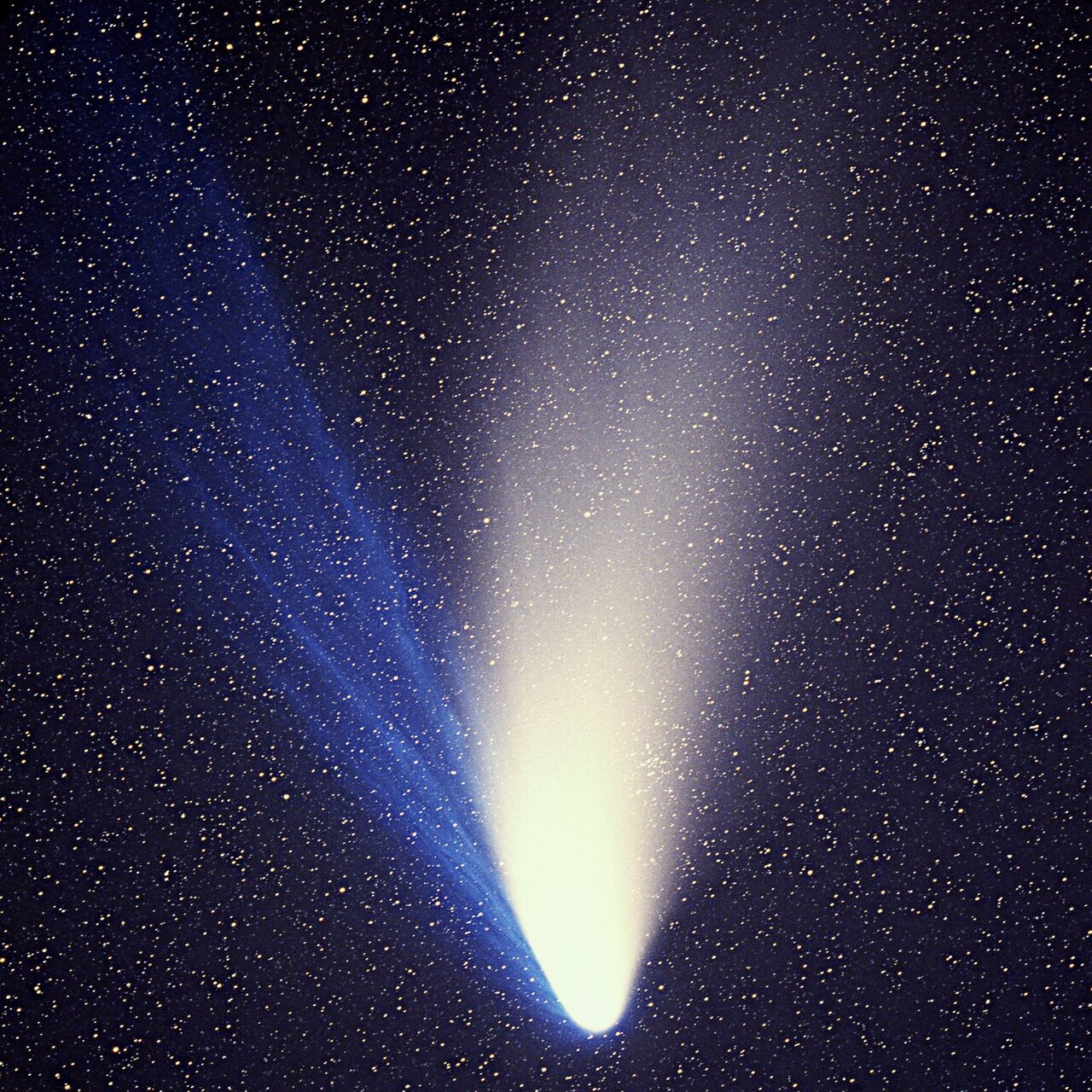
The dust tail consists of tiny solid particles released from the comet. Sunlight reflects off this dust, making the tail visible.
Dust tails often appear white or yellowish and usually curve gently as the comet moves through space.
The ion tail forms differently.
Solar ultraviolet radiation strips electrons from gas molecules escaping the comet. This process creates electrically charged particles called ions.
The solar wind then sweeps these ions directly away from the Sun.
As a result, ion tails often appear bluish and tend to point straight away from the Sun regardless of the comet’s direction of travel.
The presence of multiple tails can make comets especially dramatic and beautiful.
Why the Tail Always Points Away from the Sun
Many people assume a comet’s tail trails behind it like the exhaust from a moving airplane.
The reality is more interesting.
A comet’s tail is shaped primarily by solar radiation and the solar wind.
These forces push material away from the Sun.
Because of this, the tail always points generally away from the Sun rather than behind the comet.
Sometimes a comet can even appear to move toward its own tail.
This seemingly strange behavior is entirely normal and reflects the influence of solar forces.
Understanding this phenomenon transformed astronomers’ understanding of comet behavior.
The Brilliant Glow of a Comet
The glow of a comet comes from multiple sources.
Dust particles reflect sunlight.
Gas molecules absorb solar energy and re-emit it as light.
Different gases can produce different colors.
Carbon compounds may create greenish hues.
Ionized gases often contribute blue colors.
Dust reflections usually produce white or yellow tones.
The combination of these effects creates the stunning appearance that has captivated skywatchers throughout history.
What appears from Earth as a magical celestial object is actually a complex interaction between sunlight, gas, dust, and magnetic fields.
Ancient People’s Fear of Comets
For most of human history, comets were unpredictable.
People had no understanding of their origins or behavior.
A bright comet could suddenly appear in the sky without warning and remain visible for weeks.
This unpredictability made comets seem mysterious and frightening.
Many ancient cultures interpreted them as signs of impending disaster.
Comets were blamed for wars, plagues, famines, earthquakes, and the deaths of rulers.
Historical records from around the world describe comets as heavenly warnings.
In reality, these interpretations reflected human psychology rather than astronomical facts.
People naturally seek meaning in unusual events.
When something extraordinary appeared in the sky, it was easy to associate it with significant events on Earth.
The Turning Point in Understanding Comets
Scientific understanding of comets improved dramatically during the Renaissance and beyond.
Astronomers began carefully observing and recording their movements.
One important breakthrough came from Edmond Halley.
Halley studied historical observations of several comets and noticed similarities among them.
He concluded that certain sightings actually involved the same comet returning repeatedly.
Using the laws developed by Isaac Newton, Halley predicted that the comet would return in 1758.
Although he died before its reappearance, the prediction proved correct.
The returning object became known as Halley’s Comet.
This achievement demonstrated that comets follow predictable orbits and obey the same physical laws as planets.
The age of superstition began giving way to scientific understanding.
Halley’s Comet: Humanity’s Most Famous Visitor
No comet is more famous than Halley’s Comet.
Its average orbital period is about seventy-six years.
Because it returns within a human lifetime, generations have been able to observe it repeatedly.
Historical records indicate that Halley’s Comet has been observed for more than two thousand years.
It appeared in the sky during the Middle Ages, the Renaissance, and the modern era.
Millions witnessed its most recent visit in 1986.
Its next return is expected in 2061.
For many people alive today, that future appearance may become one of the most anticipated astronomical events of their lives.
Halley’s Comet serves as a reminder that some celestial events connect generations across centuries.
Comets and the Formation of Earth
Comets may have played a significant role in Earth’s history.
Scientists believe that during the early solar system, impacts from comets and asteroids were common.
Some researchers suggest that comets delivered substantial amounts of water to the young Earth.
Others propose that comets may have transported organic molecules that contributed to the development of life.
Although the exact extent of their contribution remains debated, there is little doubt that comet impacts influenced planetary evolution.
The ingredients locked within comets offer valuable clues about the chemistry present during Earth’s formation.
Studying these ancient objects helps scientists investigate one of humanity’s greatest questions: how life began.
When Comets Collide with Planets
Most comets spend their lives harmlessly orbiting the Sun.
Occasionally, however, collisions occur.
One of the most dramatic examples happened in 1994.
Fragments of Comet Shoemaker–Levy 9 slammed into Jupiter.
Astronomers watched as enormous explosions erupted in Jupiter’s atmosphere.
The impacts left scars larger than Earth itself.
The event provided a powerful reminder that cosmic collisions remain part of the solar system’s ongoing story.
Observing the collision helped scientists better understand planetary impacts and their consequences.
The Difference Between Comets and Asteroids
Comets and asteroids are often confused.
Both are relatively small objects orbiting the Sun.
However, their compositions differ significantly.
Asteroids are primarily rocky or metallic.
Comets contain large amounts of ice and frozen gases.
When asteroids approach the Sun, they generally remain unchanged.
When comets approach the Sun, their ice begins vaporizing, producing comas and tails.
This distinction gives comets their dramatic appearance.
In many ways, asteroids are rocky remnants of planetary formation, while comets are frozen relics from the outer solar system.
Spacecraft Visits to Comets
For centuries, astronomers could only observe comets from a distance.
Modern space exploration changed that.
Several missions have traveled directly to comets, providing unprecedented insights.
One of the most remarkable was the Rosetta mission.
Rosetta orbited Comet 67P/Churyumov–Gerasimenko and even deployed a lander onto its surface.
The mission revealed extraordinary details about comet structure, chemistry, and activity.
Scientists observed cliffs, dust jets, pits, and surprisingly complex organic molecules.
The findings transformed our understanding of these ancient objects.
For the first time, humanity was able to study a comet up close for an extended period.
How Long Do Comets Live?
Comets are not permanent.
Every trip near the Sun causes them to lose material.
Ice evaporates.
Dust escapes into space.
Over time, repeated solar encounters gradually erode the nucleus.
Eventually, some comets become inactive.
Others break apart.
Some may completely disintegrate.
The spectacular displays we admire come at a cost.
Each glowing tail represents material permanently lost from the comet.
In a sense, every bright appearance marks another step in the comet’s slow transformation.
Meteor Showers and Comets
Comets create more than beautiful tails.
They also produce meteor showers.
As a comet travels through space, it leaves trails of dust along its orbit.
When Earth passes through one of these dust streams, tiny particles enter our atmosphere.
Friction with the atmosphere heats the particles, causing them to glow.
The result is a meteor shower.
Some of the most famous annual meteor showers originate from comet debris.
Every shooting star seen during these events represents a tiny fragment of a comet burning high above Earth.
This connection means comets continue influencing our skies even when the comet itself is far away.
The Largest Comets Ever Discovered
Not all comets are small.
Some are truly enormous.
Astronomers have discovered giant comets with nuclei measuring more than a hundred kilometers across.
One remarkable example is Comet Bernardinelli–Bernstein.
Its nucleus is estimated to be vastly larger than that of most known comets.
Discoveries like this remind us that the solar system still contains surprises.
Even in the twenty-first century, astronomers continue finding previously unknown objects of extraordinary scale.
What Comets Teach Us About the Solar System
Comets are more than beautiful sky spectacles.
They are scientific treasures.
Because they preserve ancient material, they provide direct evidence about conditions that existed billions of years ago.
Every comet studied by scientists helps answer important questions.
How did planets form?
What chemicals existed in the early solar system?
How was water distributed?
What ingredients were available before life emerged?
These questions connect comet research to some of the deepest mysteries in science.
Each new observation contributes another piece to the puzzle.
Why People Still Love Comets
Despite all our scientific knowledge, comets retain their emotional power.
A bright comet remains an unforgettable sight.
Its appearance feels special because it is temporary.
Unlike stars that shine every night, a comet may appear only once in a lifetime.
People gather to watch them.
Photographers stay awake all night hoping for the perfect image.
Children look upward in wonder.
Adults feel connected to generations that witnessed the same object centuries earlier.
Comets remind us that we live within a vast and dynamic universe.
They create moments of awe that transcend culture, language, and history.
The Future of Comet Research
The coming decades promise exciting advances.
More powerful telescopes are discovering new comets at unprecedented rates.
Improved spacecraft technology may allow future missions to collect samples and return them to Earth.
Scientists continue studying comet chemistry, structure, and evolution.
New discoveries may reveal additional clues about the origin of water, the formation of planets, and the emergence of life.
Every comet entering the inner solar system provides a new opportunity for exploration.
The story of comet research is far from complete.
In many ways, it is only beginning.
Conclusion
Comets are among the most captivating objects in the solar system. Often called “dirty snowballs,” they are ancient mixtures of ice, dust, and rock that have survived since the birth of the solar system more than 4.6 billion years ago. Most spend their lives in the distant cold regions beyond the planets, but when they journey toward the Sun, they undergo a spectacular transformation.
Solar heat causes their frozen materials to vaporize, creating glowing comas and magnificent tails that can stretch across millions of kilometers. These dazzling displays have inspired wonder, fear, myths, and scientific curiosity throughout human history.
Yet comets are far more than beautiful celestial visitors. They are time capsules preserving clues about the earliest stages of planetary formation. They may have contributed water and organic molecules to the young Earth. They help scientists understand the origins of the solar system and perhaps even the beginnings of life itself.
Every bright comet that appears in the night sky carries a message from deep time. It is a traveler from the dawn of the solar system, arriving after billions of years to put on a fleeting but unforgettable performance. For a brief moment, it reminds us that the universe is alive with movement, history, and wonder—and that some of its oldest secrets are still shining above our heads.