The universe is full of categories that seem clear and straightforward. There are stars, which shine brightly through nuclear fusion. There are planets, which orbit stars and do not produce their own light. For a long time, astronomers believed these categories neatly described most objects in space.
Then they discovered something strange.
Scattered throughout our galaxy are objects that are too massive to be planets but not massive enough to become true stars. They glow faintly in the darkness, radiating heat and light, yet they never achieve the stellar brilliance of the Sun. They form like stars, but they behave in some ways like giant planets. They exist in a fascinating middle ground that challenges simple definitions.
These mysterious objects are called brown dwarfs.
Often nicknamed “failed stars,” brown dwarfs occupy one of the most intriguing positions in astronomy. They represent a bridge between planets and stars, helping scientists understand how celestial objects form, evolve, and populate the cosmos. Despite being difficult to detect, brown dwarfs may be among the most common objects in the Milky Way.
Their story is not one of failure in the ordinary sense. Instead, it is a story about cosmic possibilities, about what happens when nature almost creates a star but stops just short of crossing the finish line.
Understanding brown dwarfs takes us into the heart of star formation, the physics of extreme environments, and the ongoing search to understand our place in the universe.
The Basic Definition of a Brown Dwarf
A brown dwarf is an astronomical object that is more massive than a planet but less massive than a true star.
The key difference between a brown dwarf and a star lies in nuclear fusion.
Stars shine because their cores are hot and dense enough to fuse hydrogen atoms into helium. This process releases enormous amounts of energy, causing stars to emit light and heat for billions of years.
Brown dwarfs never reach the conditions necessary for sustained hydrogen fusion.
They are born from collapsing clouds of gas and dust, just like stars. During their formation, gravity compresses their interiors and generates heat. For a brief period, they can glow relatively brightly. However, because they lack sufficient mass, their cores never become hot enough to sustain the hydrogen fusion that powers ordinary stars.
As a result, brown dwarfs gradually cool and fade over time.
They begin life warm and luminous but slowly lose their heat, becoming dimmer as billions of years pass.
Why They Are Called “Failed Stars”
The nickname “failed star” sounds dramatic, but it can be misleading.
Brown dwarfs are not stars that somehow malfunctioned. They are not broken stars. They simply formed with too little mass to ignite sustained hydrogen fusion.
To understand this, imagine building a campfire.
A small pile of wood might produce smoke and a few glowing embers, but it may never become a roaring fire. A larger pile, under the right conditions, can burst into flames and burn for hours.
Similarly, a cloud of gas must contain enough mass for gravity to compress its core to extraordinary temperatures and pressures. If the cloud is massive enough, hydrogen fusion begins and a star is born.
If it falls short, a brown dwarf emerges instead.
From nature’s perspective, a brown dwarf is not a failed version of a star. It is simply a different outcome.
In many ways, brown dwarfs are unique cosmic objects with their own fascinating characteristics.
The Discovery of a Predicted World
The idea of brown dwarfs existed long before astronomers actually found one.
During the 1960s, scientists realized that there should be objects occupying the gap between planets and stars. Theoretical calculations suggested that nature ought to produce bodies too small for sustained hydrogen fusion yet much larger than planets.
The challenge was finding them.
Brown dwarfs are incredibly faint compared to ordinary stars.
Young brown dwarfs emit some visible light because they are still relatively hot. As they age, however, they cool dramatically and become difficult to detect with traditional telescopes.
For decades, astronomers searched without success.
Finally, in the 1990s, advances in infrared astronomy made detection possible. Brown dwarfs emit much of their energy in infrared wavelengths rather than visible light.
The discovery of confirmed brown dwarfs marked a major milestone in astronomy.
An entire category of celestial objects had moved from theory into reality.
The Mass Boundary Between Stars and Brown Dwarfs
One of the most important characteristics of a brown dwarf is its mass.
Astronomers often measure the masses of brown dwarfs relative to Jupiter, the largest planet in our Solar System.
A brown dwarf typically contains between about 13 and 80 times Jupiter’s mass.
Objects above roughly 80 Jupiter masses generally become true stars because their cores can sustain hydrogen fusion.
Objects below about 13 Jupiter masses are generally considered planets because they cannot even fuse deuterium, a heavier form of hydrogen.
Brown dwarfs occupy the region between these limits.
This range is significant because it reflects important physical processes occurring inside these objects.
Mass determines temperature, pressure, and the ability to sustain nuclear reactions.
In the universe, mass often determines destiny.
The Curious Role of Deuterium Fusion
Although brown dwarfs cannot sustain ordinary hydrogen fusion, some can briefly fuse deuterium.
Deuterium is a rare isotope of hydrogen containing an additional neutron.
It requires lower temperatures to fuse than ordinary hydrogen.
Many brown dwarfs exceed the threshold necessary for deuterium fusion during their early lives.
This process provides a temporary source of energy and helps distinguish brown dwarfs from giant planets.
However, deuterium is relatively scarce.
Once the available supply is exhausted, fusion stops.
The brown dwarf then begins a long cooling process that can continue for billions of years.
This brief period of fusion makes brown dwarfs even more intriguing because they occupy a unique middle ground between stars and planets.
How Brown Dwarfs Form
Brown dwarfs form in much the same way as stars.
The process begins inside giant molecular clouds, enormous regions filled with gas and dust.
Gravity causes parts of these clouds to collapse inward.
As material falls toward the center, temperatures and pressures rise.
In a typical stellar birth, enough material accumulates to ignite hydrogen fusion.
In the case of a brown dwarf, the collapsing cloud contains insufficient mass.
The object still forms through gravitational collapse, but fusion never becomes self-sustaining.
This similarity in origin is one reason astronomers consider brown dwarfs more closely related to stars than to planets.
Planets usually form within disks surrounding young stars.
Brown dwarfs generally form independently through direct collapse.
Their birth process tells us that nature creates celestial objects across a broad spectrum rather than fitting everything into neat categories.
The Colors of Brown Dwarfs
The name “brown dwarf” creates an interesting misconception.
Most brown dwarfs are not actually brown.
In fact, if a person could somehow see one up close, its appearance might be reddish, magenta, deep orange, or even nearly black depending on its temperature and atmospheric conditions.
The term originated because astronomers needed a name for these intermediate objects.
No perfect color description existed.
Brown was chosen somewhat arbitrarily and eventually became standard terminology.
Today, the name remains despite its imperfect accuracy.
Like many scientific terms, it survives because it is familiar rather than because it is literally correct.
Why Brown Dwarfs Are So Difficult to Detect
Finding brown dwarfs is extraordinarily challenging.
Unlike stars, they do not shine brightly through continuous nuclear fusion.
Unlike planets, many are not illuminated by nearby stars.
As they age, they become cooler and dimmer.
This means they can hide in the darkness of interstellar space, emitting only faint infrared radiation.
For many years, telescopes lacked the sensitivity needed to detect them reliably.
Infrared observatories changed everything.
Modern instruments can identify the subtle heat signatures emitted by brown dwarfs.
Space telescopes have been especially valuable because Earth’s atmosphere absorbs portions of infrared radiation.
Even with advanced technology, astronomers believe countless brown dwarfs remain undiscovered.
Many may be drifting through the galaxy almost unnoticed.
The Atmospheres of Brown Dwarfs
One of the most fascinating aspects of brown dwarfs is their atmosphere.
These atmospheres are unlike anything found on Earth.
Temperatures can range from hotter than molten lava to cooler than some planets.
Depending on conditions, clouds may form from exotic materials.
Instead of water droplets, some brown dwarfs have clouds composed of silicate particles, molten iron, or other unusual substances.
Imagine iron rain falling through an alien sky.
Imagine clouds made of minerals rather than water vapor.
Such phenomena are possible on certain brown dwarfs.
Their atmospheres provide natural laboratories for studying weather under conditions impossible to recreate on Earth.
Weather on Failed Stars
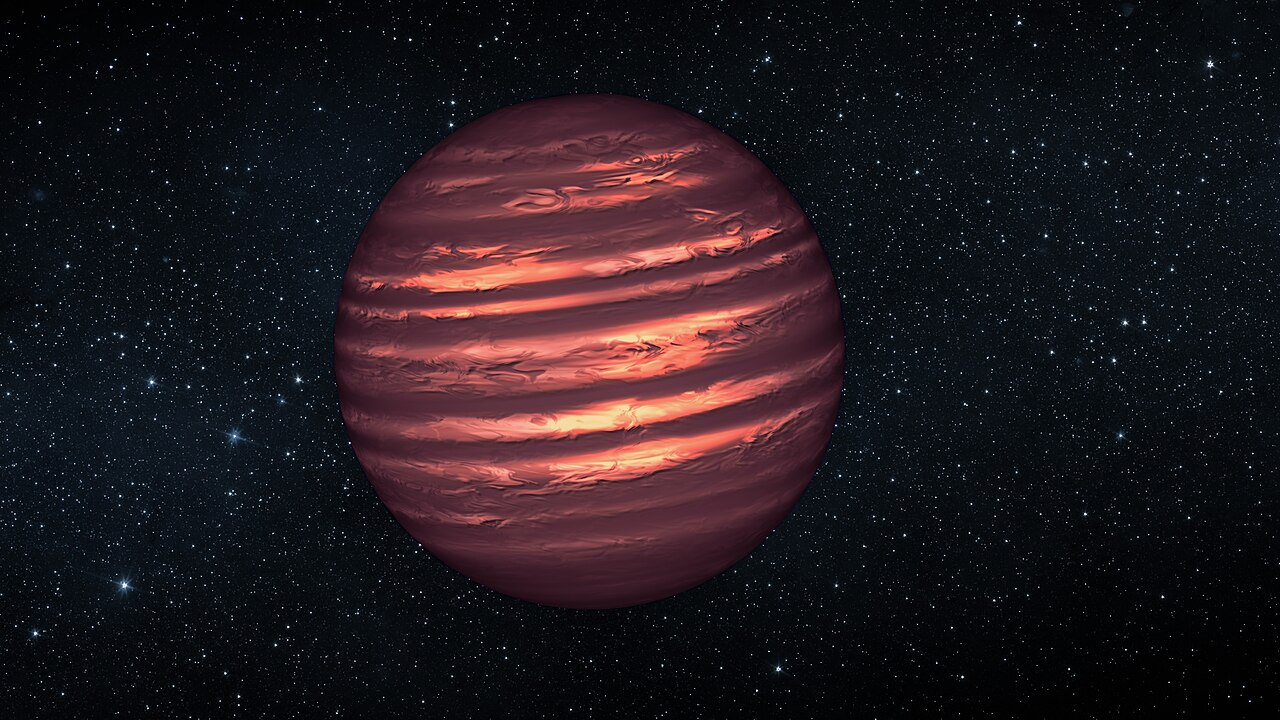
Brown dwarfs experience weather patterns.
This may seem surprising because many people associate weather only with planets.
Yet atmospheric circulation occurs wherever gases move and temperatures vary.
Observations reveal evidence of storms, cloud bands, and changing atmospheric conditions on brown dwarfs.
Some display brightness variations as they rotate, suggesting patchy cloud cover.
Others show signs of powerful atmospheric dynamics.
The weather on a brown dwarf can be far more extreme than anything experienced on Earth.
Studying these atmospheric systems helps astronomers better understand both brown dwarfs and giant exoplanets.
Brown Dwarfs and Giant Planets
Brown dwarfs often resemble giant planets such as Jupiter.
Both may possess thick atmospheres, cloud layers, and similar chemical compositions.
Both emit infrared radiation.
Both can have complex weather systems.
This similarity sometimes makes classification difficult.
The distinction often depends on mass and formation history.
A giant planet generally forms within a protoplanetary disk surrounding a star.
A brown dwarf usually forms directly from the collapse of a gas cloud.
Yet nature does not always provide clear boundaries.
Some objects blur the line between categories.
These gray areas remind scientists that the universe is often more complex than our definitions.
The Smallest Stars and the Largest Brown Dwarfs
Near the boundary separating stars and brown dwarfs lies one of astronomy’s most interesting transition zones.
Objects just above the threshold sustain hydrogen fusion and become red dwarf stars.
Objects just below the threshold remain brown dwarfs.
At first glance, these objects can appear remarkably similar.
They may have comparable sizes and temperatures.
The difference lies deep inside their cores.
A slight increase in mass can mean the difference between billions of years of stellar fusion and a gradual cooling journey through cosmic time.
This sensitivity highlights how important mass is in determining the fate of celestial objects.
The Strange Size of Brown Dwarfs
One of the most surprising facts about brown dwarfs is their size.
Despite possessing masses many times greater than Jupiter, most brown dwarfs are roughly similar in diameter to Jupiter.
This seems counterintuitive.
We might expect a more massive object to be much larger.
However, matter behaves differently under extreme pressures.
As brown dwarfs gain mass, gravity compresses them more strongly.
The increased compression offsets much of the expected size increase.
As a result, a brown dwarf dozens of times more massive than Jupiter may have a comparable diameter.
This unusual relationship is one of the remarkable consequences of physics under extreme conditions.
Brown Dwarfs Across the Galaxy
Brown dwarfs appear throughout the Milky Way.
They can exist alone, drifting through interstellar space.
They can orbit stars.
Some even orbit other brown dwarfs.
Astronomers suspect that brown dwarfs are extremely common.
Because they are difficult to detect, estimates vary considerably.
However, many researchers believe billions of brown dwarfs may inhabit our galaxy.
If true, these objects represent a significant component of the Milky Way’s population.
They may outnumber many types of stars.
The galaxy could be filled with faint, cooling worlds hidden in the darkness between brighter celestial objects.
Can Brown Dwarfs Have Planets?
Yes, brown dwarfs can possess planetary systems.
Observations have revealed planets orbiting certain brown dwarfs.
This discovery raises fascinating questions about planetary formation.
If planets can form around brown dwarfs, then planetary systems may be even more common than previously imagined.
Some of these planets might experience unusual environments.
Because brown dwarfs emit relatively little light, habitable conditions would require special circumstances.
Nevertheless, the existence of such systems demonstrates nature’s remarkable ability to create diversity throughout the universe.
The Search for Life Around Brown Dwarfs
The possibility of life around brown dwarfs remains an active area of scientific interest.
Although brown dwarfs are much dimmer than stars, they still emit energy.
A planet orbiting close enough could potentially receive sufficient warmth for liquid water under certain conditions.
However, challenges exist.
Brown dwarfs cool over time, causing their habitable zones to shift.
A planet that is comfortably warm today may become frozen in the distant future.
Despite these difficulties, scientists continue exploring the possibilities.
The search for life encourages researchers to consider environments once thought unlikely.
Brown dwarfs expand our understanding of where habitable worlds might exist.
What Happens as Brown Dwarfs Age?
Unlike stars, brown dwarfs do not maintain stable brightness for billions of years through hydrogen fusion.
Instead, they gradually cool.
Young brown dwarfs can be relatively warm and luminous.
Older brown dwarfs become cooler, dimmer, and harder to detect.
Over immense timescales, they radiate away their stored heat.
Their evolution is essentially a long cooling process.
This makes age estimation particularly challenging.
A cool brown dwarf might be old, low in mass, or both.
Astronomers must carefully analyze multiple factors to understand an individual object’s history.
Brown Dwarfs and the Study of Exoplanets
Brown dwarfs play an important role in exoplanet research.
Many brown dwarfs share atmospheric characteristics with giant exoplanets.
Because brown dwarfs are often easier to observe directly, they provide valuable opportunities for studying atmospheric chemistry and weather.
Insights gained from brown dwarfs help scientists interpret observations of distant planets.
In this sense, brown dwarfs act as natural laboratories.
They bridge the gap between stellar astronomy and planetary science.
Their study strengthens our understanding of both fields.
The Coldest Brown Dwarfs Ever Found
Some of the coldest known brown dwarfs have temperatures comparable to those found on planets.
These objects challenge traditional assumptions about what separates stars from planets.
Certain brown dwarfs are so cool that their atmospheres contain water vapor and other molecules commonly associated with planetary environments.
Detecting these ultra-cool objects requires highly sensitive infrared instruments.
Their discovery demonstrates the extraordinary diversity within the brown dwarf population.
Some resemble miniature stars.
Others appear almost planetary.
Together they reveal the complexity of nature’s creations.
Brown Dwarfs in Popular Imagination
Brown dwarfs rarely receive the same public attention as black holes, supernovae, or exoplanets.
Yet they possess a unique appeal.
They are cosmic outsiders.
Neither fully stars nor fully planets, they occupy a category all their own.
Their nickname, “failed stars,” adds an emotional dimension that captures public imagination.
People often see a reflection of familiar human themes in them.
Yet the truth is more inspiring than the nickname suggests.
Brown dwarfs are not failures.
They are examples of the incredible variety produced by the universe.
They remind us that not every object must fit neatly into established categories.
Why Brown Dwarfs Matter
At first glance, brown dwarfs might seem like obscure astronomical curiosities.
In reality, they address some of the most fundamental questions in astrophysics.
How do stars form?
How do planets form?
Where does one category end and another begin?
How common are planetary systems?
What conditions exist throughout the galaxy?
Brown dwarfs provide valuable clues.
They help scientists test theories of formation and evolution.
They reveal how gravity, pressure, temperature, and chemistry interact under extreme conditions.
Every new brown dwarf discovered adds another piece to the cosmic puzzle.
The Future of Brown Dwarf Research
The coming decades promise exciting advances in brown dwarf science.
More powerful telescopes are allowing astronomers to detect fainter and more distant objects than ever before.
Advanced infrared observatories are revealing atmospheric details once thought impossible to study.
Researchers continue discovering new brown dwarfs with unusual properties.
Some challenge existing theories.
Others open entirely new avenues of investigation.
As technology improves, astronomers may uncover vast populations of previously hidden brown dwarfs throughout the Milky Way.
These discoveries could reshape our understanding of the galaxy’s structure and history.
Conclusion
Brown dwarfs are among the most fascinating objects in the universe. Existing between planets and stars, they occupy a unique cosmic middle ground that challenges traditional classifications. They form like stars but lack sufficient mass to sustain hydrogen fusion. They resemble giant planets in some ways yet follow their own distinct evolutionary path.
Far from being mere “failed stars,” brown dwarfs are successful examples of nature’s creativity. They reveal that the universe does not always fit neatly into human categories. Instead, it produces a rich spectrum of objects, each governed by the same fundamental laws of physics yet expressing those laws in different ways.
Their atmospheres contain exotic clouds and powerful weather systems. Their interiors showcase matter under immense pressure. Their existence helps scientists understand star formation, planetary science, and the broader architecture of our galaxy.
Perhaps the most remarkable aspect of brown dwarfs is that they remind us how much remains undiscovered. Hidden in the darkness between the stars, countless brown dwarfs may still await detection. Quietly cooling and drifting through the Milky Way, they serve as a reminder that the universe is filled with wonders that blur boundaries, challenge assumptions, and inspire curiosity.
In the vast cosmic landscape, brown dwarfs stand as living proof that the space between categories can be just as fascinating as the categories themselves.