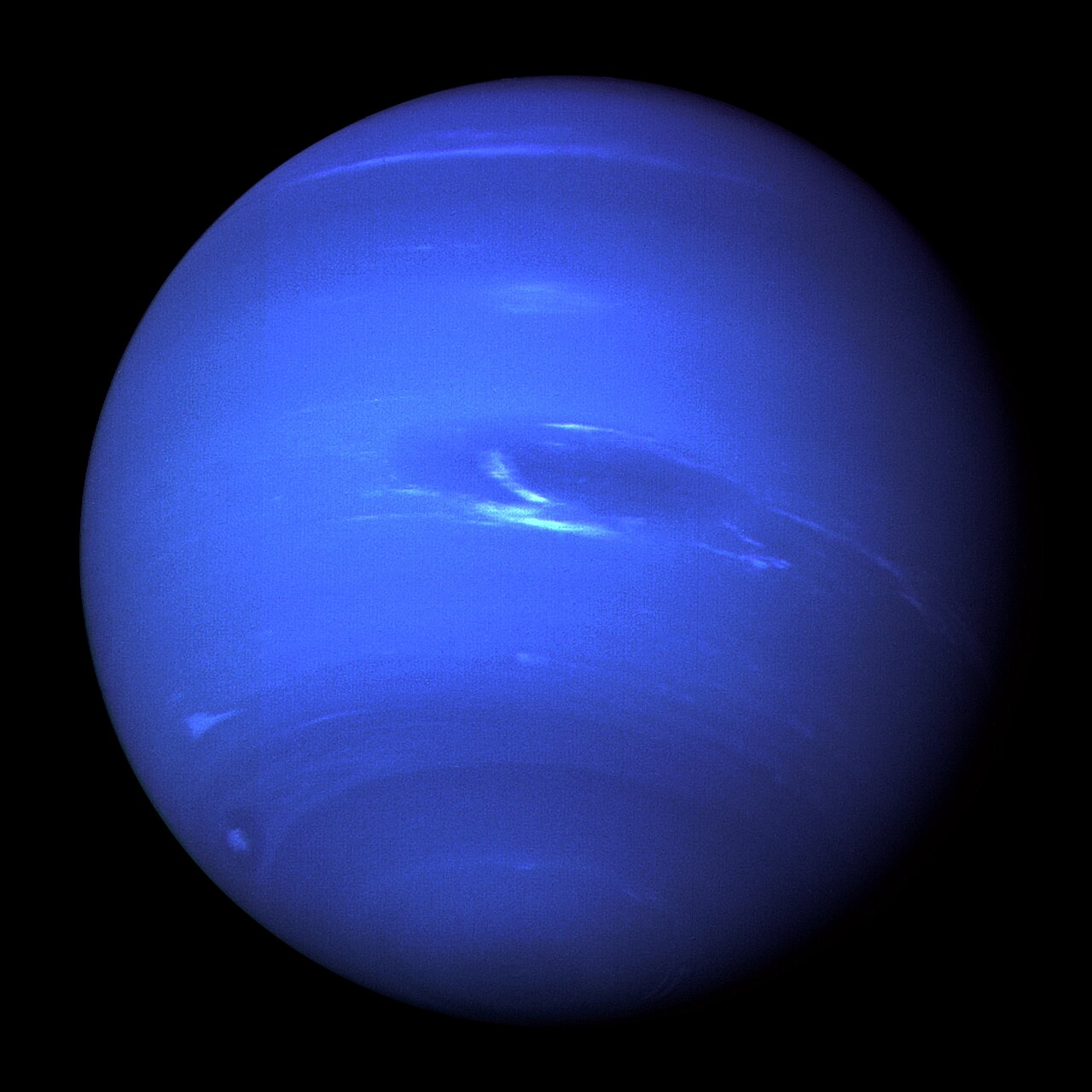
Far beyond the familiar warmth of Earth, beyond the rocky worlds and the giant planets, lies a distant realm where sunlight is little more than a brilliant star. In this cold, dark frontier orbits Neptune—the eighth and outermost major planet in our Solar System.
For centuries, Neptune remained invisible to human history. Unlike Mercury, Venus, Mars, Jupiter, and Saturn, it cannot be seen with the naked eye. It waited silently in the darkness until mathematics revealed its existence before telescopes confirmed it. That alone makes Neptune unique: it was the first planet discovered through calculations rather than direct observation.
Although spacecraft have visited every giant planet, Neptune remains one of the least explored worlds in the Solar System. Only a single spacecraft has ever flown past it, yet the information gathered has transformed our understanding of giant planets, atmospheric physics, planetary formation, and even distant exoplanets orbiting other stars.
Neptune is a world of violent storms, supersonic winds, mysterious dark vortices, invisible rings, icy moons, and an interior unlike anything found on Earth. Every new observation reminds astronomers that this distant giant is far more dynamic than anyone once imagined.
Here are fifteen incredible facts about Neptune that reveal why this beautiful blue world continues to fascinate scientists around the globe.
1. Neptune Was Discovered with Mathematics Before Anyone Saw It
One of the most remarkable stories in the history of science is the discovery of Neptune.
During the early nineteenth century, astronomers noticed that Uranus was not moving exactly as predicted. Something invisible appeared to be tugging on its orbit. Rather than assuming existing theories were wrong, mathematicians wondered whether another unseen planet might be responsible.
Working independently, French mathematician Urbain Le Verrier and British mathematician John Couch Adams calculated where such a planet should be located based solely on its gravitational effects.
On September 23, 1846, German astronomer Johann Gottfried Galle pointed a telescope toward the predicted position.
There it was.
The planet appeared astonishingly close to the calculated location.
It was one of the greatest triumphs of Newtonian physics and demonstrated that mathematics could reveal worlds hidden from human eyes.
2. Neptune Is More Than 30 Times Farther from the Sun Than Earth
Neptune orbits the Sun at an average distance of about 4.5 billion kilometers (2.8 billion miles).
To appreciate this enormous distance, imagine sunlight traveling through space at nearly 300,000 kilometers per second.
Even at that incredible speed, sunlight takes approximately four hours to reach Neptune.
By comparison, sunlight reaches Earth in just over eight minutes.
At Neptune, the Sun appears much smaller than it does from Earth, yet it still shines hundreds of times brighter than our full Moon.
3. One Year on Neptune Lasts Nearly 165 Earth Years
Because Neptune is so far from the Sun, its journey around our star is extraordinarily long.
A single Neptunian year lasts about 164.8 Earth years.
Since its discovery in 1846, Neptune completed its first full orbit around the Sun only in 2011.
That means no human alive during its discovery ever witnessed an entire Neptunian year.
Each season on Neptune lasts more than four decades.
Imagine experiencing a winter that continued for over forty Earth years.
4. Neptune Has the Fastest Winds in the Solar System
One of Neptune’s greatest surprises is its incredibly violent weather.
Despite receiving only about one nine-hundredth of the sunlight Earth receives, Neptune possesses the fastest planetary winds known.
Some winds exceed 2,000 kilometers per hour (about 1,200 miles per hour).
These speeds are faster than the speed of sound under Earth’s atmospheric conditions.
Scientists still do not fully understand why Neptune’s atmosphere is so energetic.
Its internal heat appears to play a major role, driving atmospheric circulation despite the planet’s great distance from the Sun.
5. Neptune Is an Ice Giant, Not a Gas Giant
Neptune is often grouped with Jupiter and Saturn, but astronomers classify it differently.
Jupiter and Saturn are true gas giants because they consist primarily of hydrogen and helium.
Neptune and Uranus belong to a separate category known as ice giants.
The word “ice” can be misleading.
Scientists do not mean ordinary frozen ice like that found in a household freezer.
Instead, Neptune contains large amounts of substances such as water, ammonia, and methane under enormous pressure.
Deep inside the planet, these materials exist in exotic high-pressure forms unlike anything naturally found on Earth.
6. Its Beautiful Blue Color Comes from Methane—But Not Entirely
Neptune is famous for its rich blue appearance.
For many years, scientists believed methane alone explained its color.
Methane absorbs red wavelengths of sunlight while reflecting blue light back into space.
However, modern observations indicate that methane cannot fully account for Neptune’s deep blue color.
Researchers now think additional atmospheric particles and complex photochemical processes likely contribute to its distinctive appearance.
Exactly how these processes interact remains an active area of research.
7. Neptune Radiates More Heat Than It Receives from the Sun
One of the most fascinating aspects of Neptune is its internal energy.
The planet emits roughly twice as much energy as it absorbs from sunlight.
This means Neptune possesses an internal heat source.
Scientists believe this heat may result from leftover energy from the planet’s formation, slow gravitational contraction, and internal processes occurring deep beneath its cloud tops.
That extra energy likely helps power Neptune’s enormous storms and extreme winds.
8. Only One Spacecraft Has Ever Visited Neptune
Despite its scientific importance, Neptune has received remarkably little direct exploration.
Only NASA’s Voyager 2 has ever visited the planet.
The spacecraft flew past Neptune in August 1989 after traveling for more than a decade through the outer Solar System.
During its brief encounter, Voyager 2 transformed scientific understanding of the planet.
It discovered new moons, observed powerful storms, measured the magnetic field, investigated the rings, and photographed Neptune in extraordinary detail.
Everything humanity knows from close-up observations comes from this single flyby.
9. Neptune Once Had a Giant Storm Called the Great Dark Spot
When Voyager 2 arrived, it observed an enormous storm known as the Great Dark Spot.
It resembled Jupiter’s famous Great Red Spot but differed in one important way.
Unlike Jupiter’s long-lived storm, Neptune’s dark vortices appear to form and disappear over time.
When the Hubble Space Telescope later observed Neptune, the original Great Dark Spot had vanished.
Since then, astronomers have discovered several new dark storms forming elsewhere on the planet.
These storms remain among the most mysterious weather systems in the Solar System.
10. Neptune Has Faint Rings
Although Saturn’s rings are the most spectacular, Neptune also possesses a ring system.
Its rings are extremely faint and composed primarily of dust particles mixed with larger fragments.
One unusual feature is the presence of bright ring arcs.
Instead of forming perfectly uniform circles, some sections appear significantly brighter than others.
For many years, astronomers wondered how these arcs remained stable without spreading evenly around the planet.
Gravitational interactions with nearby moons likely help maintain these structures.
11. Triton Is One of the Most Extraordinary Moons Ever Discovered
Neptune’s largest moon, Triton, is unlike nearly every other large moon in the Solar System.
Most large moons orbit in the same direction their planets rotate.
Triton moves in the opposite direction.
This unusual retrograde orbit strongly suggests Triton did not form around Neptune.
Instead, scientists believe it was originally a dwarf planet from the Kuiper Belt that Neptune captured through gravity billions of years ago.
Its capture dramatically reshaped Neptune’s moon system.
12. Triton Has Active Ice Volcanoes
Voyager 2 revealed something astonishing on Triton.
Dark plumes were rising from its icy surface.
These were not ordinary volcanic eruptions involving molten rock.
Instead, they were cryovolcanoes—or ice volcanoes.
Rather than lava, these eruptions involve materials such as nitrogen and other volatile compounds.
The discovery proved that geological activity can occur even in the extremely cold outer Solar System.
Today, Triton remains one of the leading candidates in the search for hidden subsurface oceans beyond Earth.
13. Neptune’s Magnetic Field Is Surprisingly Strange
Earth’s magnetic field is roughly aligned with its rotation axis.
Neptune’s is very different.
Its magnetic field is significantly tilted and offset from the planet’s center.
This unusual geometry creates a highly irregular magnetosphere that changes dramatically as Neptune rotates.
Scientists think the magnetic field is generated not deep in the planet’s core but within electrically conducting layers composed of water, ammonia, and methane under immense pressure.
Understanding Neptune’s magnetic field helps researchers investigate how magnetic fields form inside giant planets both within and beyond our Solar System.
14. Diamond Rain May Fall Deep Inside Neptune
Among the most fascinating scientific hypotheses involving Neptune is the possibility of diamond rain.
Inside the planet, pressures reach millions of times greater than Earth’s atmospheric pressure.
Laboratory experiments suggest that under these extreme conditions, methane molecules can break apart.
Carbon atoms may then compress into diamond crystals.
Some theoretical models indicate these diamonds could sink through Neptune’s interior like rain falling through Earth’s atmosphere.
Although direct confirmation remains impossible, experimental evidence supports the underlying physics.
If true, Neptune may contain vast quantities of diamonds hidden deep beneath its clouds.
15. Neptune Helps Scientists Understand Distant Worlds
Neptune is not merely interesting because it belongs to our Solar System.
It has become one of astronomy’s most valuable laboratories for studying exoplanets.
Many planets discovered around other stars are similar in size to Neptune.
These so-called “Neptune-sized” worlds are among the most common planetary types detected throughout our galaxy.
By studying Neptune’s atmosphere, internal structure, weather systems, magnetic field, and formation history, astronomers gain crucial insights into thousands of distant planets that cannot yet be explored directly.
In many ways, Neptune serves as a nearby example of one of the galaxy’s most widespread classes of planets.
Why Neptune Continues to Fascinate Scientists
Neptune remains one of the Solar System’s greatest frontiers.
Unlike Mars, which has hosted numerous missions, or Jupiter and Saturn, which have each been visited multiple times, Neptune has been explored only once from close range.
Every major question about the planet opens several more.
Scientists still seek to understand the source of its extreme winds, the evolution of its storms, the chemistry behind its deep blue color, the nature of its interior, the origin of its unusual magnetic field, and the geological activity of Triton.
Future missions equipped with modern instruments could revolutionize our understanding of this distant giant, just as Voyager 2 did in 1989.
The Mysterious Blue Giant at the Solar System’s Edge
Neptune may seem unimaginably distant, but its scientific importance reaches far beyond its lonely orbit.
It is a world where sunlight is faint, yet storms rage with incredible intensity. It is a planet whose existence was predicted by mathematics before anyone saw it. It possesses winds faster than any elsewhere in the Solar System, mysterious disappearing storms, delicate rings, a captured moon with active ice geysers, and perhaps even rain made of diamonds.
Most remarkably, Neptune reminds us how much remains to be discovered.
Despite centuries of astronomical progress, humanity has explored this magnificent world only once. Countless secrets still swirl beneath its blue clouds, waiting for future spacecraft—and future generations of scientists—to uncover them.