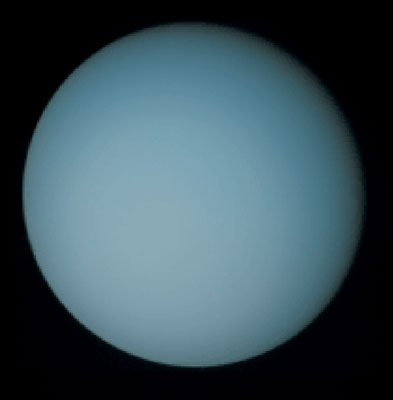
Far beyond the warmth of the Sun, beyond the asteroid belt, beyond Jupiter and Saturn, and even beyond the cloud-covered world of Neptune’s neighbor, lies one of the most unusual planets ever discovered—Uranus. At first glance, it may appear to be just another giant blue planet, but beneath its calm appearance lies a world unlike any other in our Solar System.
Uranus spins on its side, experiences seasons that last decades, possesses an icy interior unlike the gas giants, and hosts an intricate system of rings and moons. Its atmosphere reaches temperatures so cold that few places in the known Solar System can rival it. Even today, Uranus remains one of the least explored major planets. Since its discovery in 1781, only one spacecraft has ever flown past it, leaving scientists with many unanswered questions.
Modern observations from powerful telescopes, including the Hubble Space Telescope and the James Webb Space Telescope, continue to reveal surprising details about this mysterious ice giant.
Here are 15 incredible facts that make Uranus one of the most fascinating worlds in our cosmic neighborhood.
1. Uranus Spins on Its Side
If you could watch the planets from above the Solar System, one thing would immediately stand out about Uranus.
Almost every planet rotates like a spinning top, with its axis tilted only slightly. Earth, for example, is tilted by about 23.5 degrees.
Uranus is dramatically different.
Its rotational axis is tilted by approximately 98 degrees, meaning the planet essentially spins on its side. Imagine rolling a ball across the floor instead of spinning it upright—that is remarkably similar to how Uranus rotates.
Scientists believe this unusual orientation likely resulted from one or more enormous collisions early in the Solar System’s history. A massive protoplanet may have struck Uranus billions of years ago, knocking it onto its side. More recent computer simulations also suggest that multiple smaller impacts could have gradually produced the same effect.
Whatever the exact cause, Uranus remains unique among the major planets.
2. A Day Lasts Only About 17 Hours
Despite being nearly four times wider than Earth, Uranus rotates surprisingly quickly.
One complete rotation takes about 17 hours and 14 minutes.
This means a day on Uranus is shorter than an Earth day, even though the planet is enormously larger.
Fast rotation affects the planet’s atmospheric circulation, magnetic field, and overall shape. Like other giant planets, Uranus is slightly flattened at its poles because centrifugal forces cause its equator to bulge outward.
Its rapid spin also contributes to powerful atmospheric dynamics that scientists continue to study.
3. A Year Lasts 84 Earth Years
Although Uranus spins rapidly, it moves very slowly around the Sun.
Located nearly 2.9 billion kilometers (1.8 billion miles) from our star, Uranus requires approximately 84 Earth years to complete a single orbit.
Someone born during one Uranian year would celebrate their first birthday only after living an entire human lifetime.
This enormous orbital period also creates some of the most extreme seasonal changes in the Solar System.
4. Its Seasons Last More Than Two Decades
Earth experiences four seasons every year because of its moderate axial tilt.
Uranus experiences seasons unlike anywhere else.
Because the planet rotates almost sideways, each pole points almost directly toward the Sun during part of its orbit. As a result, one hemisphere can experience continuous daylight while the other remains in darkness.
Each season lasts roughly 21 Earth years.
Imagine a sunrise that is followed by more than two decades of daylight before sunset finally arrives.
These extraordinary seasons influence atmospheric circulation and cloud formation in ways scientists are still trying to understand.
5. Uranus Is an Ice Giant, Not a Gas Giant
People often group Uranus with Jupiter and Saturn because all four are giant planets.
However, Uranus belongs to a distinct category known as the ice giants.
Unlike Jupiter and Saturn, which consist primarily of hydrogen and helium, Uranus contains much larger amounts of substances astronomers call “ices.”
These include water, ammonia, and methane under conditions of immense pressure and temperature. Deep inside the planet, these materials exist in exotic forms unlike ordinary ice found on Earth.
This different internal composition makes Uranus fundamentally distinct from the larger gas giants.
6. It Is the Coldest Planet in the Solar System
One might expect Neptune, which orbits farther from the Sun, to be colder.
Surprisingly, Uranus holds the record.
Temperatures in its upper atmosphere can fall to around 49 kelvin, or approximately −224°C (−371°F).
This makes Uranus the coldest planetary atmosphere in the Solar System.
Scientists are not entirely certain why.
Unlike Neptune, Uranus appears to emit very little internal heat. Most giant planets radiate significant energy left over from their formation, but Uranus releases remarkably little.
The reason for this unusually low heat output remains one of planetary science’s biggest mysteries.
7. Its Blue-Green Color Comes From Methane
Uranus owes its beautiful blue-green appearance to methane gas in its atmosphere.
Sunlight contains many colors.
Methane absorbs much of the red portion of incoming sunlight while allowing blue and green wavelengths to be scattered back into space.
The result is the planet’s distinctive turquoise color.
However, methane is only a small component of the atmosphere.
Hydrogen and helium remain the dominant gases, while methane contributes disproportionately to the planet’s striking appearance.
8. Uranus Has Rings
For many years, Saturn was thought to be the only ringed planet.
Scientists now know that all four giant planets possess rings.
Uranus has a surprisingly complex ring system consisting of narrow, dark rings made primarily of rocky material.
The rings were discovered in 1977 when astronomers observed the planet passing in front of a distant star. The star’s light dimmed several times before Uranus itself crossed in front, revealing the presence of previously unknown rings.
Today, astronomers have identified 13 known rings around Uranus.
Although much fainter than Saturn’s spectacular rings, they provide important clues about the planet’s history and gravitational interactions.
9. It Has 28 Known Moons
Uranus possesses an impressive family of natural satellites.
Astronomers have identified 28 known moons, ranging from tiny irregular objects to large spherical worlds.
Unlike the moons of many other planets, Uranus’s major satellites are named after characters from the works of William Shakespeare and Alexander Pope.
Some of the largest include Titania, Oberon, Umbriel, Ariel, and Miranda.
Each moon displays unique geological features, including cliffs, valleys, ancient impact craters, and evidence of tectonic activity.
Future missions could reveal whether some of these icy worlds possess hidden internal oceans.
10. Miranda Has One of the Strangest Surfaces Ever Seen
Among Uranus’s moons, Miranda stands apart.
When NASA’s Voyager 2 spacecraft flew past in 1986, it photographed a world unlike anything scientists expected.
Miranda’s surface appears stitched together from dramatically different terrains.
Gigantic cliffs tower more than 20 kilometers high—among the tallest known in the Solar System.
Some regions appear heavily cratered, while others seem relatively young.
Scientists think Miranda may have been shattered by a massive impact long ago before reassembling under its own gravity, though alternative geological explanations remain under investigation.
Its bizarre appearance continues to puzzle planetary scientists.
11. Only One Spacecraft Has Ever Visited
Despite being one of the Solar System’s major planets, Uranus has received remarkably little direct exploration.
Only NASA’s Voyager 2 has ever visited.
The spacecraft flew past Uranus in January 1986 after traveling for nearly a decade through space.
During its brief encounter, Voyager 2 discovered new moons, rings, magnetic field properties, and atmospheric features while capturing humanity’s first close-up images of the planet.
The flyby lasted only a short time.
Everything scientists know directly from spacecraft observations comes from this single encounter.
Many researchers hope a dedicated orbital mission will eventually explore Uranus in far greater detail.
12. Uranus Has a Wildly Tilted Magnetic Field
Earth’s magnetic field is roughly aligned with its rotational axis.
Uranus is very different.
Its magnetic field is tilted by about 59 degrees relative to its rotation axis and is significantly offset from the planet’s center.
This unusual geometry creates an extremely complex magnetosphere.
As Uranus rotates, its magnetic field swings dramatically through space, producing constantly changing interactions with the solar wind.
Scientists believe the magnetic field may originate in electrically conducting layers of water-ammonia mixtures deep inside the planet rather than near its center.
13. Powerful Storms Rage Through Its Atmosphere
For many years, Uranus appeared relatively calm compared with Jupiter or Neptune.
Modern observations have revealed that appearances can be deceiving.
Powerful storms periodically erupt within its atmosphere.
Large cloud systems have been observed moving across the planet, sometimes reaching impressive sizes.
Wind speeds can exceed 900 kilometers per hour (about 560 miles per hour).
Infrared observations show that Uranus’s atmosphere becomes increasingly active near equinoxes, when sunlight reaches the equatorial regions more directly.
These seasonal atmospheric changes continue to surprise researchers.
14. Diamonds May Rain Deep Inside the Planet
One of the most fascinating hypotheses about Uranus involves its deep interior.
Laboratory experiments suggest that under the enormous pressures and temperatures found inside ice giants, methane molecules could break apart.
The carbon atoms released during this process might crystallize into diamonds.
These diamonds could then sink through the planet’s interior like rain.
Scientists have recreated similar conditions using high-powered lasers and shock-compression experiments, providing evidence that diamond formation is physically plausible under such extreme environments.
Although direct confirmation inside Uranus remains impossible for now, diamond rain is considered a scientifically credible possibility rather than science fiction.
15. Uranus May Hold the Key to Understanding Thousands of Exoplanets
Perhaps Uranus’s greatest importance lies beyond our own Solar System.
Astronomers have discovered thousands of planets orbiting other stars.
Many of them are similar in size to Uranus and Neptune.
In fact, planets within this size range appear to be among the most common types of worlds in the Milky Way.
Yet Uranus remains one of the least explored planets in our own Solar System.
Understanding its atmosphere, interior, chemistry, magnetic field, and formation could help scientists interpret countless distant exoplanets that cannot be studied up close.
A future mission to Uranus would therefore do much more than reveal one mysterious planet—it could transform our understanding of planetary systems throughout the galaxy.
Why Uranus Continues to Fascinate Scientists
Despite centuries of observation, Uranus remains a world filled with unanswered questions.
Why does it emit so little internal heat?
Exactly what caused its dramatic tilt?
How did its magnetic field become so unusual?
What lies deep beneath its blue-green clouds?
Could some of its moons harbor hidden oceans?
Planetary scientists consider Uranus one of the highest-priority destinations for future exploration because answering these questions would improve our understanding not only of the Solar System but also of planets orbiting other stars.
Modern telescopes continue to reveal new atmospheric features, seasonal changes, and ring structures. The James Webb Space Telescope has recently provided some of the clearest infrared views ever obtained, uncovering previously unseen details of the planet’s atmosphere and rings.
A Planet Unlike Any Other
Uranus may not possess Saturn’s dazzling rings or Jupiter’s enormous storms, but it is extraordinary in its own way. It rotates on its side, experiences decades-long seasons, hosts a strangely tilted magnetic field, and contains one of the coldest atmospheres known among the planets. Its mysterious interior, complex ring system, and fascinating moons make it one of the Solar System’s most scientifically valuable worlds.
As humanity prepares for the next generation of planetary exploration, Uranus stands waiting in the deep darkness beyond Saturn—a quiet, icy giant whose greatest discoveries may still lie ahead.