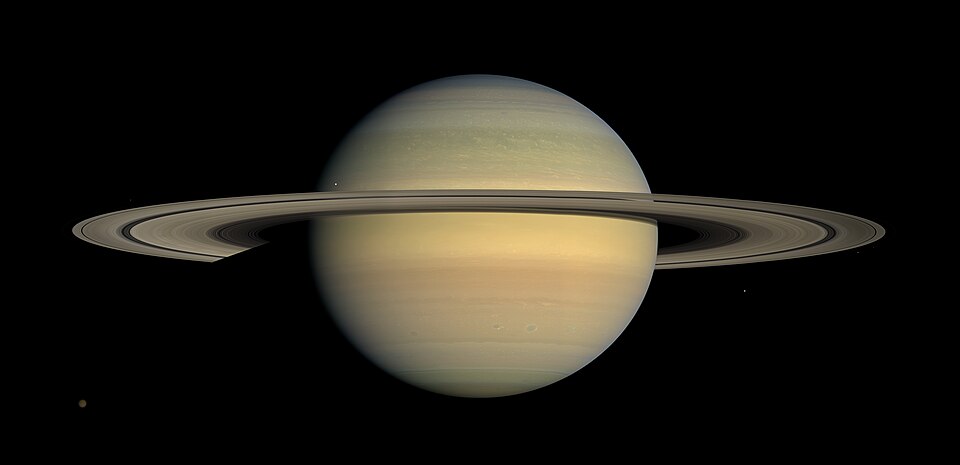
Among all the worlds that orbit our Sun, few inspire as much wonder as Saturn. With its breathtaking rings stretching across space like a celestial masterpiece, Saturn has fascinated skywatchers for thousands of years. Ancient civilizations saw it as a wandering star, while modern spacecraft have revealed a dynamic world of powerful storms, icy moons, and mysteries that continue to surprise scientists.
At nearly ten times Earth’s diameter, Saturn is the second-largest planet in the Solar System and one of the four giant planets made mostly of hydrogen and helium. But despite its enormous size, Saturn is full of unexpected contradictions. It is so light that it would theoretically float in an enormous ocean, yet it hosts winds faster than the most violent hurricanes on Earth. Its beautiful rings appear permanent, but scientists now know they are surprisingly young and may eventually disappear.
Decades of exploration, especially by NASA’s Cassini spacecraft, transformed Saturn from a distant point of light into one of the best-studied worlds beyond Earth. Every new discovery revealed that Saturn is far more than a planet with rings—it is an entire planetary system filled with active moons, complex weather, hidden oceans, and fascinating physical phenomena.
Here are fifteen incredible facts about Saturn that reveal why this magnificent giant continues to captivate astronomers and space enthusiasts around the world.
1. Saturn Could Float on Water—At Least in Theory
One of the most famous facts about Saturn sounds almost impossible.
Saturn is the only planet in the Solar System with an average density lower than water. Its average density is approximately 0.69 grams per cubic centimeter, while water has a density of about 1 gram per cubic centimeter.
If an unimaginably large ocean could somehow exist, Saturn would theoretically float.
Of course, such an ocean could never be created. Saturn measures about 120,500 kilometers across, making it far too enormous for any real body of water. In addition, the immense pressure inside the planet would dramatically complicate such a scenario.
Still, the comparison highlights something remarkable about Saturn’s composition.
Unlike Earth, which consists largely of rock and metal, Saturn is composed primarily of hydrogen and helium gases surrounding a much smaller dense interior. These lightweight elements lower the planet’s average density despite its enormous mass.
It is a striking reminder that the largest objects are not always the densest.
2. Its Rings Are Astonishingly Thin
Saturn’s rings appear massive through telescopes, stretching hundreds of thousands of kilometers across space.
Yet they are astonishingly thin.
Although the main ring system spans roughly 280,000 kilometers from one side to the other, most of the rings are only about 10 to 100 meters thick. In many places, they are thinner than a large office building is tall.
Imagine a sheet of paper extending across an entire continent.
That comparison comes surprisingly close.
The rings consist primarily of countless particles made of water ice mixed with smaller amounts of rocky material and dust. These particles range in size from microscopic grains to chunks as large as mountains.
Each fragment independently orbits Saturn according to the laws of gravity.
Rather than being solid structures, the rings are vast collections of individual icy bodies traveling together through space.
3. Saturn Has More Confirmed Moons Than Any Other Planet
Saturn is not merely a planet.
It is the center of an entire miniature planetary system.
Astronomers have confirmed well over 270 moons orbiting Saturn, giving it the largest known collection of natural satellites in the Solar System. As telescope technology improves, additional small moons continue to be identified.
These moons vary enormously.
Some measure only a few kilometers across.
Others rival planets in complexity.
Among them are icy worlds, cratered remnants, irregular captured objects, and geologically active satellites.
Each moon tells a different story about the formation and evolution of the Saturnian system.
Together they make Saturn one of the richest laboratories for studying planetary science.
4. Titan Has Rivers, Lakes, and Rain—But Not Made of Water
Saturn’s largest moon, Titan, is unlike any other moon in the Solar System.
It possesses a dense atmosphere even thicker than Earth’s.
Even more extraordinary, Titan has weather.
Clouds form.
Rain falls.
Rivers flow.
Lakes fill.
But none of these contain liquid water.
Instead, Titan’s extremely cold temperatures allow methane and ethane to exist as liquids. These hydrocarbons evaporate, form clouds, produce rainfall, carve river valleys, and collect in enormous lakes near the poles.
It is the only known world besides Earth with stable liquid bodies on its surface.
Scientists believe Titan may resemble aspects of the early Earth before life evolved, making it one of the most important targets in planetary science.
5. Enceladus Hides a Global Ocean Beneath Its Ice
Another of Saturn’s moons completely transformed scientists’ understanding of where life might exist.
Enceladus appears small and frozen on the outside.
Beneath its icy shell, however, lies a global ocean.
NASA’s Cassini spacecraft discovered enormous plumes of water vapor erupting through fractures near the moon’s south pole.
These geysers shoot water, ice particles, salts, and organic molecules hundreds of kilometers into space.
Cassini even flew directly through these plumes, allowing instruments to analyze their composition.
Evidence suggests that hydrothermal activity occurs on the ocean floor, where warm water interacts with rock.
On Earth, similar hydrothermal environments support rich ecosystems without sunlight.
Although no life has been detected on Enceladus, it has become one of the most promising places in the Solar System to search for extraterrestrial microorganisms.
6. Saturn’s Winds Are Faster Than Most Hurricanes on Earth
Saturn’s atmosphere is far from calm.
Powerful jet streams race around the planet at speeds exceeding 1,800 kilometers per hour in some regions.
These winds are several times faster than the strongest hurricanes ever recorded on Earth.
The atmosphere consists mainly of hydrogen and helium with traces of ammonia, methane, and water vapor.
Complex interactions between heat rising from Saturn’s interior and solar energy drive enormous atmospheric circulation patterns.
The result is a constantly changing landscape of bands, storms, and swirling cloud systems stretching across the giant planet.
7. A Giant Hexagon Sits Above Saturn’s North Pole
Perhaps the strangest weather pattern in the Solar System exists at Saturn’s north pole.
There, scientists discovered a massive six-sided jet stream.
Known simply as Saturn’s Hexagon, this atmospheric feature measures approximately 30,000 kilometers across—large enough to fit about four Earths inside it.
Unlike ordinary storms, the hexagon has maintained its overall shape for decades.
Scientists first observed it during the Voyager missions in the early 1980s, and Cassini later studied it in remarkable detail.
Laboratory experiments suggest that rotating fluids can naturally produce polygonal flow patterns under certain conditions.
Even so, the precise mechanisms responsible for Saturn’s persistent hexagonal jet stream continue to be investigated.
It remains one of planetary science’s most remarkable atmospheric phenomena.
8. Saturn Radiates More Energy Than It Receives from the Sun
Despite being nearly ten times farther from the Sun than Earth, Saturn generates a surprising amount of internal heat.
The planet emits roughly twice as much energy as it receives from sunlight.
Where does this extra energy come from?
Scientists believe several processes contribute.
One important mechanism involves helium slowly separating from liquid hydrogen deep inside the planet.
As helium droplets sink toward the interior, gravitational energy converts into heat.
Residual heat left over from Saturn’s formation billions of years ago also continues to escape.
This internal energy powers much of Saturn’s atmospheric activity.
9. Saturn Spins So Fast That It Is Flattened
A day on Saturn lasts only about ten and a half hours.
Considering the planet’s enormous size, this represents an astonishing rotation speed.
Rapid spinning causes Saturn to bulge outward around its equator while flattening slightly at the poles.
This shape is called an oblate spheroid.
Saturn’s equatorial diameter exceeds its polar diameter by nearly 10%.
The flattening is easily visible in spacecraft images.
Rapid rotation also influences the planet’s atmospheric circulation, contributing to its powerful jet streams.
10. The Rings May Be Surprisingly Young
For centuries people assumed Saturn’s rings formed alongside the planet itself about 4.5 billion years ago.
Recent evidence paints a different picture.
Measurements made by the Cassini spacecraft suggest that the visible rings may be only about 100 to 400 million years old.
That is relatively recent on geological timescales.
Scientists think the rings may have formed when one or more icy moons or comets were torn apart by Saturn’s gravity after crossing the Roche limit—the distance inside which tidal forces overcome an object’s own gravity.
Although debate continues, many researchers now believe the spectacular rings may be temporary rather than ancient.
11. Saturn’s Rings Are Slowly Disappearing
As beautiful as Saturn’s rings appear today, they are not permanent.
Scientists have discovered that tiny ring particles gradually spiral toward the planet.
This process, sometimes called “ring rain,” occurs because charged particles interact with Saturn’s magnetic field and atmosphere.
Material from the rings slowly falls into the planet.
Current estimates suggest that, if this process continues, much of the visible ring system could disappear within a few hundred million years.
Humans happen to exist during a fortunate era when Saturn’s rings are especially magnificent.
Future observers, millions of years from now, may see a very different planet.
12. Saturn’s Magnetic Field Is Surprisingly Symmetrical
Most planetary magnetic fields are tilted relative to their rotation axes.
Earth’s magnetic field, for example, is offset by about 11 degrees.
Saturn is unusual.
Its magnetic field appears almost perfectly aligned with its rotation axis.
This near-perfect symmetry puzzles scientists because many theories of planetary magnetic field generation predict at least a small tilt.
Understanding Saturn’s magnetic field may improve models describing how magnetic dynamos operate inside giant planets.
13. Some of Saturn’s Moons Share the Same Orbit
Among Saturn’s many moons are rare examples of co-orbital motion.
Moons such as Janus and Epimetheus orbit at nearly the same distance from Saturn.
Every few years, they approach one another closely.
Instead of colliding, they exchange orbital energy.
One moon moves slightly farther from Saturn while the other moves slightly closer.
They effectively swap places.
This graceful gravitational dance is unique among large moons in the Solar System and beautifully demonstrates the precision of orbital mechanics.
14. Cassini Changed Everything We Knew About Saturn
No mission has transformed understanding of Saturn more than Cassini–Huygens.
Launched in 1997, Cassini entered Saturn’s orbit in 2004 and remained there for more than thirteen years.
The mission studied the rings, atmosphere, magnetic field, and dozens of moons in unprecedented detail.
Its companion probe, Huygens, successfully landed on Titan in 2005, becoming the first spacecraft to touch down in the outer Solar System.
Cassini discovered active geysers on Enceladus, revealed seasonal changes across Saturn, mapped Titan’s lakes, measured ring structure in extraordinary detail, and revolutionized nearly every aspect of Saturn science.
In 2017, the spacecraft deliberately entered Saturn’s atmosphere, ending the mission while protecting potentially habitable moons from accidental contamination.
Its scientific legacy continues to shape planetary research today.
15. Saturn Is Still Full of Mysteries
Despite decades of observation and one of the most successful planetary missions ever flown, Saturn continues to surprise scientists.
Researchers still seek better understanding of the planet’s deep interior.
The exact size and composition of its core remain uncertain.
Scientists continue investigating how its magnetic field forms, why the north-polar hexagon remains stable, how long the rings will survive, and what processes shape Titan’s climate over millions of years.
Questions also remain about Enceladus’s hidden ocean and whether conditions there could support life.
Future missions may reveal entirely new discoveries.
Like every great frontier in science, Saturn becomes more fascinating with every answer because each answer generates new questions.
Why Saturn Matters
Saturn is much more than a beautiful object in the night sky.
It serves as a natural laboratory where scientists study planetary formation, atmospheric physics, gravitational dynamics, chemistry, and the conditions that might allow life to exist beyond Earth.
Its moons offer clues about the origins of oceans, the evolution of planetary systems, and even the possibility of extraterrestrial biology.
Its rings help astronomers understand how disks of material behave around massive objects, providing insights that apply not only to planets but also to young stars and distant galaxies.
Every observation of Saturn contributes to a broader understanding of how our Solar System formed and how planetary systems throughout the universe may evolve.
A Planet That Never Stops Inspiring Wonder
Saturn has captivated humanity since ancient civilizations first noticed its slow movement across the night sky. Today, powerful telescopes and sophisticated spacecraft have revealed a world far more extraordinary than anyone could have imagined.
Its elegant rings, turbulent atmosphere, mysterious magnetic field, remarkable moons, and hidden oceans remind us that the Solar System is far richer and more diverse than it appears from Earth.
Even after centuries of observation and decades of scientific exploration, Saturn continues to challenge assumptions and inspire discovery. It stands not only as one of the most beautiful planets in the Solar System but also as one of its greatest scientific treasures—a giant world where every new observation deepens our appreciation for the complexity, beauty, and endless mystery of the universe.