For thousands of years, humanity believed the planets of our own Solar System represented the full diversity of worlds in the universe. Rocky planets orbited close to the Sun, giant gas planets circled farther away, and icy bodies drifted in the cold outer reaches. It seemed like a neat, orderly arrangement.
Then astronomers began discovering planets around other stars.
Everything changed.
Since the first confirmed detection of an exoplanet orbiting a Sun-like star in 1995, scientists have identified more than 5,000 confirmed exoplanets, with thousands more candidates awaiting verification. Instead of finding familiar worlds, astronomers uncovered planets that challenge nearly every expectation about how planetary systems form and evolve.
Some worlds are hotter than molten lava. Others rain glass sideways at thousands of kilometers per hour. One planet is so dark it reflects almost no light, while another is less dense than Styrofoam. There are planets orbiting two stars like the fictional world of Tatooine, planets circling dead stars, and even worlds where an entire year lasts only a few hours.
These discoveries have transformed planetary science. They reveal that nature is far more imaginative than science fiction.
The following fifteen planets are among the weirdest worlds ever found. Although they sound unbelievable, every one of them is supported by scientific observations and represents a genuine astronomical discovery.
1. HD 189733 b – The Planet Where It Rains Molten Glass
If weather forecasts existed for this world, they would be terrifying.
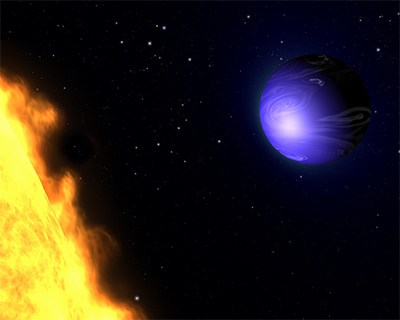
HD 189733 b is one of the best-studied exoplanets because it periodically passes in front of its parent star from Earth’s perspective. Located about 64 light-years away, it belongs to a class known as hot Jupiters—gas giants that orbit extremely close to their stars.
Its atmosphere reaches temperatures approaching 1,000 degrees Celsius (about 1,800°F), making ordinary water clouds impossible.
Instead, atmospheric studies indicate the presence of silicate particles—the materials that make up glass on Earth.
Powerful winds race through the atmosphere at speeds exceeding 8,000 kilometers per hour (about 5,000 mph). Scientists believe these winds carry tiny molten silicate particles sideways through the atmosphere.
In effect, the planet may experience sideways rain made of molten glass.
The beautiful deep-blue appearance of the planet is equally deceptive. Unlike Earth’s oceans, its color likely comes from silicate particles scattering blue light.
It is one of the most hostile weather systems ever discovered.
2. WASP-12b – The Planet Being Torn Apart
Some planets die slowly.
WASP-12b is gradually being destroyed by its own star.
Orbiting so close that one year lasts only about 26 hours, this enormous gas giant experiences temperatures exceeding 2,500°C (4,500°F).
The star’s immense gravity stretches the planet into an egg-like shape.
Astronomers have detected material flowing away from the planet toward the star, indicating that the atmosphere is literally escaping into space.
Computer models predict that this process will eventually destroy the planet completely.
It is one of the clearest examples of a world being consumed by its parent star.
3. 55 Cancri e – The Lava Ocean World
Imagine standing on a planet where much of the surface glows like the inside of a blast furnace.
55 Cancri e is a rocky super-Earth roughly twice Earth’s diameter but far more massive.
It orbits so close to its star that one year lasts less than eighteen hours.
Surface temperatures exceed 2,000°C (3,600°F), hot enough to melt many rocks.
Observations suggest enormous lava oceans may cover large portions of its surface.
The planet may even possess an atmosphere composed partly of vaporized rock.
Instead of oceans of water, this world likely contains seas of molten stone.
4. TrES-2b – The Darkest Known Planet
Most planets reflect at least some of the light that reaches them.
TrES-2b barely does.
This strange gas giant reflects less than one percent of incoming visible light, making it darker than fresh asphalt or black acrylic paint.
Scientists believe its atmosphere contains light-absorbing chemicals such as vaporized sodium and potassium while lacking bright reflective clouds.
Despite being extremely hot, it appears almost completely black.
If you could somehow see it from nearby, it would resemble a faint red ember rather than a brightly illuminated planet.
5. Kepler-16b – The Real-Life Tatooine
For decades, the double-sunset world of Tatooine belonged only to fiction.
Then astronomers discovered Kepler-16b.
Instead of orbiting one star, this planet circles two stars simultaneously.
Its sky would feature constantly changing sunrises and sunsets as the stars move around each other.
Although the planet itself is probably too cold and gaseous for life as we know it, it confirmed that circumbinary planets are not only possible—they are relatively common.
Nature once again proved stranger than imagination.
6. PSR B1620-26 b – The Ancient Survivor
Nicknamed the “Methuselah Planet,” this extraordinary world may be nearly 13 billion years old.
That makes it among the oldest known planets in the universe.
Even stranger, it orbits a pulsar—a rapidly spinning neutron star—and a white dwarf.
Pulsars are the incredibly dense remnants of exploded stars.
The planet somehow survived dramatic stellar evolution that destroyed the original star.
Its existence demonstrates that planetary systems can endure events once thought completely catastrophic.
7. HD 80606 b – The Planet with Extreme Seasons
Earth’s orbit is nearly circular.
HD 80606 b’s orbit is anything but.
Its highly elongated orbit carries it from relatively cool regions into intense stellar heat.
During close approach to its star, temperatures rise by hundreds of degrees in only a few hours.
This rapid heating generates violent atmospheric expansion and enormous storms.
No world in our Solar System experiences seasonal changes this dramatic.
8. GJ 1214 b – The Water-Rich Mystery
Astronomers believe GJ 1214 b may belong to an entirely different category of planet.
Instead of being mostly rock or gas, it may contain enormous quantities of water beneath a thick atmosphere.
Under the immense pressure, ordinary liquid water would not exist.
Instead, scientists think exotic forms of high-pressure ice could form despite extremely high temperatures.
These strange ice phases are unlike anything naturally occurring on Earth’s surface.
The planet challenges traditional classifications of planetary composition.
9. KELT-9b – Hotter Than Many Stars
Some stars are actually cooler than this planet.
KELT-9b reaches daytime temperatures above 4,000°C (7,200°F).
That is hotter than the surfaces of many red dwarf stars.
At such temperatures, molecules cannot remain intact.
Even metals such as iron become vapor.
Its atmosphere contains vaporized heavy elements that would normally exist only as solids.
This world pushes the limits of planetary survival.
10. OGLE-2005-BLG-390Lb – The Frozen Giant
Not every strange planet is hot.
OGLE-2005-BLG-390Lb is one of the coldest known rocky worlds.
Surface temperatures may fall below –220°C (–364°F).
Any water would exist only as extremely hard ice.
The planet likely resembles an enormous frozen wasteland, orbiting far from a dim star.
Its discovery demonstrated that extremely cold rocky planets may be common throughout the Milky Way.
11. Kepler-70b – The Planet That Survived Stellar Death
Most planets would be destroyed when their stars expand into red giants.
Kepler-70b appears to have survived.
It orbits an exposed stellar core left behind after the star shed its outer layers.
Exactly how the planet survived remains uncertain.
Some astronomers suggest it may actually be the stripped core of a once-larger gas giant.
Either explanation makes it an extraordinary object.
12. WASP-107b – The Planet Lighter Than Styrofoam
WASP-107b is nearly the size of Jupiter.
Yet it possesses only a small fraction of Jupiter’s mass.
Its average density is astonishingly low.
If an impossibly large ocean existed, this planet would theoretically float.
Astronomers call such worlds “super-puffs.”
Their enormous atmospheres remain difficult to explain using current models of planetary formation.
13. TOI-849 b – The Naked Core
Gas giants normally hide their solid interiors beneath thousands of kilometers of atmosphere.
TOI-849 b appears to have lost almost all of that atmosphere.
Scientists think they may be observing the exposed core of what was once a giant planet.
If correct, it offers an unprecedented glimpse into planetary interiors normally hidden forever.
Studying this object may reveal how gas giants originally formed.
14. LHS 3844 b – The Airless Inferno
Many rocky planets possess atmospheres.
LHS 3844 b apparently does not.
Observations indicate its surface may be almost completely exposed to space.
One side permanently faces its star, becoming intensely hot.
The opposite side remains in perpetual darkness and extreme cold.
Without an atmosphere to transport heat, the temperature difference between day and night becomes enormous.
It is a vivid example of how atmospheres shape planetary climates.
15. Kepler-10b – A World Older Than Earth
Kepler-10b was one of the first confirmed rocky exoplanets.
It formed more than 10 billion years ago, making it significantly older than Earth.
Its ancient age reveals that rocky planets began forming relatively early in the history of the Milky Way.
Although its surface is far too hot for life as we know it, its existence demonstrates that Earth-sized worlds have existed for billions of years before our own planet formed.
It provides a glimpse into an era when the universe itself was much younger.
Why Are So Many Exoplanets So Strange?
The Solar System gave humanity a misleading impression of planetary diversity.
For centuries, astronomers assumed that most planetary systems would resemble ours.
Exoplanet discoveries have overturned that assumption.
Modern theories suggest that planets frequently migrate after formation. Giant planets can move inward toward their stars. Gravitational interactions between neighboring planets may dramatically reshape entire systems. Some worlds are captured into unusual orbits, while others are ejected into interstellar space.
This dynamic picture explains why astronomers observe such astonishing variety.
Instead of one standard planetary blueprint, nature appears capable of producing an extraordinary range of worlds.
How Scientists Discover These Alien Worlds
Finding planets around distant stars is remarkably difficult because planets emit little visible light compared with their stars.
Most exoplanets are detected indirectly.
The transit method measures tiny decreases in a star’s brightness as a planet passes in front of it.
The radial velocity method detects the slight wobble of a star caused by the gravitational pull of an orbiting planet.
Gravitational microlensing reveals planets when a foreground star temporarily magnifies the light of a more distant star.
Direct imaging has successfully photographed a small number of young, massive planets orbiting far from their stars.
Space telescopes such as Kepler, TESS, and the James Webb Space Telescope have dramatically expanded our understanding of planetary diversity.
Their observations continue to reveal worlds unlike anything previously imagined.
The Universe Is More Creative Than We Ever Imagined
Every strange planet teaches astronomers something new about how worlds form, evolve, and survive.
Some demonstrate that atmospheres can become unimaginably violent. Others reveal exotic forms of planetary chemistry. A few challenge existing theories so fundamentally that scientists must revise long-held assumptions.
Most remarkable of all is that these fifteen planets almost certainly represent only a tiny fraction of what exists.
The Milky Way alone contains hundreds of billions of stars, and current evidence suggests that planets are more common than stars themselves. Across our galaxy—and across the observable universe—there may be trillions upon trillions of worlds, each shaped by unique histories and extraordinary environments.
Some may have oceans beneath ice shells. Others may possess skies unlike anything on Earth, with clouds of metal, rain made of minerals, or sunsets illuminated by multiple stars. There may be planets stranger than any humanity has yet imagined.
The weirdest planets known today are not the end of discovery. They are only the beginning of a much larger cosmic story—one that reminds us that the universe is far more diverse, surprising, and astonishing than our own Solar System ever led us to believe.