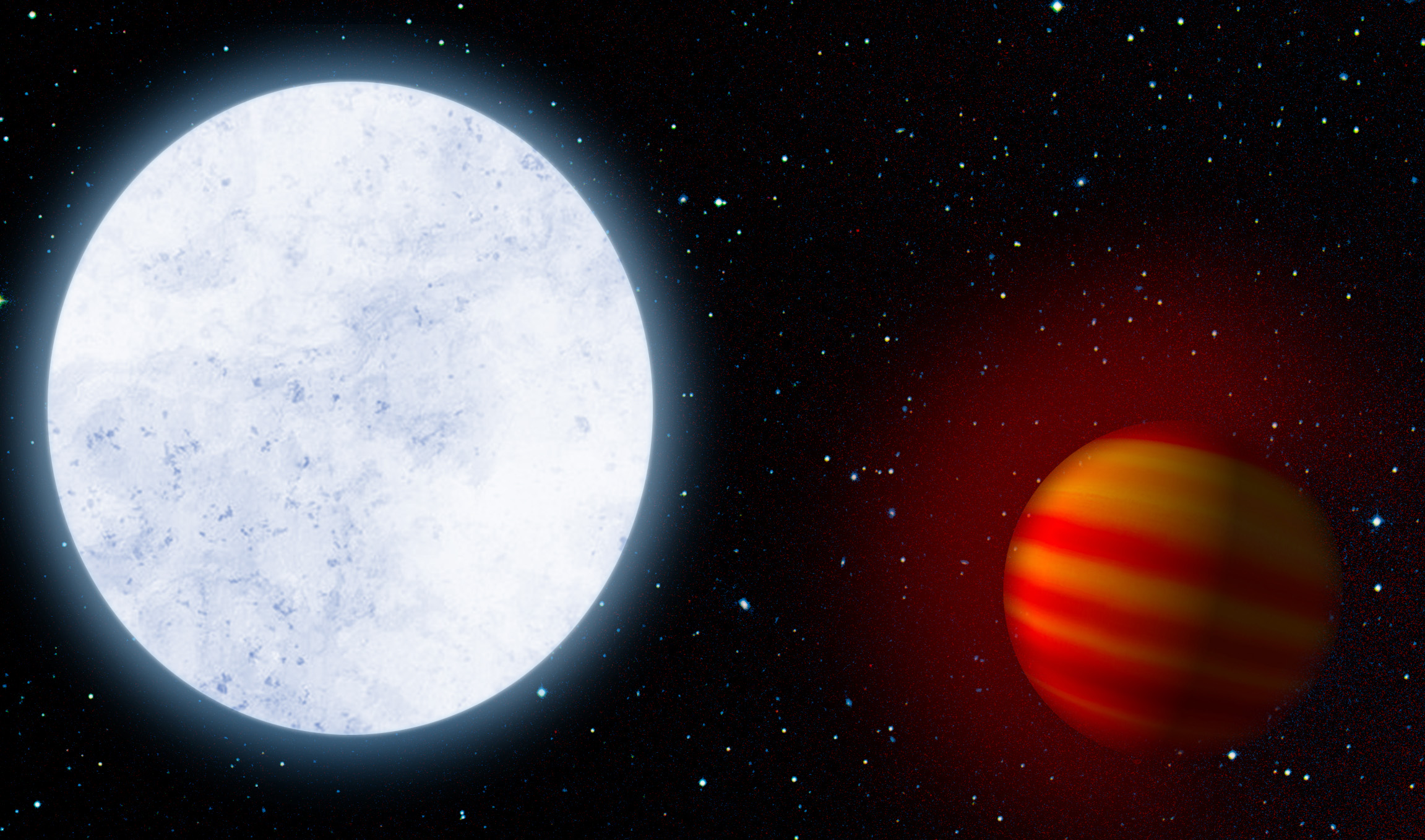
When we imagine planets, Earth naturally comes to mind—a world with oceans, clouds, forests, and temperatures that support life. But beyond our Solar System lies an astonishing collection of planets so unimaginably hot that they challenge everything we think a planet can be.
Some orbit so close to their stars that a single year lasts only a few hours. Their surfaces—or, in many cases, their cloud tops—reach temperatures capable of melting iron, vaporizing rock, and even breaking apart molecules. Their atmospheres are blasted by intense stellar radiation, whipped by supersonic winds, and in some cases literally escaping into space.
Many of these worlds belong to a class known as ultra-hot Jupiters—gas giants that orbit extraordinarily close to their parent stars. Others are rocky lava worlds where molten rock may flow across the surface like glowing rivers.
These planets are laboratories unlike anything found in our own Solar System. By studying them, astronomers gain valuable insights into atmospheric chemistry, planetary evolution, star-planet interactions, and the limits of planetary survival.
Here are twelve of the hottest planets ever discovered, ranked among the most extreme worlds known to science.
1. KELT-9b
Among all confirmed exoplanets, KELT-9b stands as one of the hottest ever discovered.
Located about 670 light-years from Earth in the constellation Cygnus, this extraordinary gas giant orbits an extremely hot A-type star called KELT-9. Unlike our Sun, which has a surface temperature of about 5,500°C (9,932°F), its host star is significantly hotter.
KELT-9b circles its star in only about 1.5 Earth days, placing it incredibly close to the intense stellar radiation.
The planet’s dayside reaches approximately 4,300°C (7,800°F)—hotter than the surfaces of many stars known as red dwarfs.
At these temperatures, molecules cannot remain stable.
Water vapor, methane, carbon dioxide, and many other familiar molecules are torn apart into their individual atoms. Even metals such as iron and titanium become gaseous.
Astronomers have detected vaporized metals in its atmosphere, making KELT-9b one of the most chemically exotic planets ever studied.
Its atmosphere is also slowly escaping into space under relentless ultraviolet radiation, demonstrating how extreme heat can gradually reshape an entire planet.
2. WASP-33b
Orbiting the rapidly rotating star WASP-33, WASP-33b is another extraordinary ultra-hot Jupiter.
Its equilibrium temperature exceeds 2,700°C (4,900°F), making it one of the hottest exoplanets known.
Unlike many stars, WASP-33 pulsates. These stellar vibrations allow astronomers to study interactions between the planet and its host star in remarkable detail.
Spectroscopic observations have revealed ionized metals and complex atmospheric chemistry.
Because of the enormous heat, the atmosphere behaves differently from cooler gas giants.
Instead of stable molecules dominating the upper atmosphere, individual atoms and ions become increasingly important.
Researchers believe temperature differences between the day and night sides generate powerful winds capable of redistributing enormous amounts of energy.
3. WASP-121b
Known as one of the most intensely studied exoplanets, WASP-121b pushes planetary survival to its limits.
It orbits so close to its star that tidal forces stretch the planet into a slightly egg-shaped form.
Its dayside temperature exceeds 2,500°C (4,500°F).
Observations using both the Hubble Space Telescope and the James Webb Space Telescope have detected water molecules, carbon-bearing compounds, and vaporized metals.
One particularly fascinating discovery involves atmospheric temperature inversion.
Unlike Earth’s atmosphere, where temperature generally decreases with altitude in the lower layers, WASP-121b contains upper atmospheric regions that become hotter because they absorb intense stellar radiation.
Scientists have also detected evidence of silicon monoxide, suggesting rock-forming minerals may exist in vapor form high above the planet.
4. WASP-18b
Massive, dense, and blisteringly hot, WASP-18b is approximately ten times the mass of Jupiter.
Despite its enormous size, it orbits extremely close to its host star, completing one orbit in less than one Earth day.
Its atmospheric temperature approaches 2,700°C (4,900°F).
Unlike cooler giant planets that possess abundant water vapor, WASP-18b’s extreme temperatures fundamentally alter atmospheric chemistry.
Studies suggest that water becomes much less abundant than expected because molecular equilibrium changes under such intense heat.
The planet also experiences tremendous tidal interactions with its star, making it an important target for understanding orbital evolution.
5. KELT-20b (MASCARA-2b)
Discovered independently by two different surveys, this planet is known as both KELT-20b and MASCARA-2b.
It orbits a bright A-type star roughly every 3.5 days.
Dayside temperatures exceed 2,200°C (4,000°F).
Astronomers have detected hydrogen, iron, and other atomic species escaping into space.
The host star emits intense ultraviolet radiation that continuously heats and expands the planet’s upper atmosphere.
Observations indicate that atmospheric escape is actively shaping the planet’s long-term evolution.
6. HAT-P-7b
Located approximately 1,000 light-years away, HAT-P-7b is famous not only for its temperature but also for its unusual weather.
The planet reaches roughly 2,200–2,500°C (4,000–4,500°F) on its dayside.
Observations suggest cloud patterns may shift dramatically over time.
Unlike Earth’s water clouds, these are thought to consist of vaporized minerals such as corundum—the mineral that forms rubies and sapphires under cooler conditions.
Strong winds may transport these exotic cloud materials between the scorching dayside and relatively cooler nightside.
7. WASP-103b
If you could somehow see WASP-103b up close, you would notice that it is not perfectly round.
Its host star’s gravity stretches the planet into an elongated shape.
Its dayside temperature approaches 2,500°C (4,500°F).
The planet orbits so closely that astronomers believe it may eventually spiral inward and be destroyed.
Because of its distorted shape, scientists use WASP-103b to study how tidal forces affect planetary interiors and atmospheres.
8. WASP-12b
One of the most famous ultra-hot Jupiters ever discovered, WASP-12b is slowly being torn apart.
Its temperature reaches approximately 2,500°C (4,500°F).
The planet fills much of its gravitational boundary, known as the Roche lobe.
As a result, gas continuously escapes toward its host star.
Astronomers have observed evidence that the star is actively pulling material away from the planet.
This process offers a rare glimpse into the final stages of planetary destruction.
Eventually, much of WASP-12b’s atmosphere may disappear entirely.
9. CoRoT-7b
Unlike many planets on this list, CoRoT-7b is rocky rather than gaseous.
It was one of the first confirmed rocky exoplanets ever discovered.
Orbiting extremely close to its star, the dayside reaches approximately 2,300°C (4,170°F).
At these temperatures, much of the rocky surface is believed to melt into vast oceans of lava.
Some models suggest vaporized rock forms a thin atmosphere.
As molten material evaporates, minerals enter the atmosphere before condensing elsewhere on the planet.
CoRoT-7b may literally experience “rock rain.”
10. 55 Cancri e
Perhaps the best-known lava world, 55 Cancri e orbits a nearby Sun-like star only about 41 light-years away.
The planet completes one orbit in less than 18 hours.
Its surface temperature can exceed 2,400°C (4,350°F).
Observations have revealed surprising variations in thermal emission over time, suggesting active geological processes.
Scientists have proposed several possibilities, including enormous lava lakes, volcanic eruptions, or changing atmospheric conditions.
Because of its proximity to Earth, 55 Cancri e has become one of the most intensively observed rocky exoplanets.
11. TOI-1431b (MASCARA-5b)
TOI-1431b, also known as MASCARA-5b, belongs to the growing family of ultra-hot Jupiters orbiting bright stars.
Its atmospheric temperature exceeds 2,300°C (4,170°F).
Researchers have detected signatures of ionized calcium and other high-temperature elements.
The planet’s atmosphere provides an ideal laboratory for studying how intense radiation alters planetary chemistry.
Observations continue to improve as new instruments become available.
12. HD 149026 b (Smertrios)
Although somewhat cooler than the hottest planets on this list, HD 149026 b, nicknamed Smertrios, remains among the hottest known gas giants.
Its equilibrium temperature exceeds 2,000°C (3,600°F).
What makes this planet especially interesting is its unusually massive core.
Planet formation models suggest it may contain one of the largest heavy-element cores ever identified in a giant planet.
Studying such worlds helps astronomers understand how gas giants form and evolve under extreme stellar heating.
Why Are These Planets So Hot?
The extraordinary temperatures of these planets result primarily from their incredibly close orbits.
Many orbit their stars at distances less than one-tenth of Mercury’s distance from the Sun.
Some are so close that a complete year lasts less than a single Earth day.
At these distances, they receive thousands of times more stellar energy than Earth receives from the Sun.
Most are also tidally locked, meaning one side always faces the star while the opposite side remains in permanent darkness.
This creates enormous temperature differences that drive powerful atmospheric winds capable of reaching several kilometers per second.
The hotter the host star, the more intense the heating becomes.
Planets orbiting hot A-type stars, such as KELT-9b and WASP-33b, experience particularly extreme radiation environments.
What Happens on a Planet This Hot?
Extreme temperatures fundamentally change how planets behave.
Molecules that are stable on Earth fall apart into individual atoms.
Water vapor can dissociate into hydrogen and oxygen.
Hydrogen may then escape into space.
Iron, titanium, calcium, magnesium, and other metals become gases.
Clouds may consist of vaporized rock rather than water droplets.
Some rocky planets develop global magma oceans.
Atmospheres expand dramatically and, in some cases, begin escaping under intense ultraviolet radiation.
Even weather becomes alien.
Instead of rain made of water, some planets may experience precipitation composed of molten rock or condensed minerals.
How Scientists Measure These Temperatures
Astronomers cannot directly land thermometers on distant exoplanets.
Instead, they measure temperature using several sophisticated techniques.
During a secondary eclipse, when the planet passes behind its star, telescopes compare the combined light before and during the eclipse. The difference reveals how much infrared radiation the planet emits.
Spectroscopy provides even more detailed information.
Different atoms and molecules absorb and emit specific wavelengths of light.
By analyzing these signatures, scientists estimate atmospheric temperature, chemical composition, and pressure.
Powerful observatories such as the James Webb Space Telescope, the Hubble Space Telescope, and advanced ground-based telescopes continue to refine these measurements with increasing precision.
Could Life Exist on These Worlds?
According to current scientific understanding, these planets are extremely unlikely to support life as we know it.
Temperatures capable of melting rock and vaporizing metals would destroy complex organic molecules.
Many possess intense ultraviolet radiation, violent atmospheric escape, and enormous pressure differences.
However, studying these inhospitable worlds remains essential.
They reveal how planetary atmospheres evolve under extreme conditions.
They test atmospheric chemistry models.
They improve our understanding of planetary formation and migration.
Most importantly, they help astronomers recognize what makes Earth—and potentially other habitable worlds—so remarkably rare.
The Universe’s Most Extreme Worlds
The discovery of these scorching planets has transformed planetary science. Just a few decades ago, astronomers assumed our Solar System represented a fairly typical arrangement of planets. Instead, modern observations have revealed an astonishing diversity of worlds far beyond anything once imagined.
Some planets are colder than Pluto. Others may be covered by global oceans. Some wander through interstellar space without a parent star. And then there are the ultra-hot giants and lava worlds—planets where temperatures rival those of stars, where iron becomes vapor, rocks melt into glowing seas, and atmospheres slowly evaporate into space.
These extraordinary worlds remind us that the universe is far more creative than human imagination once allowed. Every new exoplanet discovered expands the boundaries of planetary science, revealing that nature is capable of building environments far stranger, hotter, and more spectacular than anything found within our own Solar System.