When most people think about space, they imagine blazing stars, fiery planets, and scorching temperatures measured in thousands or even millions of degrees. Indeed, much of the universe is defined by extreme heat. The cores of stars fuse hydrogen at temperatures exceeding 15 million degrees Celsius, while exploding supernovae briefly outshine entire galaxies.
Yet beyond the warmth of stars lies another reality—a universe where cold reigns supreme.
Far from stellar heat, sunlight becomes little more than a faint glow. Atmospheres freeze solid, oceans turn into rock-hard ice, and chemical reactions nearly stop altogether. Some worlds are so cold that nitrogen freezes onto the ground like snow. Others are covered with methane ice or frozen carbon monoxide. A few receive so little energy that they hover only a few dozen degrees above absolute zero, the theoretical temperature at which molecular motion nearly ceases.
These frozen worlds are not merely scientific curiosities. They help astronomers understand how planets form, how atmospheres evolve, how chemistry changes under extreme conditions, and whether life might survive in environments far different from Earth.
Modern telescopes, spacecraft, and planetary missions have revealed astonishingly cold objects throughout our Solar System and beyond. Some are dwarf planets drifting through the Kuiper Belt. Others are icy moons orbiting giant planets. A few are enormous rogue worlds wandering through interstellar darkness without any parent star.
The following ten worlds are among the coldest scientists have ever discovered.
1. Pluto
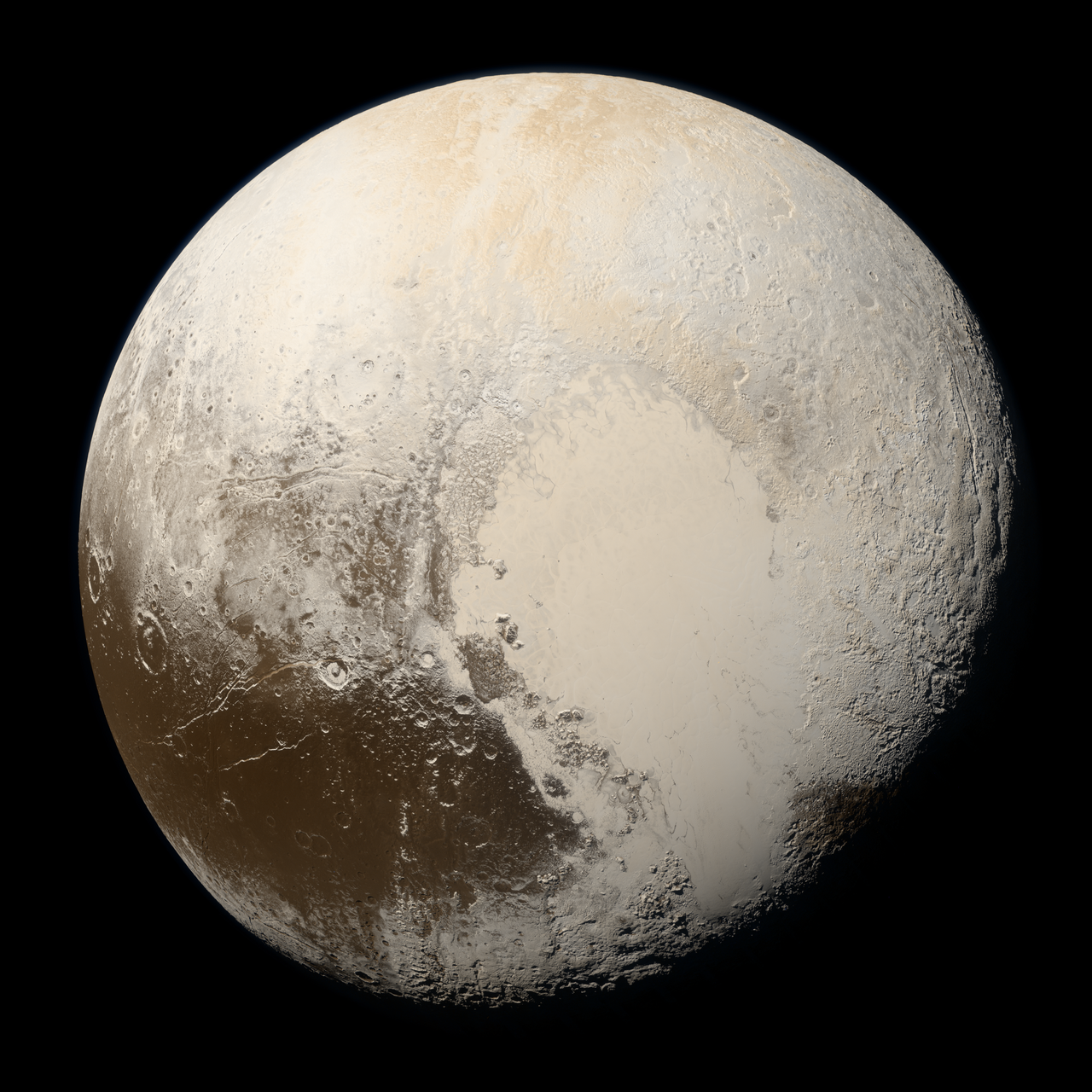
For decades, Pluto represented the outermost known planet in the Solar System. Although it is now classified as a dwarf planet, it remains one of the most fascinating frozen worlds ever explored.
Located an average of about 5.9 billion kilometers (3.7 billion miles) from the Sun, Pluto receives only about one sixteen-hundredth of the sunlight Earth does. At this distance, sunlight is weaker than bright moonlight on Earth.
Surface temperatures typically range between about −240°C and −230°C (33–43 K), making Pluto one of the coldest known planetary bodies in the Solar System.
When NASA’s New Horizons flew past Pluto in 2015, scientists expected a heavily cratered ice ball. Instead, they discovered a surprisingly dynamic world.
Towering mountains made of water ice rise several kilometers high. Vast plains of frozen nitrogen slowly flow like glaciers. Thin layers of methane and carbon monoxide cover portions of the landscape. A blue atmospheric haze extends hundreds of kilometers above the surface.
Perhaps most surprising, Pluto appears to possess internal geological activity despite its incredible cold.
The famous heart-shaped region known as Sputnik Planitia contains nitrogen ice that slowly convects, continuously renewing the surface. Some scientists also suspect a buried subsurface ocean may still exist beneath its frozen crust.
Pluto demonstrates that extreme cold does not necessarily mean geological death.
2. Triton
Orbiting the giant planet Neptune is one of the coldest major moons ever studied.
Triton has an average surface temperature of approximately −235°C (38 K).
Discovered in 1846 shortly after Neptune itself, Triton is unusual in many ways. Unlike nearly every large moon in the Solar System, it orbits backward, suggesting it was originally a dwarf planet captured by Neptune’s gravity.
When NASA’s Voyager 2 flew past Triton in 1989, it revealed a surprisingly active world.
Dark geysers erupted through the icy surface, spraying nitrogen gas and dark particles several kilometers into the thin atmosphere.
Scientists believe sunlight penetrates translucent nitrogen ice, warming darker material beneath. Pressure builds until gas bursts through the surface in dramatic eruptions.
Despite temperatures only a few dozen degrees above absolute zero, Triton remains geologically active.
Its surface consists primarily of frozen nitrogen, methane, carbon monoxide, and water ice. Large smooth plains suggest cryovolcanism—volcanic activity involving water and other volatile substances instead of molten rock.
3. Eris
Even farther from the Sun than Pluto lies the massive dwarf planet Eris.
Discovered in 2005, Eris helped trigger the debate that ultimately led to Pluto’s reclassification as a dwarf planet.
Eris travels on a highly elongated orbit that carries it extraordinarily far from the Sun. Near its most distant point, solar energy becomes incredibly weak.
Surface temperatures can fall to around −243°C (30 K).
At these temperatures, even nitrogen and methane behave differently than they do on Pluto.
Astronomers believe methane frost covers much of Eris, while seasonal changes may redistribute frozen gases across its surface as the dwarf planet slowly moves through its 557-year orbit.
Because Eris has only been observed remotely through telescopes, much remains unknown.
Its high reflectivity suggests an extremely fresh icy surface continually renewed by seasonal frost.
Even sunlight requires many hours to travel from the Sun to this distant world.
4. Sedna
Among the most mysterious objects ever discovered in the Solar System is Sedna.
Its orbit is unlike almost anything else known.
Sedna requires roughly 11,400 years to complete a single journey around the Sun.
At its greatest distance, it ventures more than 900 astronomical units away.
There, sunlight becomes almost unimaginably faint.
Scientists estimate surface temperatures can approach approximately −240°C to −250°C, depending on its orbital position.
Sedna may preserve some of the oldest and least-altered material remaining from the Solar System’s formation.
Because it spends nearly its entire orbit in profound isolation, it experiences environmental conditions unlike those of most planetary bodies.
Its reddish surface likely contains complex organic compounds altered by cosmic radiation over billions of years.
Sedna represents a bridge between the distant Kuiper Belt and the even more remote Oort Cloud.
5. Uranus
Although Neptune is farther from the Sun, the coldest planetary atmosphere in the Solar System actually belongs to Uranus.
Temperatures within portions of Uranus’s upper atmosphere have been measured as low as −224°C (49 K).
This surprising result puzzled astronomers for decades.
One might expect Neptune to be colder because it receives less sunlight.
Instead, Neptune generates significantly more internal heat than Uranus.
For reasons still not fully understood, Uranus radiates remarkably little energy from its interior.
As a result, parts of its atmosphere become colder than those of any other planet.
The planet’s atmosphere consists primarily of hydrogen and helium, with methane giving Uranus its characteristic blue-green color.
High-altitude clouds form from frozen methane crystals drifting through one of the coldest atmospheres known.
6. Neptune
At an average distance of about 4.5 billion kilometers from the Sun, Neptune receives only a tiny fraction of Earth’s sunlight.
Cloud-top temperatures typically reach around −214°C (59 K).
Despite this intense cold, Neptune is surprisingly dynamic.
It possesses some of the fastest winds in the Solar System, exceeding 2,000 kilometers per hour in some regions.
Internal heat rising from deep within the planet powers storms, cloud systems, and atmospheric circulation despite the weak solar energy reaching its atmosphere.
Neptune reminds scientists that temperature alone does not determine planetary activity.
Even frozen worlds can possess extraordinarily energetic weather.
7. Europa
Beneath an icy shell orbiting Jupiter may lie one of the Solar System’s most promising locations for extraterrestrial life.
Europa has average surface temperatures between approximately −220°C and −160°C, depending on latitude.
Its surface is among the smoothest known anywhere.
Gigantic cracks crisscross bright water ice stretching around the entire moon.
Although the surface is brutally cold, evidence strongly suggests a global liquid ocean exists beneath.
Tidal forces generated by Jupiter continuously flex Europa’s interior, producing heat through friction.
This hidden ocean may contain more liquid water than all of Earth’s oceans combined.
Scientists consider Europa one of the highest-priority targets in the search for life beyond Earth.
The contrast between its frozen surface and potentially warm ocean illustrates how internal energy can transform apparently hostile environments.
8. Enceladus
Tiny compared to Earth’s Moon, Enceladus nevertheless astonished planetary scientists.
Its surface averages roughly −201°C.
Yet beneath this frozen exterior lies an active ocean.
NASA’s Cassini–Huygens observed enormous water-rich plumes erupting from fractures near Enceladus’s south pole.
These geysers eject water vapor, ice particles, salts, silica, and organic molecules into space.
The discovery transformed understanding of icy moons.
Hydrothermal activity may occur where the ocean meets the rocky core, creating conditions similar to deep-sea hydrothermal vents on Earth.
Although Enceladus ranks among the coldest worlds at its surface, its hidden interior remains surprisingly dynamic.
9. Titan
Saturn’s largest moon, Titan, is unique.
Its surface temperature averages about −179°C (94 K).
That is cold enough for methane and ethane to exist as liquids.
Titan possesses rivers.
It has lakes.
It has seas.
But instead of water, these bodies contain liquid hydrocarbons.
Its thick nitrogen atmosphere resembles Earth’s more closely than any other moon’s atmosphere does.
Complex organic chemistry occurs continually as sunlight and energetic particles interact with atmospheric methane.
Scientists believe Titan may resemble aspects of the young Earth before life emerged.
Its frozen environment hosts one of the most chemically active landscapes beyond our planet.
10. Rogue Planet CFBDSIR 2149–0403
Not every world orbits a star.
Astronomers have discovered free-floating planetary-mass objects drifting through interstellar space.
One remarkable example is CFBDSIR 2149–0403.
Because it lacks a parent star, it receives essentially no external warmth.
Its temperature is estimated to be only a few hundred degrees Celsius above absolute zero—roughly around 400 K when young, cooling further over billions of years depending on its true age and mass. If it is indeed a rogue planet rather than a brown dwarf, it illustrates the ultimate frozen fate of isolated worlds as they radiate away their internal heat over cosmic timescales.
Many rogue planets likely become far colder than any planet bound to a star once their internal heat dissipates.
These lonely worlds drift through darkness for billions of years, illuminated only by distant stars.
They may represent one of the most common yet least understood classes of planetary objects in our galaxy.
Why Are These Worlds So Cold?
The temperatures of these worlds arise from several factors.
Distance from the Sun is the most obvious. Solar energy decreases rapidly with increasing distance, leaving outer Solar System bodies with very little incoming heat.
Atmospheric composition also matters. Thin atmospheres lose heat efficiently, while thick atmospheres can trap or redistribute energy.
Internal heat provides another important factor. Neptune remains warmer than expected because it releases substantial heat from within, while Uranus surprisingly emits very little internal energy.
Surface composition influences temperature as well. Bright ice reflects much of the sunlight that reaches it, limiting warming.
Finally, some worlds receive virtually no stellar energy at all, particularly rogue planets wandering through interstellar space.
How Scientists Measure Extreme Cold
Planetary temperatures are measured using multiple techniques.
Spacecraft carry infrared instruments capable of detecting thermal radiation emitted by planetary surfaces and atmospheres.
Earth-based observatories also observe infrared wavelengths that reveal surface temperatures from enormous distances.
Laboratory studies help scientists understand how different ices behave under extremely low temperatures, allowing observations to be interpreted accurately.
Computer models combine these measurements with information about sunlight, atmospheric chemistry, geology, and seasonal cycles.
Together, these methods produce increasingly precise estimates of conditions across distant worlds.
Could Life Exist on Frozen Worlds?
Extreme surface cold does not necessarily eliminate the possibility of life.
Europa and Enceladus demonstrate that liquid oceans may survive beneath kilometers of ice.
Internal heating produced by radioactive decay or gravitational tides can maintain liquid water even where surface temperatures are unimaginably low.
Astrobiologists increasingly believe that subsurface oceans may be among the most promising habitats beyond Earth.
Meanwhile, Titan challenges conventional assumptions by showing that complex organic chemistry can occur in environments dominated by liquid methane instead of liquid water.
These worlds expand our understanding of where habitable environments might exist.
The Beauty of Cosmic Winter
The coldest worlds in the universe are not lifeless wastelands devoid of interest. They are landscapes of frozen nitrogen plains, methane snowfalls, crystal-clear water-ice mountains, hidden oceans, towering geysers, and chemical processes unlike anything found on Earth. They reveal that planetary diversity extends far beyond the warm environments most familiar to us.
As telescopes grow more powerful and new spacecraft venture deeper into the Solar System, scientists will undoubtedly discover even colder worlds. Some may orbit faint red dwarf stars. Others may wander the darkness between stars entirely alone. Each discovery will broaden our understanding of how planets form, evolve, and survive under the most extreme conditions nature can produce.
These frozen worlds remind us that the universe is astonishingly diverse. While Earth is a blue oasis of liquid water and moderate temperatures, much of the cosmos belongs to ice, darkness, and silence—places where the Sun is only a distant point of light, yet where remarkable geological activity, hidden oceans, and perhaps even life itself may still endure beneath an endless cosmic winter.