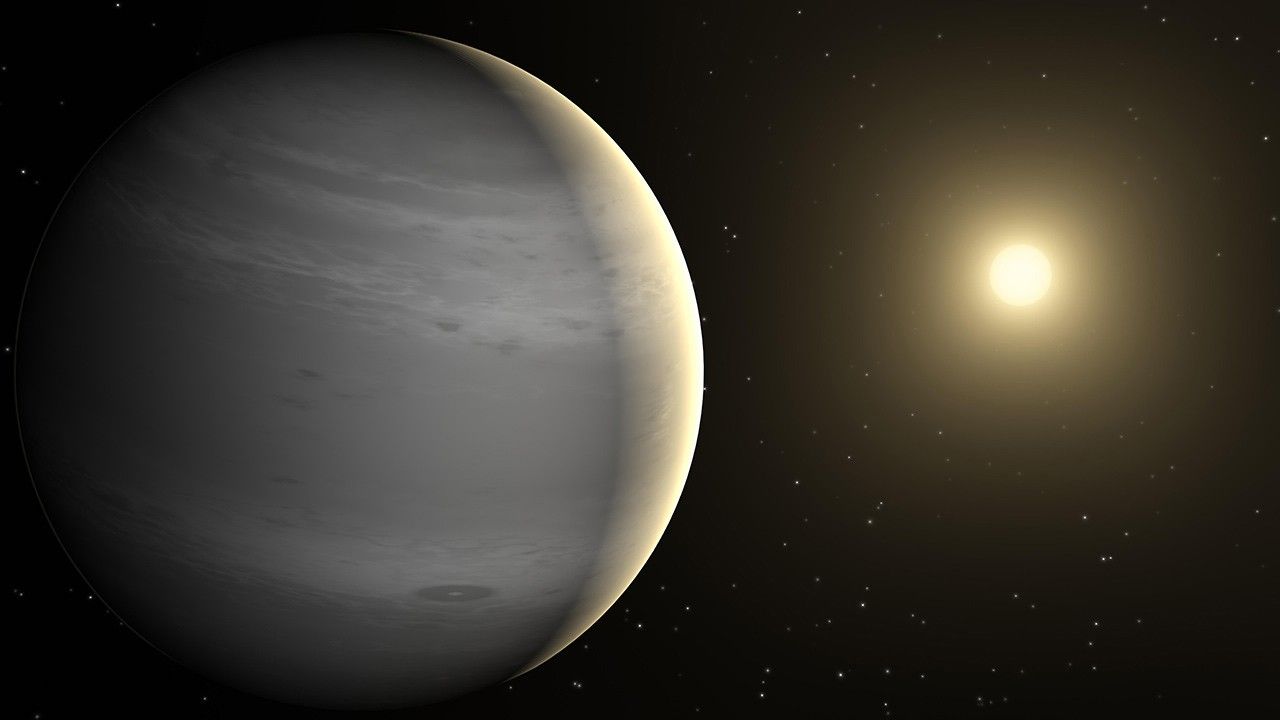
For thousands of years, humanity believed the planets of our own Solar System represented the full diversity of worlds in the universe. Jupiter seemed unimaginably enormous, Saturn dazzled with its rings, and Neptune marked the outer reaches of planetary grandeur. Then, in the last few decades, astronomy entered a revolutionary era.
With the discovery of planets orbiting distant stars—known as exoplanets—scientists realized that nature is capable of producing worlds far larger, hotter, stranger, and more extreme than anyone had imagined. Some are so immense that they challenge the very definition of a planet. Others orbit so close to their stars that their atmospheres are literally evaporating into space. A few are so bloated by intense stellar radiation that they have incredibly low densities despite their enormous sizes.
When discussing the “largest” planets, astronomers usually refer to physical radius, not mass. This distinction is important because the largest planets by diameter are not necessarily the most massive. Once a gas giant grows beyond about one Jupiter mass, gravity begins compressing it, preventing it from becoming much larger in radius. In fact, some planets several times more massive than Jupiter are actually smaller than less massive worlds.
Current observations indicate that planets larger than about twice Jupiter’s radius are extremely rare because stronger gravity compresses hydrogen and helium under immense pressure. Some of the largest known planets are also among the least dense objects ever discovered, with densities lower than cork.
The following fifteen worlds are among the largest planets ever confirmed by astronomers, based primarily on measured radius. While new discoveries continue to refine these rankings, these extraordinary giants represent some of the biggest planetary bodies known in the Milky Way.
1. HAT-P-67 b
Among all confirmed exoplanets, HAT-P-67 b ranks as one of the largest by radius ever discovered.
This extraordinary gas giant has an estimated radius of roughly 2.08 times that of Jupiter, making it more than twenty times wider than Earth. Despite its enormous size, it possesses an astonishingly low density. If a sufficiently large ocean existed—which is physically impossible—it would likely float more easily than many common materials on Earth.
The planet orbits a rapidly rotating F-type star approximately 1,200 light-years away in the constellation Hercules.
Its orbit is remarkably close to its host star, completing one revolution in just over four days. Intense stellar radiation heats the atmosphere to extreme temperatures, causing it to expand dramatically.
Astronomers believe the planet is significantly inflated by this constant heating. Instead of being compact like Jupiter, its upper atmosphere has swollen into an enormous envelope extending far from its core.
Despite its giant dimensions, HAT-P-67 b contains only a fraction of Jupiter’s density, making it one of the puffiest planets ever found.
2. WASP-17 b
When it was announced in 2009, WASP-17 b astonished astronomers.
With a radius approaching 2.0 Jupiter radii, this gas giant became one of the largest known planets and remains among the most inflated.
Located roughly 1,300 light-years from Earth, it circles its star in fewer than four days.
One remarkable feature of WASP-17 b is that it travels in the opposite direction of its star’s rotation—a retrograde orbit that likely resulted from dramatic gravitational interactions early in the system’s history.
Its atmosphere reaches temperatures exceeding 1,500 kelvin, causing hydrogen and helium gases to expand enormously.
Although physically gigantic, the planet contains less than half Jupiter’s mass.
Its average density is lower than many forms of foam.
Studies using space telescopes have detected water vapor and investigated atmospheric chemistry, making WASP-17 b an important laboratory for understanding inflated gas giants.
3. Kepler-51 d
Not every giant planet is massive.
Kepler-51 d is one of the strangest planets ever discovered because of its extraordinary combination of large size and extremely low mass.
Its radius is approximately 1.9 times that of Jupiter, yet its mass is only a tiny fraction of Jupiter’s.
Astronomers often describe planets like this as “super-puffs.”
The planet’s atmosphere is thought to consist largely of hydrogen and helium extending thousands of kilometers above the interior.
Computer models suggest its atmosphere may contain high-altitude hazes that help explain observations.
Because gravity is relatively weak, the planet struggles to retain its expanded outer layers, making atmospheric escape an important area of ongoing research.
Kepler-51 d demonstrates that planetary size alone does not reveal a planet’s true nature.
4. WASP-79 b
WASP-79 b is another spectacular hot Jupiter whose intense stellar heating has dramatically inflated its atmosphere.
The planet has a radius of approximately 1.8 to 1.9 times Jupiter’s.
Orbiting an F-type star roughly 780 light-years away, it receives enormous amounts of stellar radiation.
Observations using transmission spectroscopy have revealed evidence of water vapor in its atmosphere.
Scientists continue studying cloud formation, atmospheric circulation, and heat transport on this enormous world.
Despite its tremendous size, the planet remains much less dense than Jupiter, illustrating how temperature can profoundly affect planetary structure.
5. WASP-107 b
Although not quite as large as some entries above, WASP-107 b deserves special attention because of its remarkable internal structure.
Its radius is approximately 94% that of Jupiter, but its mass is only about one-tenth Jupiter’s.
This combination makes it one of the least dense planets ever measured.
Astronomers have detected helium escaping from its atmosphere, providing direct evidence that intense stellar radiation is gradually stripping away its outer layers.
The escaping gas extends into space like a giant comet-like tail.
WASP-107 b offers valuable insight into atmospheric evolution and the long-term survival of giant planets orbiting close to their stars.
6. HAT-P-32 b
HAT-P-32 b ranks among the largest hot Jupiters discovered.
Its radius measures roughly 1.8 Jupiter radii.
The planet orbits extremely close to its host star, completing one orbit in just over two days.
Observations indicate an atmosphere filled with clouds or hazes that obscure many chemical features.
This thick atmospheric layer makes detailed spectroscopic analysis challenging but scientifically valuable.
Researchers continue investigating how such atmospheres form under intense irradiation.
7. TrES-4 b
When first discovered, TrES-4 b immediately attracted attention for its enormous size.
Its radius is approximately 1.8 times Jupiter’s.
Yet its mass is less than Jupiter’s.
The planet’s atmosphere is so expanded that it became one of the earliest examples of an extremely inflated hot Jupiter.
Theoretical models continue exploring how stellar heating, internal energy transport, and atmospheric opacity combine to produce such extraordinary dimensions.
8. WASP-121 b
WASP-121 b is not only enormous but also one of the hottest known planets.
Its radius approaches 1.8 Jupiter radii.
The planet orbits so close to its star that one year lasts only about thirty hours.
Temperatures exceed 2,500 kelvin.
Under these conditions, many metals vaporize.
Astronomers have detected water molecules, iron vapor, magnesium, vanadium oxide, and other elements within its atmosphere.
The planet is also slowly being distorted by tidal forces and may eventually be torn apart if it moves even closer to its star.
9. KELT-9 b
KELT-9 b orbits the hottest known star to host a confirmed planet.
Its radius measures approximately 1.8 Jupiter radii, while temperatures exceed 4,000 kelvin—hotter than some stars.
Its atmosphere contains vaporized metals including iron and titanium.
Molecules cannot survive for long under such intense heat.
Instead, atoms dominate the upper atmosphere.
KELT-9 b represents one of the most extreme environments ever observed on a planet.
10. Kepler-7 b
Kepler-7 b combines large size with remarkably low density.
Its radius is about 1.6 times Jupiter’s.
The planet became famous after astronomers produced one of the first cloud maps of an exoplanet.
Unlike Jupiter’s colorful bands, Kepler-7 b appears to possess enormous reflective cloud systems concentrated in particular regions.
These observations help scientists understand atmospheric circulation under extreme conditions.
11. WASP-12 b
WASP-12 b has a radius approaching 1.8 Jupiter radii and orbits dangerously close to its parent star.
Gravitational forces have stretched the planet into an egg-like shape.
Material continuously escapes from its atmosphere and falls toward the star.
Astronomers believe tidal interactions may eventually destroy the planet entirely.
It remains one of the best-studied examples of planetary atmospheric loss.
12. HAT-P-33 b
HAT-P-33 b is another enormously inflated hot Jupiter.
Its radius exceeds 1.7 Jupiter radii, despite having only a modest mass.
The star it orbits is unusually active, making precise measurements difficult.
Even so, observations consistently indicate one of the largest planetary atmospheres currently known.
Researchers continue studying its orbital evolution and atmospheric expansion.
13. WASP-31 b
With a radius around 1.5 to 1.6 Jupiter radii, WASP-31 b is another giant whose atmosphere has revealed fascinating chemistry.
Using transmission spectroscopy, astronomers detected evidence of potassium while finding surprisingly weak sodium signatures.
The atmosphere also appears to contain high-altitude clouds.
These observations provide important tests for atmospheric models of giant exoplanets.
14. HAT-P-41 b
HAT-P-41 b has an estimated radius approaching 1.7 Jupiter radii.
Its close orbit exposes it to intense stellar radiation that contributes to atmospheric inflation.
Space-based observations have investigated its atmospheric composition, temperature structure, and cloud properties.
Like many giant hot Jupiters, the planet likely experiences permanent day and night sides because tidal forces lock one hemisphere toward its star.
15. XO-6 b
XO-6 b rounds out this list as another exceptionally large gas giant.
Its radius measures approximately 1.9 Jupiter radii, placing it among the biggest confirmed planets by size.
The planet circles a rapidly rotating star every few days.
Its atmosphere experiences extreme heating, leading to significant inflation compared with colder gas giants.
Because the host star rotates quickly, studying the system has provided astronomers with valuable information about planetary orbital alignment and migration.
Why These Giant Planets Are So Large
One of the biggest surprises in exoplanet science is that many of the largest planets are not the most massive.
In fact, adding more mass to a gas giant eventually causes gravity to compress the planet rather than expand it.
This occurs because hydrogen and helium become increasingly compressed under enormous pressure.
As a result, a planet with three or four times Jupiter’s mass may actually be smaller than a less massive but intensely heated hot Jupiter.
The giants on this list achieve their enormous radii largely because they orbit extremely close to their stars.
Intense stellar radiation heats their upper atmospheres, causing gases to expand dramatically.
Additional mechanisms—including tidal heating, atmospheric circulation, and delayed cooling—may also contribute.
Understanding these inflation processes remains an active area of astronomical research.
When Does a Planet Become Too Massive?
Astronomers distinguish giant planets from brown dwarfs using mass rather than size.
Objects exceeding roughly 13 times Jupiter’s mass can temporarily fuse deuterium, a heavy form of hydrogen.
Such objects are generally classified as brown dwarfs rather than planets, although the boundary is not always straightforward because formation history also matters.
Interestingly, many brown dwarfs are actually smaller in radius than the inflated planets discussed here.
This illustrates how size and mass can differ dramatically in astronomy.
The Search for Even Bigger Worlds
Modern observatories such as NASA’s Transiting Exoplanet Survey Satellite (TESS), the James Webb Space Telescope, and numerous ground-based telescopes continue discovering new giant planets.
Future missions will improve measurements of planetary radii, masses, and atmospheric composition with unprecedented precision.
Some currently known planets may eventually be reclassified as new data become available, while future discoveries could reveal even larger worlds approaching the theoretical upper limit for planetary size.
Giants Beyond Imagination
The discovery of enormous exoplanets has fundamentally changed humanity’s view of the universe.
Jupiter once seemed like the ultimate giant. Today, astronomers know of worlds that dwarf it in physical size, possess atmospheres hundreds of times more extended, and orbit under conditions so extreme that metals vaporize and gases escape into space.
These colossal planets remind us that nature is remarkably creative. The universe continually produces worlds that challenge theory, stretch the limits of planetary physics, and force scientists to rethink how planets form and evolve.
Each new giant discovered among the stars is more than just another entry in an astronomical catalog. It is another reminder that our Solar System represents only one small chapter in the astonishing diversity of planetary systems throughout the Milky Way.