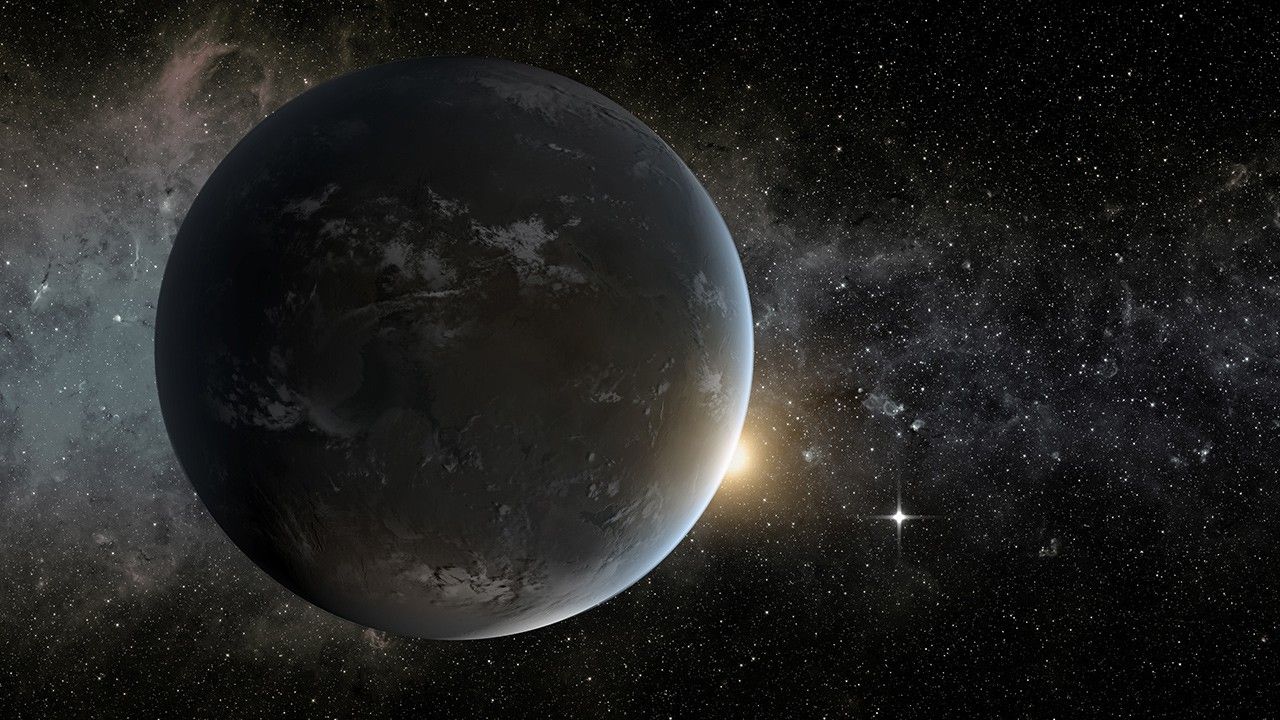
For thousands of years, humanity believed Earth was unique—a solitary oasis of life surrounded by an endless ocean of stars. Today, that view has changed dramatically. Thanks to powerful space telescopes and decades of astronomical discoveries, scientists now know that planets are common throughout the Milky Way. Since the first confirmed exoplanet orbiting a Sun-like star was discovered in 1995, astronomers have identified more than 5,000 confirmed exoplanets, with thousands more awaiting confirmation.
Among these distant worlds are giant gas planets larger than Jupiter, scorched lava worlds hotter than molten rock, frozen planets wandering through interstellar space, and rocky planets that may possess conditions surprisingly similar to those on Earth.
The question that drives much of modern astronomy is no longer whether planets exist elsewhere. It is whether any of them could support life.
Scientists cannot yet say that any exoplanet is inhabited. No telescope has detected forests, oceans, animals, or alien civilizations. Instead, researchers evaluate “habitability” by examining measurable properties. They ask whether a planet receives the right amount of stellar energy for liquid water to exist, whether its size suggests a rocky composition, whether its gravity could retain an atmosphere, whether its host star is relatively stable, and whether the system has existed long enough for life to potentially emerge.
Habitability does not mean inhabited.
A planet may appear ideal yet prove barren. Conversely, life could exist in environments very different from Earth. Nevertheless, these potentially habitable worlds represent the best places currently known to search for extraterrestrial biology.
The following ten planets are among the most promising candidates identified so far. Each has strengths, uncertainties, and fascinating scientific stories that continue to unfold.
1. Kepler-442b
Among all currently known exoplanets, Kepler-442b is frequently regarded as one of the strongest candidates for potential habitability.
Discovered in 2015 by NASA’s Kepler Space Telescope, this world orbits a relatively cool K-type star approximately 1,200 light-years from Earth in the constellation Lyra.
Kepler-442b is about 1.34 times Earth’s radius, making it likely to be a rocky super-Earth rather than a gas giant. Models suggest that planets of this size often retain solid surfaces while possessing somewhat stronger gravity than Earth.
Its greatest advantage is its orbit.
The planet lies within the habitable zone of its star—the region where temperatures could allow liquid water to exist on a planetary surface if an appropriate atmosphere is present.
Because K-type stars burn their fuel more slowly than the Sun, they can remain stable for tens of billions of years. This potentially provides much longer periods for biological evolution than Earth has experienced so far.
Researchers estimate that Kepler-442b receives about two-thirds as much stellar energy as Earth receives from the Sun. Depending on atmospheric composition, this could produce moderate surface temperatures.
However, important uncertainties remain.
Astronomers do not yet know whether the planet possesses oceans, continents, an atmosphere, or even a magnetic field. All of these factors strongly influence habitability.
Nevertheless, among currently known exoplanets, Kepler-442b consistently ranks near the top of scientific assessments.
2. TRAPPIST-1e
Few planetary systems have transformed exoplanet research as dramatically as the TRAPPIST-1 system.
Located about 40 light-years away, this remarkable red dwarf star hosts seven Earth-sized planets packed into an extraordinarily compact system.
Among them, TRAPPIST-1e stands out as perhaps the most promising.
Its radius and mass closely resemble Earth’s, strongly suggesting a rocky composition.
Most importantly, it orbits within the star’s habitable zone.
Because the host star is much cooler than the Sun, TRAPPIST-1e circles it at an extremely close distance while still receiving a level of stellar energy comparable to Earth.
Scientists have modeled numerous climate scenarios for the planet. Under several plausible atmospheric conditions, liquid water could remain stable across significant portions of its surface.
The system has become one of the primary targets of the James Webb Space Telescope, which is beginning to investigate planetary atmospheres through transit spectroscopy.
Yet challenges exist.
Red dwarf stars often produce powerful stellar flares capable of stripping planetary atmospheres over time.
Whether TRAPPIST-1e possesses sufficient atmospheric protection remains unknown.
Even so, because of its proximity and Earth-like characteristics, it represents one of the best laboratories for studying potentially habitable worlds beyond our Solar System.
3. Proxima Centauri b
If humanity ever sends an interstellar probe to another potentially habitable planet, Proxima Centauri b is the most likely destination.
It orbits Proxima Centauri, the closest known star to the Sun, only about 4.24 light-years away.
Discovered in 2016 using precise measurements of stellar motion, the planet has an estimated minimum mass slightly greater than Earth’s.
Its location within the habitable zone immediately captured worldwide attention.
The possibility that Earth’s nearest stellar neighbor hosts a potentially habitable world fundamentally changed discussions about future space exploration.
However, Proxima Centauri is an active red dwarf star.
It frequently emits intense flares that bombard nearby planets with ultraviolet and X-ray radiation.
Whether Proxima Centauri b has retained a substantial atmosphere despite billions of years of stellar activity remains one of astronomy’s biggest unanswered questions.
Some climate models suggest that a sufficiently dense atmosphere or global ocean could provide protection.
Others indicate atmospheric erosion may have rendered the surface hostile.
Despite these uncertainties, no potentially habitable planet lies closer to Earth.
That fact alone ensures its continuing importance in exoplanet research.
4. TOI-700 d
The discovery of TOI-700 d demonstrated the capabilities of NASA’s Transiting Exoplanet Survey Satellite (TESS).
Located approximately 100 light-years away, the planet orbits a relatively quiet red dwarf star.
Unlike many active red dwarfs, TOI-700 appears comparatively stable, reducing concerns about frequent stellar flares.
TOI-700 d is roughly 20 percent larger than Earth and receives approximately 86 percent of the stellar energy Earth receives from the Sun.
Climate simulations suggest that, under certain atmospheric conditions, stable liquid water could exist.
Researchers have modeled scenarios involving Earth-like atmospheres, dense carbon dioxide atmospheres, and ocean-covered worlds.
Several of these simulations produce climates capable of maintaining temperate conditions.
The system has become an important target for future atmospheric characterization.
5. Kepler-186f
When Kepler-186f was announced in 2014, it marked a historic milestone.
It became the first Earth-sized planet confirmed within the habitable zone of another star.
Located roughly 580 light-years away, the planet orbits a cool red dwarf.
Its radius measures only about 11 percent larger than Earth’s, making it one of the closest Earth analogs discovered during the Kepler mission.
Scientists know relatively little about its atmosphere, composition, or climate.
Nevertheless, its discovery proved that Earth-sized planets within habitable zones are not rare exceptions.
They exist throughout the galaxy.
This realization fundamentally changed estimates of how many potentially habitable planets may populate the Milky Way.
6. LHS 1140 b
LHS 1140 b has emerged as one of the most intriguing super-Earths known today.
Orbiting a nearby red dwarf approximately 49 light-years away, it possesses about six times Earth’s mass and roughly 1.7 times Earth’s radius.
Although more massive than Earth, density measurements indicate a rocky composition.
Recent observations have raised the possibility that the planet could possess a substantial atmosphere.
Some models even suggest it may host a global ocean or extensive bodies of liquid water if atmospheric conditions are favorable.
Its host star is relatively quiet compared with many red dwarfs, improving long-term prospects for atmospheric stability.
The James Webb Space Telescope continues investigating whether atmospheric gases are present.
Future observations may dramatically improve understanding of this fascinating world.
7. K2-18 b
Few exoplanets have generated as much recent scientific excitement as K2-18 b.
Located approximately 124 light-years away, it is significantly larger than Earth, with about 8.6 Earth masses.
Rather than being a simple rocky planet, many researchers classify it as a possible “Hycean world”—a hypothetical type of planet featuring deep global oceans beneath hydrogen-rich atmospheres.
Observations by the James Webb Space Telescope have detected atmospheric molecules including methane and carbon dioxide.
Scientists continue debating the planet’s exact nature.
Some studies suggest it may possess conditions compatible with liquid water beneath its atmosphere.
Others argue it may instead resemble a mini-Neptune with no habitable surface.
Its true environment remains uncertain.
Nevertheless, K2-18 b represents one of the most important targets in the search for potentially habitable environments beyond Earth.
8. Ross 128 b
Ross 128 b orbits one of the quietest red dwarf stars known.
Located only about 11 light-years away, it is among the nearest potentially habitable exoplanets.
Unlike Proxima Centauri, Ross 128 exhibits relatively low flare activity.
This significantly improves the chances that nearby planets could retain stable atmospheres.
Ross 128 b has a minimum mass roughly 1.35 times Earth’s and receives only slightly more stellar energy than Earth receives from the Sun.
Although its exact atmospheric properties remain unknown, its calm stellar environment makes it one of the most attractive nearby candidates for future observation.
As telescope technology improves, Ross 128 b may become one of the first nearby planets whose atmosphere can be studied in detail.
9. Teegarden’s Star b
Discovered in 2019, Teegarden’s Star b quickly attracted attention because of its exceptional Earth Similarity Index.
It orbits an ancient red dwarf located only about 12.5 light-years away.
The planet’s minimum mass is remarkably close to Earth’s, and it receives approximately the same amount of stellar energy as our planet.
Computer simulations suggest that, under suitable atmospheric conditions, temperatures compatible with liquid water could exist.
Its host star appears relatively stable and has likely existed for billions of years, providing ample time for biological evolution if life ever emerged.
Although many properties remain unknown, Teegarden’s Star b ranks among the most promising nearby rocky exoplanets.
10. Wolf 1069 b
One of the newest additions to the list of potentially habitable worlds is Wolf 1069 b.
Announced in 2023, the planet orbits a nearby red dwarf only about 31 light-years away.
It possesses a mass similar to Earth’s and resides within the star’s habitable zone.
Researchers estimate that it receives roughly two-thirds of the stellar energy Earth receives from the Sun.
Because the host star is relatively inactive compared with many red dwarfs, scientists consider atmospheric survival more plausible than in highly active systems.
One side of the planet may permanently face its star due to tidal locking.
However, modern climate models indicate that with a sufficiently dense atmosphere, heat could circulate efficiently enough to maintain habitable conditions across portions of the surface.
Wolf 1069 b has quickly become a high-priority target for future observations.
What Makes a Planet Truly Habitable?
Finding a planet inside the habitable zone is only the beginning.
Habitability depends upon a remarkable combination of factors working together over immense spans of time.
A planet must likely possess a stable atmosphere capable of regulating temperature.
Liquid water must remain available for extended periods.
The host star should avoid frequent violent eruptions.
A magnetic field may help protect the atmosphere from stellar winds.
Plate tectonics could recycle carbon and stabilize long-term climate, although scientists do not yet know whether this process is essential.
Even the planet’s rotation, axial tilt, orbital shape, and geological activity may influence habitability.
Earth itself demonstrates how many interconnected systems contribute to a living world.
Simply matching one or two characteristics is unlikely to be sufficient.
How Scientists Search for Signs of Life
The search for life extends far beyond discovering planets.
Modern astronomers increasingly focus on planetary atmospheres.
As a planet passes in front of its host star, tiny fractions of starlight filter through its atmosphere.
Different gases absorb different wavelengths of light.
By analyzing these absorption patterns, scientists can identify atmospheric molecules.
Water vapor, oxygen, ozone, methane, carbon dioxide, and other gases may provide clues about planetary environments.
Future observatories may eventually detect combinations of gases that are difficult to explain without biological activity.
Such evidence would not prove intelligent life.
It could, however, suggest the presence of microorganisms or simple ecosystems.
That would represent one of the greatest scientific discoveries in human history.
The Next Generation of Planet Hunters
Astronomy is entering an extraordinary era.
The James Webb Space Telescope is already revolutionizing atmospheric studies.
Future observatories, including the European Extremely Large Telescope, the Giant Magellan Telescope, the Thirty Meter Telescope, NASA’s planned Habitable Worlds Observatory, and other next-generation instruments will dramatically expand scientists’ ability to characterize distant planets.
Instead of merely detecting planets, astronomers may eventually map cloud systems, measure seasons, identify continents and oceans indirectly, and search for chemical signatures of life.
Each technological advance brings humanity closer to answering one of the oldest questions ever asked.
A Galaxy Filled with Possibility
Only a generation ago, humanity knew of no planets beyond our Solar System.
Today, thousands have been confirmed.
Many more await discovery.
The ten worlds described here are not guaranteed second Earths. Some may prove barren deserts, frozen wastelands, or inhospitable ocean worlds. Others could possess environments unlike anything found in our Solar System. At present, scientists simply do not know.
Yet each represents a remarkable possibility.
Each reminds us that Earth is almost certainly not the only rocky world capable of supporting liquid water.
Somewhere among the hundreds of billions of stars in the Milky Way—and the trillions of galaxies beyond—there may exist countless planets where rain falls, rivers flow, clouds drift across blue skies, and perhaps, somewhere, life has found a way to flourish.
Whether any of these ten planets truly hosts living organisms remains one of astronomy’s greatest unanswered questions. But with every new telescope, every improved observation, and every exoplanet discovered, humanity moves one step closer to finding the answer.