For centuries, when scientists and philosophers imagined life beyond Earth, they focused almost entirely on planets. Worlds orbiting distant stars seemed like the obvious places where oceans, atmospheres, and perhaps civilizations might exist. Moons, by comparison, were often treated as little more than rocky companions circling larger worlds.
Modern planetary science has completely transformed that view.
Today, some of the most promising places to search for extraterrestrial life are not planets at all—they are moons. Hidden beneath thick shells of ice, wrapped in mysterious atmospheres, or warmed by the relentless pull of gravity, several moons in our own Solar System may possess the essential ingredients needed for life as we understand it.
The discovery of subsurface oceans, organic molecules, hydrothermal activity, and active water plumes has changed one of humanity’s oldest questions from “Are moons dead?” to “Could some of them actually be alive?”
Scientists do not claim that alien life has been found. There is currently no confirmed evidence of life beyond Earth. However, multiple moons possess environments that may be habitable for microbial organisms—or perhaps even more complex forms of life if favorable conditions have existed long enough.
Habitability does not guarantee life. It simply means that the necessary ingredients may be present: liquid water, energy sources, essential chemical elements, and environmental stability.
As robotic spacecraft continue exploring the outer Solar System and increasingly powerful telescopes examine distant planetary systems, these remarkable moons have become some of the most exciting destinations in astrobiology.
Here are fifteen moons that scientists consider among the most intriguing candidates in the search for alien life.
1. Europa (Jupiter)
Among every moon in the Solar System, none has inspired more excitement among astrobiologists than Europa.
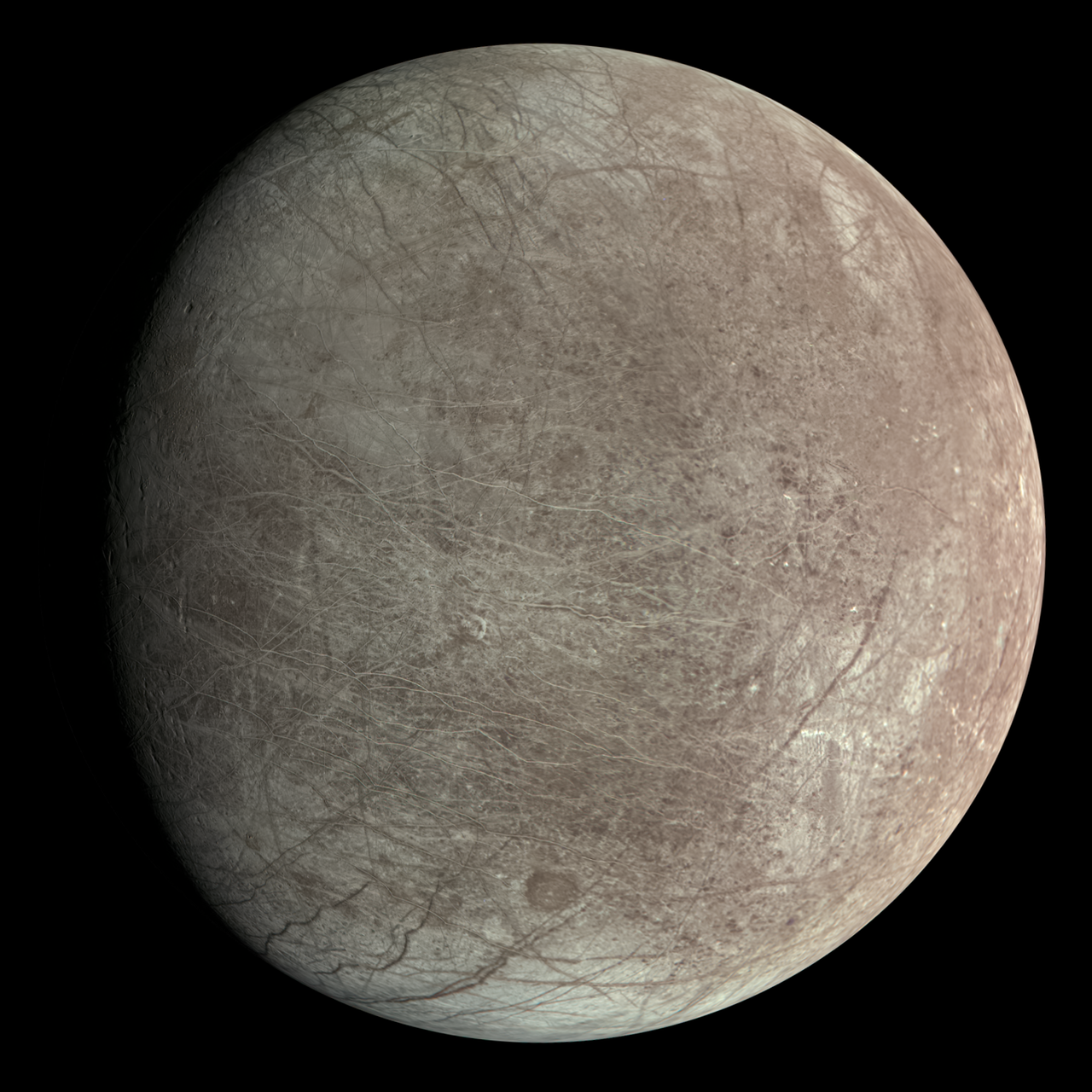
Slightly smaller than Earth’s Moon, Europa appears deceptively simple. Its bright icy surface is covered with long reddish fractures stretching across thousands of kilometers. Very few impact craters scar the landscape, suggesting that the surface is geologically young and continually renewed.
The true wonder lies beneath the ice.
Multiple lines of evidence indicate that Europa hides a global ocean beneath an ice shell estimated to be several kilometers to perhaps a few tens of kilometers thick. This ocean may contain more than twice as much water as all of Earth’s oceans combined.
The gravitational pull of Jupiter constantly flexes Europa’s interior through tidal heating. This process generates internal warmth that prevents the ocean from freezing solid.
Scientists believe that the rocky seafloor may host hydrothermal vents similar to those on Earth’s ocean floor. Around terrestrial hydrothermal vents, sunlight is unnecessary. Entire ecosystems thrive using chemical energy supplied by interactions between seawater and hot rock.
If similar environments exist within Europa’s ocean, they could provide energy and nutrients capable of supporting microbial life.
Observations by the Galileo spacecraft, the Hubble Space Telescope, and more recently the Juno mission have strengthened evidence for this hidden ocean.
NASA’s Europa Clipper mission is now exploring this remarkable moon in unprecedented detail, searching for signs that its hidden ocean may indeed be habitable.
2. Enceladus (Saturn)
If Europa is the most famous candidate for alien life, Enceladus may be the most surprising.
Only about 500 kilometers across, this tiny moon of Saturn was once thought to be an ordinary frozen world.
Everything changed when the Cassini spacecraft flew past it.
Near Enceladus’ south pole, Cassini discovered enormous geysers erupting through fractures known as “tiger stripes.” These spectacular plumes eject water vapor, ice particles, salts, silica grains, methane, molecular hydrogen, and numerous organic compounds into space.
Cassini actually flew directly through these plumes, allowing onboard instruments to analyze their composition.
The findings transformed astrobiology.
The detected molecular hydrogen strongly suggests that hydrothermal reactions occur where liquid water interacts with warm rock deep beneath the surface.
Such reactions provide chemical energy capable of supporting microbial ecosystems on Earth.
The presence of phosphorus—an essential ingredient for life—has further strengthened Enceladus’ status as one of the Solar System’s most promising habitable environments.
Scientists now believe that beneath its icy crust lies a global ocean surrounding a rocky core.
Remarkably, future missions would not necessarily need to drill through kilometers of ice. Material from the subsurface ocean is already being sprayed into space by natural geysers, making direct sampling possible.
3. Titan (Saturn)
Titan is unlike any other moon in the Solar System.
Larger than the planet Mercury, Titan possesses a thick nitrogen-rich atmosphere even denser than Earth’s.
Orange atmospheric haze conceals an astonishing landscape.
Radar observations by Cassini revealed rivers, lakes, seas, rainstorms, dunes, mountains, and coastlines.
Yet these rivers are not made of water.
Surface temperatures near -179°C keep water frozen as hard as rock.
Instead, liquid methane and ethane perform the role that water plays on Earth.
Methane clouds produce rainfall.
Rivers carve channels.
Lakes fill enormous basins.
Although the surface is extremely cold, scientists believe Titan also possesses a deep subsurface ocean composed primarily of liquid water mixed with ammonia.
This hidden ocean may provide a potentially habitable environment.
Meanwhile, Titan’s atmosphere naturally produces extraordinarily complex organic chemistry.
Sunlight and energetic particles break apart atmospheric molecules, generating thousands of organic compounds that eventually settle onto the surface.
Some researchers even speculate that entirely different forms of life—using liquid hydrocarbons rather than water—might theoretically exist, although no evidence currently supports this possibility.
NASA’s Dragonfly mission will explore Titan directly during the 2030s, investigating its chemistry and searching for clues about prebiotic processes.
4. Ganymede (Jupiter)
Ganymede is the largest moon in the Solar System.
It is even larger than Mercury.
Despite its enormous size, Ganymede remained underestimated for decades.
Modern observations reveal that it possesses a complex internal structure including a metallic core, rocky mantle, and multiple layers of ice and liquid water.
Scientists believe several subsurface oceans may exist within stacked layers beneath the icy crust.
One remarkable feature distinguishes Ganymede from every other moon.
It possesses its own magnetic field.
Generated by movement within its metallic core, this magnetic field helps scientists investigate the moon’s internal structure and provides valuable evidence regarding its hidden ocean.
Although the deepest oceans may lie beneath thick layers of ice, they still represent enormous reservoirs of liquid water.
The European Space Agency’s JUICE mission is currently studying Ganymede in detail to better understand its geology, magnetic environment, and potential habitability.
5. Callisto (Jupiter)
Among Jupiter’s large moons, Callisto appears heavily scarred by billions of years of impacts.
Its ancient cratered surface suggests limited geological activity.
Yet appearances can be misleading.
Magnetic measurements indicate that Callisto likely contains a subsurface salty ocean buried beneath ice.
Unlike Europa, tidal heating inside Callisto is relatively weak.
As a result, its ocean may be colder and less geologically active.
Nevertheless, liquid water itself remains an essential requirement for habitability.
Although Callisto currently ranks below Europa and Ganymede in terms of astrobiological potential, it remains an intriguing candidate deserving continued exploration.
6. Triton (Neptune)
Triton is one of the strangest moons ever discovered.
Unlike nearly every large moon in the Solar System, Triton orbits its planet backward.
This unusual motion strongly suggests that Triton was originally a dwarf planet captured by Neptune’s gravity.
The Voyager 2 spacecraft revealed nitrogen geysers erupting from its icy surface.
Such activity indicates that Triton remains geologically active despite its tremendous distance from the Sun.
Models suggest that tidal heating following its capture may have generated a subsurface ocean.
Although much colder than Europa or Enceladus today, some researchers believe liquid water may still survive beneath its frozen crust.
Future exploration could reveal whether this distant world retains habitable environments.
7. Dione (Saturn)
Dione appears quiet compared with Enceladus, yet subtle evidence suggests more activity than once believed.
Gravity measurements indicate the possible existence of a deep subsurface ocean.
Bright fractures crossing its surface resemble features associated with internal geological processes.
Although evidence remains less compelling than for Enceladus, Dione may still possess liquid water maintained by internal heat.
If confirmed, it would add another potentially habitable ocean world to Saturn’s growing collection.
8. Rhea (Saturn)
Rhea, Saturn’s second-largest moon, has traditionally been viewed as an inert icy body.
Recent studies, however, have suggested that under certain internal models, a subsurface ocean could exist beneath its frozen crust.
Evidence remains tentative, and many questions persist regarding its internal structure.
Nevertheless, Rhea illustrates how even seemingly ordinary icy moons may conceal hidden oceans invisible from the surface.
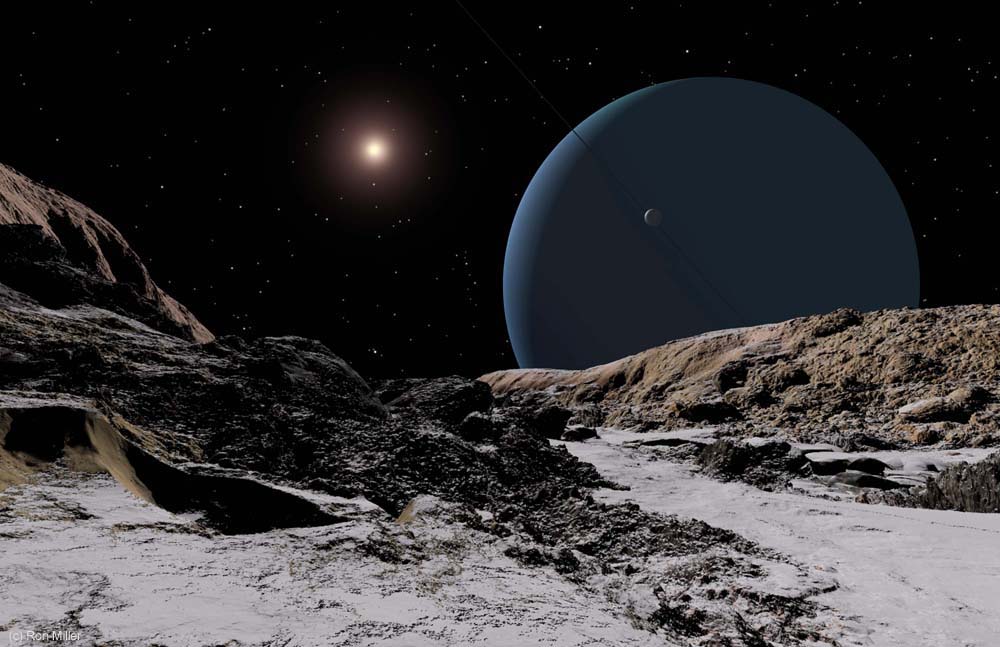
9. Ariel (Uranus)
Among Uranus’ major moons, Ariel appears surprisingly young.
Its surface displays enormous fault systems, valleys, and relatively few impact craters.
These observations imply substantial geological resurfacing.
Scientists suspect that Ariel once possessed extensive internal heating.
Some models indicate that portions of its interior may still contain liquid water.
Future missions to the Uranian system could dramatically improve understanding of Ariel’s potential habitability.
10. Titania (Uranus)
Titania is the largest moon of Uranus.
Large canyons stretch across its surface, suggesting ancient tectonic activity driven by internal expansion.
Some planetary models indicate that Titania could retain a buried liquid ocean insulated beneath thick ice.
Although direct evidence remains limited, Titania has become an increasingly interesting target in studies of ocean worlds.
11. Oberon (Uranus)
Oberon, Uranus’ outermost major moon, has long been considered relatively inactive.
However, theoretical models suggest that radioactive decay within its rocky interior may have generated enough heat to preserve pockets of liquid water beneath the surface.
Whether such oceans survive today remains uncertain.
Even so, Oberon demonstrates how hidden oceans may be more common than once believed.
12. Miranda (Uranus)
Miranda is one of the most bizarre-looking worlds in the Solar System.
Gigantic cliffs, enormous fault systems, and strangely patched terrain suggest dramatic geological upheaval.
Scientists believe intense tidal heating in the past may have melted substantial portions of its interior.
Although Miranda is small, some researchers continue investigating whether remnants of internal liquid water could still exist.
Its extraordinary geology hints at a surprisingly dynamic history.
13. Charon (Pluto)
Pluto’s largest moon, Charon, surprised scientists when NASA’s New Horizons spacecraft arrived in 2015.
Instead of an ancient frozen wasteland, Charon displayed enormous canyons, tectonic fractures, and evidence of widespread resurfacing.
These features suggest that internal oceans may once have existed.
Whether any liquid water survives today remains uncertain.
Even if Charon’s ocean has completely frozen, studying its geological history helps scientists understand how ocean worlds evolve over billions of years.
14. Mimas (Saturn)
For decades, Mimas was famous primarily because its giant impact crater resembles the fictional Death Star.
Scientists assumed it was geologically dead.
Recent orbital analyses have challenged that assumption.
Measurements suggest Mimas may contain a surprisingly young subsurface ocean hidden beneath a relatively rigid ice shell.
If confirmed, this would represent one of the newest additions to the growing family of ocean worlds.
The possibility has dramatically changed scientific interest in this small moon.
15. Io (Jupiter)
At first glance, Io seems like an unlikely place for life.
It is the most volcanically active body in the Solar System.
Hundreds of volcanoes continuously erupt molten sulfur and silicate lava across its surface.
Extreme radiation from Jupiter further complicates any possibility of life near the surface.
Yet Io deserves inclusion because it demonstrates the incredible power of tidal heating.
The same gravitational forces that produce Io’s volcanoes generate the internal warmth maintaining liquid oceans inside Europa and perhaps other icy moons.
Although Io itself is generally considered hostile to known forms of life, understanding its geology helps scientists understand how energy is supplied to neighboring potentially habitable moons.
In a sense, Io teaches us one of astrobiology’s most important lessons: without internal energy, hidden oceans might never remain liquid.
Why Moons Have Become the Best Places to Search for Life
The growing interest in moons represents one of the greatest revolutions in planetary science.
For decades, researchers searched primarily for planets located within a star’s “habitable zone,” where surface temperatures allow liquid water.
Ocean moons reveal a different possibility.
Habitability does not necessarily require sunlight.
Internal heat generated by radioactive decay or tidal forces can maintain liquid oceans beneath thick ice for billions of years.
These hidden seas remain protected from harmful radiation and asteroid impacts.
Hydrothermal systems may supply chemical energy similar to ecosystems found around Earth’s deep-sea vents.
Such environments demonstrate that life, if it exists elsewhere, might thrive in darkness.
What Scientists Look For
Astrobiologists generally focus on several key ingredients.
Liquid water remains the highest priority because every known organism depends upon it.
Energy sources are equally important.
Life requires continuous energy to maintain metabolism.
Chemical building blocks—including carbon, hydrogen, oxygen, nitrogen, phosphorus, and sulfur—must also be available.
Finally, environmental stability over long periods increases the chances that life could emerge and evolve.
Europa, Enceladus, and Titan currently satisfy many of these conditions better than any other moons known.
The Next Generation of Exploration
The coming decades promise an extraordinary era of discovery.
NASA’s Europa Clipper is conducting repeated close flybys of Europa, investigating its ice shell, hidden ocean, chemistry, and geology.
The European Space Agency’s JUICE mission is exploring Jupiter’s icy moons, especially Ganymede, Callisto, and Europa.
NASA’s Dragonfly rotorcraft will one day fly through Titan’s thick atmosphere, exploring dunes, impact craters, and ancient organic deposits.
Scientists continue proposing missions capable of sampling Enceladus’ spectacular water plumes, potentially searching directly for biological molecules.
These missions represent humanity’s first serious attempt to determine whether life exists within the hidden oceans of distant moons.
A Universe That May Be Richer Than We Ever Imagined
Perhaps the most profound discovery of modern planetary science is not that life exists elsewhere.
It is that the universe contains far more potentially habitable environments than anyone once believed.
Only a few decades ago, Earth appeared unique.
Today, scientists know of multiple ocean worlds in our own Solar System alone. Beneath frozen crusts, hidden from sunlight for billions of years, enormous seas may stretch across entire moons. Some contain organic compounds. Others exhibit hydrothermal activity. Several possess all the known ingredients necessary for life.
Whether any of them actually harbor living organisms remains unknown.
No confirmed evidence of extraterrestrial life has yet been found.
But the search has become far more hopeful than ever before.
The next great discovery in biology may not come from a rainforest, a coral reef, or the deepest trench on Earth.
It may emerge from a tiny droplet of water ejected by a geyser on Enceladus, from the hidden ocean beneath Europa’s cracked ice, or from the rich organic chemistry of Titan.
If that day comes, humanity’s understanding of life—and of its place in the universe—will change forever.