When we think about the Solar System, planets usually take center stage. We imagine the towering storms of Jupiter, the icy rings of Saturn, the red deserts of Mars, or the blue oceans of Earth. Yet scattered throughout the Solar System are worlds that deserve just as much attention—its moons.
Far from being mere companions to planets, many moons are remarkable worlds in their own right. Some possess oceans hidden beneath thick shells of ice. Others are wrapped in dense atmospheres, sculpted by active volcanoes, or scarred by ancient impacts. One moon even has lakes and rivers—not of water, but of liquid methane and ethane. Another may contain more liquid water than all of Earth’s oceans combined.
The Solar System contains more than 900 confirmed natural satellites, and astronomers continue discovering new ones. Most are small, irregular bodies captured by planetary gravity. But a select few are enormous. These giant moons rival planets in size and complexity. In fact, if some of them orbited the Sun instead of planets, they might once have been considered planets themselves.
Scientists measure the size of moons by their average diameter. The largest moons are primarily found around the giant planets—Jupiter, Saturn, Uranus, and Neptune—whose immense gravity enabled them to acquire or form extensive satellite systems billions of years ago.
Here are the ten largest moons in the Solar System, ranked by mean diameter.
1. Ganymede
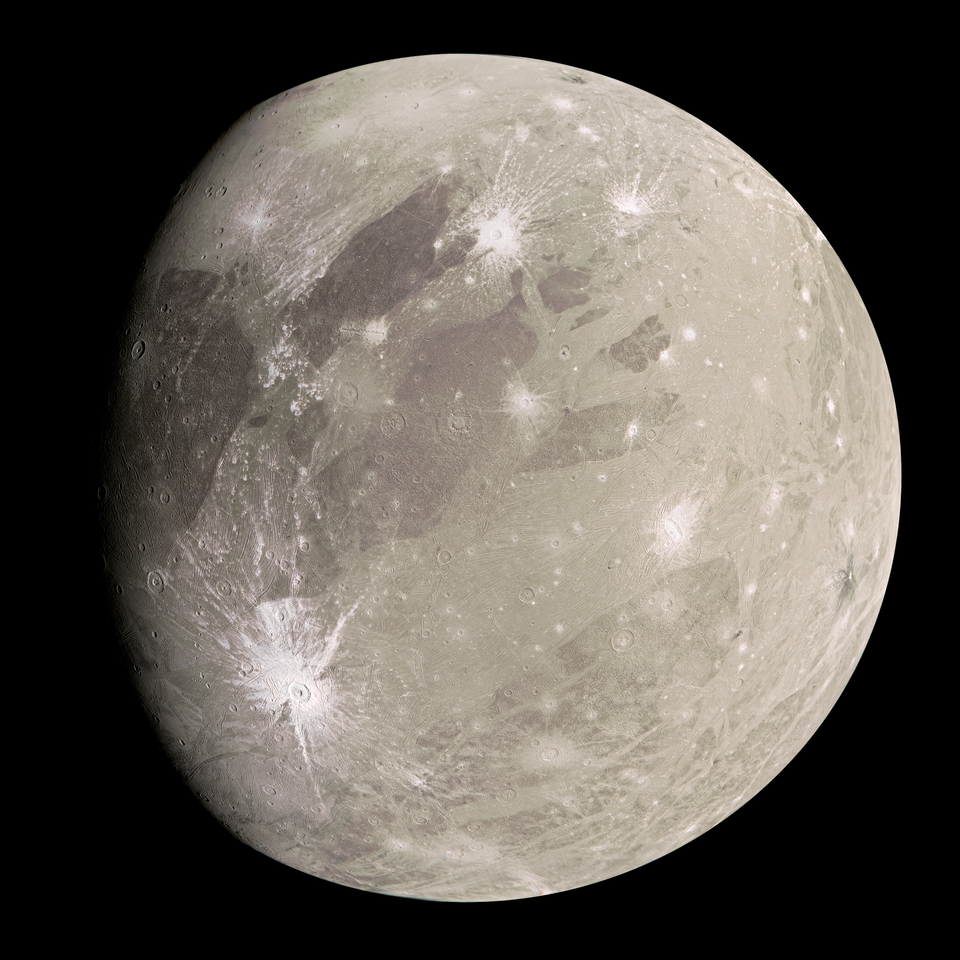
No moon in the Solar System surpasses Ganymede in size. Orbiting Jupiter, Ganymede has a mean diameter of approximately 5,268 kilometers (3,273 miles), making it even larger than the planet Mercury.
Despite its enormous size, Ganymede is not more massive than Mercury because it contains much more ice and less dense rock. Nevertheless, it is an extraordinary world.
Its surface displays two dramatically different terrains. Dark, ancient regions preserve billions of years of impact craters, while lighter regions are crossed by long grooves and ridges created through tectonic activity. These contrasting landscapes tell the story of a moon that remained geologically active long after its formation.
One of Ganymede’s most remarkable features is its magnetic field. It is the only known moon with a permanent internally generated magnetic field, likely produced by a molten iron-rich core. This magnetic field creates miniature auroras that have helped scientists investigate the moon’s hidden interior.
Beneath its icy crust lies compelling evidence for a vast subsurface ocean. Measurements by NASA’s Galileo spacecraft and later observations suggest that this ocean may contain more water than all of Earth’s surface oceans combined. Instead of a single body of water, the interior may consist of multiple ocean layers separated by different types of ice.
Ganymede continues to attract scientific interest because of its potential habitability. Although its ocean is buried beneath many kilometers of ice, researchers consider it one of the most promising places to study extraterrestrial environments capable of supporting life.
The European Space Agency’s Jupiter Icy Moons Explorer (JUICE), launched in 2023, is expected to investigate Ganymede in unprecedented detail, eventually becoming the first spacecraft to orbit a moon other than Earth’s Moon.
2. Titan
Saturn’s largest moon, Titan, measures about 5,149 kilometers (3,199 miles) in diameter, making it the second-largest moon in the Solar System.
Titan is unlike any other moon.
It is the only moon known to possess a thick atmosphere. Surface pressure exceeds that of Earth, while the atmosphere itself consists primarily of nitrogen, much like our own. However, temperatures near minus 179 degrees Celsius (minus 290 degrees Fahrenheit) make Titan an extraordinarily cold environment.
Instead of water shaping the landscape, Titan experiences an entirely different chemical cycle.
Methane and ethane evaporate, form clouds, produce rain, carve river channels, fill lakes, and collect in vast northern seas. It is the only known world besides Earth with stable liquid bodies on its surface.
Radar observations by NASA’s Cassini spacecraft revealed mountains, dunes stretching hundreds of kilometers, winding rivers, and coastlines remarkably similar to those found on Earth.
Beneath Titan’s icy crust, scientists believe another global ocean exists, composed primarily of liquid water mixed with ammonia.
Complex organic molecules constantly form in Titan’s atmosphere through interactions with sunlight and energetic particles. These compounds settle onto the surface, making Titan one of the best natural laboratories for studying prebiotic chemistry—the chemistry that may resemble conditions before life emerged on Earth.
NASA’s Dragonfly mission, scheduled for launch later this decade, will send a nuclear-powered rotorcraft to explore Titan directly, searching for clues about chemistry, geology, and the potential ingredients of life.
3. Callisto
The third-largest moon belongs once again to Jupiter.
Callisto measures approximately 4,821 kilometers (2,996 miles) across and represents one of the oldest preserved landscapes in the Solar System.
Unlike neighboring Ganymede, Callisto experienced relatively little internal geological activity after its formation. As a result, its ancient surface remains densely covered with impact craters accumulated over billions of years.
Among its most spectacular features is Valhalla, an enormous multi-ring impact structure extending nearly 3,800 kilometers across. It ranks among the largest impact basins known anywhere in the Solar System.
Despite its heavily cratered appearance, Callisto may conceal a hidden ocean beneath its icy shell. Measurements of Jupiter’s magnetic field interactions suggest the presence of a conductive liquid layer deep below the surface.
Interestingly, Callisto receives less intense radiation than Europa or Io because it orbits farther from Jupiter. This makes it one of the safer locations for future human exploration within the Jovian system.
Its combination of geological stability, ancient history, and potential subsurface ocean makes Callisto a valuable scientific target for understanding planetary evolution.
4. Io
At approximately 3,643 kilometers (2,263 miles) in diameter, Io is Jupiter’s third-largest moon and the fourth largest in the Solar System.
Size alone does not make Io extraordinary.
Its geology does.
Io is the most volcanically active body ever discovered.
More than 400 active volcanoes have been identified, many erupting sulfur-rich material hundreds of kilometers above the surface. Massive lava flows constantly reshape the landscape, erasing impact craters almost as quickly as they form.
This intense activity results from tidal heating.
As Io orbits Jupiter, enormous gravitational forces continuously stretch and compress its interior. This flexing generates immense heat through friction, melting rock beneath the surface.
The result is a world covered with lava lakes, sulfur plains, volcanic mountains, and colorful deposits ranging from yellow and orange to deep red and black.
Io demonstrates that planetary geology does not require sunlight or radioactive decay alone. Gravity itself can become a powerful internal heat source.
Its violent environment makes Io one of the most dynamic worlds known.
5. Earth’s Moon
Our own Moon ranks fifth with a diameter of approximately 3,475 kilometers (2,159 miles).
Although it is smaller than the four giant moons above it, Earth’s Moon is unusually large relative to its parent planet. No other rocky planet possesses such a proportionally large satellite.
The leading scientific explanation for its formation is the giant impact hypothesis. According to this model, a Mars-sized object collided with the young Earth around 4.5 billion years ago. Debris from the collision eventually coalesced to form the Moon.
The Moon profoundly influences Earth.
Its gravitational pull generates ocean tides, stabilizes Earth’s axial tilt, and may have contributed to the long-term climatic stability that helped life evolve.
The lunar surface preserves a detailed record of Solar System history. Vast dark plains called maria formed from ancient volcanic eruptions, while brighter highlands preserve rocks dating back more than four billion years.
Since the Apollo missions, lunar exploration has accelerated once again. Robotic spacecraft continue investigating polar regions where permanently shadowed craters may contain water ice, an important resource for future exploration.
The Moon remains humanity’s closest gateway to deep space.
6. Europa
Europa, another of Jupiter’s large moons, measures about 3,122 kilometers (1,940 miles) in diameter.
Its smooth, bright surface immediately distinguishes it from most other worlds.
Instead of countless craters, Europa is covered with fractures, ridges, and long reddish streaks that crisscross the icy crust.
These features indicate that the surface has been repeatedly renewed over geological time.
The greatest fascination lies beneath the ice.
Virtually all available evidence suggests that Europa possesses a global ocean beneath an ice shell estimated to be between roughly 15 and 25 kilometers thick in many locations, though thickness may vary.
The ocean itself may be over 100 kilometers deep.
Tidal heating generated by Jupiter’s gravity likely keeps this immense body of water liquid despite extremely cold surface temperatures.
Interactions between water, rock, and internal heat could create environments similar to hydrothermal systems found on Earth’s ocean floor—places where life thrives without sunlight.
For this reason, Europa is considered one of the most promising locations in the Solar System for searching for extraterrestrial life.
NASA’s Europa Clipper mission is expected to investigate the moon’s ice shell, chemistry, and potential habitability in unprecedented detail.
7. Triton
Neptune’s largest moon, Triton, has a diameter of approximately 2,707 kilometers (1,682 miles).
Unlike most large moons, Triton orbits in the opposite direction of its planet’s rotation.
This unusual retrograde orbit strongly suggests that Triton did not form around Neptune but was instead captured from the distant Kuiper Belt.
Its surface consists largely of frozen nitrogen, water ice, carbon dioxide ice, and methane ice.
When Voyager 2 flew past Triton in 1989, it discovered active nitrogen geysers erupting from the surface—making Triton one of the few geologically active icy worlds known.
Scientists believe Triton may possess a subsurface ocean maintained by radioactive heating and residual warmth from its capture.
Over billions of years, Triton’s orbit is slowly shrinking.
Eventually, Neptune’s gravity may tear the moon apart, creating a spectacular ring system.
8. Titania
Titania, the largest moon of Uranus, measures approximately 1,578 kilometers (981 miles) across.
Discovered by astronomer William Herschel in 1787, Titania is named after the queen of the fairies in William Shakespeare’s A Midsummer Night’s Dream.
Its surface displays giant fault valleys stretching hundreds of kilometers, indicating that internal expansion fractured the icy crust.
Impact craters cover much of the landscape, but tectonic features reveal that geological activity occurred after heavy bombardment.
Models suggest Titania may contain a buried ocean consisting of water mixed with antifreeze compounds such as ammonia.
Although Uranus has received relatively little exploration, Titania represents one of its most intriguing worlds.
9. Rhea
Saturn’s second-largest moon, Rhea, has a diameter of approximately 1,528 kilometers (949 miles).
Rhea is composed primarily of water ice with a smaller proportion of rocky material.
Its heavily cratered surface records billions of years of impacts, while enormous fractures indicate ancient tectonic stresses.
One surprising discovery made by the Cassini spacecraft was evidence of an extremely thin atmosphere composed mainly of oxygen and carbon dioxide.
This atmosphere is far too tenuous to support life or weather, but it demonstrates that even icy moons can generate complex surface chemistry through interactions with energetic particles.
Some models suggest that Rhea may once have possessed internal liquid layers, although evidence remains less compelling than for moons such as Europa or Ganymede.
10. Oberon
Completing the list is Oberon, Uranus’s second-largest moon, with a diameter of approximately 1,523 kilometers (946 miles).
Like Titania, Oberon was discovered by William Herschel in 1787 and named after the king of the fairies from Shakespeare’s works.
Oberon’s surface is ancient and densely cratered.
Many impact craters display bright ejecta rays extending outward across the dark terrain. Some large craters show signs that darker material rose from beneath the surface after impacts.
Towering cliffs suggest ancient internal expansion similar to that observed on Titania.
Scientists believe Oberon consists of roughly equal amounts of rock and ice. Some theoretical models allow for the possibility of a residual subsurface ocean, although current evidence remains limited.
Because Voyager 2 is the only spacecraft ever to visit Uranus, much about Oberon remains unknown.
Future missions to the Uranian system could transform our understanding of this distant world.
Why the Largest Moons Are So Extraordinary
These giant moons challenge the traditional distinction between planets and satellites.
Several are larger than Mercury.
Many possess differentiated interiors with metallic cores, rocky mantles, and icy crusts.
Multiple moons likely contain global oceans hidden beneath ice.
Some have atmospheres.
Others experience active volcanism, tectonic deformation, or cryovolcanism.
Each is a complete world with its own geological history, internal evolution, and environmental processes.
The largest moons demonstrate that fascinating planetary science is not limited to planets themselves.
Hidden Oceans Across the Solar System
One of the most important discoveries of modern planetary science is that several of the Solar System’s largest moons contain subsurface oceans.
Europa, Ganymede, Callisto, Titan, and likely Triton all show evidence consistent with buried liquid water.
These oceans are protected beneath thick layers of ice from harsh radiation and extreme surface conditions.
Internal heating produced by radioactive decay or tidal interactions may keep the water liquid for billions of years.
Because liquid water is considered one of the essential ingredients for life as we know it, these hidden oceans have become primary targets in the search for extraterrestrial biology.
Future Exploration
The coming decades promise an unprecedented era of moon exploration.
The European Space Agency’s JUICE mission will conduct detailed investigations of Ganymede, Callisto, and Europa.
NASA’s Europa Clipper will perform repeated close flybys of Europa to study its ocean and ice shell.
NASA’s Dragonfly mission will explore Titan using a flying robotic vehicle capable of traveling between multiple landing sites.
Scientists are also proposing future missions to Uranus, Neptune, Triton, and other distant moons.
Every new spacecraft reveals that these satellites are far more complex than anyone once imagined.
Worlds Worthy of Their Own Stories
For centuries, moons were regarded as little more than companions orbiting larger planets.
Modern exploration has completely changed that view.
The largest moons of the Solar System are dynamic worlds shaped by volcanism, tectonics, hidden oceans, chemical evolution, and atmospheric processes. Some preserve records of the earliest Solar System. Others may still be geologically active today. A few may even possess environments capable of supporting microbial life beneath layers of ice.
Together, these ten giant moons remind us that the Solar System is not simply a collection of planets. It is a vast family of worlds—each with its own history, mysteries, and potential discoveries still waiting beyond the next mission.