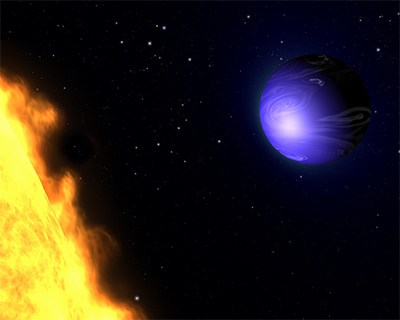
On a clear night, the stars appear as tiny, delicate points of light scattered across the sky. They seem almost identical from Earth—small, distant, and peaceful. But this impression is profoundly misleading. Hidden among the countless stars of the Milky Way and beyond are celestial titans so enormous that they defy ordinary imagination. Some are so vast that if one replaced our Sun, its outer atmosphere would stretch beyond the orbit of Jupiter, swallowing Mercury, Venus, Earth, Mars, and the asteroid belt without difficulty.
These colossal stars are among the most extreme objects in the universe. They burn through their nuclear fuel at astonishing rates, shine hundreds of thousands—or even millions—of times brighter than the Sun, and live comparatively short but spectacular lives. Most belong to the class of red hypergiants or red supergiants, although a few blue supergiants also rank among the largest stars known.
It is important to understand that measuring the “largest” stars is far from simple. Unlike rocky planets, giant stars do not have solid surfaces. Their outer layers are diffuse, turbulent, and constantly changing. Pulsations, powerful stellar winds, and massive eruptions can cause their apparent sizes to vary over time. As a result, astronomers often revise stellar radius estimates as better observations become available.
The stars in this article represent the biggest known stars based primarily on their estimated radii. While the exact rankings may change as astronomy advances, each of these stellar giants ranks among the largest ever discovered.
1. Stephenson 2-18
Among all known stars, Stephenson 2-18 currently stands as one of the largest—and quite possibly the largest—ever identified.
Located approximately 19,000 light-years from Earth in the direction of the constellation Scutum, this enormous red supergiant belongs to the open cluster Stephenson 2.
Its estimated radius is roughly 2,150 times that of the Sun, although uncertainties remain because of the challenges involved in measuring stars hidden behind thick interstellar dust.
To appreciate its scale, imagine replacing the Sun with Stephenson 2-18. The star’s outer atmosphere would extend beyond the orbit of Saturn, engulfing every planet from Mercury through Jupiter.
Despite its incredible size, Stephenson 2-18 is not especially massive compared with its radius. As stars evolve into red supergiants, their outer layers expand dramatically while becoming much less dense. The star’s average density is astonishingly low—far thinner than the best laboratory vacuum on Earth.
Astronomers believe Stephenson 2-18 represents one of the final evolutionary stages of a very massive star. Eventually, it is expected to explode as a supernova, enriching surrounding space with heavy elements forged in its interior.
2. UY Scuti
For many years, UY Scuti was widely regarded as the largest known star.
Situated about 9,500 light-years away in the constellation Scutum, this red supergiant remains one of the most extraordinary stars ever observed.
Current estimates place its radius at approximately 1,700 to 1,900 solar radii, although measurements vary depending on observational methods and atmospheric modeling.
If placed at the center of our Solar System, UY Scuti would engulf the orbits of Mercury, Venus, Earth, Mars, and likely extend close to Jupiter.
Its luminosity reaches hundreds of thousands of times that of the Sun.
Yet despite its enormous size, UY Scuti is relatively cool by stellar standards. Its surface temperature is only about 3,300 to 3,600 kelvin, giving it a deep reddish appearance.
The star continuously loses material through powerful stellar winds, ejecting enormous quantities of gas into surrounding space. This process contributes to the cosmic recycling of elements that eventually become part of future stars and planets.
3. WOH G64
Deep inside the Large Magellanic Cloud, a satellite galaxy of the Milky Way, lies the remarkable red supergiant WOH G64.
Its estimated radius approaches 1,500 to 1,800 times that of the Sun, making it one of the largest extragalactic stars ever studied.
WOH G64 is especially interesting because it appears surrounded by a thick envelope of dust produced by its own intense mass loss.
Infrared observations have been essential for studying this star because visible light is heavily obscured by the surrounding material.
Astronomers believe the star has entered an unstable evolutionary phase. Strong stellar winds continue to remove matter from its outer layers, gradually reshaping its future before an eventual supernova explosion.
4. Westerlund 1-26
Located within the massive young star cluster Westerlund 1, Westerlund 1-26 is another extraordinary red supergiant.
Estimated to possess a radius between 1,500 and 1,700 solar radii, it ranks among the largest stars known in the Milky Way.
One of its most remarkable features is the enormous cloud of ionized gas surrounding it.
Normally, red supergiants are too cool to ionize surrounding material efficiently. The presence of this glowing nebula has therefore intrigued astronomers, suggesting interactions with nearby hot stars or other complex physical processes.
Its immense atmosphere continues to expand and shed material into space, illustrating the violent late stages of massive stellar evolution.
5. KW Sagittarii
KW Sagittarii is a red supergiant located roughly 7,800 light-years away.
With an estimated radius near 1,500 solar radii, it stands among the largest stars currently known.
Although not as famous as UY Scuti, KW Sagittarii has played an important role in helping astronomers understand the evolution of extremely large stars.
Its atmosphere is highly extended and dynamic. Pulsations cause subtle variations in brightness, while continuous stellar winds remove mass from its outer layers.
Like many red supergiants, its remaining lifetime is expected to be relatively short on astronomical timescales.
6. VY Canis Majoris
Few stars have fascinated astronomers more than VY Canis Majoris.
Earlier estimates once suggested it exceeded 2,000 solar radii, but improved observations have revised its radius downward to approximately 1,300 to 1,500 solar radii.
Even after these revisions, it remains among the largest stars known.
Located about 3,800 light-years away, VY Canis Majoris is an extreme red hypergiant experiencing enormous mass loss.
It ejects gas in asymmetric eruptions that have created a spectacular surrounding nebula.
Observations from the Hubble Space Telescope reveal intricate arcs and knots of expelled material, evidence of repeated violent outbursts over thousands of years.
Scientists continue studying these eruptions to better understand how massive stars approach the end of their lives.
7. VX Sagittarii
VX Sagittarii occupies an unusual position between the classifications of red supergiant and asymptotic giant branch star.
Its estimated radius ranges around 1,300 to 1,500 solar radii, depending on observational models.
The star exhibits strong brightness variations and possesses a highly complex atmosphere rich in molecules and dust.
Radio observations have detected powerful maser emissions produced by water and silicon monoxide molecules in its expanding envelope.
These natural microwave amplifiers allow astronomers to study the dynamics of stellar winds with remarkable precision.
8. AH Scorpii
Located in the constellation Scorpius, AH Scorpii is another enormous red supergiant.
Its estimated radius reaches approximately 1,400 solar radii.
The star displays pronounced variability caused by pulsations within its vast outer atmosphere.
Infrared observations reveal ongoing dust production as stellar winds continuously expel material into surrounding space.
AH Scorpii serves as an excellent laboratory for studying the relationship between pulsation, mass loss, and the evolution of giant stars.
9. RW Cephei
RW Cephei belongs to the rare class of yellow hypergiants, among the most unstable stars known.
Although slightly smaller than the largest red supergiants, its radius still reaches approximately 1,200 to 1,500 solar radii.
Yellow hypergiants are believed to represent short-lived transitional stages in stellar evolution.
RW Cephei experiences dramatic changes in brightness and surface conditions as instability drives powerful outflows.
These stars evolve rapidly compared with ordinary stars, making observations especially valuable for understanding late stellar evolution.
10. KY Cygni
KY Cygni is an immense red supergiant situated thousands of light-years away.
Current estimates place its radius around 1,400 solar radii.
Like other stars in this category, KY Cygni possesses an atmosphere extending over enormous distances while remaining remarkably diffuse.
Powerful convection currents transport energy through its outer layers, creating complex patterns of motion and variability.
The star’s immense luminosity results from its enormous surface area despite relatively cool surface temperatures.
11. Mu Cephei
Known historically as Herschel’s Garnet Star, Mu Cephei is one of the brightest red supergiants visible from Earth.
Its deep crimson color has fascinated observers for centuries.
Modern measurements estimate its radius at roughly 1,200 to 1,400 times that of the Sun.
Although not the absolute largest, Mu Cephei remains among the most famous giant stars because of its brightness and accessibility to amateur astronomers.
Its immense atmosphere continually loses matter through stellar winds, contributing enriched elements to the interstellar medium.
12. Betelgeuse
Perhaps no giant star is better known than Betelgeuse, the bright red shoulder of the constellation Orion.
Although significantly smaller than Stephenson 2-18 or UY Scuti, Betelgeuse still possesses an estimated radius of roughly 700 to 1,000 solar radii, depending on its pulsation phase.
Its enormous size allows astronomers to image portions of its surface directly using advanced telescopes.
In 2019 and 2020, Betelgeuse underwent an unexpected episode known as the Great Dimming.
Detailed studies later showed that a combination of surface cooling and a giant cloud of expelled dust temporarily reduced its brightness.
Betelgeuse remains one of the best-studied red supergiants and is expected to explode as a supernova sometime within the next hundred thousand years—a very short interval in astronomical terms.
13. Antares
Antares, the brilliant red heart of the constellation Scorpius, ranks among the nearest red supergiants.
Its radius is estimated at approximately 700 to 900 solar radii.
The star possesses a hot blue companion that provides astronomers with valuable opportunities to study stellar interactions.
Like Betelgeuse, Antares displays giant convection cells across its surface.
These cells are vastly larger than those found on the Sun, illustrating how differently energy moves through enormous stellar atmospheres.
14. S Persei
Located within the double cluster of Perseus, S Persei is another impressive red supergiant.
Its estimated radius approaches 800 to 1,000 solar radii.
The star produces strong maser emissions that help astronomers map the motions of gas in its extended atmosphere.
These observations provide important insights into the mechanisms driving stellar mass loss in evolved massive stars.
S Persei’s future almost certainly includes a spectacular supernova explosion.
15. NML Cygni
NML Cygni is one of the most luminous red hypergiants in the Milky Way.
Its estimated radius lies near 1,000 to 1,200 solar radii, although values vary depending on observational techniques.
Located within the Cygnus OB2 association, NML Cygni is deeply embedded in dense clouds of gas and dust.
Its intense stellar wind has created an enormous circumstellar envelope that emits strongly in infrared wavelengths.
The star continues to lose mass at one of the highest rates observed among known hypergiants.
Astronomers consider it a prime candidate for eventual core-collapse supernova.
Why Measuring Giant Stars Is So Difficult
Ranking the universe’s largest stars is surprisingly challenging.
Unlike planets, stars have no solid surfaces. Their outer atmospheres gradually fade into surrounding space, making it difficult to define exactly where a star ends.
Many giant stars also pulsate. Their radii can change significantly over months or years.
Powerful stellar winds create extended shells of gas and dust that complicate measurements.
Astronomers therefore rely on sophisticated techniques, including interferometry, spectroscopy, infrared observations, stellar atmosphere models, and precise distance measurements. As instruments improve, radius estimates are frequently revised.
For this reason, the rankings presented today may change with future discoveries.
Why Do Some Stars Become So Enormous?
The largest stars begin life with masses many times greater than the Sun.
As they exhaust hydrogen fuel in their cores, nuclear fusion shifts to heavier elements. Changes in internal pressure cause the outer layers to expand dramatically.
Although these stars become vastly larger, their outer atmospheres cool considerably. This is why most giant stars appear deep red.
The enormous expansion comes at a cost.
Their nuclear fuel is consumed rapidly.
While the Sun is expected to live for roughly 10 billion years, many hypergiants survive only a few million years before reaching catastrophic ends.
The Violent Fate of Stellar Giants
Nearly every star on this list faces the same destiny.
Eventually, nuclear fusion will no longer generate enough pressure to support the core against gravity.
The core will collapse within seconds.
This collapse triggers one of the universe’s most powerful explosions—a core-collapse supernova.
During these explosions, temperatures and pressures become so extreme that many of the heavy elements essential for planets and life are created.
Iron, calcium, gold, uranium, and countless other elements owe their existence, directly or indirectly, to generations of massive stars that lived and died long before the Solar System formed.
Some of these stellar giants will leave behind neutron stars.
The most massive may collapse further into black holes.
Giants That Shape the Cosmos
The largest stars are more than astronomical curiosities. They are cosmic engines that shape entire galaxies.
Their intense ultraviolet radiation sculpts nearby clouds of gas.
Their stellar winds trigger—or suppress—the birth of new stars.
Their supernova explosions enrich space with heavy elements, making rocky planets, oceans, and eventually life itself possible.
Although their lives are brief compared with smaller stars like the Sun, their influence lasts for billions of years.
Looking up at the night sky, it is easy to imagine every star as another Sun.
In reality, some are so immense that they stretch beyond ordinary comprehension. Their atmospheres span billions of kilometers. Their brightness rivals hundreds of thousands of Suns. Their deaths can briefly outshine entire galaxies.
These fifteen stellar giants remind us that the universe operates on scales far beyond human experience. They are not merely the biggest stars ever discovered—they are among the grandest structures nature has ever created, living monuments to the extraordinary power of stellar evolution.