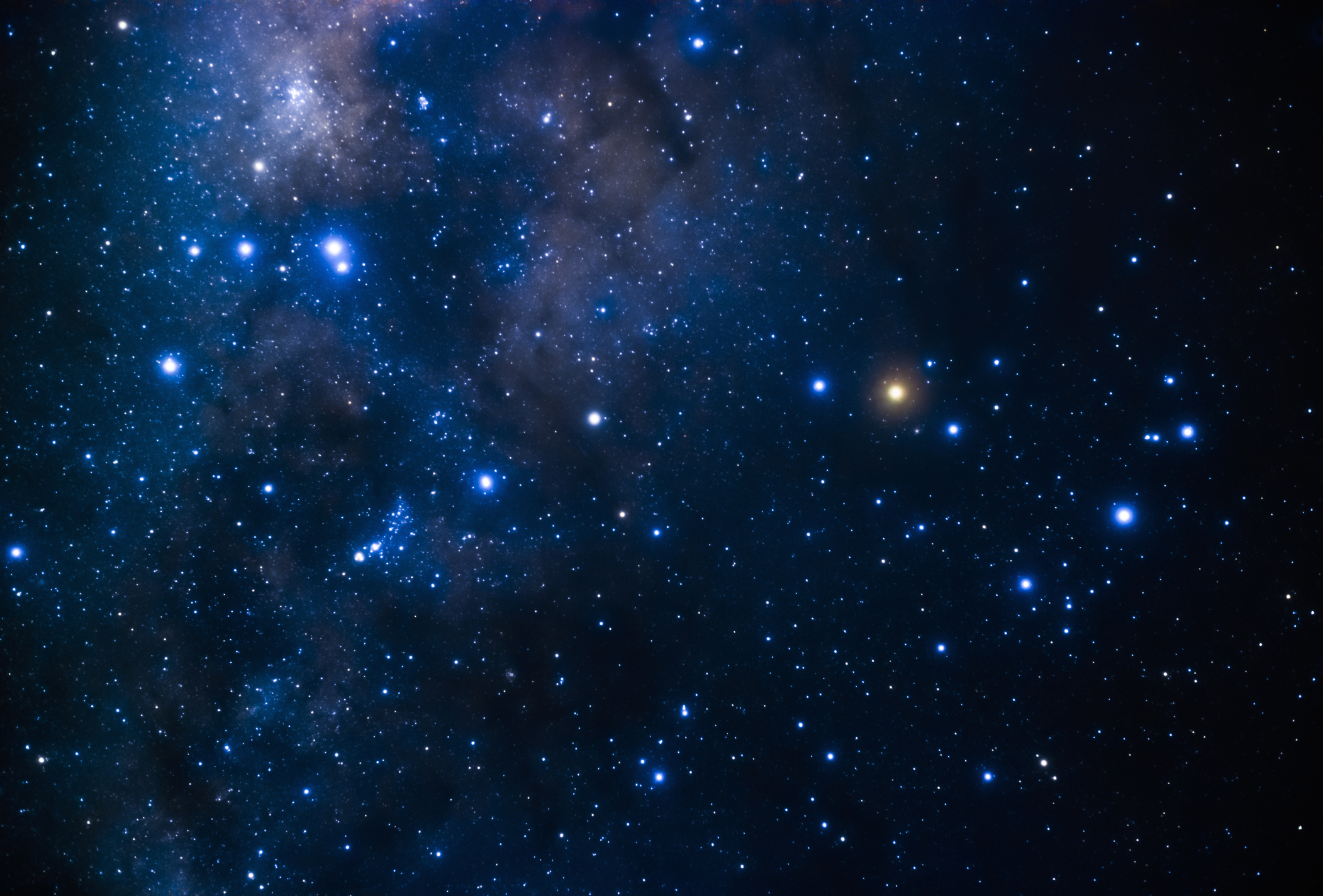
On a clear night, the sky becomes a vast ocean of lights. Some stars shine brilliantly, instantly catching our attention. Others appear faint and delicate, barely visible against the darkness. Even without any scientific training, most people notice that stars are not equally bright.
But have you ever wondered how astronomers actually measure that brightness?
How can scientists compare the glow of a nearby star with that of a distant giant? How do they determine whether a star is truly powerful or merely appears bright because it happens to be close to Earth? And why do some stars with negative numbers attached to them turn out to be brighter than stars with positive numbers?
The answer lies in one of astronomy’s most important tools: stellar magnitude.
Stellar magnitude is the system astronomers use to measure the brightness of celestial objects. It may sound like a simple concept, but behind it lies a fascinating story that stretches from ancient Greek skywatchers to modern space telescopes. The magnitude system helps scientists understand the true nature of stars, calculate distances across the galaxy, discover exoplanets, study exploding supernovae, and even explore the history of the universe itself.
At first glance, stellar magnitude can seem confusing because its numbering system works in the opposite way many people expect. Yet once understood, it becomes one of the most elegant and powerful ideas in astronomy.
The story of stellar magnitude is not just about numbers. It is about humanity’s effort to make sense of the countless lights scattered across the night sky.
Looking Up Before Modern Science
Long before telescopes existed, ancient civilizations spent countless hours observing the stars.
People relied on the sky for navigation, agriculture, religion, and storytelling. The movement of celestial objects helped determine seasons and guided travelers across deserts and oceans.
As generations watched the heavens, they noticed something obvious: some stars were brighter than others.
Thousands of years ago, observers had no electronic instruments. They could not measure light scientifically. Instead, they relied on the human eye.
One of the earliest known systems for describing stellar brightness emerged in ancient Greece.
The Greek astronomer Hipparchus, who lived during the second century BCE, is often credited with creating an early classification scheme for stars.
Hipparchus divided visible stars into different brightness groups.
The brightest stars were assigned to the first category.
Slightly dimmer stars belonged to the second category.
Even fainter stars fell into the third category, and so on.
The faintest stars visible to the naked eye were placed in the sixth category.
This simple classification became the foundation of the modern magnitude system.
What is remarkable is that despite being more than two thousand years old, the basic idea still survives today.
The Birth of the Magnitude Scale
The ancient brightness categories eventually evolved into what astronomers now call magnitude.
The word “magnitude” originally meant size or importance, but in astronomy it refers specifically to brightness.
As scientific instruments improved, astronomers realized they needed a more precise system than simple visual categories.
Stars did not fit neatly into six groups.
Brightness varied continuously.
Scientists therefore transformed the ancient ranking method into a mathematical scale.
The result became one of the most widely used measurement systems in astronomy.
Although modern magnitude calculations are far more accurate than those used by ancient observers, the historical numbering convention remained.
This is why some of the brightest stars still have low magnitude numbers.
Why Lower Numbers Mean Brighter Stars
One of the first things newcomers notice about stellar magnitude is that it seems backwards.
In everyday life, larger numbers usually mean larger quantities.
A building with 100 floors is taller than a building with 10 floors.
A person earning $1,000 earns more than someone earning $100.
But stellar magnitude works differently.
A star with a magnitude of 1 is brighter than a star with a magnitude of 2.
A magnitude 2 star is brighter than a magnitude 3 star.
The system continues downward.
Eventually, extremely bright objects receive zero or even negative magnitude values.
This arrangement exists because modern astronomers preserved the ancient classification tradition established long before precise measurements were possible.
Although it initially seems confusing, astronomers continue using the system because it has become deeply integrated into scientific practice.
Once understood, it becomes second nature.
Brightness Is Not What It Seems
Imagine standing beside a campfire.
Now imagine looking at another campfire several kilometers away.
The nearby fire appears brighter, even if both fires produce the same amount of light.
This simple observation reveals an important truth.
Apparent brightness depends not only on how much light an object produces but also on how far away it is.
The same principle applies to stars.
Some stars look brilliant because they are relatively close to Earth.
Others appear faint because they are incredibly distant.
This creates a challenge for astronomers.
When measuring a star’s brightness, are they measuring how bright it appears or how bright it truly is?
The answer is both.
To solve this problem, astronomers developed two related but distinct concepts.
These are known as apparent magnitude and absolute magnitude.
Understanding the difference between them is essential.
Apparent Magnitude: How Bright a Star Looks
Apparent magnitude describes how bright a celestial object appears from Earth.
This is the brightness we actually observe when looking at the sky.
A nearby star may have a very bright apparent magnitude because its light has not traveled far.
A distant star may appear faint even if it produces enormous amounts of energy.
When ancient astronomers classified stars by brightness, they were effectively measuring apparent magnitude.
They had no way of knowing the actual distances involved.
Today, modern instruments can determine apparent magnitude with extraordinary precision.
Astronomers can measure objects far too faint for human eyes to detect.
Some celestial bodies observed by powerful telescopes have apparent magnitudes exceeding 30, making them billions of times dimmer than stars visible without equipment.
Apparent magnitude remains one of the most important observational measurements in astronomy.
Absolute Magnitude: The True Brightness of a Star
While apparent magnitude tells us how bright a star looks, absolute magnitude reveals how bright it truly is.
Absolute magnitude is defined as the brightness a star would have if placed at a standard distance of 10 parsecs from Earth.
A parsec equals approximately 32.6 light-years.
By imagining every star positioned at exactly the same distance, astronomers can compare their intrinsic brightness fairly.
This is similar to comparing light bulbs after placing them all at equal distances from an observer.
Only then can we determine which bulbs genuinely emit more light.
Absolute magnitude allows astronomers to distinguish between nearby faint stars and distant luminous giants.
Without this concept, understanding stellar properties would be much more difficult.
The Surprising Case of the Sun
The Sun provides an excellent example of the difference between apparent and absolute magnitude.
From Earth, the Sun appears overwhelmingly bright.
Its apparent magnitude is approximately -26.7.
No other object in our sky comes close.
The reason is obvious.
The Sun is extremely close compared with other stars.
If the Sun were moved to the standard distance used for absolute magnitude measurements, it would appear much dimmer.
Its absolute magnitude is about 4.8.
This reveals something interesting.
Although the Sun is a powerful star, it is not among the most luminous stars in the galaxy.
Many stars produce far more energy than our Sun.
They simply appear faint because they are much farther away.
Negative Magnitudes and Extremely Bright Objects
Because the magnitude scale extends beyond zero, some objects receive negative values.
These are the brightest objects visible from Earth.
The brighter the object, the more negative its magnitude becomes.
The Sun has the most negative apparent magnitude seen from Earth.
The full Moon also has a strongly negative magnitude.
Several planets occasionally reach negative magnitudes as well.
The planet Venus is famous for its brilliant appearance and often becomes the brightest object in the night sky after the Moon.
Certain exceptionally bright stars also have negative magnitudes.
These negative values sometimes surprise beginners, but they are simply a consequence of how the historical magnitude system evolved.
Understanding the Mathematics Behind Magnitude
One reason the magnitude scale feels unusual is that it is logarithmic rather than linear.
In a linear system, doubling a value means exactly twice as much.
The magnitude scale does not work this way.
Astronomers discovered that human vision perceives brightness approximately logarithmically.
A light source that emits ten times more energy does not necessarily appear ten times brighter to our eyes.
To reflect this reality, magnitude uses a logarithmic relationship.
A difference of five magnitudes corresponds to a brightness ratio of exactly one hundred.
This means a magnitude 1 star is one hundred times brighter than a magnitude 6 star.
A difference of one magnitude corresponds to a brightness factor of about 2.512.
Although these numbers may seem complicated, the system allows astronomers to compare objects spanning enormous brightness ranges.
Measuring Light Before Modern Technology
For much of history, measuring stellar brightness depended on human observation.
Astronomers compared stars visually.
They estimated relative brightness by carefully studying the night sky.
This approach worked surprisingly well, but it had limitations.
Human eyesight varies from person to person.
Atmospheric conditions affect observations.
Fatigue can influence judgment.
As astronomy became more scientific, researchers sought more objective methods.
The development of telescopes improved observations, but truly precise brightness measurements required new technologies.
The invention of photography marked a major turning point.
Photographic plates could record faint stars and preserve observations permanently.
Eventually, electronic detectors transformed stellar measurement even further.
Modern Photometry
Today, astronomers use a technique called photometry to measure brightness.
Photometry involves detecting and quantifying light from celestial objects.
Modern telescopes employ highly sensitive electronic detectors known as charge-coupled devices, or CCDs.
These detectors count incoming photons, the fundamental particles of light.
By analyzing the number of photons received, astronomers can calculate stellar brightness with remarkable accuracy.
Modern photometry allows measurements far beyond the capabilities of the human eye.
Scientists can detect tiny brightness variations that reveal important information about stars and planets.
This precision has revolutionized astronomy.
Why Different Colors Matter
Not all starlight is the same.
Stars emit light across a range of wavelengths.
Some stars appear blue-white.
Others appear yellow, orange, or red.
These colors provide clues about temperature and composition.
Because different stars emit different proportions of light at different wavelengths, astronomers often measure magnitude through specific filters.
Each filter isolates a particular range of colors.
This creates multiple magnitude values for the same star.
Comparing these measurements helps astronomers determine physical properties such as temperature, age, and chemical composition.
Color measurements have become a powerful tool for understanding stellar evolution.
Stellar Magnitude and Distance
One of astronomy’s greatest challenges is measuring cosmic distances.
The universe is unimaginably vast.
Direct measurement is usually impossible.
Fortunately, stellar magnitude helps solve this problem.
If astronomers know a star’s absolute magnitude and can measure its apparent magnitude, they can estimate its distance.
The relationship between brightness and distance follows predictable physical laws.
As light travels, it spreads out.
The farther an object is, the fainter it appears.
Using magnitude calculations, astronomers can determine how far away stars and galaxies are located.
This technique has played a crucial role in mapping the universe.
Variable Stars and Changing Magnitudes
Not all stars maintain constant brightness.
Some stars naturally vary over time.
These are known as variable stars.
Their magnitudes rise and fall due to physical processes occurring within the stars themselves.
Certain variable stars expand and contract rhythmically.
Others experience eruptions or interactions with companion stars.
By monitoring magnitude changes, astronomers can learn about stellar structure and evolution.
Some variable stars are especially important because their brightness patterns allow distance measurements across vast regions of space.
Without them, understanding the scale of the universe would be much more difficult.
Magnitude and Exoplanet Discovery
One of the most exciting applications of brightness measurement involves the search for planets around other stars.
Many exoplanets are discovered using the transit method.
When a planet passes in front of its star, it blocks a tiny fraction of the starlight.
The star’s apparent magnitude decreases slightly.
Sensitive instruments can detect these subtle dips.
By analyzing repeated brightness changes, astronomers can determine a planet’s size, orbit, and other characteristics.
Thousands of exoplanets have been discovered through careful monitoring of stellar magnitudes.
This demonstrates how a seemingly simple brightness measurement can reveal entirely new worlds.
Supernovae and Cosmic Explosions
Some of the most dramatic events in the universe involve exploding stars.
These explosions, called supernovae, can briefly outshine entire galaxies.
When a supernova occurs, its magnitude changes dramatically.
Astronomers monitor these brightness variations to understand the explosion process.
Certain types of supernovae possess predictable intrinsic brightness.
Because of this, they serve as cosmic distance markers.
By comparing apparent and absolute magnitudes, scientists can estimate distances to remote galaxies.
This method helped reveal one of the most astonishing discoveries in modern astronomy: the expansion of the universe is accelerating.
Thus, stellar magnitude contributed directly to our understanding of cosmic history.
Measuring Galaxies and Nebulae
Magnitude is not limited to stars.
Astronomers use it for many celestial objects.
Galaxies possess magnitudes.
Nebulae possess magnitudes.
Comets, asteroids, and planets possess magnitudes.
Even distant quasars receive magnitude measurements.
The same principles apply regardless of the object’s nature.
Brightness remains a fundamental observational property.
By measuring magnitude, scientists gain valuable insights into size, energy output, distance, and physical characteristics.
The concept serves as a universal language for describing celestial brightness.
The Role of Space Telescopes
Earth’s atmosphere affects incoming starlight.
Air turbulence causes stars to twinkle.
Atmospheric molecules absorb certain wavelengths.
Weather conditions can interfere with observations.
Space telescopes overcome these challenges.
Operating above Earth’s atmosphere, they can measure brightness with exceptional precision.
Observatories such as Hubble Space Telescope and James Webb Space Telescope have expanded the limits of photometric measurement.
These instruments detect objects so faint that their light traveled billions of years before reaching us.
In many cases, magnitude measurements from space reveal phenomena invisible from the ground.
Why Human Eyes Still Matter
Despite advanced technology, the human eye remains historically important in stellar magnitude studies.
Many amateur astronomers continue contributing valuable observations.
Variable stars, novae, and transient events are often monitored by dedicated observers around the world.
Visual magnitude estimates can complement professional measurements.
This connection between ancient skywatchers and modern science is remarkable.
The same stars observed by Hipparchus more than two thousand years ago are still being studied today.
The methods have evolved dramatically, but the fascination remains unchanged.
Magnitude and Stellar Evolution
Stars change throughout their lives.
They are born from collapsing clouds of gas and dust.
They spend millions or billions of years converting hydrogen into helium.
Eventually they exhaust their fuel and enter new evolutionary stages.
Throughout these transitions, brightness changes.
Magnitude measurements allow astronomers to track stellar evolution.
Young stars, mature stars, red giants, white dwarfs, and supergiants each exhibit characteristic brightness patterns.
By studying magnitudes across large stellar populations, scientists reconstruct the life stories of stars.
These observations help explain the past and future of our own Sun.
Challenges in Measuring Brightness
Although magnitude is a powerful concept, measuring brightness is not always straightforward.
Dust between stars can absorb light.
Gas clouds can alter observations.
Atmospheric effects may distort measurements.
Some objects emit most of their energy outside visible wavelengths.
Astronomers must account for these factors carefully.
Advanced calibration techniques help correct observational errors.
Sophisticated computer models further improve accuracy.
Even with modern technology, measuring the universe remains a challenging endeavor requiring meticulous attention to detail.
The Emotional Side of Stellar Magnitude
At first glance, stellar magnitude seems like a purely technical topic.
It involves numbers, measurements, and calculations.
Yet there is something deeply human behind it.
Every magnitude value represents light that has traveled immense distances through space.
Some photons entering a telescope tonight may have begun their journey before human civilization existed.
Others may have left their stars before Earth even formed.
When astronomers measure brightness, they are not merely recording data.
They are reading messages carried across the cosmos by light itself.
Magnitude transforms those messages into something we can understand.
It allows humanity to compare distant suns, map invisible structures, and uncover hidden worlds.
In a sense, every magnitude measurement is a bridge connecting Earth to the universe beyond.
The Future of Brightness Measurement
Astronomy continues advancing rapidly.
New telescopes are becoming larger and more sensitive.
Future observatories will detect even fainter objects.
Scientists will measure brightness changes with unprecedented precision.
These improvements may reveal previously unknown exoplanets, uncover the earliest galaxies, and help solve major cosmic mysteries.
Artificial intelligence is already assisting astronomers in analyzing enormous amounts of photometric data.
As technology improves, magnitude measurements will become even more powerful.
Yet the underlying principle will remain surprisingly simple.
Astronomers will still be asking the same question that ancient skywatchers asked thousands of years ago:
How bright is that star?
Conclusion
Stellar magnitude is one of the most fundamental and useful concepts in astronomy. Developed from ancient observations and refined through modern science, it provides a standardized way to measure the brightness of stars and other celestial objects.
Although the system may initially seem unusual, with lower numbers representing brighter objects and negative values assigned to the brightest ones, it offers a remarkably effective method for comparing the countless lights scattered throughout the universe. Apparent magnitude tells us how bright an object appears from Earth, while absolute magnitude reveals its true intrinsic brightness. Together, these measurements help astronomers determine distances, study stellar evolution, discover exoplanets, investigate supernovae, and map the cosmos.
From the naked-eye observations of ancient civilizations to the sophisticated detectors aboard modern space telescopes, the measurement of stellar brightness has remained central to our understanding of the universe. Every magnitude value contains information about a star’s nature, history, and place within the cosmic landscape.
The next time you look up at the night sky, remember that those seemingly simple points of light are not merely decorations in the darkness. Each star carries a measurable brightness, a story written in photons that have crossed unimaginable distances. Through the concept of stellar magnitude, astronomers have learned to read those stories, transforming tiny specks of light into profound knowledge about the universe and our place within it.