The universe is filled with objects so strange that they seem impossible. There are black holes that trap light, galaxies containing trillions of stars, and giant clouds where new suns are born. Yet among all these cosmic wonders, few objects are as astonishing as neutron stars.
Imagine taking a star several times more massive than the Sun and crushing its core into a sphere only about 20 kilometers (12 miles) across. Imagine packing more mass than our Sun into an object small enough to fit inside a large city. Imagine a teaspoon of material so heavy that it would weigh billions of tons on Earth.
This is not science fiction. This is a neutron star.
Neutron stars are among the densest objects in the known universe. Only black holes are thought to be denser. They represent one of nature’s most extreme experiments, where gravity squeezes matter to conditions that cannot be recreated on Earth. These stellar remnants are cosmic laboratories, helping scientists understand the fundamental laws of physics under extraordinary circumstances.
For decades, neutron stars have fascinated astronomers because they challenge our understanding of matter, gravity, magnetism, and even the nature of space and time. They are small, incredibly dense, unbelievably powerful, and surprisingly important for understanding how the universe works.
To appreciate the wonder of neutron stars, we must begin with the life and death of massive stars.
The Life of a Star
Every neutron star begins its existence as a normal star.
Stars are enormous spheres of hot gas held together by gravity. Deep inside their cores, nuclear fusion converts hydrogen into helium, releasing tremendous amounts of energy.
This energy pushes outward while gravity pulls inward.
For millions or billions of years, these opposing forces remain balanced.
The result is a stable star.
Our Sun is currently in this stage of life. It shines because fusion reactions in its core continuously generate energy.
However, stars do not live forever.
Eventually, they exhaust their nuclear fuel.
What happens next depends largely on the star’s mass.
Small stars end their lives relatively peacefully. Massive stars, however, experience one of the most dramatic endings in the universe.
When Massive Stars Run Out of Fuel
A star much more massive than the Sun follows a complicated life cycle.
As hydrogen becomes scarce, the star begins fusing heavier elements. Helium becomes carbon. Carbon becomes oxygen. Oxygen eventually leads to the formation of even heavier elements.
This process continues until iron accumulates in the core.
Iron creates a problem.
Unlike lighter elements, iron fusion does not release energy. Instead, it consumes energy.
Once the core becomes dominated by iron, the star loses its ability to support itself through fusion.
The balance between gravity and pressure collapses.
Gravity suddenly gains the upper hand.
The core begins collapsing inward at astonishing speed.
What happens next unfolds in mere seconds.
The Catastrophic Collapse
As the core collapses, temperatures and pressures rise to unimaginable levels.
Atoms are crushed together so violently that their normal structure breaks down.
Electrons are forced into protons.
When this happens, they combine to form neutrons.
This transformation is called electron capture.
Within moments, much of the core becomes a gigantic mass of tightly packed neutrons.
The collapse happens so rapidly that the outer layers of the star crash inward and then rebound violently.
The result is a colossal explosion known as a supernova.
For a brief period, the dying star can outshine an entire galaxy.
The supernova blasts enormous quantities of material into space, enriching the cosmos with heavy elements that later become part of planets, oceans, mountains, and even living organisms.
At the center of the explosion, something extraordinary remains.
A neutron star is born.
What Exactly Is a Neutron Star?
A neutron star is the collapsed core of a massive star that exploded as a supernova.
Although its mass may exceed that of the Sun, its diameter is typically only around 20 kilometers.
This means an enormous amount of matter has been squeezed into an incredibly small volume.
The result is extreme density.
Most of the star consists almost entirely of neutrons packed tightly together.
Ordinary matter cannot exist in the same form under such conditions.
The structure of a neutron star is unlike anything found elsewhere in the universe.
It is not simply a giant atomic nucleus, but it shares some similarities.
Matter inside a neutron star exists in states that scientists are still trying to understand.
This makes neutron stars some of the most fascinating objects in astrophysics.
Understanding the Incredible Density
The density of a neutron star is difficult to comprehend.
Human brains evolved to understand everyday experiences, not objects that compress stellar masses into city-sized spheres.
Imagine Mount Everest.
Now imagine crushing it until it becomes the size of a grain of sand.
That comparison still does not fully capture the density of a neutron star.
A sugar-cube-sized piece of neutron star material would weigh roughly a billion tons on Earth.
A single teaspoon could weigh billions of tons.
If a neutron star could somehow be placed on Earth, its gravity would cause catastrophic destruction.
Fortunately, neutron stars remain safely distant in space.
Their incredible density represents one of nature’s most extreme achievements.
Why Doesn’t the Star Keep Collapsing?
An important question arises.
If gravity is so powerful, why doesn’t a neutron star collapse completely?
The answer involves quantum physics.
Neutrons are particles that obey a rule known as the Pauli Exclusion Principle.
This principle prevents identical particles from occupying the same quantum state.
As gravity compresses the star, neutrons resist being squeezed into identical conditions.
This resistance creates neutron degeneracy pressure.
Unlike ordinary pressure, which comes from heat, degeneracy pressure arises from quantum mechanical effects.
It is strong enough to halt the collapse.
The star reaches a new state of equilibrium.
Gravity pulls inward.
Quantum forces push outward.
The result is a stable neutron star.
At least, stable under most circumstances.
The Thin Crust of a Neutron Star
Although neutron stars are mostly composed of neutrons, they are not entirely uniform.
The outermost region forms a crust.
This crust is incredibly hard and dense.
Scientists believe it consists of atomic nuclei packed together in ways unlike anything found on Earth.
The crust may be only about a kilometer thick, yet it contains immense mass.
As one moves deeper beneath the surface, conditions become increasingly strange.
Pressure rises dramatically.
Matter is squeezed into exotic forms.
The boundary between familiar matter and exotic neutron-rich material becomes blurred.
Even today, researchers continue investigating exactly what exists inside these extraordinary objects.
The Mysterious Interior
The interior of a neutron star remains one of the greatest mysteries in modern astrophysics.
Scientists know the density becomes immense.
They know neutrons dominate.
But the precise arrangement of matter is uncertain.
Some theories suggest that particles called hyperons may appear.
Others propose that quarks—the building blocks of protons and neutrons—may exist in a free state.
Some researchers even speculate about entirely new forms of matter.
Because conditions inside neutron stars cannot be reproduced on Earth, astronomers must rely on observations and theoretical models.
Each new measurement helps reveal clues about what lies hidden deep within these collapsed stars.
The Gravity of a Neutron Star
Gravity on a neutron star is astonishingly strong.
Although neutron stars contain only slightly more mass than the Sun, that mass is compressed into a much smaller volume.
As a result, surface gravity becomes extreme.
A person standing on a neutron star would weigh billions of times more than on Earth.
Of course, surviving such conditions would be impossible.
Even light struggles to escape.
Photons leaving the surface lose energy due to the intense gravitational field.
This phenomenon, known as gravitational redshift, was predicted by Einstein’s theory of general relativity.
Neutron stars provide valuable opportunities for testing Einstein’s ideas under extreme conditions.
The Fastest Spinning Stars in the Universe
Many neutron stars rotate incredibly rapidly.
This rapid rotation originates from the collapse itself.
Imagine a figure skater pulling in their arms while spinning.
As their body becomes smaller, their rotation speeds up.
The same principle applies to collapsing stars.
A massive stellar core shrinks dramatically while conserving angular momentum.
The result is an enormous increase in rotation speed.
Some neutron stars spin dozens, hundreds, or even more than a thousand times per second.
These objects rank among the fastest-spinning known objects in the universe.
Their rotation is so stable that some rival atomic clocks in precision.
Pulsars: Cosmic Lighthouses
One of the most famous types of neutron star is the pulsar.
Pulsars were first discovered in 1967 by astronomer Jocelyn Bell Burnell and her colleagues.
At first, the regular pulses seemed so precise that some jokingly wondered whether they originated from extraterrestrial intelligence.
The true explanation proved even more fascinating.
Pulsars are rotating neutron stars that emit beams of radiation from their magnetic poles.
These beams sweep across space like lighthouse beams.
When one beam points toward Earth, astronomers detect a pulse.
As the star rotates, the beam moves away.
This creates a repeating signal.
Some pulsars pulse with extraordinary precision for millions of years.
Their stability makes them useful tools for studying gravity, space-time, and the structure of our galaxy.
Magnetars: The Most Magnetic Objects Known
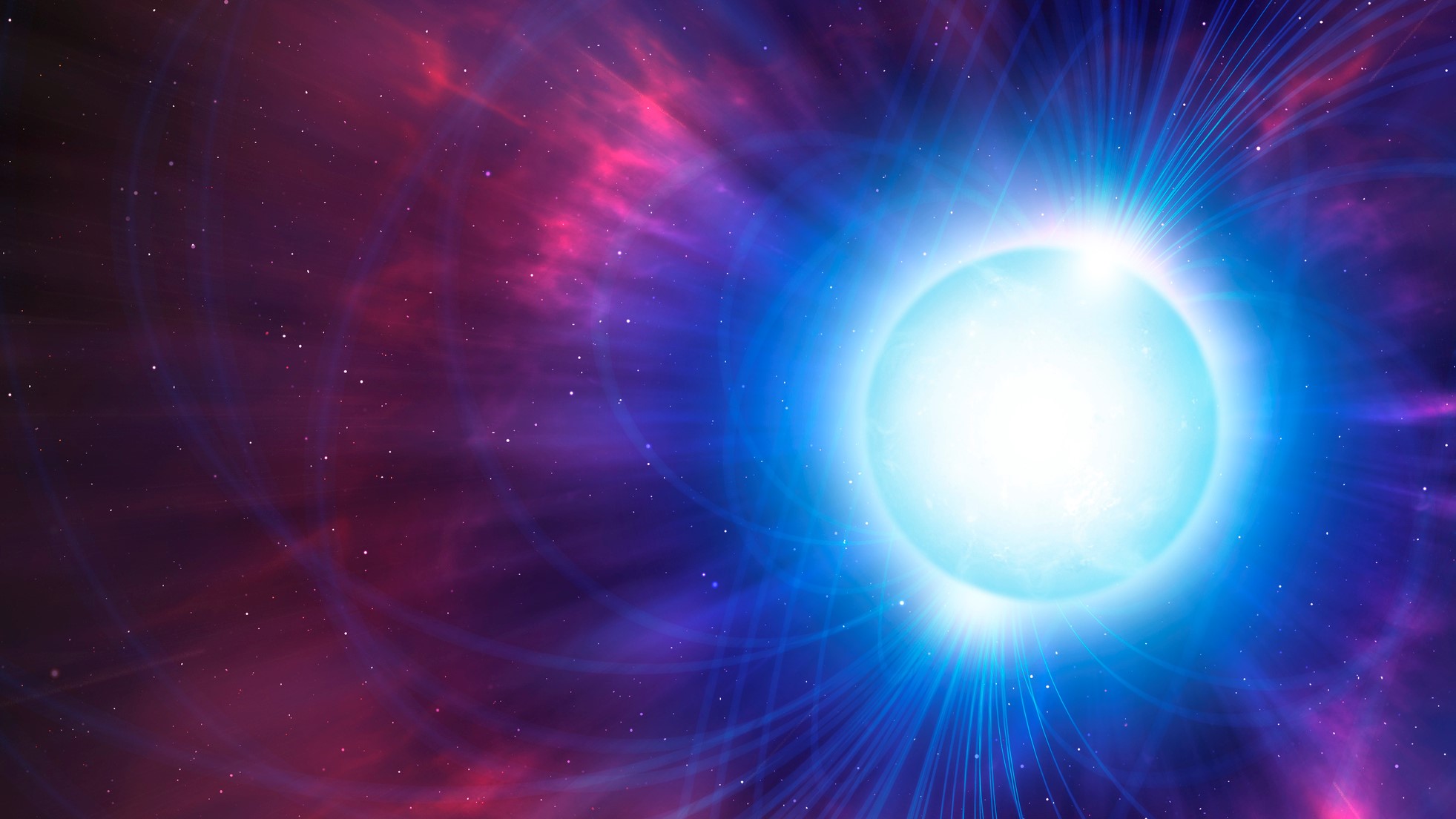
Some neutron stars possess magnetic fields so powerful that they deserve their own category.
These objects are called magnetars.
The magnetic field of a typical refrigerator magnet is weak.
Earth’s magnetic field is stronger but still modest by cosmic standards.
A magnetar’s magnetic field is almost beyond comprehension.
It can be trillions of times stronger than Earth’s magnetic field.
If a magnetar passed halfway between Earth and the Moon, its magnetic field could potentially disrupt electronic devices on our planet.
Fortunately, known magnetars are far away.
These extreme magnetic fields can produce violent bursts of high-energy radiation.
Magnetars are among the most powerful and mysterious objects in the universe.
How Scientists Detect Neutron Stars
Neutron stars are small.
Compared to ordinary stars, they emit relatively little visible light.
As a result, finding them is not always easy.
Astronomers use multiple methods.
Radio telescopes detect pulsars.
X-ray telescopes observe hot neutron stars and matter falling onto them.
Gamma-ray observatories identify energetic emissions.
Some neutron stars reveal themselves through interactions with companion stars.
Others are discovered through gravitational waves.
Modern astronomy combines information from many sources, allowing scientists to study neutron stars in unprecedented detail.
Binary Systems and Stellar Partnerships
Many neutron stars exist in binary systems.
These systems contain two objects orbiting one another.
Sometimes the companion is an ordinary star.
Sometimes it is another neutron star.
In some cases, matter from the companion star falls onto the neutron star.
This process releases enormous amounts of energy.
The infalling material heats up and emits powerful X-rays.
Such systems become some of the brightest X-ray sources in the sky.
Binary systems provide valuable opportunities to measure neutron star masses and test theories of gravity.
When Two Neutron Stars Collide
One of the most dramatic events in the universe occurs when two neutron stars merge.
Over millions or billions of years, gravitational waves gradually rob the system of energy.
The stars spiral closer together.
Eventually, they collide.
The collision releases tremendous energy.
It generates gravitational waves that ripple across space-time.
It also produces bursts of radiation visible across vast cosmic distances.
In 2017, astronomers observed gravitational waves from a neutron star merger for the first time.
This landmark event opened a new era of astronomy.
Scientists could study the same event using both light and gravitational waves.
The observation confirmed many predictions and provided new insights into the origin of heavy elements.
The Cosmic Origins of Gold
One of the most exciting discoveries involving neutron stars concerns precious metals.
For decades, scientists debated where many heavy elements originate.
Gold, platinum, and similar elements require extreme conditions for their formation.
Neutron star mergers provide exactly those conditions.
During a collision, enormous numbers of neutrons become available.
Atomic nuclei rapidly capture neutrons, creating heavy elements.
These newly formed elements are then ejected into space.
Over time, they become incorporated into future stars and planets.
This means much of the gold found on Earth may have originated in ancient neutron star collisions.
The jewelry people wear today could contain atoms forged in one of the most violent events in cosmic history.
Neutron Stars and Einstein’s Relativity
Neutron stars are ideal laboratories for testing Einstein’s theories.
Their intense gravity bends light, distorts time, and influences surrounding space.
Astronomers can observe these effects directly.
In binary systems, neutron stars allow extremely precise measurements of gravitational behavior.
So far, Einstein’s theory of general relativity has passed every major test involving neutron stars.
Yet scientists continue searching for subtle deviations.
Any discrepancy could reveal new physics beyond our current understanding.
Thus, neutron stars help researchers explore some of the deepest questions in science.
Could a Neutron Star Become a Black Hole?
Not every collapsing stellar core becomes a neutron star.
If the core is massive enough, neutron degeneracy pressure cannot stop gravity indefinitely.
Collapse continues.
Eventually, a black hole forms.
Scientists estimate that neutron stars have an upper mass limit.
The exact value remains uncertain because it depends on the behavior of matter at extreme densities.
When neutron stars gain too much mass, they may collapse into black holes.
This transition represents one of the most dramatic transformations in the universe.
The object crosses a threshold beyond which even light cannot escape.
The Strange Shape of Nuclear Pasta
Among the most unusual ideas in neutron star research is something known as nuclear pasta.
Deep within the crust, matter may arrange itself into bizarre structures.
These structures arise because competing forces push and pull atomic nuclei into unusual configurations.
Scientists have proposed shapes resembling sheets, tubes, strands, and layers.
Because some resemble familiar foods such as lasagna and spaghetti, researchers nicknamed them nuclear pasta.
Although the name sounds humorous, the science is serious.
These structures may influence how neutron stars cool, vibrate, and evolve.
They highlight how strange matter becomes under extreme conditions.
How Neutron Stars Cool
Newborn neutron stars are incredibly hot.
Immediately after formation, temperatures can reach hundreds of billions of degrees.
Over time, they gradually cool.
Much of this cooling occurs through the emission of particles called neutrinos.
Neutrinos interact very weakly with matter, allowing them to escape easily.
As the star ages, cooling slows.
Studying neutron star temperatures helps scientists understand what occurs inside these objects.
Different internal compositions produce different cooling rates.
Thus, temperature measurements offer clues about the hidden physics deep within neutron stars.
The Future of Neutron Star Research
The study of neutron stars is advancing rapidly.
New telescopes provide increasingly detailed observations.
Gravitational-wave detectors are identifying more cosmic collisions.
Advanced computer simulations are revealing how matter behaves under extraordinary conditions.
Future missions may help determine exactly what exists inside neutron star cores.
Scientists hope to answer long-standing questions about dense matter, gravity, magnetic fields, and fundamental particles.
Each discovery brings us closer to understanding some of the most extreme environments in the universe.
Yet many mysteries remain.
That uncertainty makes neutron stars one of the most exciting frontiers in modern astronomy.
Why Neutron Stars Matter
At first glance, neutron stars may seem distant and irrelevant to everyday life.
After all, they exist far beyond our solar system.
Yet they play an important role in understanding the universe.
They reveal how stars die.
They help explain the origin of heavy elements.
They test the laws of physics under conditions impossible to reproduce on Earth.
They connect astronomy, nuclear physics, quantum mechanics, and relativity.
Neutron stars remind us that the universe is capable of creating objects far stranger than anything humans could imagine.
Studying them deepens our understanding of reality itself.
Conclusion
Neutron stars are among the most extraordinary objects ever discovered. Born from the violent deaths of massive stars, they represent matter compressed to unimaginable densities. Within a sphere only about 20 kilometers across, they pack more mass than the Sun, creating gravitational and magnetic environments unlike anything found elsewhere.
These collapsed stellar cores challenge our understanding of physics at every level. Their interiors may contain exotic forms of matter. Their gravity tests Einstein’s theories. Their collisions create precious elements such as gold and platinum. Their spinning beams sweep across the cosmos as pulsars, while their magnetic fields make magnetars some of the most powerful objects known.
Perhaps the most remarkable thing about neutron stars is that they transform the familiar into the extraordinary. The atoms inside them were once part of ordinary stars. Through gravity’s relentless force, those atoms were crushed into something entirely different—a cosmic object so dense and strange that it continues to astonish scientists decades after its discovery.
As telescopes improve and new observations arrive, neutron stars will undoubtedly reveal more secrets. Hidden within their tiny dimensions may be answers to some of the deepest questions in modern science. They stand as reminders that the universe is not only vast but also endlessly surprising, filled with wonders that stretch the limits of human imagination.