Few ideas in modern science capture the imagination quite like wormholes. They appear in science fiction movies, television series, novels, and video games as cosmic shortcuts that allow travelers to cross galaxies in moments, visit distant corners of the universe, or even travel through time. To many people, wormholes seem like a purely fictional invention designed to make exciting stories possible.
Yet the surprising truth is that wormholes did not originate in science fiction.
They emerged from the mathematics of modern physics.
According to some solutions of Einstein’s theory of gravity, the fabric of space and time might allow the existence of tunnels connecting distant regions of the universe. These hypothetical structures became known as wormholes. Although no wormhole has ever been observed, and their existence remains entirely theoretical, they are taken seriously enough that physicists continue to study them.
Wormholes occupy a fascinating space between imagination and science. They challenge our understanding of reality, force us to think differently about distance and time, and raise profound questions about the nature of the universe itself.
If they exist, wormholes could represent some of the most extraordinary objects in existence. They might connect distant galaxies, link different universes, or even make time travel theoretically possible. On the other hand, they may turn out to be mathematical curiosities that nature never actually creates.
Either way, wormholes reveal something remarkable about modern physics: the universe is often stranger than we ever imagined.
Understanding Space and Time
To understand wormholes, we must first understand one of the most important discoveries in physics: space and time are not separate entities.
For much of human history, people viewed space as an empty stage where events occurred and time as a universal clock ticking identically for everyone.
This view changed dramatically in the early twentieth century.
Albert Einstein showed that space and time are woven together into a single four-dimensional structure called spacetime.
Everything that exists moves through spacetime.
Planets orbit stars within it.
Galaxies drift through it.
Light travels across it.
Human lives unfold within it.
Spacetime is not rigid or fixed. It can stretch, bend, curve, and distort under the influence of mass and energy.
This realization became the foundation of Einstein’s revolutionary theory of gravity.
Einstein’s View of Gravity
Before Einstein, gravity was understood through Isaac Newton’s famous theory.
Newton described gravity as a force pulling objects toward one another.
This explanation worked extremely well for centuries and remains useful today.
Einstein offered a deeper perspective.
According to his theory of general relativity, gravity is not really a force in the traditional sense.
Instead, massive objects bend the fabric of spacetime around them.
Imagine placing a heavy bowling ball on a stretched rubber sheet. The sheet sinks beneath the weight, creating a depression. Smaller objects rolling nearby naturally move toward the bowling ball because of the curved surface.
Although this analogy is imperfect, it captures the basic idea.
The Sun bends spacetime.
Earth moves through that curved spacetime.
The result appears to us as gravity.
Einstein’s equations showed that spacetime could behave in astonishing ways, including possibilities that seemed almost impossible.
One of those possibilities eventually led to the concept of wormholes.
The Birth of the Wormhole Idea
The story of wormholes began shortly after Einstein published general relativity in 1915.
Scientists quickly realized that Einstein’s equations allowed many unusual solutions.
Some solutions described black holes.
Others predicted an expanding universe.
Among the strange mathematical possibilities was a structure that connected separate regions of spacetime.
In 1935, Albert Einstein and physicist Nathan Rosen explored one such solution.
Their work described what became known as an Einstein-Rosen bridge.
This bridge connected two separate points in spacetime through a theoretical tunnel.
At the time, Einstein and Rosen were not proposing a practical transportation system for space travelers.
They were investigating mathematical consequences of relativity.
Nevertheless, their work planted the seed for what later became known as the wormhole.
Why Is It Called a Wormhole?
The name “wormhole” comes from a simple analogy.
Imagine an apple.
An ant wants to travel from one side of the apple to the other.
If it walks along the surface, the journey may be relatively long.
But suppose a worm burrows directly through the apple.
The worm creates a shortcut connecting two distant points.
The path through the apple is shorter than the path along the surface.
Similarly, a wormhole would connect two distant regions of spacetime through a shortcut.
Instead of traveling across vast cosmic distances, a traveler could theoretically enter one end of the wormhole and emerge elsewhere much more quickly.
This intuitive image helped popularize the concept and gave wormholes their memorable name.
What Exactly Is a Wormhole?
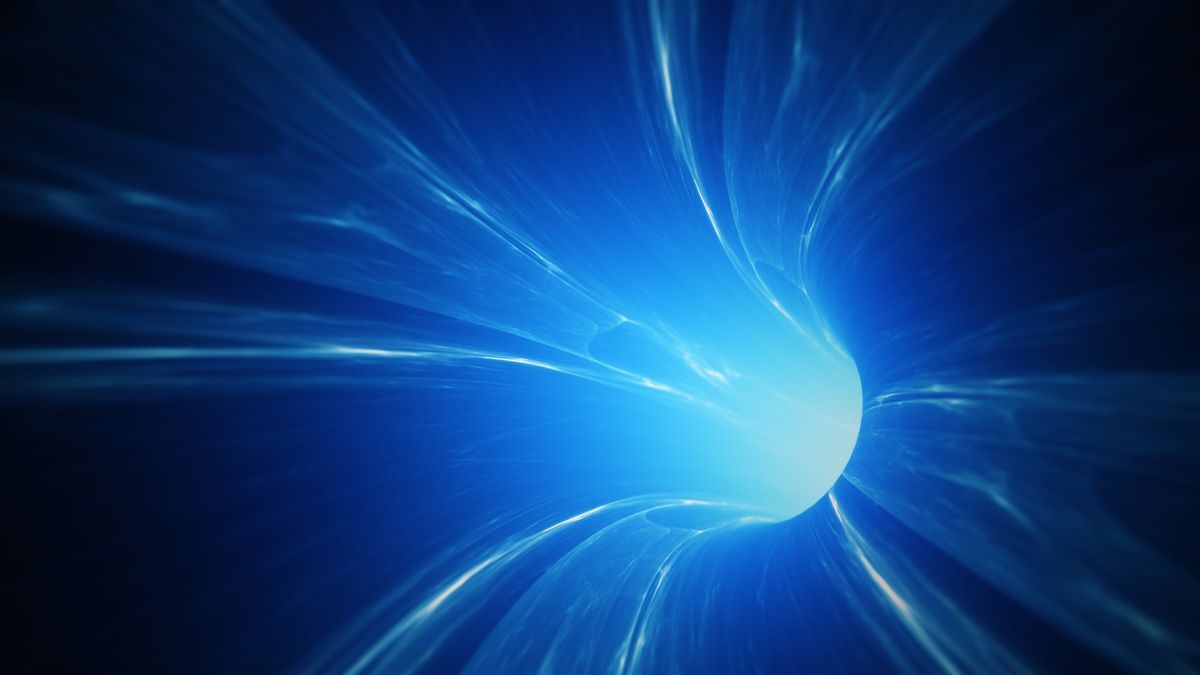
A wormhole is a hypothetical tunnel through spacetime that connects two separate locations.
These locations could be extremely far apart.
One mouth of a wormhole might exist near Earth while the other could be thousands, millions, or even billions of light-years away.
From the outside, the two locations remain separated by enormous distances.
Inside the wormhole, however, the path connecting them could be much shorter.
The wormhole acts as a bridge through curved spacetime.
Rather than moving faster than light through ordinary space, a traveler would take a shortcut through the geometry of spacetime itself.
This distinction is important.
According to Einstein’s theory, nothing can travel through space faster than light.
A wormhole does not necessarily violate this rule because it changes the route rather than increasing speed.
The traveler follows a shorter path.
Visualizing a Wormhole
Human intuition struggles with concepts involving curved spacetime.
To help visualize wormholes, physicists often use a two-dimensional analogy.
Imagine a sheet of paper.
Draw two dots far apart on the sheet.
A line connecting them across the surface represents normal travel through space.
Now fold the paper so the dots touch.
Punch a hole through both layers.
Suddenly, the two distant points become directly connected.
The tunnel through the paper represents a wormhole.
Although real spacetime is far more complex than a folded sheet of paper, this analogy captures the essential idea.
Distance can be altered by geometry.
What seems far apart in ordinary space may be closely connected through a different route.
Wormholes and Black Holes
Wormholes are often confused with black holes.
While they share certain similarities, they are not the same thing.
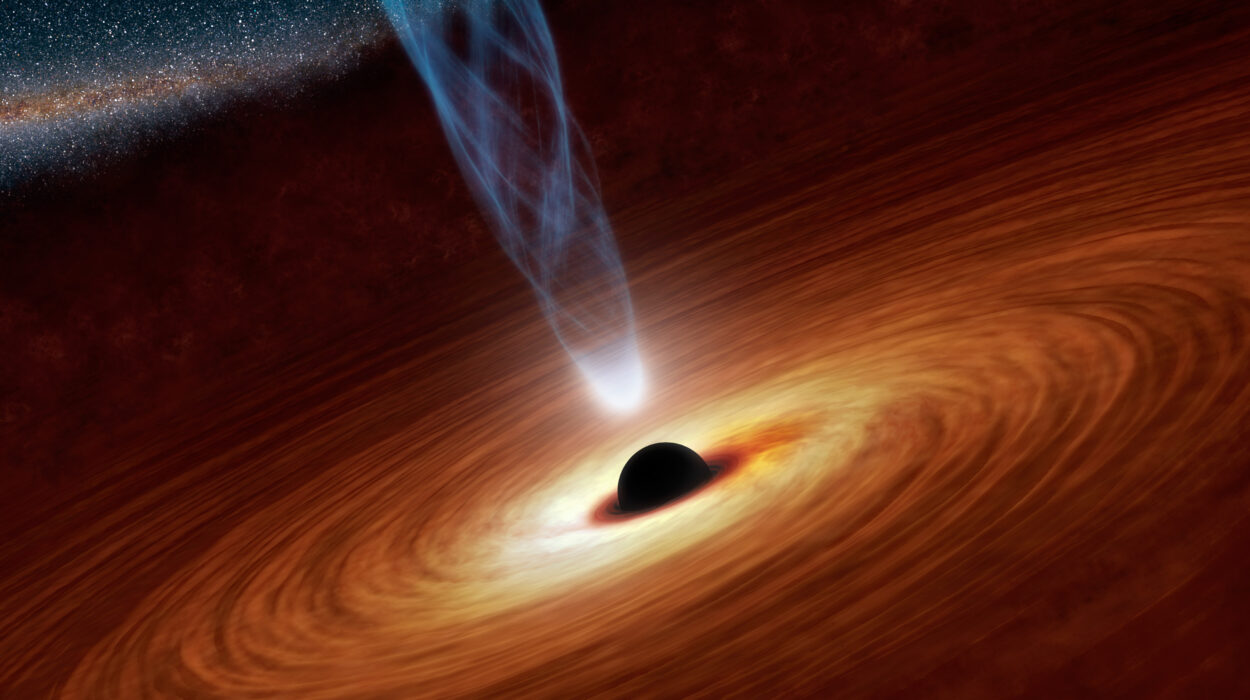
A black hole forms when matter becomes compressed into an extremely dense region.
Its gravity becomes so strong that nothing—not even light—can escape from within a boundary known as the event horizon.
A wormhole, in contrast, is theoretically a tunnel connecting different regions of spacetime.
Some mathematical models suggest wormholes might resemble black holes from the outside.
Both involve intense spacetime curvature.
Both emerge from Einstein’s equations.
However, a black hole traps anything that enters, whereas a traversable wormhole would theoretically allow passage through it.
Whether such traversable wormholes can actually exist remains one of the biggest unanswered questions.
The Problem with Early Wormholes
The original Einstein-Rosen bridge had a major flaw.
It was unstable.
Calculations suggested that the wormhole would collapse almost instantly after forming.
The tunnel would pinch shut before anything could pass through it.
Even a beam of light would not have enough time to cross.
This instability remains one of the greatest obstacles facing wormhole theories.
A wormhole might theoretically exist, but if it closes immediately, it cannot serve as a useful bridge.
Physicists therefore began searching for ways to keep a wormhole open.
This search led to some truly bizarre ideas.
The Mystery of Exotic Matter
To prevent a wormhole from collapsing, physicists found that something unusual might be required.
The wormhole’s throat—the narrow region connecting its two ends—would need support against the immense gravitational forces trying to close it.
Ordinary matter cannot provide this support.
Instead, theoretical models often require something called exotic matter.
Exotic matter is not simply unusual matter.
It refers to matter possessing negative energy density or other strange properties not found in everyday materials.
In effect, exotic matter would create a kind of gravitational repulsion.
This repulsive effect could counteract the tendency of the wormhole to collapse.
The challenge is that scientists have never found large amounts of exotic matter in nature.
Certain quantum phenomena hint that negative energy may be possible under specific conditions, but whether enough could exist to stabilize a wormhole remains unknown.
Can Wormholes Really Exist?
This question sits at the heart of wormhole research.
General relativity allows wormhole solutions mathematically.
In other words, Einstein’s equations do not automatically forbid them.
However, mathematical possibility does not guarantee physical reality.
Many solutions to physical equations describe situations that never actually occur in nature.
To determine whether wormholes truly exist, scientists need evidence.
So far, none has been found.
No telescope has observed a confirmed wormhole.
No spacecraft has detected one.
No experiment has demonstrated their existence.
At present, wormholes remain theoretical objects.
They are permitted by some models of physics, but they have not been verified by observation.
Traversable Wormholes
When most people imagine wormholes, they envision traversable wormholes.
These are wormholes that can be crossed safely by matter, spacecraft, or people.
A traversable wormhole would remain open long enough for travel.
Its internal structure would avoid crushing tidal forces.
Its entrances would be stable and accessible.
In principle, such a wormhole could function as a cosmic tunnel connecting distant locations.
A traveler entering one mouth might emerge somewhere else almost immediately.
The concept is exciting because it appears to offer a way around one of the universe’s greatest limitations: distance.
Even light requires years to cross the space between stars.
A traversable wormhole could theoretically reduce that journey dramatically.
Faster Than Light Without Breaking the Rules
One reason wormholes fascinate physicists is that they may allow effective faster-than-light travel without violating Einstein’s speed limit.
This sounds contradictory.
After all, relativity says nothing can travel faster than light.
The key lies in understanding what that limit means.
Relativity forbids objects from moving through local space faster than light.
A wormhole does not necessarily require that.
Instead, it changes the geometry connecting two points.
Imagine two cities separated by a winding mountain road.
A tunnel through the mountain provides a shorter route.
Travelers using the tunnel arrive sooner without increasing their speed.
Similarly, a wormhole shortens the path through spacetime.
The traveler never exceeds the speed of light locally.
The shortcut does the work.
Could Wormholes Connect Different Universes?
Some theoretical models suggest wormholes might connect entirely separate universes.
This idea ventures into highly speculative territory, but it emerges naturally from certain mathematical frameworks.
If multiple universes exist, wormholes could potentially act as bridges between them.
A traveler entering one mouth might emerge not merely in another galaxy but in a completely different universe with its own physical conditions.
At present, there is no evidence for such connections.
In fact, there is no confirmed evidence that multiple universes exist at all.
Nevertheless, the possibility illustrates how deeply wormholes challenge conventional ideas about reality.
Wormholes and Time Travel
Perhaps the most controversial aspect of wormhole theory involves time travel.
Certain calculations suggest that under specific circumstances, wormholes might function as time machines.
This possibility arises because relativity allows time to flow at different rates under different conditions.
Suppose one mouth of a wormhole experiences extreme motion or intense gravity while the other does not.
Time could pass differently at each end.
When the mouths are reunited, a time difference may exist.
Travel through the wormhole could potentially allow movement between different moments in time.
This idea has generated enormous interest among physicists and science-fiction writers alike.
However, the concept introduces serious paradoxes.
Could someone travel into the past and alter history?
Would causality break down?
Scientists continue debating these questions.
The Grandfather Paradox
Time travel immediately raises logical problems.
One of the most famous is the grandfather paradox.
Imagine a traveler journeys into the past and prevents their grandfather from meeting their grandmother.
If their grandparents never meet, the traveler is never born.
But if the traveler is never born, who traveled back to alter the past?
The contradiction highlights the difficulties associated with backward time travel.
Various proposed solutions exist.
Some physicists suggest timelines cannot be altered.
Others propose branching universes where changes create new histories.
At present, no consensus exists because practical time travel remains entirely hypothetical.
Wormholes in Quantum Physics
Modern physics consists largely of two powerful theories.
General relativity describes gravity and large-scale structures.
Quantum mechanics governs the microscopic world of particles.
Unfortunately, these theories do not fit together perfectly.
Physicists hope that a future theory of quantum gravity will unite them.
Interestingly, wormholes may play a role in this effort.
Recent theoretical research has explored possible connections between quantum entanglement and wormholes.
Some scientists have proposed that certain forms of entanglement might be mathematically related to microscopic wormhole-like structures.
These ideas remain highly speculative, but they represent active areas of research.
Wormholes may ultimately teach us something fundamental about the nature of space, time, and reality itself.
Searching for Wormholes
If wormholes exist, how could we find them?
Astronomers have proposed several possibilities.
A wormhole’s gravitational effects might differ slightly from those of a black hole.
Light passing near a wormhole could produce distinctive gravitational lensing patterns.
Stars orbiting a wormhole might behave differently than expected.
Radiation emitted near a wormhole could reveal unusual signatures.
Future telescopes may become sensitive enough to detect such clues.
For now, however, no observation has provided convincing evidence of an actual wormhole.
The search continues.
Wormholes in Science Fiction
Few scientific concepts have influenced popular culture as much as wormholes.
They appear throughout science fiction because they solve a major storytelling problem.
The universe is unimaginably large.
Even traveling at light speed, journeys between stars would require years.
Wormholes provide convenient shortcuts.
They allow characters to reach distant worlds within practical timeframes.
Movies, television series, and novels often portray wormholes as stable portals connecting remote regions of space.
While these depictions frequently simplify the science, they are often inspired by genuine theoretical ideas.
In this way, wormholes represent a rare example of advanced physics entering mainstream imagination.
Why Scientists Take Wormholes Seriously
Some people assume wormholes are purely fantasy because they sound so extraordinary.
Yet physicists study them for good reasons.
Wormholes emerge naturally from respected physical theories.
Investigating them helps researchers test the limits of general relativity.
Their study reveals important insights about spacetime geometry.
Questions surrounding wormholes also expose gaps in our understanding of gravity and quantum mechanics.
Even if wormholes never exist physically, exploring them can still lead to valuable discoveries.
Science often advances by examining extreme possibilities.
The Challenges of Building a Wormhole
Suppose wormholes do exist.
Could an advanced civilization create one?
Current knowledge suggests enormous challenges.
The energy requirements would likely be staggering.
Exotic matter might be necessary.
Stability would remain a major concern.
Controlling a structure involving intense spacetime curvature would require technologies far beyond anything humanity possesses.
At present, constructing a wormhole lies firmly in the realm of speculation.
It is not merely difficult.
It may prove impossible.
Yet history reminds us that today’s impossibilities sometimes become tomorrow’s breakthroughs.
What Wormholes Teach Us About Reality
Perhaps the most valuable aspect of wormholes is not whether they exist.
It is what they reveal about our understanding of the universe.
Wormholes demonstrate that reality is far stranger than common sense suggests.
Space is not simply empty distance.
Time is not an absolute clock.
Geometry itself can shape the behavior of the cosmos.
The equations describing gravity allow possibilities that would have seemed absurd only a century ago.
By studying wormholes, physicists are forced to confront profound questions about existence.
What is space?
What is time?
How are distant regions of the universe connected?
Can reality possess hidden structures beyond our everyday experience?
These questions lie at the frontier of human knowledge.
The Future of Wormhole Research
The coming decades may bring remarkable advances.
New telescopes will probe deeper into the universe.
Improved gravitational-wave observatories may reveal previously unseen phenomena.
Progress in quantum gravity could transform our understanding of spacetime.
Future discoveries may strengthen the case for wormholes or rule them out entirely.
Either outcome would represent an important scientific achievement.
What matters is not whether wormholes fulfill our dreams of cosmic travel.
What matters is that studying them helps uncover the true nature of reality.
Conclusion
A wormhole is a hypothetical tunnel through spacetime that could connect distant regions of the universe, different universes, or even different moments in time. Emerging from solutions to Einstein’s theory of general relativity, wormholes represent one of the most fascinating and mysterious ideas in modern physics. They offer the tantalizing possibility of cosmic shortcuts that bypass immense distances without violating the fundamental speed limits of nature.
Despite their popularity in science fiction, wormholes remain purely theoretical. No confirmed wormhole has ever been observed, and significant scientific challenges—including stability and the need for exotic matter—stand in the way of their existence. Yet physicists continue to study them because they illuminate deep questions about gravity, quantum mechanics, space, and time.
Whether wormholes ultimately prove real or remain mathematical curiosities, they occupy a unique place in science. They remind us that the universe is not limited by human intuition. Hidden within the equations describing reality may be possibilities more extraordinary than anything we have yet discovered. In that sense, wormholes are more than theoretical bridges across the cosmos—they are bridges between what we know and the vast mysteries that still await exploration.