Imagine standing beside a calm lake on a windless day. The water is smooth, almost perfectly still. Then a stone drops into the lake. Instantly, ripples spread outward from the point of impact, carrying energy across the surface.
Now imagine something similar happening not in water, but in the very fabric of the universe itself.
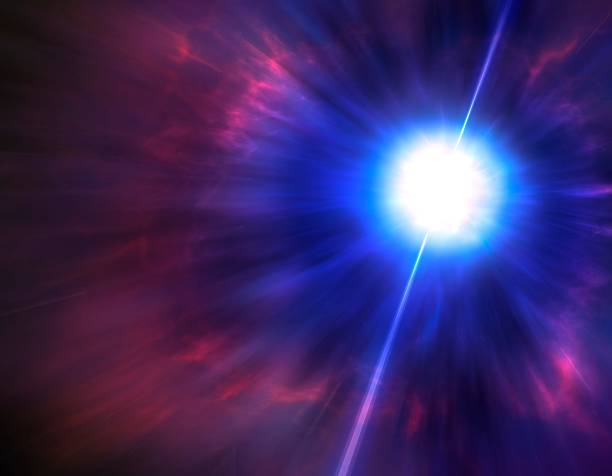
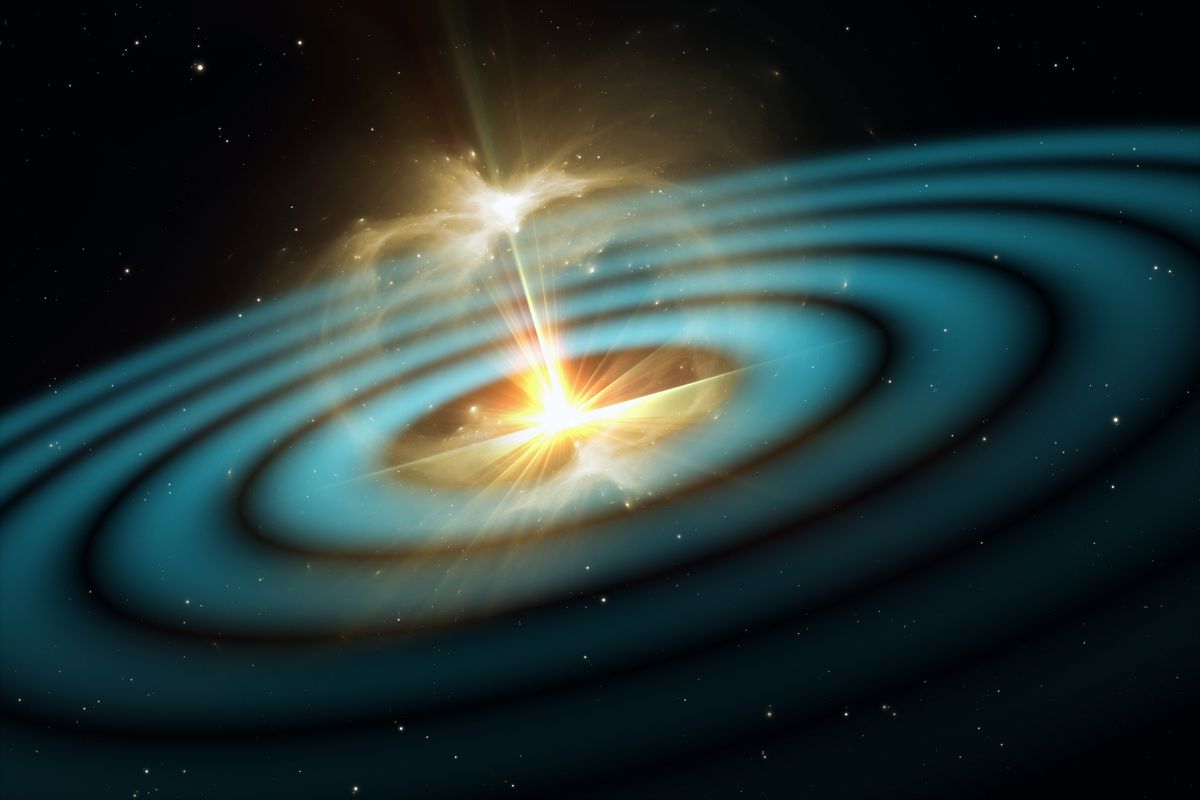
Far across the cosmos, two black holes spiral toward each other. They move faster and faster, locked in a gravitational dance that has lasted millions or even billions of years. Eventually they collide in a violent merger so powerful that it briefly releases more energy than all the stars in the observable universe combined. That colossal event sends ripples racing across the cosmos at the speed of light.
These ripples are called gravitational waves.
For decades, gravitational waves existed only as a prediction of physics. Scientists believed they were real, but nobody had ever directly observed them. Detecting them seemed almost impossible because by the time these waves reached Earth, their effects would be unimaginably tiny.
Yet in 2015, humanity finally heard the universe in a completely new way.
For the first time, scientists directly detected gravitational waves from the collision of two distant black holes. The discovery confirmed a century-old prediction made by Albert Einstein and opened an entirely new window onto the cosmos.
Today, gravitational waves are transforming astronomy. They allow scientists to study events that would otherwise remain invisible. They reveal the collisions of black holes, the mergers of neutron stars, and perhaps one day even echoes from the birth of the universe itself.
These tiny ripples have become one of the greatest scientific breakthroughs of the modern era.
Understanding Gravity Before Understanding Gravitational Waves
To understand gravitational waves, we first need to understand gravity itself.
Gravity is one of the fundamental forces of nature. It is the force that pulls objects toward one another.
Gravity keeps our feet on Earth.
It holds the Moon in orbit around Earth.
It keeps planets circling the Sun.
It binds stars together into galaxies and galaxies into clusters.
For centuries, scientists viewed gravity largely through the work of Sir Isaac Newton. Newton described gravity as an attractive force between objects with mass.
His theory worked remarkably well and remains useful today.
Yet Newton’s explanation left an important question unanswered.
How exactly does gravity work?
How can the Sun influence Earth across 150 million kilometers of empty space?
The answer came from a revolutionary new idea proposed by Albert Einstein.
Einstein Changes Everything
In 1915, Albert Einstein introduced the theory of general relativity.
This theory completely transformed humanity’s understanding of gravity.
Instead of treating gravity as a force pulling objects together, Einstein proposed something much stranger and more profound.
According to general relativity, space and time are woven together into a four-dimensional structure called spacetime.
Massive objects such as planets, stars, and black holes warp this spacetime.
An often-used analogy involves placing a heavy bowling ball on a stretched rubber sheet. The ball creates a depression in the sheet. Smaller objects placed nearby roll toward it because the surface itself is curved.
Although the analogy is imperfect, it captures the central idea.
Gravity is not simply a force acting through space.
Gravity is the curvature of spacetime itself.
Earth orbits the Sun because it follows the curved geometry created by the Sun’s mass.
Objects move along paths determined by the shape of spacetime around them.
This elegant concept became one of the greatest achievements in the history of science.
The Dynamic Nature of Spacetime
Einstein’s theory introduced another remarkable idea.
Spacetime is not rigid.
It can bend, stretch, compress, and move.
Before Einstein, many scientists imagined space as a fixed stage on which the universe unfolded.
General relativity revealed that the stage itself participates in the action.
When massive objects move, they alter the geometry of spacetime.
And when extremely massive objects accelerate, they can generate waves that travel through spacetime itself.
These are gravitational waves.
They are disturbances in the structure of spacetime that propagate outward at the speed of light.
Just as a stone creates ripples on a pond, accelerating masses create ripples in spacetime.
Einstein Predicts Gravitational Waves
Only a year after publishing general relativity, Einstein realized that his equations predicted the existence of gravitational waves.
In 1916, he showed mathematically that disturbances in spacetime should travel outward from accelerating masses.
This prediction was extraordinary.
It suggested that the universe could transmit information through ripples in spacetime itself.
Yet Einstein himself sometimes doubted whether these waves truly existed.
The mathematics was complex, and even many experts struggled to understand the implications.
For decades, gravitational waves remained largely theoretical.
Scientists debated whether they were real physical phenomena or merely mathematical artifacts.
Only much later did evidence begin to accumulate in their favor.
What Exactly Is a Gravitational Wave?
A gravitational wave is a traveling distortion in spacetime caused by accelerating masses.
As the wave moves, it stretches and compresses spacetime.
Imagine a circle of floating objects in space.
If a gravitational wave passes through the circle, the distances between objects change slightly.
The circle temporarily becomes stretched in one direction and compressed in another.
Moments later, the effect reverses.
The objects themselves may not move significantly through space.
Instead, spacetime itself changes shape.
This is one of the most difficult aspects of gravitational waves to visualize because they affect the very framework within which distances are measured.
The distortions are incredibly tiny, but they are real.
Why Gravitational Waves Are So Weak
One reason gravitational waves were so difficult to detect is that gravity is an extraordinarily weak force compared with other fundamental forces.
A small refrigerator magnet can easily overcome the gravitational pull of the entire Earth on a paper clip.
Because gravity is weak, generating detectable gravitational waves requires enormous masses moving at incredible speeds.
Ordinary events on Earth produce gravitational waves, but the effects are far too small to measure.
Even large natural disasters generate gravitational waves far below current detection limits.
The strongest waves come from some of the most extreme objects in the universe.
These include black holes, neutron stars, and supernova explosions.
Only such extraordinary events can produce gravitational waves strong enough to eventually reach Earth and be detected.
Black Holes: Factories of Gravitational Waves
Among the most powerful sources of gravitational waves are black holes.
A black hole forms when a massive star collapses under its own gravity.
The resulting object contains enormous mass packed into an extremely compact region.
Its gravitational pull becomes so strong that not even light can escape.
When two black holes orbit one another, they gradually lose energy by emitting gravitational waves.
As energy escapes, the black holes move closer together.
Their orbital speeds increase.
The gravitational waves grow stronger.
Eventually the black holes merge in a spectacular collision.
During the final moments, they may circle each other hundreds of times per second.
The resulting burst of gravitational waves can briefly outshine every star in the observable universe in terms of energy output.
Yet because gravity is weak and distances are vast, only faint ripples reach Earth.
Neutron Stars and Cosmic Catastrophes
Another major source of gravitational waves is neutron star mergers.
Neutron stars are among the densest objects known.
They form when massive stars explode as supernovae and leave behind crushed stellar cores.
A neutron star may contain more mass than the Sun squeezed into a sphere only about twenty kilometers wide.
When two neutron stars spiral together, they generate powerful gravitational waves.
Their collision creates some of the most energetic events in the universe.
These mergers can also produce heavy elements such as gold, platinum, and uranium.
In fact, much of the gold found on Earth may have originated in ancient neutron star collisions billions of years ago.
Gravitational waves allow scientists to study these events in unprecedented detail.
The Challenge of Detection
Although gravitational waves carry immense energy, detecting them is incredibly difficult.
By the time a wave reaches Earth, its effects are astonishingly small.
A passing gravitational wave changes distances by less than the width of an atomic nucleus across several kilometers.
Imagine measuring the distance to a nearby star and detecting a change smaller than the width of a human hair.
The required precision seems almost impossible.
Yet scientists found a way.
The solution involved some of the most sophisticated instruments ever built.
The Birth of LIGO
The breakthrough came through the creation of the Laser Interferometer Gravitational-Wave Observatory, commonly known as LIGO.
LIGO consists of two enormous facilities located in the United States.
Each observatory contains two long tunnels arranged in an L shape.
The arms stretch four kilometers in length.
Powerful lasers travel back and forth along these arms.
Under normal conditions, the laser beams remain perfectly synchronized.
If a gravitational wave passes through Earth, spacetime stretches in one direction and compresses in another.
This changes the lengths of the arms by tiny amounts.
The laser beams become slightly misaligned.
Sensitive instruments can detect the difference.
The challenge was extraordinary.
Scientists spent decades improving the technology required to achieve the necessary precision.
The Historic Detection of 2015
On September 14, 2015, something remarkable happened.
Both LIGO detectors recorded a faint signal.
The signal lasted only a fraction of a second.
Yet its pattern matched precisely what Einstein’s theory predicted for two merging black holes.
The event occurred about 1.3 billion light-years away.
Two black holes roughly 36 and 29 times the mass of the Sun had collided.
The merger produced a single larger black hole.
Approximately three solar masses worth of energy were converted directly into gravitational waves.
The signal traveled across the universe for more than a billion years before reaching Earth.
Scientists announced the discovery in February 2016.
The news electrified the scientific community.
Einstein had been right.
Gravitational waves were real.
Humanity had opened a completely new way of observing the universe.
Listening to the Universe
Traditional astronomy relies primarily on electromagnetic radiation.
Scientists study visible light, radio waves, infrared radiation, X-rays, and gamma rays.
These forms of light reveal enormous amounts of information.
Yet not everything in the universe emits detectable electromagnetic radiation.
Black holes, for example, are famously dark.
Gravitational waves provide a completely different form of information.
Rather than seeing the universe, scientists can now listen to it.
Many researchers compare gravitational-wave astronomy to hearing.
Light allows us to see cosmic objects.
Gravitational waves allow us to sense their motions.
The universe suddenly became richer and more complex.
An entirely new cosmic language had been discovered.
How Gravitational Wave Signals Sound
Scientists often convert gravitational-wave signals into audio frequencies.
The resulting sounds are surprisingly simple.
Many resemble brief chirps.
As two black holes spiral closer together, their orbital speed increases.
The frequency of the emitted gravitational waves rises accordingly.
When converted into sound, the signal climbs rapidly in pitch before ending abruptly at the moment of merger.
That tiny chirp represents a cataclysmic event involving enormous masses and energies.
A fraction of a second of data can reveal the collision of objects located billions of light-years away.
It is one of the most astonishing achievements of modern science.
Confirming Einstein’s Theory
The detection of gravitational waves provided one of the strongest confirmations of general relativity ever achieved.
Einstein’s equations predicted not only the existence of gravitational waves but also their detailed properties.
The observed signals matched theoretical predictions with remarkable accuracy.
Subsequent detections have continued to support the theory.
More than a century after its creation, general relativity remains one of the most successful scientific theories ever developed.
Each new gravitational-wave observation serves as another test.
So far, Einstein’s theory continues to pass.
Multi-Messenger Astronomy
One of the most exciting developments in modern astronomy is multi-messenger astronomy.
This approach combines information from different cosmic messengers.
Scientists use light, gravitational waves, neutrinos, and cosmic rays together to study the universe.
A major milestone occurred in 2017 when detectors observed gravitational waves from a neutron star merger.
Astronomers quickly located the event using telescopes.
For the first time, scientists observed the same cosmic event through both gravitational waves and electromagnetic radiation.
The combined observations revealed details impossible to obtain through either method alone.
A new era of astronomy had begun.
What Gravitational Waves Reveal About Black Holes
Before gravitational-wave astronomy, black holes were difficult to study directly.
Scientists often inferred their existence through indirect evidence.
Gravitational waves changed that.
Now researchers can observe black hole mergers directly.
The waves reveal masses, spins, orbital motions, and collision dynamics.
Many discoveries have challenged expectations.
Scientists have detected black holes larger than some theories predicted.
They have observed unusual merger patterns and surprising populations of black holes.
Each detection expands our understanding of these mysterious objects.
Exploring the Extreme Universe
Gravitational waves provide access to environments impossible to recreate on Earth.
Near merging black holes, gravity becomes extraordinarily intense.
Spacetime twists and bends in extreme ways.
The energies involved exceed anything humans can generate.
By studying gravitational waves, scientists gain insight into physics under the most extreme conditions known.
These observations help test theories of gravity, matter, and spacetime.
In many cases, gravitational waves allow researchers to explore regions of the universe that would otherwise remain inaccessible.
Searching for the First Moments of the Universe
Perhaps the most ambitious goal of gravitational-wave astronomy involves studying the early universe.
Light cannot reveal everything about cosmic history.
The early universe was once so hot and dense that light could not travel freely.
As a result, there is a limit to how far back traditional astronomy can see.
Gravitational waves may offer a way around this barrier.
Some theories predict that primordial gravitational waves were generated shortly after the Big Bang.
If detected, these ancient ripples could provide information about the universe’s earliest moments.
Scientists hope future instruments may uncover clues about conditions that existed fractions of a second after cosmic creation.
Future Gravitational Wave Observatories
The success of LIGO has inspired new observatories around the world.
Additional detectors improve the ability to locate gravitational-wave sources.
Future facilities will be even more sensitive.
One particularly exciting project is the planned space-based observatory known as Laser Interferometer Space Antenna, or LISA.
Unlike Earth-based detectors, LISA will operate in space using spacecraft separated by millions of kilometers.
This enormous scale will allow detection of lower-frequency gravitational waves.
Scientists expect LISA to observe supermassive black hole mergers and other phenomena beyond the reach of current detectors.
The future promises an increasingly detailed map of the gravitational-wave universe.
Could We Ever Feel a Gravitational Wave?
A natural question arises.
If gravitational waves pass through Earth, why don’t we feel them?
The answer lies in their weakness.
The distortions they produce are incredibly small.
Even powerful gravitational waves change distances by amounts far too tiny for human senses to detect.
Countless gravitational waves may pass through us without notice.
Our bodies, buildings, mountains, and oceans stretch and compress by imperceptible amounts.
Only highly specialized instruments can measure these effects.
The universe is constantly humming with gravitational vibrations, even though we remain unaware of them.
Gravitational Waves and Human Curiosity
The story of gravitational waves is also a story of human curiosity and perseverance.
Einstein predicted them in 1916.
Scientists spent decades debating their existence.
Researchers devoted entire careers to developing detection methods.
Many worked without knowing whether success would ever come.
The eventual discovery required generations of effort, international collaboration, technological innovation, and extraordinary patience.
It demonstrated humanity’s ability to uncover truths about the universe that once seemed forever beyond reach.
Few achievements better illustrate the power of scientific inquiry.
The Beauty of Ripples in Reality
There is something profoundly beautiful about gravitational waves.
They reveal that space and time are not static backgrounds but dynamic participants in the cosmic story.
Every black hole merger, every neutron star collision, and perhaps even the birth of the universe sends messages across spacetime.
These messages travel for millions or billions of years before reaching us.
When scientists detect a gravitational wave, they are sensing an event that may have occurred long before complex life existed on Earth.
The signal is a whisper from deep time and deep space.
It connects humanity to some of the most dramatic events in the cosmos.
Conclusion
Gravitational waves are ripples in spacetime generated by accelerating masses, especially some of the most extreme objects in the universe, such as black holes and neutron stars. First predicted by Albert Einstein in 1916 as a consequence of general relativity, they remained undetected for nearly a century until the historic LIGO discovery in 2015. Their detection confirmed a major prediction of modern physics and opened an entirely new way of studying the cosmos.
Unlike light, gravitational waves allow scientists to observe the motions of massive objects directly, revealing events that would otherwise remain hidden. They have transformed our understanding of black holes, neutron stars, gravity, and cosmic evolution. As new detectors become more sensitive and future observatories begin operation, gravitational-wave astronomy promises discoveries that may reshape our understanding of the universe.
These faint ripples are far more than scientific curiosities. They are messages carried across the fabric of reality itself, traveling through space and time to tell the story of distant collisions, extraordinary energies, and the dynamic universe we inhabit. Through gravitational waves, humanity has gained a new sense with which to explore the cosmos—and the journey has only just begun.