On a clear night, the stars seem like permanent fixtures of the sky. They sparkle quietly above us, appearing timeless and unchanging. Yet every star has a beginning, a life story, and eventually an end. Long before a star shines brightly across the cosmos, it starts its journey inside one of the most beautiful and mysterious structures in the universe: a nebula.
Nebulae are among the most breathtaking objects ever observed by astronomers. Through powerful telescopes, they appear as enormous clouds of glowing color stretching across space like cosmic paintings. Some resemble giant wings. Others look like pillars, bubbles, flowers, or ghostly curtains drifting through the darkness. Their beauty is so extraordinary that many of the most famous images from space are photographs of nebulae.
But nebulae are far more than celestial artwork. They are the factories where stars are born. Within these vast clouds of gas and dust, gravity slowly gathers material together until new stars ignite. Entire solar systems can emerge from these cosmic nurseries. In a very real sense, nebulae are the places where future worlds begin.
Even more fascinating is the fact that nebulae are also connected to the deaths of stars. Some nebulae are created when aging stars shed their outer layers. Others are formed by colossal stellar explosions. This means nebulae are involved in both the beginning and the end of stellar life cycles.
To understand nebulae is to understand one of the most important processes in the universe. These magnificent clouds help explain where stars come from, how galaxies evolve, and ultimately how the atoms in our own bodies were created.
Understanding the Meaning of a Nebula
The word “nebula” comes from a Latin term meaning “cloud” or “mist.”
The name is fitting because early astronomers saw nebulae as fuzzy patches of light in the sky. Before the invention of powerful telescopes, these objects appeared as faint, cloudy smudges that looked very different from ordinary stars.
Today we know that nebulae are enormous clouds of gas and dust located throughout space. They can span dozens, hundreds, or even thousands of light-years.
Although they appear dense and colorful in photographs, nebulae are actually incredibly thin. A nebula may contain a huge amount of material, but that material is spread across vast distances. The density inside many nebulae is far lower than even the best vacuum chambers created on Earth.
Despite their thinness, nebulae contain enough matter to play a crucial role in shaping the universe.
What Nebulae Are Made Of
Most nebulae consist primarily of hydrogen, the simplest and most abundant element in the universe.
Hydrogen atoms dominate the composition of these cosmic clouds because hydrogen was created in enormous quantities shortly after the Big Bang. Helium is also common, along with smaller amounts of heavier elements such as oxygen, carbon, nitrogen, silicon, sulfur, and iron.
Tiny particles of cosmic dust are mixed throughout the gas.
This dust is not the same as household dust. Instead, it consists of microscopic grains made from substances such as carbon compounds, silicates, and ice.
Although dust makes up only a small fraction of a nebula’s mass, it has a major impact on its appearance. Dust absorbs, scatters, and reflects light, helping create the spectacular visual structures seen in astronomical images.
The combination of gas, dust, gravity, radiation, and magnetic fields transforms nebulae into dynamic environments filled with activity.
The Discovery of Nebulae
Ancient observers noticed some nebulae long before telescopes existed.
One famous example is the Andromeda Galaxy, which was once thought to be a nebula because it appeared as a faint cloudy patch.
As telescopes improved during the seventeenth and eighteenth centuries, astronomers discovered many more nebulae.
Initially, nobody knew exactly what these objects were.
Some were later revealed to be distant galaxies. Others turned out to be genuine clouds of gas and dust inside our own galaxy.
The distinction was not fully understood until the twentieth century.
Today, astronomers use the term nebula specifically for interstellar clouds composed of gas and dust, while galaxies are recognized as enormous systems containing billions of stars.
This understanding transformed our picture of the universe and revealed the critical role nebulae play in stellar evolution.
Why Nebulae Matter
Nebulae are important because they act as cosmic recycling centers.
Stars are born inside nebulae. Later, when stars die, they often return material back into space. This material can eventually become part of new nebulae, leading to the formation of new generations of stars.
This cycle has been repeating for billions of years.
The carbon in your body, the oxygen you breathe, the calcium in your bones, and the iron in your blood were all forged inside ancient stars. When those stars died, they released these elements into space.
Over time, the material became incorporated into new nebulae.
Eventually, one of those nebulae gave birth to the Sun, Earth, and everything living on our planet.
In this sense, nebulae are not merely distant astronomical objects. They are part of our own cosmic ancestry.
How Stars Are Born Inside Nebulae
The most famous role of nebulae is star formation.
The process begins when regions within a nebula become slightly denser than their surroundings.
Gravity then starts pulling material inward.
As gas accumulates, the region becomes increasingly compact. More mass means stronger gravity, which attracts even more material.
This creates a self-reinforcing process.
Over thousands and millions of years, a dense core develops inside the cloud.
As material continues falling inward, pressure and temperature rise dramatically.
Eventually, the core becomes hot enough for nuclear fusion to begin.
At that moment, a new star is born.
Fusion allows hydrogen nuclei to combine into helium while releasing enormous amounts of energy.
The newborn star starts shining, illuminating the surrounding nebula and creating some of the most spectacular sights in the cosmos.
The Birthplace of Our Sun
Astronomers believe our own solar system originated within a nebula about 4.6 billion years ago.
A giant molecular cloud likely collapsed under gravity, forming the young Sun at its center.
The remaining material flattened into a rotating disk.
Within this disk, dust particles collided and gradually combined into larger objects.
These objects eventually formed planets, moons, asteroids, and comets.
The process transformed a cloud of gas and dust into the solar system we know today.
Although the original nebula disappeared long ago, its legacy remains all around us.
Every rock, ocean, mountain, tree, animal, and human being traces its origins back to that ancient stellar nursery.
Giant Molecular Clouds
The largest star-forming nebulae are known as giant molecular clouds.
These immense structures contain enormous quantities of molecular hydrogen and other molecules.
They are among the coldest places in space, often reaching temperatures only a few degrees above absolute zero.
Their cold temperatures allow molecules to survive without being broken apart by radiation.
Giant molecular clouds can contain enough material to create thousands or even millions of stars.
Within them, dense regions gradually collapse and fragment into smaller clouds.
Each fragment may eventually become a star or a group of stars.
Some of the most active star-forming regions in the Milky Way exist inside these colossal clouds.
Emission Nebulae: Clouds That Glow
One of the most visually stunning types of nebula is the emission nebula.
These nebulae glow because nearby stars energize their gas.
Young, hot stars emit intense ultraviolet radiation.
This radiation strips electrons from hydrogen atoms.
When the electrons later recombine with the atoms, they release light.
The result is a glowing nebula shining with vibrant colors.
Many emission nebulae appear reddish because hydrogen emits a characteristic red light.
Other colors arise from oxygen, sulfur, and various elements present within the cloud.
These glowing structures create some of astronomy’s most iconic images.
Reflection Nebulae: Cosmic Mirrors
Not all nebulae produce their own light.
Some shine because they reflect light from nearby stars.
These are called reflection nebulae.
Tiny dust particles scatter starlight throughout the cloud.
Blue light scatters more efficiently than red light, causing many reflection nebulae to appear blue.
The process is similar to why Earth’s sky appears blue during the day.
Reflection nebulae often create delicate, ethereal scenes that look almost dreamlike through telescopes.
Their beauty has fascinated astronomers for generations.
Dark Nebulae: Shadows Among the Stars
Some nebulae are so dense that they block light from objects behind them.
These are known as dark nebulae.
Rather than glowing brightly, they appear as dark silhouettes against star-filled backgrounds.
The dust within dark nebulae absorbs visible light extremely effectively.
As a result, they can hide entire regions of space from view.
Yet appearances can be deceiving.
Inside many dark nebulae, stars are actively forming.
Infrared telescopes can often peer through the dust and reveal newborn stars concealed within the darkness.
These hidden nurseries provide valuable insights into the earliest stages of stellar development.
Planetary Nebulae: The Final Breath of Dying Stars
Despite their name, planetary nebulae have nothing to do with planets.
The term originated because early telescopes made them appear vaguely planet-like.
Planetary nebulae form when medium-sized stars approach the end of their lives.
As such stars exhaust their fuel, they become unstable and shed their outer layers into space.
The exposed stellar core emits powerful radiation that causes the expelled gas to glow.
The result is a beautiful shell of luminous material surrounding the dying star.
These nebulae often display intricate shapes, including rings, bubbles, spirals, and symmetrical patterns.
They rank among the most visually striking objects in astronomy.
Supernova Remnants: Explosive Nebulae
Some nebulae are created through violence rather than gradual processes.
When massive stars die, they may explode as supernovae.
These explosions release tremendous amounts of energy.
The blast sends stellar material racing outward at enormous speeds.
As the expanding debris interacts with surrounding gas, it forms a supernova remnant.
These nebulae reveal the aftermath of one of nature’s most powerful events.
Supernova remnants enrich space with heavy elements that later contribute to future stars and planets.
Without such explosions, many of the elements essential for life would be far less abundant.
The Famous Orion Nebula
Among all stellar nurseries, few are as famous as the Orion Nebula.
Visible even with small telescopes, it lies approximately 1,300 light-years from Earth.
The Orion Nebula is one of the nearest major star-forming regions.
Within its glowing gas clouds, thousands of young stars are actively forming.
Astronomers have studied it extensively because its relative proximity provides a detailed look at stellar birth.
Images reveal a spectacular landscape of glowing gas, dark dust, and energetic young stars.
The Orion Nebula offers a glimpse into processes that once created our own Sun.
The Eagle Nebula and the Pillars of Creation
Perhaps no nebula image has become more famous than the Pillars of Creation within the Eagle Nebula.
Captured by the Hubble Space Telescope, the image shows towering columns of gas and dust stretching across space.
These pillars contain dense pockets where new stars are forming.
The structures are constantly sculpted by radiation and stellar winds from nearby massive stars.
Although they appear solid, the pillars are dynamic environments changing over time.
The image became an icon of modern astronomy because it combines breathtaking beauty with profound scientific significance.
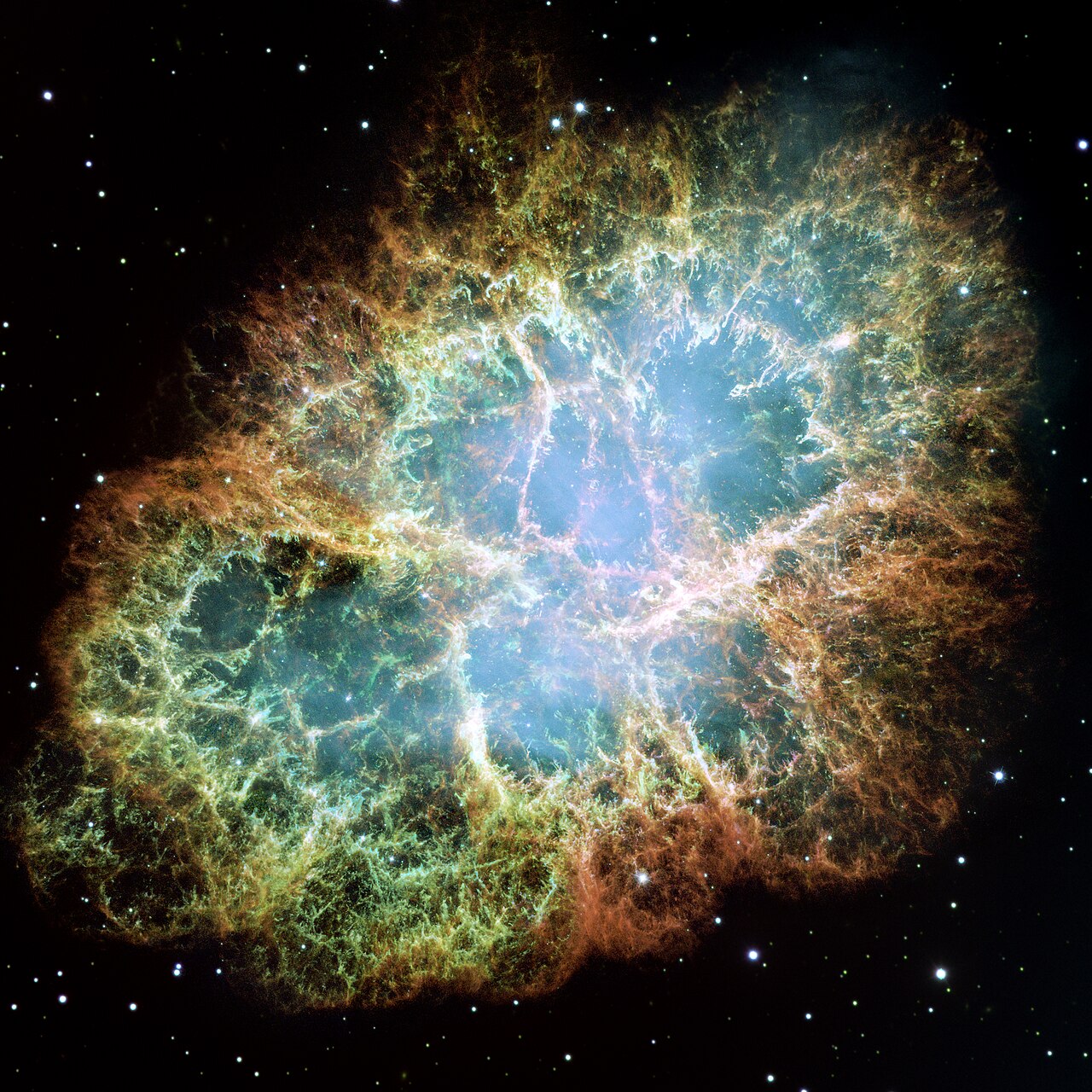
The Crab Nebula
The Crab Nebula represents a different stage of cosmic evolution.
This nebula formed from a supernova observed by astronomers in 1054 CE.
Historical records from China, Japan, and elsewhere describe a bright new star appearing in the sky.
Today, the Crab Nebula remains as the explosion’s enduring legacy.
At its center lies a rapidly spinning neutron star.
The surrounding nebula continues expanding outward, carrying evidence of the ancient stellar catastrophe.
The Crab Nebula demonstrates how stellar death contributes to cosmic renewal.
Colors in Nebulae
The vivid colors seen in nebula photographs often raise questions.
Do nebulae really look like that?
The answer is both yes and no.
Nebulae genuinely emit light at specific wavelengths associated with various elements.
However, many astronomical images enhance these colors to reveal details invisible to human eyes.
Different colors help scientists map the distribution of elements and physical processes within the cloud.
Red commonly indicates hydrogen.
Green and blue often represent oxygen.
Other colors may highlight sulfur or additional elements.
These visualizations transform scientific data into stunning works of cosmic art.
How Astronomers Study Nebulae
Modern astronomy uses many techniques to investigate nebulae.
Visible-light telescopes reveal glowing structures.
Infrared telescopes peer through dust clouds.
Radio telescopes detect molecules hidden within cold regions.
Ultraviolet and X-ray observatories examine energetic processes occurring near young stars and supernova remnants.
By combining information from different wavelengths, astronomers create comprehensive pictures of nebular environments.
This approach allows scientists to study star formation, chemical composition, temperature, density, and motion.
Each wavelength provides a different perspective on the same cosmic object.
Nebulae and the Life Cycle of Stars
Nebulae are deeply connected to stellar evolution.
Stars emerge from nebulae.
During their lives, stars alter surrounding nebular material through radiation and stellar winds.
When stars die, they often create new nebulae.
The material released eventually contributes to future generations of stars.
This continuous cycle links birth, life, death, and rebirth across cosmic timescales.
Galaxies evolve through these processes.
Heavy elements accumulate.
Planetary systems form.
Life becomes possible.
Nebulae sit at the heart of this grand cosmic story.
Nebulae Beyond the Milky Way
Although many famous nebulae reside within our galaxy, nebulae also exist throughout the universe.
Other galaxies contain vast star-forming regions, glowing emission clouds, and supernova remnants.
Powerful telescopes have observed nebulae millions and even billions of light-years away.
These observations allow astronomers to compare star formation across different environments.
They also reveal how galaxies have evolved throughout cosmic history.
The same physical processes operating in nearby nebulae occur throughout the observable universe.
Could New Planets Be Forming Right Now?
One of the most exciting realities of astronomy is that planet formation is happening at this very moment.
Inside many nebulae, young stars are surrounded by disks of gas and dust.
These disks serve as the raw material for future planetary systems.
Some may eventually produce rocky planets similar to Earth.
Others may form giant gas worlds larger than Jupiter.
Countless moons, asteroids, and comets may also emerge.
Some of these worlds could potentially possess environments suitable for life.
Every stellar nursery represents a potential birthplace for future planetary systems.
The Emotional Power of Nebulae
Few astronomical objects inspire wonder as effectively as nebulae.
Part of their appeal comes from their beauty.
Their glowing colors and intricate shapes seem almost unreal.
Yet another reason lies in what they represent.
Nebulae remind us that creation is an ongoing process.
The universe is not static.
Stars continue forming.
Planets continue emerging.
New possibilities continue appearing.
When we look at a nebula, we are witnessing the beginning of stories that may last billions of years.
Some future civilization somewhere in the universe might one day live on a planet currently taking shape inside one of these distant clouds.
That thought can be both humbling and inspiring.
What Nebulae Teach Us About Ourselves
The study of nebulae reveals a profound truth about our place in the cosmos.
Everything around us originated from material recycled through generations of stars.
The atoms that compose our bodies were once scattered across ancient nebulae.
Before Earth existed, before the Sun formed, before life emerged, those atoms traveled through interstellar clouds.
In a sense, every person is connected to the same cosmic cycle that creates stars today.
The universe is not separate from us.
We are part of it.
The story of nebulae is also our story.
Conclusion
Nebulae are among the most extraordinary structures in the universe. These immense clouds of gas and dust serve as stellar nurseries where new stars are born, while also preserving the remains of stars that have reached the ends of their lives. They represent both creation and transformation on a cosmic scale.
Far from being empty regions of space, nebulae are dynamic environments filled with complex physical processes. Gravity gathers material together, stars ignite, radiation sculpts vast clouds, and stellar explosions enrich the cosmos with new elements. Through these processes, nebulae shape galaxies and help drive the ongoing evolution of the universe.
Their significance extends beyond astronomy. Nebulae remind us that everything we know—including Earth and ourselves—originated from the same cosmic cycle of stellar birth and death. The elements necessary for life were forged in stars and distributed through nebulae long before our planet existed.
When we gaze upon images of glowing stellar nurseries such as the Orion Nebula or the Eagle Nebula, we are not merely looking at beautiful clouds in space. We are witnessing the places where future stars, planets, and perhaps even future forms of life are coming into existence.
Nebulae are nature’s grand workshops, where the universe continually creates something new from the raw materials of the cosmos. They are among the most beautiful reminders that the story of creation is still unfolding across the stars.