Dark matter is one of the greatest scientific mysteries of the modern age. It surrounds us, shapes galaxies, influences the evolution of the universe, and outweighs all the ordinary matter we can see by more than five to one. Yet despite decades of research and increasingly sophisticated technology, no one has ever directly observed a single dark matter particle.
Everything we know about dark matter comes from its gravity. It neither emits light nor reflects it. It appears invisible to every telescope designed to detect electromagnetic radiation, from radio waves to gamma rays. Nevertheless, without dark matter, galaxies would likely fly apart, galaxy clusters would not hold together, and the large-scale structure of the universe would look entirely different.
Modern cosmology estimates that ordinary matter—the atoms making up stars, planets, gas, dust, and every living organism—accounts for only about 5 percent of the universe’s total energy content. Dark matter contributes roughly 27 percent, while dark energy makes up the remaining majority. This means that everything humans have ever directly observed represents only a small fraction of cosmic reality.
Despite its importance, dark matter remains astonishingly elusive. Every major experiment designed to identify it has raised new questions instead of delivering definitive answers.
Here are ten of the biggest dark matter mysteries that continue to puzzle scientists.
1. What Is Dark Matter Actually Made Of?
The biggest mystery is also the most fundamental.
Scientists know dark matter exists because of its gravitational influence, but they still do not know what it is.
Unlike ordinary matter, dark matter does not appear to interact with light. It is invisible across the entire electromagnetic spectrum. It cannot be photographed, illuminated, or directly seen with even the most powerful telescopes.
The leading scientific theories suggest that dark matter consists of particles beyond the Standard Model of particle physics. Over the decades, researchers have proposed numerous candidates.
Weakly Interacting Massive Particles (WIMPs) were once considered the leading possibility because theoretical calculations naturally predicted approximately the right abundance of dark matter. Massive underground detectors were built specifically to find them.
Axions, incredibly light hypothetical particles originally proposed to solve another problem in quantum chromodynamics, later became another major candidate.
Sterile neutrinos, dark photons, primordial black holes, and several entirely new classes of particles have also been proposed.
Yet none has been confirmed.
After decades of searching, scientists still cannot answer the simplest question:
What is dark matter?
2. Why Has No One Ever Detected a Dark Matter Particle?
One might assume that something making up over one-quarter of the universe should be relatively easy to detect.
Instead, dark matter behaves almost like a cosmic ghost.
Every second, trillions of hypothetical dark matter particles may be passing through Earth’s atmosphere—and even through our bodies—without leaving obvious traces.
Scientists have constructed some of the most sensitive experiments ever built.
These detectors are buried deep underground to shield them from cosmic rays and background radiation.
Massive tanks filled with liquid xenon, germanium crystals, ultra-cold detectors, and advanced superconducting sensors all wait for an extremely rare interaction between dark matter and ordinary matter.
So far, none has produced universally accepted evidence.
Each improvement in detector sensitivity has ruled out more theoretical possibilities while leaving the central mystery unresolved.
Perhaps dark matter interacts even more weakly than expected.
Perhaps scientists are searching for the wrong kind of particle.
Or perhaps the true explanation is something no one has imagined yet.
3. Why Does Dark Matter Ignore Light?
Everything visible in the universe interacts with light.
Stars emit light.
Planets reflect it.
Gas clouds absorb it.
Atoms scatter it.
Even black holes can indirectly reveal themselves by affecting nearby matter that emits radiation.
Dark matter appears different.
It neither absorbs nor emits detectable electromagnetic radiation.
This remarkable property makes it effectively invisible.
Scientists know that if dark matter strongly interacted with light, the early universe would have evolved differently. Observations of the cosmic microwave background strongly constrain such interactions.
Yet physicists still do not know why dark matter appears almost completely isolated from electromagnetism.
Does it possess entirely new forces?
Does it exist in an invisible “dark sector” with its own particles and interactions?
Could dark matter have hidden electromagnetic properties too weak to detect?
No one knows.
4. Why Is Dark Matter Distributed the Way It Is?
Dark matter is not spread evenly throughout the universe.
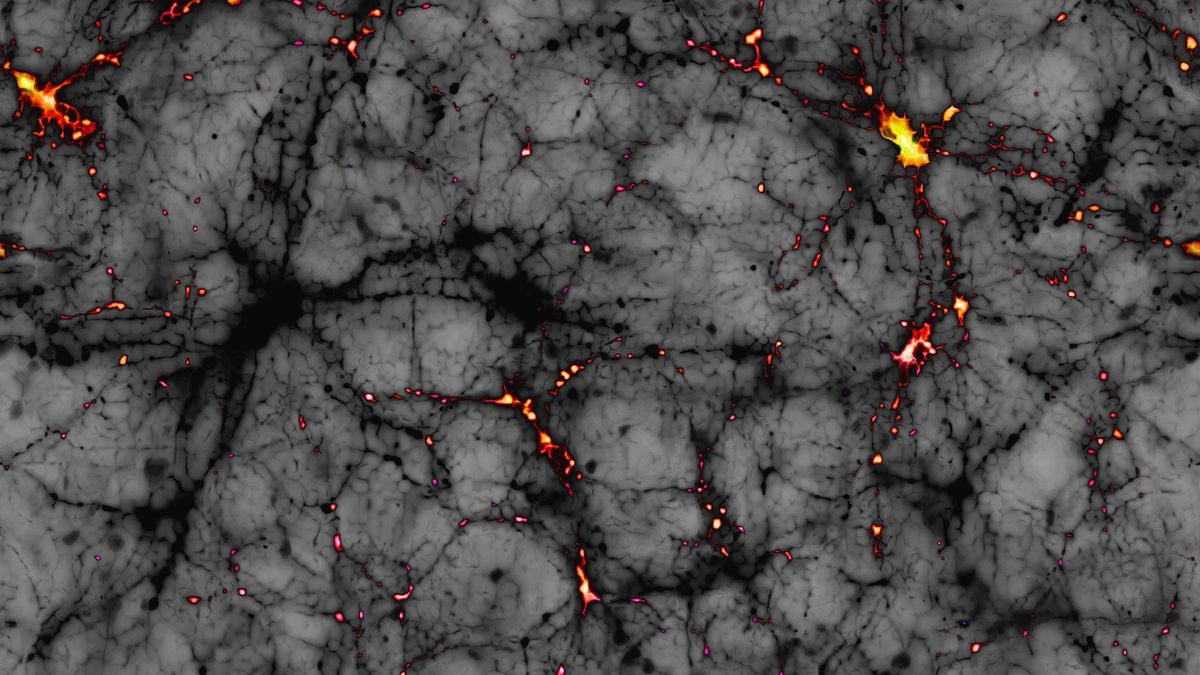
Computer simulations predict that dark matter forms an enormous cosmic web connecting galaxies across billions of light-years.
Within galaxies, dark matter is thought to surround visible stars in large halos extending far beyond the luminous disk.
However, detailed observations reveal surprising differences.
Some galaxies appear extremely rich in dark matter.
Others seem to contain far less than expected.
A handful of galaxies have been reported to contain almost no detectable dark matter at all, while others appear almost completely dominated by it.
These observations raise difficult questions.
Why do some galaxies accumulate much more dark matter than others?
How exactly does dark matter interact with galaxy formation?
Current theories explain many large-scale structures successfully but continue to struggle with certain small-scale observations.
5. Why Do Galaxy Rotation Curves Stay Flat?
One of the strongest pieces of evidence for dark matter comes from galaxy rotation curves.
According to Newtonian gravity, stars farther from a galaxy’s center should orbit more slowly because less visible matter lies inside their orbits.
Instead, astronomers observe something unexpected.
Stars far from galactic centers often orbit at nearly the same speed as stars much closer in.
These nearly flat rotation curves imply that galaxies contain enormous amounts of unseen mass extending far beyond their visible stars.
Dark matter explains this observation remarkably well.
Yet some galaxies exhibit subtle behaviors that are surprisingly difficult to reproduce precisely in simulations.
Alternative theories, such as Modified Newtonian Dynamics (MOND), attempt to explain these observations without invoking dark matter, although they face significant challenges in explaining many other cosmological observations.
Whether galaxy rotation curves hide additional secrets remains an active area of research.
6. Why Has the Large Hadron Collider Found Nothing?
The Large Hadron Collider (LHC), the world’s most powerful particle accelerator, was expected by many physicists to reveal evidence of new particles beyond the Standard Model.
Some hoped dark matter particles might be produced during high-energy proton collisions.
Instead, despite years of operation and enormous quantities of data, the LHC has not produced definitive evidence for dark matter.
Scientists continue searching using indirect signatures such as missing energy and momentum that could indicate invisible particles escaping the detectors.
Thus far, no convincing signal has emerged.
This absence of evidence forces researchers to reconsider many theoretical models that once seemed highly promising.
Dark matter may simply lie beyond the energy reach of current accelerators—or it may interact far more weakly than anticipated.
7. Could Dark Matter Have Its Own Hidden Universe?
One fascinating possibility is that dark matter may not consist of a single particle.
Instead, it could form an entire hidden sector of physics.
Just as ordinary matter contains electrons, protons, neutrons, photons, atoms, molecules, stars, and planets, dark matter might possess its own rich internal structure.
Some theoretical models propose dark atoms.
Others suggest dark photons.
Some even imagine complex dark chemistry.
If these hidden particles interact mainly with each other rather than with ordinary matter, they could remain almost completely invisible to us while still influencing the universe gravitationally.
This possibility dramatically expands the mystery.
Dark matter might not simply be invisible matter.
It could represent an entirely unseen cosmic ecosystem.
So far, however, no experimental evidence confirms this extraordinary idea.
8. Did Dark Matter Shape the First Galaxies?
Astronomers believe dark matter played a central role in the formation of cosmic structure.
Shortly after the Big Bang, ordinary matter remained hot and smooth.
Dark matter, however, may have begun clumping earlier under gravity.
These dense concentrations would have acted as gravitational scaffolding, pulling gas inward and eventually allowing stars and galaxies to form.
Without dark matter, the universe might have remained much smoother for far longer.
Yet important details remain uncertain.
Exactly when did dark matter first begin clumping?
How rapidly did the earliest dark matter halos grow?
Did dark matter influence the birth of the first stars differently than current models predict?
Powerful telescopes, including observations of extremely distant galaxies, continue helping scientists investigate these early cosmic epochs.
Many questions remain unanswered.
9. Why Doesn’t Dark Matter Form Stars and Planets?
Ordinary matter naturally forms increasingly complex structures.
Gas collapses into stars.
Stars produce heavy elements.
Those elements create planets.
Planets eventually provide environments where life can emerge.
Dark matter seems fundamentally different.
Although gravity causes dark matter to gather into enormous halos surrounding galaxies, it apparently does not collapse into dense objects like stars or planets.
Why?
The answer likely lies in how dark matter behaves.
Ordinary matter loses energy by emitting light and heat, allowing gas clouds to cool and collapse.
Dark matter appears unable to shed energy this way.
Without efficient cooling mechanisms, it remains spread over much larger volumes.
Still, scientists cannot rule out every possibility.
If dark matter possesses unknown interactions within a hidden sector, perhaps some forms of dark matter could produce compact structures invisible to ordinary telescopes.
This intriguing possibility continues to inspire theoretical research.
10. Could Our Entire Understanding of Gravity Be Incomplete?
The final mystery may be the most profound.
What if dark matter does not exist at all?
Some physicists argue that instead of adding invisible matter to explain cosmic observations, perhaps our understanding of gravity itself needs revision.
Several alternative theories modify gravity on galactic or cosmological scales.
Modified Newtonian Dynamics (MOND) successfully explains many galaxy rotation curves but struggles with galaxy clusters, gravitational lensing, and the cosmic microwave background.
Other relativistic theories extend Einstein’s equations in various ways, attempting to reproduce observations without invoking dark matter.
So far, however, no alternative has matched the overall success of the standard cosmological model across the full range of observations.
Nevertheless, the possibility remains scientifically important.
History has repeatedly shown that unexpected observations sometimes reveal entirely new laws of nature.
Whether dark matter represents undiscovered particles, hidden forces, new physics, or even an incomplete understanding of gravity remains one of science’s greatest open questions.
The Search Continues
The mystery of dark matter has inspired one of the largest scientific investigations in history. Physicists, astronomers, and cosmologists are pursuing answers using underground detectors, space telescopes, particle accelerators, gravitational lensing surveys, precision measurements of the cosmic microwave background, and increasingly sophisticated computer simulations.
Future observatories may provide new clues by mapping the universe with unprecedented precision. Next-generation particle detectors will probe interaction strengths never before explored. Advances in quantum sensing, artificial intelligence, and astronomical instrumentation may reveal subtle signatures that have so far escaped detection.
Every new observation helps narrow the possibilities, even when it fails to produce the long-awaited breakthrough.
Conclusion
Dark matter remains one of the deepest unsolved mysteries in modern science. It appears to dominate the matter content of the universe, govern the formation of galaxies, and shape the large-scale cosmic web, yet its true nature continues to evade discovery.
The ten mysteries explored here illustrate just how much remains unknown. Scientists still do not know what dark matter is made of, why it interacts so weakly with ordinary matter, why it has never been directly detected, or whether our current theories tell the complete story. Each unanswered question points toward new experiments, new observations, and perhaps entirely new physics waiting to be uncovered.
History has shown that some of humanity’s greatest scientific revolutions began with mysteries that seemed impossible to solve. Dark matter may well be the next. When its true identity is finally revealed, it could transform our understanding of the universe as profoundly as the discoveries of gravity, relativity, or quantum mechanics once did, opening an entirely new chapter in humanity’s exploration of the cosmos.