Imagine a star so dense that a spoonful of its material would weigh billions of tons on Earth. Imagine that same star spinning hundreds of times every second while blasting beams of energy across space like a giant cosmic lighthouse. Now imagine that its pulses arrive with such incredible regularity that some are more precise than the finest mechanical clocks ever built by humans.
This is a pulsar.
Among all the strange objects discovered in the universe, pulsars stand out as some of the most fascinating. They are the collapsed remains of once-massive stars, compressed into objects only about the size of a city yet containing more mass than our Sun. They rotate at astonishing speeds and emit powerful beams of radiation that sweep across the cosmos. Whenever one of those beams points toward Earth, astronomers detect a pulse of energy.
These pulses are so regular that pulsars have earned a remarkable nickname: the universe’s most precise cosmic clocks.
Since their accidental discovery in 1967, pulsars have transformed our understanding of stars, gravity, matter, and even space-time itself. They have helped scientists test Einstein’s theories, search for gravitational waves, study extreme physics, and explore mysteries that remain unsolved.
Yet despite decades of research, pulsars still inspire wonder. They are remnants of stellar death that continue shining across millions of light-years, sending rhythmic signals through the darkness like heartbeats from the distant universe.
The Discovery That Shocked Astronomy
The story of pulsars begins with a surprising observation.
In 1967, a graduate student named Jocelyn Bell Burnell was analyzing radio telescope data at the University of Cambridge. She noticed an unusual signal that appeared as a series of regular pulses.
At first, the signal seemed impossible.
Natural cosmic sources generally do not produce such perfectly timed bursts. The pulses arrived every 1.337 seconds with astonishing consistency.
The signal was so strange that some researchers briefly considered the possibility that it might come from an intelligent extraterrestrial civilization.
The source was jokingly nicknamed “LGM-1,” which stood for “Little Green Men 1.”
However, further observations soon revealed additional similar objects elsewhere in the sky. It became clear that these signals were not coming from aliens but from a previously unknown type of celestial object.
Astronomers had discovered pulsars.
The finding was revolutionary. It revealed an entirely new class of objects and opened a window into some of the most extreme environments in the universe.
What Exactly Is a Pulsar?
A pulsar is a rapidly rotating neutron star that emits beams of electromagnetic radiation from its magnetic poles.
That definition may sound complicated, but the idea becomes much easier to understand when broken into parts.
A neutron star forms after a massive star reaches the end of its life.
When such a star runs out of fuel, gravity overwhelms the forces supporting it. The core collapses dramatically, triggering a powerful supernova explosion.
The outer layers of the star are blasted into space.
The core survives as an incredibly dense object called a neutron star.
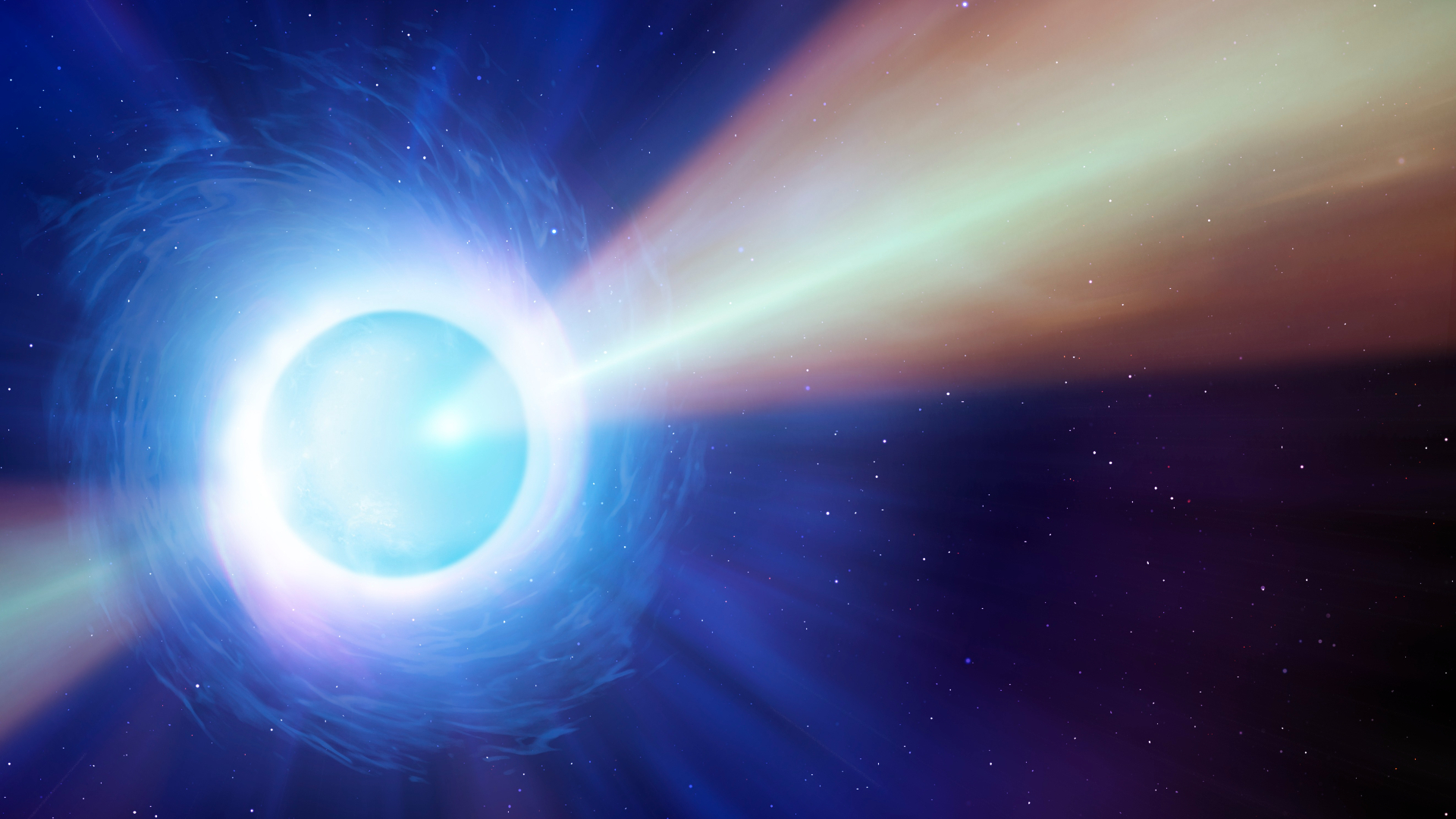
Some neutron stars possess strong magnetic fields and rotate rapidly. If their magnetic poles are not perfectly aligned with their rotation axis, they emit beams of radiation that sweep through space.
As the star spins, these beams move like the beam of a lighthouse.
If Earth happens to lie in the path of one of those beams, astronomers observe regular pulses.
The star itself is not turning on and off. Instead, its rotating beam repeatedly sweeps across our line of sight.
That is why these objects are called pulsars.
The Death of a Massive Star
To truly understand pulsars, we must begin with their birth.
Ironically, pulsars are born from stellar death.
Massive stars spend millions of years producing energy through nuclear fusion. Deep within their cores, hydrogen atoms fuse into helium. Later, heavier elements form through increasingly complex fusion reactions.
This process creates enormous pressure that balances the inward pull of gravity.
For most of a star’s life, these forces remain in equilibrium.
Eventually, however, the star exhausts its nuclear fuel.
Once fusion stops, the outward pressure weakens.
Gravity suddenly gains the upper hand.
The star’s core collapses at incredible speed.
Within seconds, matter becomes compressed to extraordinary densities.
The collapse triggers a supernova explosion, one of the most powerful events in the universe.
The remaining core becomes a neutron star.
If conditions are right, that neutron star may become a pulsar.
The Incredible Density of Neutron Stars
One of the most astonishing facts about pulsars is their density.
A typical neutron star contains roughly one to two times the mass of our Sun.
Yet all of that mass is squeezed into an object only about 20 kilometers (12 miles) across.
To appreciate how extreme this is, imagine compressing a mountain into the size of a grain of sand.
The matter inside a neutron star exists under conditions impossible to reproduce fully on Earth.
Atoms are crushed.
Electrons and protons combine.
Matter becomes dominated by neutrons.
The result is one of the densest forms of matter known.
A teaspoon of neutron-star material would weigh billions of tons.
This density creates gravitational forces so intense that the surface gravity of a neutron star is hundreds of billions of times stronger than Earth’s.
Standing on such a surface would be impossible.
The environment is unlike anything humans experience in everyday life.
Why Pulsars Spin So Fast
One of the defining characteristics of pulsars is their rapid rotation.
Some spin once every few seconds.
Others rotate hundreds of times every second.
How can an object with the mass of a star spin so rapidly?
The answer involves a principle known as conservation of angular momentum.
Imagine an ice skater spinning with arms extended.
When the skater pulls their arms inward, they rotate faster.
The same principle applies when a massive star collapses.
Before collapse, the star may rotate relatively slowly.
As gravity compresses it into a much smaller object, its rotation speeds up dramatically.
The result is a neutron star spinning at extraordinary rates.
Some pulsars rotate more than 700 times per second.
At these speeds, points on the star’s surface move at significant fractions of the speed of light.
The Lighthouse Effect
The characteristic pulsing behavior of pulsars arises from what astronomers call the lighthouse effect.
A pulsar emits radiation from regions near its magnetic poles.
These poles are usually tilted relative to the star’s rotation axis.
As the star spins, the beams sweep across space.
Whenever one beam crosses Earth’s line of sight, astronomers detect a pulse.
Then the beam moves away.
A short time later it returns.
The cycle repeats with remarkable precision.
This is similar to watching a lighthouse from a distance.
The lighthouse beam appears briefly, disappears, and then returns as the structure rotates.
The light itself never stops shining.
The same principle explains pulsar pulses.
What Kind of Radiation Do Pulsars Emit?
Pulsars emit radiation across a wide range of wavelengths.
Many were first discovered through radio waves.
These radio pulsars remain among the most extensively studied.
However, pulsars can also emit visible light, X-rays, and gamma rays.
Some are especially powerful sources of high-energy radiation.
The exact mechanisms behind these emissions are complex and remain active areas of research.
Strong magnetic fields accelerate charged particles near the pulsar.
These particles produce radiation through various physical processes.
The result is a powerful beacon visible across vast cosmic distances.
Even though pulsars are relatively small, their energy output can be enormous.
The Strongest Magnetic Fields in the Universe
Pulsars possess incredibly strong magnetic fields.
Earth’s magnetic field guides compasses and helps protect us from solar radiation.
A typical refrigerator magnet is stronger than Earth’s field.
Pulsars operate on an entirely different scale.
Their magnetic fields can be trillions of times stronger than Earth’s.
These fields dominate the surrounding environment.
They accelerate particles to extraordinary energies.
They shape radiation beams and influence matter nearby.
Some neutron stars, known as magnetars, possess even stronger magnetic fields.
These may be the most magnetic objects in the known universe.
The extreme magnetism of pulsars makes them valuable laboratories for studying physics under conditions impossible to replicate on Earth.
Millisecond Pulsars: Nature’s Ultimate Timekeepers
Among all pulsars, millisecond pulsars are especially impressive.
These objects rotate hundreds of times each second.
Some complete a rotation in less than two milliseconds.
That means they spin faster than a kitchen blender, a jet engine turbine, or virtually any everyday machine humans have created.
Yet despite their speed, they remain remarkably stable.
Their pulses arrive with extraordinary regularity.
Some rival atomic clocks in precision.
This stability allows astronomers to predict pulse arrival times years into the future.
The slightest deviation may indicate an important physical phenomenon.
Because of their precision, millisecond pulsars serve as natural clocks distributed throughout our galaxy.
How Pulsars Become Millisecond Pulsars
Scientists believe many millisecond pulsars are “recycled.”
They begin life as ordinary neutron stars.
Later, they acquire a companion star.
Matter from the companion gradually falls onto the neutron star.
As material accumulates, angular momentum transfers to the neutron star.
This process acts like a cosmic accelerator.
Over millions of years, the neutron star spins faster and faster.
Eventually it reaches millisecond periods.
The result is a rapidly rotating pulsar with extraordinary stability.
These recycled pulsars provide valuable clues about stellar evolution and binary star systems.
Pulsars and Einstein’s Theory of Relativity
One reason pulsars are so important scientifically is that they allow researchers to test Einstein’s theories.
Einstein’s theory of general relativity describes gravity as the curvature of space-time.
Many predictions of the theory are difficult to test.
Pulsars provide ideal environments because they exist in regions of intense gravity.
Binary pulsars are particularly useful.
In these systems, a pulsar orbits another star.
The precise timing of pulses allows astronomers to measure orbital motion with extraordinary accuracy.
Tiny effects predicted by relativity become detectable.
Observations of binary pulsars have repeatedly confirmed Einstein’s theory.
Some of the strongest evidence supporting general relativity comes from pulsar studies.
The Nobel Prize and Binary Pulsars
A major breakthrough occurred in 1974 when astronomers Russell Hulse and Joseph Taylor discovered a binary pulsar.
The system contained two compact stars orbiting one another.
Careful measurements revealed that the orbit was slowly shrinking.
This matched predictions involving gravitational-wave energy loss.
The discovery provided the first indirect evidence for gravitational waves.
Decades later, direct detection of gravitational waves would become one of the greatest achievements in modern astronomy.
The pulsar observations played a crucial role in laying the foundation for that success.
Pulsars as Gravitational Wave Detectors
Today, astronomers use pulsars to search for gravitational waves in a completely different way.
Gravitational waves are ripples in space-time produced by massive accelerating objects.
As these waves pass through space, they slightly alter distances.
Pulsar timing arrays take advantage of pulsars’ extraordinary precision.
Researchers monitor many millisecond pulsars scattered across the sky.
If a gravitational wave passes through our region of space, it subtly changes pulse arrival times.
By comparing observations from multiple pulsars, scientists can detect these distortions.
In effect, the galaxy itself becomes a gigantic gravitational-wave observatory.
This technique is opening a new window onto the universe.
The Famous Crab Pulsar
One of the best-known pulsars is the Crab Pulsar.
It lies within the famous Crab Nebula.
The nebula formed from a supernova observed by Chinese astronomers in 1054.
At its center sits a rapidly spinning neutron star.
The Crab Pulsar rotates about 30 times per second.
It emits radiation across the electromagnetic spectrum.
Its energy powers much of the surrounding nebula’s glow.
Because it is relatively young and energetic, the Crab Pulsar has become one of the most studied pulsars in astronomy.
Pulsars and the Search for Exoplanets
Pulsars have contributed to another major scientific achievement.
The first confirmed exoplanets were discovered around a pulsar.
In the early 1990s, astronomers detected tiny irregularities in pulsar timing.
The variations revealed the presence of orbiting planets.
This discovery was astonishing.
The planets existed around the remnant of a star that had exploded in a supernova.
Before then, most scientists assumed planetary systems could not survive such catastrophic events.
The finding expanded our understanding of where planets can exist.
It also marked the beginning of the modern era of exoplanet discovery.
What Would It Be Like Near a Pulsar?
Imagining a journey near a pulsar reveals how extreme these objects are.
Approaching one would expose you to intense radiation.
Its gravitational field would become overwhelming.
Magnetic forces would dominate the environment.
The sky would likely be filled with brilliant beams sweeping across space.
Nearby matter could be accelerated to enormous energies.
Time itself would behave differently because of strong relativistic effects.
No spacecraft currently exists that could safely approach such conditions.
Pulsars remind us that the universe contains environments far beyond ordinary human experience.
Can Pulsars Eventually Die?
Although pulsars are incredibly stable, they do not shine forever.
Each pulse carries away energy.
Over time, rotation gradually slows.
As spinning decreases, the pulsar’s ability to generate radiation weakens.
Eventually the beams may become too faint to detect.
At that stage, the object may effectively disappear from our view.
The neutron star itself still exists.
It simply no longer functions as an active pulsar.
Astronomers sometimes refer to this stage as the pulsar graveyard.
Countless dormant neutron stars may be scattered throughout the galaxy.
Pulsars and the Future of Space Navigation
One of the most exciting practical applications of pulsars involves navigation.
Because pulsars emit highly predictable signals, they can function as natural cosmic landmarks.
Future spacecraft may use pulsar timing for autonomous navigation.
Instead of relying entirely on Earth-based tracking, a spacecraft could determine its position by measuring signals from multiple pulsars.
The concept resembles GPS but on a galactic scale.
For missions traveling deep into the Solar System or beyond, pulsar navigation could become an invaluable tool.
The same cosmic clocks that help scientists study the universe may one day guide humanity through it.
Unanswered Questions About Pulsars
Despite decades of study, many mysteries remain.
Scientists still do not fully understand every aspect of pulsar emission mechanisms.
The precise behavior of matter inside neutron stars remains uncertain.
Researchers continue debating what occurs at the highest densities.
Some theories suggest exotic forms of matter may exist within neutron-star cores.
Others propose strange states involving fundamental particles.
Observations of pulsars provide one of the few ways to investigate these possibilities.
Each new discovery helps refine our understanding of extreme physics.
Yet many questions remain open.
Why Pulsars Fascinate Scientists
Pulsars occupy a unique place in astronomy.
They are simultaneously simple and complex.
Their rhythmic pulses make them easy to recognize.
Yet the physical processes behind those signals involve some of the most extreme conditions in nature.
Pulsars connect multiple fields of science.
They reveal how stars die.
They test theories of gravity.
They probe nuclear physics.
They help detect gravitational waves.
They even aid the search for planets and future space-navigation systems.
Few astronomical objects contribute to so many different areas of research.
The Cosmic Heartbeat of the Universe
When astronomers point radio telescopes toward a pulsar, they hear a steady rhythm.
Pulse.
Pulse.
Pulse.
Sometimes the intervals are milliseconds apart.
Sometimes they occur every few seconds.
Across thousands or even millions of years, the pattern continues.
These signals began their journey long before human civilizations existed.
They crossed vast stretches of interstellar space.
Eventually they reached Earth, where sensitive instruments transformed them into data, sounds, and discoveries.
In a universe often defined by chaos and violence, pulsars offer something remarkable: consistency.
They are the surviving hearts of dead stars, still beating across cosmic time.
Conclusion
Pulsars are among the most extraordinary objects ever discovered. Born from the explosive deaths of massive stars, these ultra-dense neutron stars spin at astonishing speeds while emitting powerful beams of radiation. As those beams sweep across Earth, they create pulses so regular that some pulsars rival the precision of atomic clocks.
Their importance extends far beyond their fascinating appearance. Pulsars have helped scientists test Einstein’s theories, uncover evidence for gravitational waves, discover exoplanets, explore extreme states of matter, and develop concepts for future space navigation. They serve as natural laboratories where the laws of physics can be examined under conditions impossible to recreate on Earth.
Yet perhaps their greatest appeal lies in what they represent. Pulsars are reminders that even after a star’s dramatic death, something remarkable can remain behind. Deep in the darkness of space, these compact stellar remnants continue sending rhythmic signals across the cosmos, marking the passage of time with astonishing precision.
Like cosmic lighthouses and celestial clocks combined, pulsars stand as some of the universe’s most beautiful examples of order emerging from catastrophe. Their steady pulses continue to echo through the galaxy, carrying stories of stellar explosions, extreme physics, and the enduring wonder of the universe itself.