The universe is filled with wonders that challenge human imagination. Among them, black holes stand as some of the most mysterious objects ever discovered. They are regions of space where gravity becomes so powerful that nothing—not even light—can escape once it crosses a certain boundary. Black holes have captured the public imagination for decades because they seem almost supernatural, like cosmic traps from which there is no return.
But what if there existed the opposite of a black hole?
What if there were places in the universe where matter and energy could leave but never enter?
What if there were cosmic fountains instead of cosmic prisons?
This extraordinary idea leads us to one of the strangest concepts in modern theoretical physics: the white hole.
A white hole is a hypothetical object predicted by certain mathematical solutions of Einstein’s equations of general relativity. It is often described as the time-reversal of a black hole. While a black hole swallows matter and traps everything inside, a white hole would do the opposite. It would continuously expel matter, energy, and light while preventing anything from entering.
Unlike black holes, which are supported by overwhelming observational evidence, white holes remain entirely theoretical. No confirmed white hole has ever been observed. Yet the idea continues to fascinate physicists because it touches on some of the deepest questions in science, including the nature of time, gravity, space, quantum mechanics, and the origins of the universe itself.
White holes occupy a unique place in scientific thought. They may not exist in reality, but exploring them helps scientists probe the limits of what is physically possible.
The Journey Begins with Black Holes
To understand white holes, we first need to understand black holes.
Black holes form when enormous amounts of matter become concentrated into a relatively small region of space. Most known black holes originate from the collapse of massive stars.
When a giant star exhausts its nuclear fuel, gravity begins to win the battle against the outward pressure generated by fusion. The star’s core collapses inward.
If enough mass remains after the collapse, gravity becomes so strong that space and time themselves are dramatically distorted.
The result is a black hole.
Around every black hole lies a boundary known as the event horizon. This is often called the point of no return.
Anything crossing the event horizon moves inward and cannot escape.
Light cannot escape.
Matter cannot escape.
Information appears trapped.
From the perspective of an outside observer, a black hole is an object that absorbs but does not release.
This one-way behavior is what makes the idea of a white hole so intriguing.
The Birth of the White Hole Concept
The concept of white holes emerged not from observations through telescopes but from mathematics.
In 1915, Albert Einstein introduced the theory of general relativity. This revolutionary theory described gravity not as a force pulling objects together but as the curvature of space-time caused by mass and energy.
Soon afterward, physicists began searching for solutions to Einstein’s equations.
One of the earliest and most important solutions came from Karl Schwarzschild in 1916.
His solution described the space-time geometry around a perfectly spherical mass.
At first, the deeper implications of Schwarzschild’s equations were not fully understood.
Decades later, mathematicians realized that these equations contained surprising possibilities.
Among them was a mathematical structure that looked remarkably like the opposite of a black hole.
Instead of allowing matter to enter but not leave, it allowed matter to leave but not enter.
This theoretical object became known as a white hole.
What Does “Time-Reversal” Mean?
The phrase “time-reversal of a black hole” sounds mysterious, but the idea can be understood through a simple thought experiment.
Imagine watching a video of a black hole consuming matter.
Gas spirals inward.
Dust falls through the event horizon.
Everything disappears into the black hole.
Now imagine playing that video backward.
Matter would emerge from the event horizon.
Gas would stream outward.
Light would escape.
Nothing would move inward.
The reversed process resembles the behavior predicted for a white hole.
Mathematically, many physical equations work equally well whether time moves forward or backward.
This symmetry inspired physicists to ask whether a reversed version of a black hole might also exist.
The answer, at least in the mathematics of general relativity, appeared to be yes.
The Event Horizon of a White Hole
Like black holes, white holes possess an event horizon.
However, its behavior is fundamentally different.
For a black hole, the event horizon marks a boundary beyond which escape becomes impossible.
For a white hole, the event horizon represents a boundary beyond which entry becomes impossible.
Matter can leave.
Matter cannot enter.
Light can emerge.
Light cannot go in.
This peculiar property creates a striking image.
A white hole would resemble a cosmic eruption frozen in time.
Instead of pulling the universe inward, it would push material outward.
Unlike black holes, which grow by absorbing matter, white holes would effectively reject everything approaching them.
Why White Holes Seem So Strange
White holes challenge our everyday understanding of nature.
In ordinary experience, systems tend toward greater disorder over time.
Ice melts.
Buildings decay.
Stars burn their fuel.
Entropy increases.
This tendency is known as the arrow of time.
Black holes fit naturally within this picture.
Matter falls inward.
Energy becomes trapped.
Processes move toward states of greater entropy.
White holes seem to reverse this trend.
They appear to create order from disorder.
Matter suddenly emerges from a hidden source.
Objects seem to appear without a conventional cause.
This apparent violation of the usual flow of time is one reason many physicists remain skeptical about whether white holes can actually exist in nature.
The Einstein-Rosen Bridge Connection
The story of white holes becomes even more fascinating when wormholes enter the picture.
In 1935, Albert Einstein and Nathan Rosen developed a theoretical structure now known as the Einstein-Rosen bridge.
This concept eventually evolved into what we commonly call a wormhole.
A wormhole is a hypothetical tunnel connecting two distant regions of space-time.
In some mathematical models, one end of a wormhole behaves like a black hole while the other behaves like a white hole.
Matter enters through the black hole side and exits through the white hole side.
This idea captured the imagination of scientists and science-fiction writers alike.
However, most calculations suggest such wormholes would be extremely unstable.
They would likely collapse before anything could travel through them.
Nevertheless, the connection between wormholes and white holes remains one of the most intriguing aspects of theoretical physics.
Could White Holes Actually Exist?
This is the central question.
The honest answer is that nobody knows.
General relativity permits mathematical solutions resembling white holes.
However, mathematical possibility does not guarantee physical reality.
Many solutions to physical equations describe situations that never occur in nature.
The challenge is determining whether white holes can form under realistic conditions.
Black holes form naturally when massive stars collapse.
Astronomers have observed countless pieces of evidence supporting their existence.
White holes present a much greater problem.
Scientists do not know of any natural process capable of creating one.
Without a plausible formation mechanism, white holes remain speculative.
The Stability Problem
One major obstacle facing white hole theories is stability.
A white hole would be extraordinarily sensitive to its surroundings.
Imagine a white hole floating through space.
Sooner or later, some particle, photon, gas cloud, or dust grain would approach it.
But according to the theory, nothing can enter a white hole.
This creates a paradox.
The slightest interaction with incoming matter could destabilize the system.
Calculations suggest that white holes would likely collapse almost instantly under realistic conditions.
They might transform into black holes or disappear entirely.
This instability makes long-lived white holes appear unlikely.
White Holes and the Big Bang
Some physicists have proposed a remarkable possibility.
What if the universe itself began as a white hole?
The Big Bang represents the origin of our observable universe approximately 13.8 billion years ago.
At the beginning, enormous amounts of matter and energy emerged from an extremely hot, dense state.
To some researchers, this resembles the behavior expected from a gigantic white hole.
Matter and energy appear to burst outward from a highly concentrated source.
Space itself expands.
Everything flows away from the initial state.
Although this idea remains speculative, it highlights the conceptual similarities between white holes and cosmic origins.
Whether the universe can genuinely be described as a white hole remains an open question.
Quantum Gravity and New Possibilities
Modern physics faces a major challenge.
General relativity explains gravity extremely well.
Quantum mechanics explains the microscopic world extremely well.
However, these two theories remain difficult to reconcile.
Many physicists believe a future theory of quantum gravity will unite them.
Some quantum gravity models have revived interest in white holes.
According to certain proposals, black holes may not end in singularities.
Instead, quantum effects might halt the collapse before infinite density is reached.
Over immense timescales, the black hole could transition into a white hole.
Matter trapped inside would eventually emerge.
In this scenario, white holes would not exist independently.
They would represent a later phase in the life cycle of black holes.
This idea remains highly speculative but has attracted considerable attention.
The Information Paradox
One of the deepest mysteries in physics involves information.
According to quantum mechanics, information cannot be destroyed.
Yet black holes seem capable of permanently hiding information.
This conflict creates the famous black hole information paradox.
When matter falls into a black hole, what happens to the information it contains?
Does it vanish forever?
Does it remain encoded somehow?
Could it eventually escape?
Some researchers have suggested that white holes might help solve this puzzle.
If black holes eventually transform into white holes, information could reemerge rather than being destroyed.
This possibility would preserve the principles of quantum mechanics.
Although far from proven, the idea demonstrates how white holes continue influencing cutting-edge research.
How a White Hole Would Look
If a white hole existed, what would it actually look like?
The answer depends on its size and behavior.
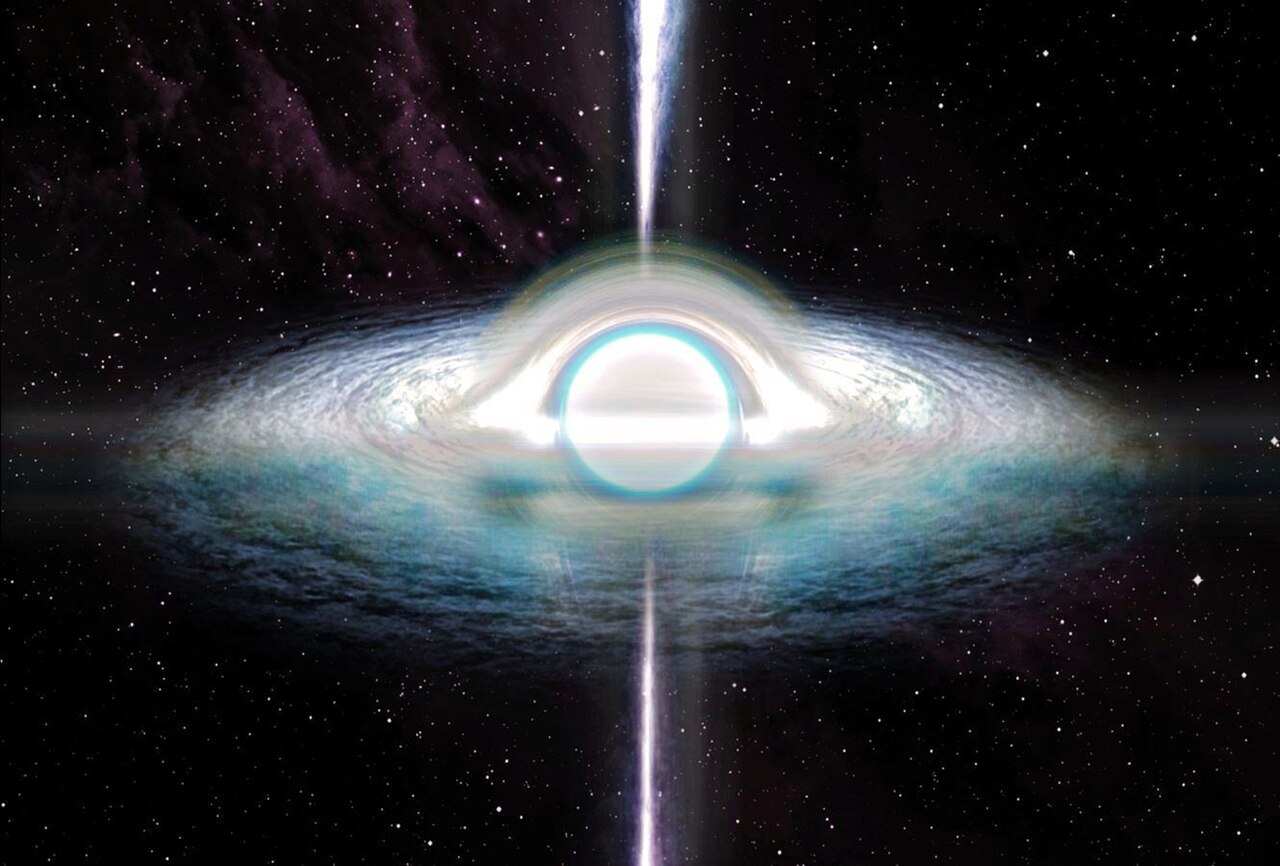
A white hole might appear as an intensely bright source of radiation and matter.
Because energy continuously emerges, it could resemble a powerful explosion.
Jets of particles might stream outward.
Light could radiate across multiple wavelengths.
Unlike a black hole, which is often identified through its effects on nearby matter, a white hole might be visible because of what it emits.
However, predicting its exact appearance is difficult because no confirmed examples exist.
Every description remains theoretical.
Could We Detect One?
Detecting a white hole would be challenging.
Astronomers routinely observe energetic phenomena throughout the universe.
Supernovae explode.
Neutron stars emit powerful radiation.
Quasars outshine entire galaxies.
Gamma-ray bursts release enormous amounts of energy.
A white hole might resemble one of these known phenomena.
Distinguishing it from other cosmic events would require identifying unique characteristics.
So far, no observation has provided convincing evidence for a white hole.
Every candidate explanation has eventually found more conventional interpretations.
White Holes and Gamma-Ray Bursts
At various times, scientists have explored whether certain gamma-ray bursts might be connected to white holes.
Gamma-ray bursts are among the most energetic events known.
For a brief period, they can release more energy than entire galaxies.
Because white holes theoretically expel matter and energy, some researchers wondered whether short-lived white holes could explain these bursts.
The idea generated interest because gamma-ray bursts appear suddenly and often occur in distant regions of space.
However, observations increasingly linked most gamma-ray bursts to collapsing stars and merging neutron stars.
As a result, white-hole explanations became less favored.
Still, the possibility illustrates how astronomers continue searching for observational signatures.
The Relationship Between Black Holes and White Holes
Black holes and white holes are often portrayed as opposites.
In many ways, they are.
Black holes absorb.
White holes expel.
Black holes trap light.
White holes release light.
Black holes allow entry but not escape.
White holes allow escape but not entry.
Yet their mathematical structures are surprisingly similar.
Both emerge from solutions to Einstein’s equations.
Both involve event horizons.
Both challenge our understanding of space and time.
Their connection highlights the deep symmetry hidden within the laws of physics.
The Role of Time in White Hole Physics
White holes force us to think differently about time.
Most physical processes seem irreversible.
A shattered glass does not spontaneously reassemble.
Smoke does not return to a candle.
Stars do not unburn themselves.
Yet many fundamental equations make no distinction between forward and backward time.
White holes arise from this symmetry.
They represent what space-time might look like if certain processes ran in reverse.
Whether nature actually permits such reversals on cosmic scales remains uncertain.
Nevertheless, white holes encourage scientists to examine assumptions that often go unquestioned.
Why Physicists Continue Studying White Holes
Given the lack of evidence, one might wonder why physicists still discuss white holes.
The answer lies in the value of theoretical exploration.
Science advances not only through observation but also through investigating possibilities.
White holes provide a testing ground for ideas about gravity, quantum mechanics, cosmology, and information.
Even if white holes never exist in reality, studying them helps researchers identify weaknesses in existing theories and develop new insights.
Many important scientific breakthroughs began as purely theoretical concepts long before observational evidence appeared.
White holes remain part of that tradition.
White Holes in Popular Culture
The mysterious nature of white holes has made them popular in science fiction.
Writers and filmmakers often use them as portals, gateways, or cosmic escape routes.
They appear in stories involving time travel, alternate universes, wormholes, and advanced civilizations.
These fictional portrayals are usually more imaginative than scientifically accurate.
Nevertheless, they reflect humanity’s fascination with the unknown.
White holes occupy a unique position between established science and speculative imagination.
They are grounded in real mathematics yet remain beyond direct observation.
The Current Scientific View
Today, most physicists regard white holes as interesting theoretical possibilities rather than established physical objects.
The mathematical foundations are legitimate.
General relativity allows white-hole solutions.
However, there is no observational evidence confirming their existence.
No telescope has identified a white hole.
No experiment has detected one.
No widely accepted formation mechanism exists.
At present, white holes remain hypothetical.
That status could change if future discoveries reveal new aspects of gravity or quantum physics.
Until then, they remain one of the most intriguing “what if” ideas in science.
The Philosophical Appeal of White Holes
Beyond physics, white holes possess a profound philosophical appeal.
Black holes symbolize endings.
They consume.
They trap.
They hide.
White holes symbolize beginnings.
They release.
They reveal.
They create.
Whether or not they exist, they offer a fascinating counterpoint to one of nature’s most extreme objects.
They remind us that every scientific theory contains possibilities stranger than fiction.
The universe often proves more imaginative than we are.
Conclusion
A white hole is a hypothetical cosmic object that represents the theoretical time-reversal of a black hole. While black holes allow matter and energy to enter but not escape, white holes would allow matter and energy to escape but prevent anything from entering. Predicted by certain mathematical solutions of Einstein’s general theory of relativity, white holes occupy a fascinating place in theoretical physics.
Unlike black holes, which are supported by extensive observational evidence, white holes remain entirely speculative. Scientists have never observed one, and major challenges—including stability, formation mechanisms, and compatibility with known physical processes—raise doubts about whether they can exist in reality. Yet white holes continue to inspire research because they touch upon some of the deepest mysteries in science, including the nature of time, gravity, information, quantum mechanics, and the origin of the universe.
Whether they are real objects waiting to be discovered or merely mathematical curiosities, white holes reveal the extraordinary depth of human curiosity. They remind us that our understanding of the cosmos is still incomplete and that beyond every answer lies another question. In the vast and mysterious universe, even the most unlikely ideas can illuminate new paths toward understanding reality itself.