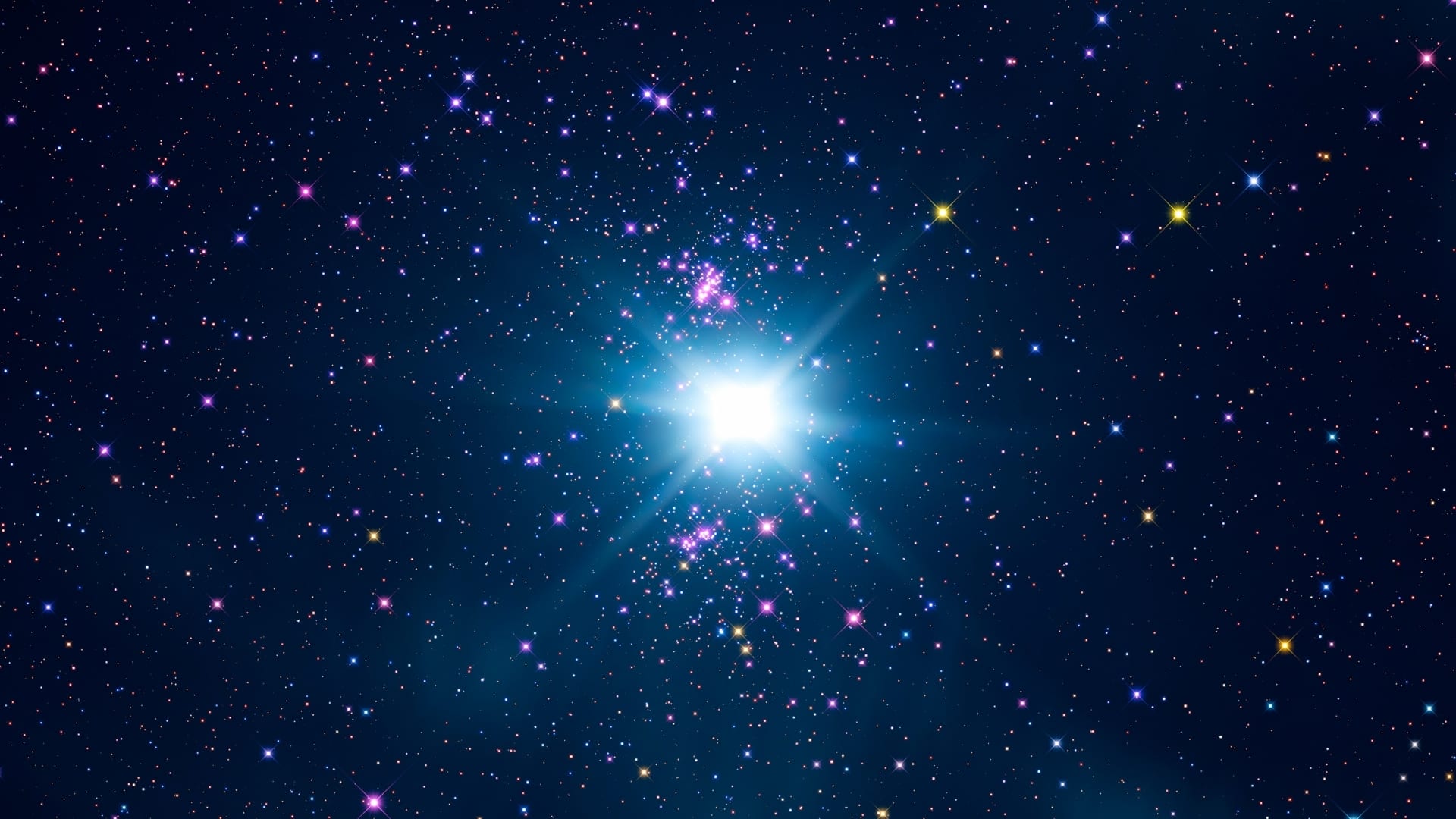
For thousands of years, people have looked up at the night sky searching for guidance. Long before GPS satellites, smartphones, maps, or compasses became common, travelers relied on the stars. Sailors crossing vast oceans, merchants traveling through deserts, explorers entering unknown lands, and even ordinary people trying to find their way home often depended on a single celestial beacon: the North Star.
Unlike most stars, which appear to move across the sky during the night, the North Star seems almost perfectly still. While countless stars rise in the east and set in the west, this special star remains nearly fixed in the same place. Night after night, season after season, year after year, it appears to stand guard over the northern horizon.
This remarkable star is known as Polaris.
To ancient observers, Polaris seemed almost magical. It provided a reliable reference point in a constantly changing sky. It became a symbol of direction, stability, guidance, and hope. Entire civilizations used it for navigation. Poets wrote about it. Sailors trusted their lives to it. Astronomers studied it. Even today, despite our advanced technology, Polaris remains one of the most important stars in the sky.
But what exactly is the North Star? Why does it appear fixed while other stars move? Is Polaris truly motionless? Has it always been the North Star? And will it remain so forever?
The answers reveal an extraordinary story involving Earth’s rotation, the geometry of space, stellar evolution, and the slow dance of our planet through cosmic time.
Understanding the Night Sky
To understand the North Star, we first need to understand why stars appear to move at all.
On a clear night, if you watch the sky for several hours, you’ll notice that stars seem to travel across the heavens. They rise, arc overhead, and eventually disappear below the horizon.
For centuries, many people assumed the stars themselves were moving around Earth.
Today we know the reality is different.
The apparent movement of stars is primarily caused by Earth’s rotation.
Our planet spins once approximately every 24 hours. As Earth rotates from west to east, the sky appears to move in the opposite direction.
Imagine sitting on a spinning carousel. Objects around you would seem to move even if they remained stationary. A similar illusion occurs as Earth rotates.
Because of this rotation, the Sun appears to rise and set. The Moon seems to cross the sky. The stars appear to move from east to west.
Yet among all this motion, one star appears different.
That star is Polaris.
What Is the North Star?
The North Star is the star located closest to the north celestial pole, the point in the sky directly above Earth’s North Pole.
Today, that star is Polaris.
The north celestial pole is an imaginary point created by extending Earth’s rotational axis into space.
Think of Earth as a spinning top. Every spinning object rotates around an axis. Earth’s axis runs through the North Pole and South Pole.
If this axis were extended infinitely into the sky, it would point toward a specific location among the stars.
Polaris happens to lie very close to that location.
As Earth rotates, the sky appears to revolve around the north celestial pole. Since Polaris is positioned near this point, it appears almost stationary while other stars seem to circle around it.
This is why Polaris is called the North Star.
It serves as a marker for true north.
Why Polaris Appears Fixed
The reason Polaris appears fixed is entirely geometric.
Imagine placing a dot at the center of a spinning wheel.
As the wheel rotates, points near the edge move rapidly in large circles.
The center point barely moves at all.
The same principle applies to the sky.
Stars far from the celestial pole trace large arcs across the heavens.
Stars closer to the pole move in smaller circles.
Polaris lies extremely close to the north celestial pole, so its apparent movement is tiny.
To the naked eye, it looks almost motionless.
In reality, Polaris does move slightly during the night.
If you take a long-exposure photograph of the northern sky, you’ll see stars creating circular trails around a central point. Polaris sits near the center of these circles.
Its movement is so small that ancient navigators could use it as a dependable guide.
Finding Polaris in the Sky
One of the most useful skills in astronomy is learning how to locate Polaris.
Fortunately, Polaris is relatively easy to find.
Most people use the constellation known as the Big Dipper.
The Big Dipper is actually part of the larger constellation Ursa Major.
Two stars forming the outer edge of the Big Dipper’s bowl point almost directly toward Polaris.
These stars are often called the “pointer stars.”
By drawing an imaginary line through them and extending it outward, observers can locate Polaris.
Polaris itself is part of the constellation Ursa Minor, often known as the Little Dipper.
Interestingly, Polaris is not the brightest star in the sky.
Many people assume it must be because of its importance.
In reality, several dozen stars appear brighter.
Its fame comes from its position, not its brightness.
The Science Behind Earth’s Axis
The story of Polaris is closely connected to Earth’s rotational axis.
Our planet spins at roughly 1,670 kilometers per hour (about 1,037 miles per hour) at the equator.
This rotation defines our days and nights.
The axis around which Earth rotates remains pointed in nearly the same direction as our planet orbits the Sun.
As a result, the north celestial pole stays in almost the same location relative to distant stars.
Polaris happens to be located very near this point.
Because the axis remains stable over short timescales, Polaris appears fixed.
This stability made it invaluable for navigation.
Ancient travelers could determine direction simply by finding Polaris.
No complicated instruments were required.
The star itself became a natural compass.
Polaris Is Not Exactly at the Pole
Although Polaris appears fixed, it is not perfectly aligned with the north celestial pole.
The star sits slightly away from the exact pole.
As a result, it traces a tiny circle around the pole during the night.
The movement is subtle enough that most people never notice it.
Modern measurements show that Polaris lies less than one degree from the north celestial pole.
To put that into perspective, your little finger held at arm’s length covers roughly one degree of the sky.
This means Polaris is extraordinarily close to the celestial pole, but not exactly on it.
That small difference explains why astrophotographs reveal slight movement.
What Kind of Star Is Polaris?
Many people think Polaris is special solely because of its position.
Yet Polaris is fascinating in its own right.
It is a massive and luminous star located approximately 433 light-years from Earth.
This means the light reaching your eyes tonight left Polaris more than four centuries ago.
When that light began its journey, many events we consider history had not yet occurred.
Polaris is a yellow-white supergiant star.
It is far larger than our Sun.
Its diameter is estimated to be dozens of times greater than the Sun’s.
Its luminosity is hundreds to thousands of times stronger.
If Polaris replaced the Sun at the center of our solar system, its enormous size would dramatically alter everything we know.
Fortunately, it remains safely distant.
Polaris Is Actually a Multiple-Star System
For many years, people viewed Polaris as a single star.
Modern astronomy has revealed a more complex reality.
Polaris is actually part of a multiple-star system.
The primary star, known as Polaris A, dominates the system’s brightness.
Two companion stars orbit nearby.
One companion is relatively close, while another orbits much farther away.
These stars are gravitationally bound together.
From Earth, the companions are difficult to see without telescopes.
To casual observers, Polaris appears as a single point of light.
Yet hidden within that tiny speck is a miniature stellar family.
Polaris and Variable Stars
Polaris belongs to an important category known as Cepheid variable stars.
Cepheid variables regularly change in brightness over time.
These pulsations occur because the star expands and contracts.
As the star changes size, its brightness fluctuates.
The variations in Polaris are relatively small compared to some Cepheid stars, but they are measurable.
Cepheid variables play a crucial role in astronomy.
Their predictable brightness cycles allow astronomers to estimate distances across the universe.
In fact, observations of Cepheid stars helped scientists determine the scale of the Milky Way and discover that other galaxies exist beyond it.
Thus, Polaris contributes not only to navigation but also to our understanding of the cosmos.
Ancient Civilizations and the North Star
The North Star has influenced human history for thousands of years.
Ancient civilizations carefully observed the heavens.
The regular motions of celestial objects provided a reliable clock and calendar.
The nearly fixed position of Polaris made it particularly valuable.
People could use it to determine direction during travel.
They could orient buildings and monuments.
They could navigate unfamiliar landscapes.
Many cultures viewed the North Star as spiritually significant.
Its apparent permanence contrasted with the motion of other stars.
This made it a symbol of stability and cosmic order.
Even before scientific explanations existed, people recognized its unique role in the sky.
Polaris and Ocean Navigation
Few groups depended on Polaris more than sailors.
Navigating open oceans is difficult.
Without landmarks, determining direction becomes a major challenge.
Before modern instruments, sailors relied heavily on celestial navigation.
Polaris offered an elegant solution.
By locating the star, navigators could determine north.
Its height above the horizon also provided information about latitude.
For example, if Polaris appeared 30 degrees above the horizon, the observer was roughly at 30 degrees north latitude.
This relationship made Polaris one of the most important navigation tools ever discovered.
Countless voyages depended upon it.
Explorers crossed oceans guided by its light.
Merchant ships followed its direction.
Entire trade networks benefited from its reliability.
The Underground Railroad and Polaris
The North Star also played a powerful role in American history.
During the nineteenth century, many enslaved people escaping from the southern United States used Polaris as a guide.
Traveling primarily at night, they followed the North Star toward freedom in northern states and Canada.
Because Polaris consistently marks north, it provided a dependable navigational reference.
For those risking everything in search of freedom, the star became a symbol of hope and liberation.
Songs, stories, and oral traditions often referenced the North Star.
Its steady presence offered reassurance during dangerous journeys.
In this way, Polaris became more than an astronomical object.
It became part of a profound human story.
Why Polaris Has Not Always Been the North Star
One of the most surprising facts about Polaris is that it has not always been the North Star.
Nor will it remain so forever.
This happens because Earth’s rotational axis slowly changes direction over time.
The phenomenon is called axial precession.
Earth behaves somewhat like a spinning top.
As a top spins, its axis slowly wobbles.
Earth experiences a similar wobble.
The process is extremely slow, taking about 26,000 years to complete one cycle.
As the axis shifts, the north celestial pole gradually moves among the stars.
Different stars take turns serving as pole stars.
Thousands of years ago, Polaris was not the closest star to the pole.
Thousands of years from now, another star will assume the role.
The Ancient North Star
Around 4,500 years ago, when the great pyramids of Egypt were being built, a different star occupied the position nearest the north celestial pole.
That star was Thuban in the constellation Draco.
Ancient Egyptian astronomers likely used Thuban as a celestial reference point.
Its position made it the North Star of that era.
Over time, Earth’s precession shifted the celestial pole away from Thuban.
The star gradually lost its special status.
This reminds us that the night sky is not truly permanent.
Even seemingly fixed celestial patterns change over long periods.
Future North Stars
Polaris currently enjoys its role as the North Star.
However, its reign is temporary.
In roughly 12,000 years, the bright star Vega will lie much closer to the north celestial pole.
Vega is one of the brightest stars visible from Earth.
Future civilizations may regard it as their North Star.
By then, Polaris will no longer occupy its privileged position.
This slow transition highlights the dynamic nature of our universe.
Nothing remains unchanged forever.
Even the stars we associate with permanence are part of larger cosmic cycles.
Polaris and the Seasons
One remarkable feature of Polaris is that it remains visible throughout the year for observers in the Northern Hemisphere.
Unlike many stars that appear only during certain seasons, Polaris never sets for many northern locations.
Stars with this property are called circumpolar stars.
Because Polaris lies so close to the celestial pole, it remains above the horizon throughout the night.
This year-round visibility increased its practical importance.
Travelers and navigators could depend on it regardless of season.
Whether winter or summer, Polaris remained available as a guide.
Why the Southern Hemisphere Has No Equivalent
People in the Southern Hemisphere often ask whether they have their own version of Polaris.
The answer is not exactly.
The south celestial pole currently lacks a bright star positioned as conveniently as Polaris.
Several stars help observers locate south, but none match Polaris in visibility and usefulness.
This means navigation by stars has historically been somewhat more challenging in the Southern Hemisphere.
Astronomers can still locate the south celestial pole using constellations such as Crux, but there is no single bright star directly marking the pole.
In this sense, the Northern Hemisphere enjoys a fortunate astronomical coincidence.
Polaris in Mythology and Culture
Throughout history, Polaris has inspired countless myths and traditions.
Many cultures imagined it as a cosmic pillar holding up the heavens.
Others viewed it as a gateway connecting Earth and the divine.
Some believed celestial spirits revolved around it.
Its apparent immobility made it a natural symbol of permanence.
In a sky filled with motion, Polaris seemed eternal.
It represented order amid change.
Direction amid uncertainty.
Stability amid chaos.
These symbolic meanings continue to resonate today.
Even people who know the scientific explanation often find something emotionally powerful about the star’s steady presence.
Observing Polaris Today
Finding Polaris remains one of the easiest and most rewarding astronomy activities.
No telescope is required.
A clear night and a reasonably dark sky are enough.
Once located, Polaris reveals an important truth about our place in the universe.
Its fixed appearance is not because the universe revolves around Earth.
Instead, it reflects Earth’s own rotation.
By observing Polaris, we can directly witness evidence of our planet’s movement through space.
The star becomes a gateway to understanding astronomy.
Many amateur astronomers begin their journey by learning to find it.
The Deeper Meaning of a Fixed Star
Although Polaris is not truly fixed, it feels fixed from a human perspective.
Generations have lived and died under its watch.
Empires have risen and fallen.
Explorers have crossed oceans.
Civilizations have transformed.
Yet Polaris has remained almost exactly where people expected to find it.
This creates a sense of continuity.
Humans naturally seek stable reference points.
In daily life, in history, and even in the sky, we look for something dependable.
For centuries, Polaris fulfilled that role.
It became a celestial anchor in an ever-changing world.
Conclusion
The North Star, known today as Polaris, is one of the most important and fascinating stars in the night sky. Its special status comes from its location near the north celestial pole, the point around which the entire northern sky appears to rotate. Because of this fortunate alignment, Polaris seems almost motionless while other stars circle around it.
For thousands of years, people have used Polaris for navigation, exploration, and orientation. Sailors crossed oceans by its light, travelers found their way using its position, and entire cultures wove it into myths, legends, and spiritual traditions. Its role as a guide made it one of humanity’s most trusted celestial companions.
Yet Polaris is more than a navigational tool. It is a giant star hundreds of light-years away, part of a multiple-star system, and an important Cepheid variable that helps astronomers measure the universe. It also reminds us that even seemingly permanent features of the cosmos are temporary. Due to Earth’s slow axial precession, Polaris has not always been the North Star and will eventually be replaced by another.
Still, for our era, Polaris remains the fixed point of the sky. On any clear night in the Northern Hemisphere, it stands as a steady beacon above the horizon, quietly marking north while the rest of the heavens appear to turn around it. In a universe defined by motion and change, the North Star continues to offer something humanity has always valued: a reliable point of reference in the vast darkness of space.