Imagine taking a book and throwing it into a black hole.
Not just any book, but a book containing every detail of a person’s life—their memories, thoughts, discoveries, and experiences. The book crosses the edge of the black hole and disappears forever from view. From the outside, it seems gone. Completely gone.
Now imagine throwing in a photograph, a computer, a diamond, a planet, and eventually an entire star.
Everything vanishes behind the black hole’s invisible boundary.
The question seems simple: What happens to all the information contained in those objects?
For centuries, scientists might have answered, “It falls into the black hole and stays there.”
But modern physics uncovered a much deeper problem.
According to some of our most successful theories, information can never truly disappear from the universe. Yet black holes seem capable of destroying it completely.
This conflict created one of the greatest scientific mysteries ever discovered—a puzzle so profound that it challenges our understanding of reality itself.
This puzzle is known as the black hole information paradox.
It is not merely a question about black holes. It is a question about the fundamental laws of nature. It sits at the crossroads of quantum mechanics, gravity, space, time, and information. Solving it may reveal secrets about the deepest structure of the universe.
The information paradox has puzzled physicists for decades. It has inspired fierce debates, revolutionary theories, and some of the most brilliant minds in science to rethink what they know about reality.
At its heart lies a surprisingly human question:
Can anything truly be lost forever?
Understanding Black Holes
To understand the information paradox, we first need to understand black holes.
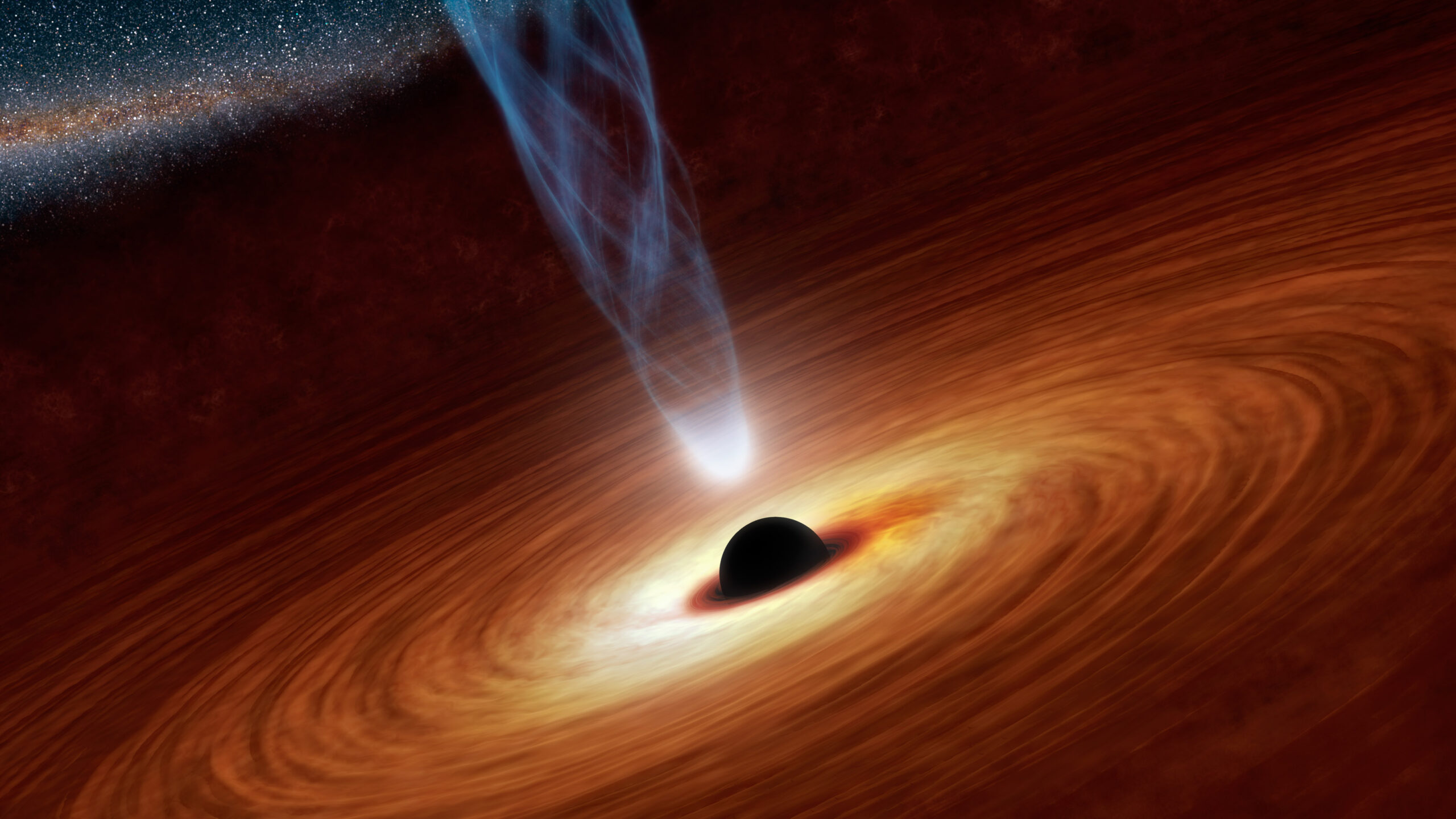
A black hole forms when a massive amount of matter is squeezed into an extremely small region of space.
Gravity becomes so powerful that nothing can escape its pull once it crosses a certain boundary called the event horizon.
The event horizon is often described as the “point of no return.”
If a spacecraft crosses it, escape becomes impossible.
If light crosses it, it can never come back.
Because light cannot escape, black holes appear dark against the background of space.
For a long time, scientists thought black holes were relatively simple objects.
According to the equations of general relativity, a black hole can be described using only a few properties such as mass, electric charge, and spin.
Everything else about the matter that formed the black hole seems to disappear from view.
This idea became known as the “no-hair theorem.”
In simple terms, black holes appeared to erase details.
A black hole formed from books would look identical to a black hole formed from trees.
A black hole formed from stars would appear the same as one formed from planets if their mass, charge, and spin matched.
At first this seemed strange but acceptable.
Then quantum mechanics entered the story.
What Physicists Mean by Information
When people hear the word “information,” they usually think about messages, books, computers, or data.
In physics, information has a more precise meaning.
Information refers to the complete description of a physical system.
Every particle has properties.
Its position matters.
Its momentum matters.
Its quantum state matters.
The arrangement of atoms inside an object matters.
All of these details together constitute information.
Imagine a jigsaw puzzle.
Even if you break the puzzle apart, the information describing the picture still exists in the arrangement of the pieces.
The pieces may be scattered, but the information is not destroyed.
This idea is deeply embedded in quantum mechanics.
According to quantum theory, information about a system’s state should never vanish completely.
It may become incredibly difficult to recover.
It may become scrambled beyond practical recognition.
But fundamentally, it should remain somewhere within the universe.
This principle is called unitarity, and it is one of the foundations of quantum physics.
Why Information Matters
At first glance, information conservation may sound like a technical detail relevant only to physicists.
In reality, it is essential.
If information could simply disappear, the universe would become unpredictable.
Imagine reading a novel where random chapters vanished without explanation.
The story would stop making sense.
Similarly, physics depends on the idea that the present evolves from the past according to consistent laws.
If information can be destroyed, those laws break down.
Scientists could no longer reliably predict how systems evolve.
Cause and effect would become uncertain.
The entire structure of quantum mechanics would be threatened.
This is why the information paradox became such a serious problem.
It was not merely a curiosity about black holes.
It challenged the foundations of modern physics.
The Classical View of Black Holes
Before the 1970s, black holes seemed relatively straightforward.
Matter falls in.
Nothing comes out.
The black hole grows larger.
Information appears trapped forever behind the event horizon.
Although inaccessible, the information still exists inside the black hole.
This picture creates some philosophical puzzles but not necessarily a contradiction.
Information is hidden, not destroyed.
Many physicists were comfortable with this idea.
Then a remarkable discovery changed everything.
Stephen Hawking’s Revolutionary Discovery
In the early 1970s, physicist Stephen Hawking made one of the most astonishing discoveries in modern science.
By combining quantum mechanics with the physics of black holes, Hawking found that black holes are not entirely black.
They emit radiation.
This phenomenon became known as Hawking Radiation.
The idea shocked the scientific community.
According to classical physics, nothing escapes a black hole.
Yet quantum effects near the event horizon allow tiny amounts of energy to leak away.
Over incredibly long timescales, this process causes black holes to lose mass.
Eventually, a black hole can evaporate completely.
This discovery transformed black holes from eternal prisons into temporary objects.
But it also created a much bigger problem.
The Birth of the Information Paradox
Hawking radiation appears random.
It depends only on properties such as mass, charge, and spin.
It does not seem to contain detailed information about the objects that fell into the black hole.
Imagine throwing a library into a black hole.
The books disappear.
The black hole eventually evaporates.
All that remains is a cloud of seemingly random radiation.
Where did the information go?
If the black hole vanishes completely and the radiation contains no record of what entered, then the information appears destroyed.
This directly contradicts quantum mechanics.
The paradox was born.
On one side stood general relativity.
On the other stood quantum theory.
Both theories were extraordinarily successful.
Yet when applied to black holes, they appeared incompatible.
Why the Problem Is So Serious
Scientific paradoxes are often puzzles that can be resolved with additional information.
The black hole information paradox is different.
It suggests that one of our most trusted theories must be incomplete.
General relativity accurately describes gravity, planets, stars, galaxies, and the large-scale universe.
Quantum mechanics accurately describes atoms, particles, chemistry, and countless technologies.
Both theories have passed every experimental test.
Yet they make conflicting predictions about information inside black holes.
Physicists faced an uncomfortable possibility.
Either information can be destroyed, meaning quantum mechanics is wrong, or our understanding of black holes is incomplete.
Neither option was easy to accept.
Hawking’s Original Position
For many years, Hawking argued that information truly disappears in black holes.
According to his calculations, the radiation emitted during evaporation carried no information about what fell inside.
Once the black hole vanished, the information vanished too.
This conclusion deeply troubled many physicists.
Destroying information would require revising fundamental principles of quantum mechanics.
Some researchers accepted Hawking’s view.
Others strongly opposed it.
The debate became one of the most famous controversies in theoretical physics.
For decades, no consensus emerged.
Quantum Mechanics Fights Back
Many physicists believed quantum theory was too successful to abandon.
If information could disappear, numerous aspects of quantum physics would require rethinking.
Instead, researchers searched for ways information might survive black hole evaporation.
Perhaps the information escaped in subtle patterns hidden within Hawking radiation.
Perhaps it remained encoded on the event horizon.
Perhaps black holes left behind remnants containing the missing information.
New ideas emerged constantly.
Each attempted to preserve the fundamental principle that information cannot be destroyed.
The challenge was proving how.
The Strange Nature of Hawking Radiation
Understanding the paradox requires examining Hawking radiation more closely.
Near the event horizon, quantum fields fluctuate continuously.
Particle-antiparticle pairs can briefly appear and disappear.
Occasionally, one particle falls into the black hole while the other escapes.
The escaping particle becomes Hawking radiation.
This process slowly drains energy from the black hole.
The problem is that the escaping radiation appears thermal.
It resembles heat emitted from a hot object.
Thermal radiation carries very little detailed information.
Imagine burning a book.
The smoke and heat contain information in principle, but recovering the original text would be extraordinarily difficult.
With Hawking radiation, the situation seemed even worse.
The information appeared completely absent.
Entropy and Black Holes
Another crucial concept in the paradox is entropy.
Entropy measures the number of possible microscopic arrangements corresponding to a system’s overall state.
In simple terms, it relates to information and disorder.
Physicists discovered that black holes possess entropy.
This was surprising because black holes seemed simple.
If they contain only mass, charge, and spin, why should they have enormous entropy?
The answer suggested black holes possess hidden microscopic states.
Something deeper was happening beneath the surface.
This realization hinted that information might somehow be stored within black holes rather than destroyed.
But the mechanism remained unclear.
The Event Horizon as a Cosmic Memory
One intriguing possibility emerged from the idea that information might be stored on the event horizon itself.
Instead of disappearing into the interior, information could become encoded on the black hole’s surface.
This concept inspired the holographic principle.
The holographic principle suggests that information contained within a volume of space may actually be represented on its boundary.
A three-dimensional region could be described by information stored on a two-dimensional surface.
Although this sounds bizarre, modern theoretical physics increasingly supports this possibility.
If true, black holes may preserve information in ways we do not yet fully understand.
The Holographic Universe
The holographic principle became one of the most influential ideas in theoretical physics.
A hologram stores three-dimensional information on a two-dimensional surface.
Similarly, the universe itself may operate according to holographic rules.
In this framework, information about objects falling into a black hole becomes encoded on the event horizon.
Nothing is truly lost.
Instead, information is transformed into a different form.
This idea provides a potential solution to the information paradox while preserving quantum mechanics.
Although much remains uncertain, holography has become a major area of research.
Black Hole Complementarity
Another proposed solution is black hole complementarity.
This concept suggests that different observers may describe reality differently without creating contradictions.
From the perspective of a distant observer, information never crosses the event horizon.
Instead, it becomes encoded near the surface.
From the perspective of someone falling into the black hole, they cross the horizon normally.
Both descriptions may be valid.
Although strange, this approach attempts to reconcile conflicting viewpoints without violating known laws of physics.
It represents one of the creative ways physicists have tried to solve the paradox.
The Firewall Debate
In 2012, a new challenge shook the field.
Some physicists argued that preserving information might require a dramatic consequence.
Instead of smoothly crossing the event horizon, an observer would encounter an intensely energetic barrier called a firewall.
This firewall would instantly destroy anything attempting to enter the black hole.
The proposal emerged from attempts to reconcile quantum entanglement with information conservation.
However, firewalls contradict one of general relativity’s central predictions.
Einstein’s theory suggests crossing the event horizon of a sufficiently large black hole should feel uneventful.
The firewall debate revealed how difficult the information paradox remains.
Each proposed solution seems to create new problems.
Quantum Entanglement Enters the Story
Quantum entanglement plays a major role in modern discussions of the paradox.
Entangled particles share deep connections regardless of distance.
Measuring one instantly influences what can be known about the other.
Hawking radiation becomes entangled with the black hole.
As evaporation continues, maintaining these entanglements while preserving information creates mathematical tensions.
Resolving these tensions has driven much of the recent research into black holes.
Many physicists now believe that understanding entanglement may hold the key to solving the paradox.
The Page Curve and Information Recovery
An important breakthrough came through studies of something called the Page curve.
Physicist Don Page analyzed how information should emerge from an evaporating black hole if quantum mechanics remains valid.
The Page curve predicts that information gradually returns through Hawking radiation.
Initially, the radiation appears random.
Later, subtle correlations begin carrying information outward.
Eventually, all information can theoretically escape.
Recent theoretical work has produced results consistent with this prediction.
Although not a complete solution, these developments strongly suggest that information may indeed survive black hole evaporation.
Modern Evidence Favors Information Preservation
Over the past two decades, scientific opinion has shifted significantly.
Many physicists now believe information is not destroyed by black holes.
Instead, it is somehow preserved and eventually released.
The exact mechanism remains uncertain.
However, advances in quantum gravity, holography, and entanglement theory increasingly support information conservation.
Even Hawking eventually revised his position.
In 2004, he announced that he believed information could escape black holes after all.
Although the details remained unresolved, this marked a major turning point in the debate.
Why Solving the Paradox Matters
The information paradox is far more than an academic puzzle.
It represents one of the best opportunities for discovering a deeper theory of nature.
Physicists know that general relativity and quantum mechanics cannot both be complete.
They work beautifully in their respective domains but clash under extreme conditions such as black holes.
The information paradox highlights this conflict with extraordinary clarity.
Any successful solution will likely reveal new insights into space, time, gravity, and quantum reality.
It could help lead to a long-sought theory of quantum gravity.
Such a theory would rank among the greatest achievements in scientific history.
What Happens to Matter Inside a Black Hole?
This question lies at the emotional heart of the paradox.
What happens when matter enters a black hole?
From our current perspective, the answer remains incomplete.
The matter contributes to the black hole’s mass.
Its detailed quantum information appears hidden.
If modern theories are correct, the information is not destroyed.
Instead, it becomes encoded in ways we do not yet fully understand.
The original matter may no longer exist in its familiar form.
The book thrown into the black hole is not sitting intact somewhere inside.
Its atoms are transformed.
Its structure is lost.
Yet the information describing that structure may persist in subtle quantum correlations.
Nature appears determined to keep a record.
Black Holes as Cosmic Laboratories
Ironically, black holes may be among the best laboratories for studying fundamental physics.
Their extreme environments bring gravity and quantum mechanics together in ways impossible to recreate on Earth.
Every attempt to understand black holes teaches us something about reality itself.
They challenge our assumptions.
They force us to confront the limits of current theories.
They reveal hidden connections between information, entropy, space, and time.
What once seemed like simple cosmic vacuum cleaners have become profound windows into the nature of existence.
The Future of the Information Paradox
The information paradox remains unsolved in the strictest sense.
Physicists possess promising ideas and growing evidence, but no universally accepted answer exists.
Future advances may come from quantum gravity research.
They may emerge from new mathematical insights.
They may arise from observations of black holes themselves.
Every year brings fresh discoveries.
As scientists continue exploring the relationship between information, spacetime, and quantum mechanics, the mystery slowly becomes clearer.
Yet some surprises almost certainly remain.
History suggests that nature often proves stranger than our imagination.
Conclusion
The black hole information paradox is one of the deepest mysteries in modern science. It arises from a conflict between two foundational theories: general relativity and quantum mechanics. Black holes appear capable of swallowing matter and erasing all information about it, while quantum theory insists that information can never truly be destroyed.
The paradox began with Stephen Hawking’s discovery that black holes emit radiation and eventually evaporate. If the radiation contains no information, then everything that fell into the black hole seems lost forever. Such a conclusion would overturn one of the core principles of quantum physics.
Decades of research have transformed the debate. Ideas involving holography, quantum entanglement, black hole entropy, and information recovery increasingly suggest that information survives, even if it becomes extraordinarily scrambled. While the exact mechanism remains uncertain, most physicists now suspect that nature preserves information after all.
At its core, the information paradox is not simply about black holes. It is about the fundamental rules governing reality. Solving it may reveal how space and time emerge, how gravity works at the quantum level, and how the universe keeps track of everything that has ever happened. The mystery remains open, but in pursuing its answer, humanity is uncovering some of the deepest secrets the cosmos has to offer.