The universe is filled with mysteries, but few are as profound—or as frustrating—as the mystery of quantum gravity.
For more than a century, physicists have possessed two astonishingly successful theories that describe reality. One explains the behavior of the largest objects in existence: stars, galaxies, black holes, and the universe itself. The other governs the tiniest particles imaginable: electrons, quarks, photons, and the strange quantum world hidden beneath everyday experience.
Individually, these theories work with incredible precision. They have passed countless experimental tests and transformed our understanding of nature. Yet when scientists try to combine them, something breaks.
The equations refuse to cooperate.
The theories contradict one another.
The deepest foundations of reality suddenly become unclear.
This conflict has created one of the greatest challenges in the history of science: finding a theory of quantum gravity.
Quantum gravity is not simply another branch of physics. Many scientists view it as the key to answering some of the biggest questions humanity has ever asked. What happens inside a black hole? What occurred at the very beginning of the universe? Is space itself fundamental, or does it emerge from something deeper? What is the true nature of reality?
For decades, researchers have searched for answers. Some compare the quest for quantum gravity to the search for the Holy Grail—a goal so important that generations of scientists have devoted their careers to pursuing it.
The journey has been difficult, filled with brilliant ideas, mathematical breakthroughs, and countless dead ends. Yet the search continues because somewhere within quantum gravity may lie a new understanding of the cosmos itself.
The Two Pillars of Modern Physics
To understand quantum gravity, we first need to understand the problem it is trying to solve.
Modern physics rests on two extraordinary achievements.
The first is general relativity.
The second is quantum mechanics.
Together, they explain nearly everything scientists have observed in nature.
Yet despite their success, they describe reality in fundamentally different ways.
General relativity is the theory of gravity developed by Albert Einstein in 1915.
Quantum mechanics emerged through the work of many scientists during the early twentieth century.
Both theories revolutionized science.
Both transformed our understanding of the universe.
And both appear to be correct.
That is precisely what makes the conflict between them so troubling.
Einstein’s Vision of Gravity
Before Einstein, gravity was understood largely through the ideas of Isaac Newton.
Newton described gravity as a force that attracts objects toward one another.
This explanation worked remarkably well.
It could predict planetary motion, falling objects, and countless other phenomena.
But Einstein saw gravity differently.
According to general relativity, gravity is not really a force at all.
Instead, massive objects bend the fabric of space and time.
Imagine placing a heavy ball on a stretched rubber sheet. The sheet curves around the ball. Smaller objects moving nearby follow paths shaped by that curvature.
Einstein proposed that something similar happens in the universe.
Stars, planets, and galaxies distort space-time itself.
Objects move along paths created by this curvature.
What we experience as gravity is actually the geometry of the universe.
This idea sounds strange, but experiments have repeatedly confirmed it.
General relativity successfully explains planetary orbits, gravitational lensing, black holes, gravitational waves, and the expansion of the cosmos.
It remains one of the greatest scientific achievements ever created.
The Strange World of Quantum Mechanics
While Einstein was reshaping our understanding of gravity, another revolution was unfolding.
Scientists studying atoms discovered something unexpected.
The microscopic world behaved nothing like the familiar world of everyday experience.
Tiny particles sometimes acted like waves.
Energy appeared in discrete packets called quanta.
Events occurred according to probabilities rather than certainty.
Particles could exist in multiple possible states before measurement.
The deeper researchers explored, the stranger reality seemed.
These discoveries led to quantum mechanics.
Quantum theory became the foundation for understanding atoms, molecules, chemistry, electronics, and countless physical processes.
Modern technology depends heavily on quantum mechanics.
Without it, computers, lasers, semiconductors, and smartphones would not exist.
Despite its strange nature, quantum mechanics has proven extraordinarily accurate.
Its predictions often agree with experiments to astonishing levels of precision.
Two Theories That Refuse to Get Along
At first glance, it may seem surprising that two successful theories could conflict.
After all, both describe aspects of the same universe.
Shouldn’t they fit together naturally?
Unfortunately, they do not.
General relativity describes reality as smooth and continuous.
Space-time behaves like a flexible geometric fabric.
Quantum mechanics describes reality as fundamentally uncertain and often discontinuous.
At extremely small scales, fluctuations and probabilities dominate.
When scientists attempt to apply quantum principles to gravity, the mathematics becomes problematic.
The equations produce infinities that cannot be eliminated.
Predictions lose meaning.
The theory breaks down.
This conflict is more than a mathematical inconvenience.
It suggests that our understanding of reality remains incomplete.
Somewhere beneath these theories lies a deeper truth that we have not yet discovered.
Why Quantum Gravity Matters
Many areas of physics can safely use either relativity or quantum mechanics independently.
Astronomers studying galaxies typically rely on relativity.
Physicists studying atoms typically rely on quantum theory.
Most situations do not require both simultaneously.
However, certain extreme environments demand a unified description.
Black holes are one example.
The earliest moments of the universe provide another.
In these situations, gravity becomes extraordinarily strong while quantum effects remain important.
Neither theory alone is sufficient.
Imagine trying to describe a language using only half of its vocabulary.
You might capture some meanings but miss others entirely.
That is the challenge physicists face when studying these extreme conditions.
Quantum gravity aims to provide the missing vocabulary.
The Birth of the Problem
The need for quantum gravity emerged gradually during the twentieth century.
Quantum mechanics successfully explained three of nature’s four fundamental forces.
The electromagnetic force fit naturally within quantum theory.
The strong nuclear force and weak nuclear force eventually did as well.
Gravity remained the exception.
Every attempt to treat gravity like the other forces encountered serious difficulties.
The problem became increasingly obvious as physics advanced.
Scientists realized that a complete understanding of nature would require gravity to be included within a quantum framework.
The search for quantum gravity officially began.
Decades later, the challenge remains unsolved.
What Is Quantum Gravity?
Quantum gravity is the effort to create a theory that combines quantum mechanics and general relativity into a single coherent framework.
Such a theory would describe gravity according to quantum principles.
It would explain how space-time behaves at the smallest scales imaginable.
It would reveal what happens when quantum effects become important in regions of intense gravity.
Most importantly, it would provide a unified description of reality where the two great pillars of modern physics no longer conflict.
Scientists do not yet know exactly what this theory will look like.
Multiple competing ideas exist.
Each attempts to solve the puzzle in a different way.
The answer remains one of the greatest open questions in science.
The Planck Scale: Where Everything Changes
One concept appears repeatedly in discussions of quantum gravity: the Planck scale.
Named after Max Planck, this scale represents an incredibly tiny realm of nature.
At distances around 10⁻³⁵ meters, quantum effects on space-time itself may become significant.
To appreciate how small this is, consider that an atom is already enormously larger than the Planck scale.
Even the most powerful particle accelerators cannot directly probe such tiny distances.
At these scales, the smooth space-time described by Einstein may cease to exist.
Instead, reality could become turbulent, fluctuating, or fundamentally discrete.
Understanding what happens at the Planck scale is one of quantum gravity’s central goals.
Space-Time May Not Be Smooth
General relativity treats space-time as smooth and continuous.
You can always divide a distance into smaller and smaller pieces.
The mathematical framework assumes continuity.
Quantum gravity suggests this picture may be incomplete.
At extremely small scales, space-time itself might possess a granular structure.
Instead of being infinitely divisible, it could consist of fundamental units.
Some physicists compare this idea to a digital photograph.
From a distance, the image appears smooth.
Zoom in far enough, however, and individual pixels become visible.
Similarly, the universe may appear continuous only because we observe it at relatively large scales.
At deeper levels, reality could have a fundamentally different structure.
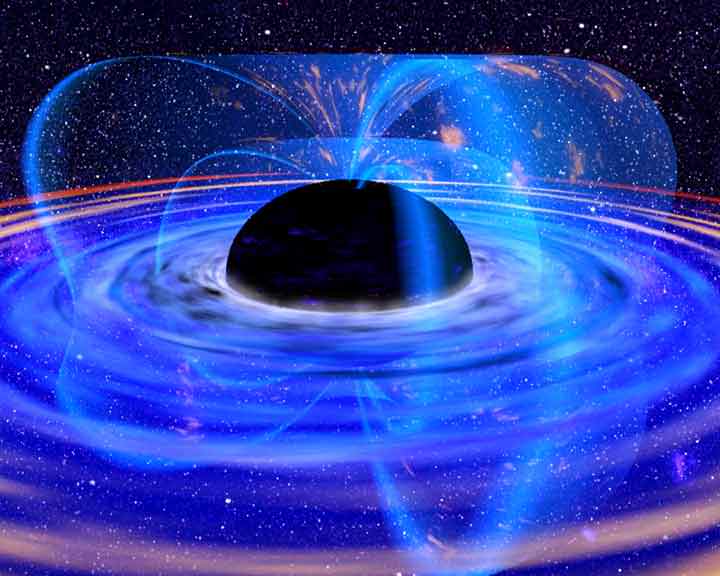
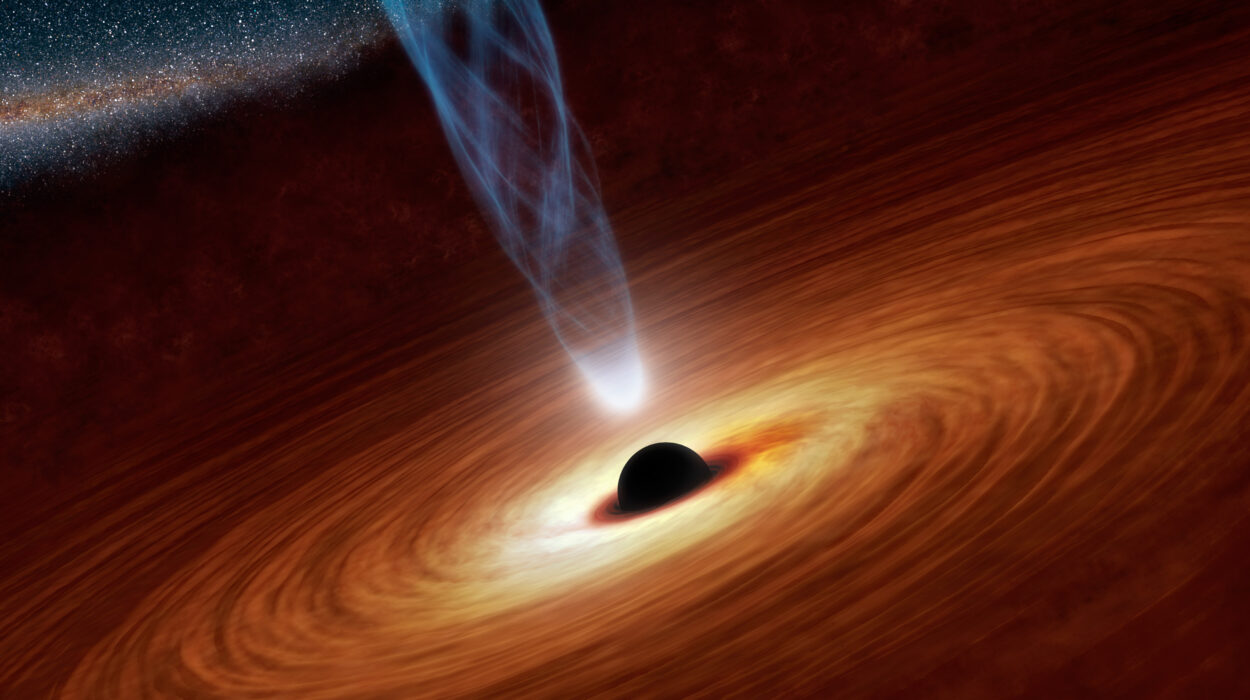
Black Holes and the Quantum Gravity Puzzle
Black holes occupy a special place in the search for quantum gravity.
These extraordinary objects form when massive stars collapse under their own gravity.
The result is a region where gravity becomes incredibly strong.
According to general relativity, matter collapsing into a black hole eventually reaches a singularity.
At a singularity, density becomes infinite and the laws of physics break down.
Most physicists suspect infinities signal an incomplete theory.
Nature rarely produces actual infinities.
Instead, infinities often indicate that a better explanation is needed.
Quantum gravity may eliminate singularities entirely.
By incorporating quantum effects, it could reveal what truly happens inside black holes.
This possibility makes black holes powerful testing grounds for new ideas.
The Information Paradox
One of the most famous mysteries involving quantum gravity is the black hole information paradox.
Quantum mechanics states that information cannot be destroyed.
General relativity seems to suggest that information falling into a black hole may disappear forever.
These conclusions appear incompatible.
The conflict became even more intriguing after physicist Stephen Hawking discovered that black holes emit radiation.
Over immense periods of time, black holes can slowly evaporate.
If a black hole disappears completely, what happens to the information that fell into it?
Does it vanish?
Is it somehow preserved?
Resolving this paradox may require a complete theory of quantum gravity.
Many researchers believe the answer could reveal profound truths about reality itself.
The Beginning of the Universe
Another place where quantum gravity becomes essential is the origin of the cosmos.
According to modern cosmology, the universe began approximately 13.8 billion years ago in the Big Bang.
Tracing cosmic history backward leads to increasingly extreme conditions.
Temperatures rise.
Densities increase.
Gravity grows stronger.
Eventually, scientists reach a point where both quantum effects and gravity become equally important.
Current theories cannot adequately describe this moment.
The mathematics breaks down.
Quantum gravity may provide the missing framework needed to understand the true beginning of the universe.
Perhaps the Big Bang was not the ultimate beginning at all.
Perhaps something existed before it.
Only a successful theory of quantum gravity may reveal the answer.
The Dream of a Theory of Everything
For generations, physicists have sought a deeper unity in nature.
Many hope quantum gravity could become part of a broader “Theory of Everything.”
This phrase does not mean a theory explaining every detail of existence.
Instead, it refers to a framework unifying all fundamental forces and particles.
Historically, science has repeatedly revealed hidden connections.
Electricity and magnetism turned out to be aspects of a single force.
The weak nuclear force and electromagnetism were later unified.
Many physicists suspect gravity may eventually join this pattern.
Quantum gravity could represent an important step toward that ultimate goal.
String Theory and Quantum Gravity
One of the most famous approaches to quantum gravity is String Theory.
String theory proposes that fundamental particles are not truly point-like.
Instead, they are tiny vibrating strings.
Different vibration patterns produce different particles.
In this framework, gravity emerges naturally.
The theory includes a hypothetical particle known as the graviton, which would carry gravitational interactions.
String theory also introduces additional dimensions beyond the familiar three dimensions of space and one dimension of time.
These extra dimensions may be hidden from everyday observation.
Although mathematically rich and influential, string theory remains experimentally unconfirmed.
Nevertheless, it continues to play a major role in quantum gravity research.
Loop Quantum Gravity
Another major approach is called Loop Quantum Gravity.
Rather than introducing strings, this theory attempts to quantize space-time itself.
According to loop quantum gravity, space may consist of tiny discrete units woven together into a complex network.
In this picture, space is not continuous.
It possesses an atomic-like structure.
The smooth geometry we observe emerges from these underlying building blocks.
Loop quantum gravity offers intriguing possibilities for eliminating singularities and understanding the early universe.
Like string theory, however, it still awaits decisive experimental confirmation.
The Challenge of Testing Quantum Gravity
One reason quantum gravity remains unsolved is that it is extraordinarily difficult to test.
Most physical theories can be evaluated through experiments.
Quantum gravity operates at scales far beyond current technological capabilities.
The energies required to directly probe the Planck scale are unimaginably high.
Building an accelerator capable of reaching such energies would be far beyond anything humanity can currently achieve.
As a result, researchers must rely on indirect methods.
They search for subtle signatures in cosmic observations, black holes, gravitational waves, and the structure of the universe.
Progress is often slow.
Yet science has overcome similar challenges before.
Gravitational Waves Open New Possibilities
The discovery of gravitational waves marked a major milestone in modern physics.
These ripples in space-time were predicted by Einstein more than a century earlier.
Their detection confirmed a key prediction of general relativity.
More importantly, gravitational waves created an entirely new way of observing the universe.
Some researchers hope future gravitational-wave observations may reveal hints of quantum gravity.
Tiny deviations from classical predictions could provide valuable clues.
Although no definitive evidence has yet emerged, this new field offers exciting possibilities for future discoveries.
Could Space and Time Be Emergent?
One of the most radical ideas in quantum gravity is that space and time may not be fundamental.
Instead, they could emerge from something deeper.
This possibility challenges centuries of intuition.
We naturally think of space and time as the stage upon which events occur.
But some modern theories suggest the stage itself may arise from more fundamental ingredients.
The situation may resemble temperature.
Temperature feels fundamental in everyday life.
Yet it emerges from the collective motion of countless particles.
Similarly, space and time might emerge from deeper quantum structures.
If true, this would represent one of the most profound discoveries in human history.
Quantum Entanglement and the Fabric of Reality
Another surprising connection has emerged between quantum gravity and quantum entanglement.
Entanglement occurs when particles become linked in ways that defy classical intuition.
Measuring one particle instantly provides information about another, regardless of distance.
Recent theoretical work suggests entanglement may play a role in constructing space-time itself.
Some researchers have proposed that the geometry of the universe could emerge from networks of quantum relationships.
In this view, space is not merely a container for matter.
Space may actually be built from information.
Although these ideas remain speculative, they have generated enormous excitement among physicists.
Why the Search Takes So Long
The quest for quantum gravity has lasted for decades.
To outsiders, this may seem surprising.
Why has progress been so slow?
The answer lies in the problem’s extraordinary difficulty.
Quantum gravity sits at the intersection of two immensely successful theories.
Any replacement must reproduce all their confirmed predictions.
It must agree with observations ranging from subatomic particles to galaxies.
It must solve deep mathematical problems while remaining physically meaningful.
Such challenges require patience.
Many scientific revolutions unfold over generations rather than years.
The search for quantum gravity may ultimately prove to be one of humanity’s most ambitious intellectual endeavors.
The Human Side of the Quest
Behind every equation lies a human story.
Thousands of physicists have devoted their careers to understanding quantum gravity.
Many entered the field inspired by a desire to uncover nature’s deepest secrets.
The search often involves frustration.
Ideas that appear promising may fail.
Elegant mathematics may not correspond to reality.
Years of work sometimes produce more questions than answers.
Yet the challenge itself continues to inspire.
Few scientific goals are as profound as discovering the fundamental structure of the universe.
The pursuit of quantum gravity reflects humanity’s enduring curiosity and determination to understand existence.
What Success Would Mean
If scientists eventually discover a successful theory of quantum gravity, the consequences could be extraordinary.
It might explain what happens inside black holes.
It could reveal the true nature of the Big Bang.
It may uncover hidden dimensions, new particles, or entirely new principles of reality.
The theory could reshape our understanding of space, time, matter, and information.
History shows that fundamental discoveries often lead to unexpected technologies.
Quantum mechanics eventually gave rise to computers and modern electronics.
Relativity became essential for satellite navigation systems.
A future quantum gravity theory might produce practical applications we cannot yet imagine.
More importantly, it would answer questions that have challenged generations of thinkers.
The Holy Grail of Physics
The phrase “Holy Grail of Physics” is often used to describe quantum gravity because it represents a goal of immense significance and extraordinary difficulty.
Like legendary seekers pursuing a hidden treasure, physicists continue searching for a theory that unites nature’s deepest laws.
The quest is not merely about solving equations.
It is about understanding reality at its most fundamental level.
What is space?
What is time?
How did the universe begin?
What lies at the heart of a black hole?
Quantum gravity may hold the answers.
For now, those answers remain beyond reach.
But history repeatedly shows that mysteries eventually yield to human curiosity.
Conclusion
Quantum gravity is the ongoing effort to unite the two greatest achievements of modern physics: general relativity and quantum mechanics. While relativity explains gravity, space, and the large-scale universe, quantum mechanics governs the microscopic realm of particles and probabilities. Both theories work remarkably well on their own, yet they become incompatible under extreme conditions such as black holes and the earliest moments of the cosmos.
The search for quantum gravity seeks to bridge this divide and reveal a deeper understanding of reality. Through approaches such as string theory, loop quantum gravity, and other emerging ideas, physicists hope to uncover the true nature of space-time, resolve long-standing paradoxes, and explain the origins of the universe itself.
Although the solution remains elusive, the pursuit of quantum gravity stands among humanity’s greatest scientific adventures. It is a quest driven by curiosity, imagination, and the belief that beneath the apparent complexity of the cosmos lies a deeper order waiting to be discovered. Whether the answer arrives tomorrow or decades from now, the search for quantum gravity continues to push the boundaries of knowledge and bring us closer to understanding the universe at its most fundamental level.