Imagine a flash of energy so powerful that, for a few brief seconds, it can outshine every star in its entire galaxy combined. Imagine an explosion capable of releasing more energy in moments than the Sun will emit during its entire lifetime of roughly 10 billion years. Imagine a cosmic event so extreme that it can be detected across billions of light-years of space, allowing astronomers to observe it from nearly the edge of the visible universe.
Such events are real.
They are known as gamma-ray bursts, or GRBs, and they rank among the most violent and energetic phenomena ever discovered. In fact, astronomers often describe gamma-ray bursts as the most powerful explosions since the Big Bang itself.
For decades, these mysterious flashes puzzled scientists. They appeared suddenly, vanished almost immediately, and seemed to come from random locations across the sky. No one knew what caused them, how far away they were, or why they released such astonishing amounts of energy.
Today, researchers have uncovered many of their secrets, yet gamma-ray bursts remain among the most fascinating objects in modern astronomy. They offer clues about the deaths of massive stars, the formation of black holes, the behavior of matter under extreme conditions, and even the history of the early universe.
To understand gamma-ray bursts is to explore some of the most dramatic events nature can produce.
Understanding Gamma Rays
Before exploring gamma-ray bursts themselves, it helps to understand gamma rays.
Light comes in many forms. Human eyes can see only a tiny portion of the electromagnetic spectrum known as visible light. Beyond visible light exist radio waves, microwaves, infrared radiation, ultraviolet light, X-rays, and gamma rays.
Gamma rays occupy the highest-energy end of the electromagnetic spectrum.
Their wavelengths are extraordinarily short.
Their frequencies are extremely high.
Their energies are immense.
Unlike visible light, gamma rays cannot be seen by human eyes. Earth’s atmosphere fortunately absorbs most incoming gamma radiation, protecting life from its harmful effects.
Because the atmosphere blocks gamma rays, astronomers must use satellites and space-based observatories to study them.
When scientists first began observing the gamma-ray universe, they discovered something astonishing.
Occasionally, space erupted with sudden flashes of gamma radiation so powerful that they briefly became the brightest gamma-ray sources in the entire sky.
These mysterious signals became known as gamma-ray bursts.
The Accidental Discovery
One of the most fascinating aspects of gamma-ray bursts is how they were discovered.
The story begins during the Cold War.
In the 1960s, the United States launched a series of military satellites called the Vela Program.
Their purpose was not astronomy.
Instead, they were designed to detect gamma rays produced by unauthorized nuclear weapons tests.
Scientists expected the satellites to monitor activity on Earth.
Instead, they detected powerful gamma-ray flashes coming from deep space.
The signals did not match any known nuclear explosions.
Nor did they originate from the Sun.
The bursts appeared to come from random directions across the universe.
For years, researchers struggled to understand what they were seeing.
When the discovery became public in 1973, it launched one of the greatest mysteries in modern astronomy.
What Exactly Is a Gamma-Ray Burst?
A gamma-ray burst is a sudden, intense flash of gamma radiation originating from deep space.
The burst itself may last only a fraction of a second or continue for several minutes.
Despite this brief duration, the amount of energy released is staggering.
During the peak of a gamma-ray burst, the source can become the most luminous object in the observable universe.
For a short time, it may emit more energy than entire galaxies containing hundreds of billions of stars.
The burst typically appears without warning.
One moment, nothing unusual is happening.
The next, detectors record an enormous surge of gamma radiation.
Then, almost as suddenly as it appeared, the burst fades away.
Yet the story does not end there.
After the initial burst, many events produce an “afterglow” that can remain visible across other wavelengths—including X-rays, ultraviolet light, visible light, infrared radiation, and radio waves—for days, weeks, or even months.
These afterglows provide astronomers with valuable opportunities to study the source.
Why Gamma-Ray Bursts Are So Powerful
The extraordinary power of gamma-ray bursts stems from the extreme conditions that create them.
In ordinary stars, energy is generated through nuclear fusion.
The Sun, for example, converts hydrogen into helium, releasing enormous energy in the process.
Yet compared to a gamma-ray burst, even the Sun seems modest.
A typical gamma-ray burst can release in seconds the same amount of energy the Sun would emit over its entire lifetime.
This happens because GRBs are associated with some of the most catastrophic events in the universe.
Massive stars collapse.
Black holes form.
Neutron stars collide.
Immense amounts of matter and energy become concentrated into tiny regions.
Under these conditions, nature unleashes energies far beyond anything humanity can produce.
The Two Main Types of Gamma-Ray Bursts
As scientists gathered more observations, they noticed that gamma-ray bursts generally fall into two major categories.
Some bursts last less than about two seconds.
Others continue longer than two seconds.
Although the distinction may seem simple, it reflects fundamentally different cosmic events.
Short-duration gamma-ray bursts typically arise from collisions involving neutron stars.
Long-duration gamma-ray bursts usually result from the deaths of massive stars.
Each type tells a different story about how the universe evolves.
Together, they reveal some of nature’s most dramatic transformations.
Long Gamma-Ray Bursts and Dying Stars
The majority of powerful long-duration gamma-ray bursts originate from the deaths of extremely massive stars.
These stars are far larger than the Sun.
During their lives, they burn through nuclear fuel at extraordinary rates.
Eventually, fusion can no longer support the star against gravity.
The star’s core begins collapsing inward.
What follows is one of the most violent events in the cosmos.
As the core collapses, it may form a black hole or an extremely dense neutron star.
Meanwhile, the outer layers of the star crash inward and then explode outward in a tremendous supernova.
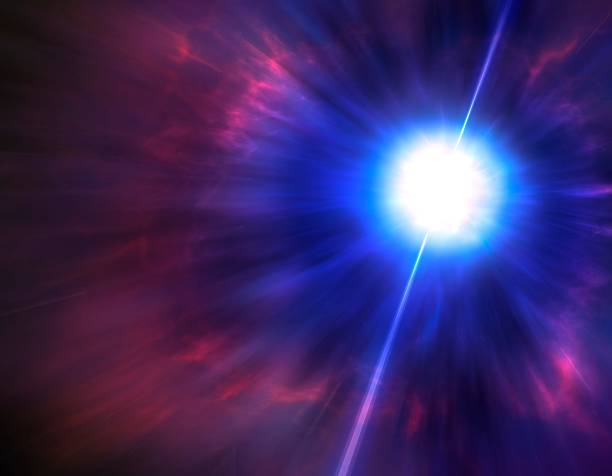
In certain cases, this collapse generates narrow jets of material moving outward at speeds approaching the speed of light.
These jets punch through the dying star and escape into space.
When one of these jets points toward Earth, astronomers observe a gamma-ray burst.
The burst itself is merely the visible signature of an extraordinarily violent stellar death.
The Collapsar Model
The leading explanation for many long gamma-ray bursts is known as the collapsar model.
In this scenario, a massive star exhausts its fuel and experiences catastrophic collapse.
The core forms a black hole.
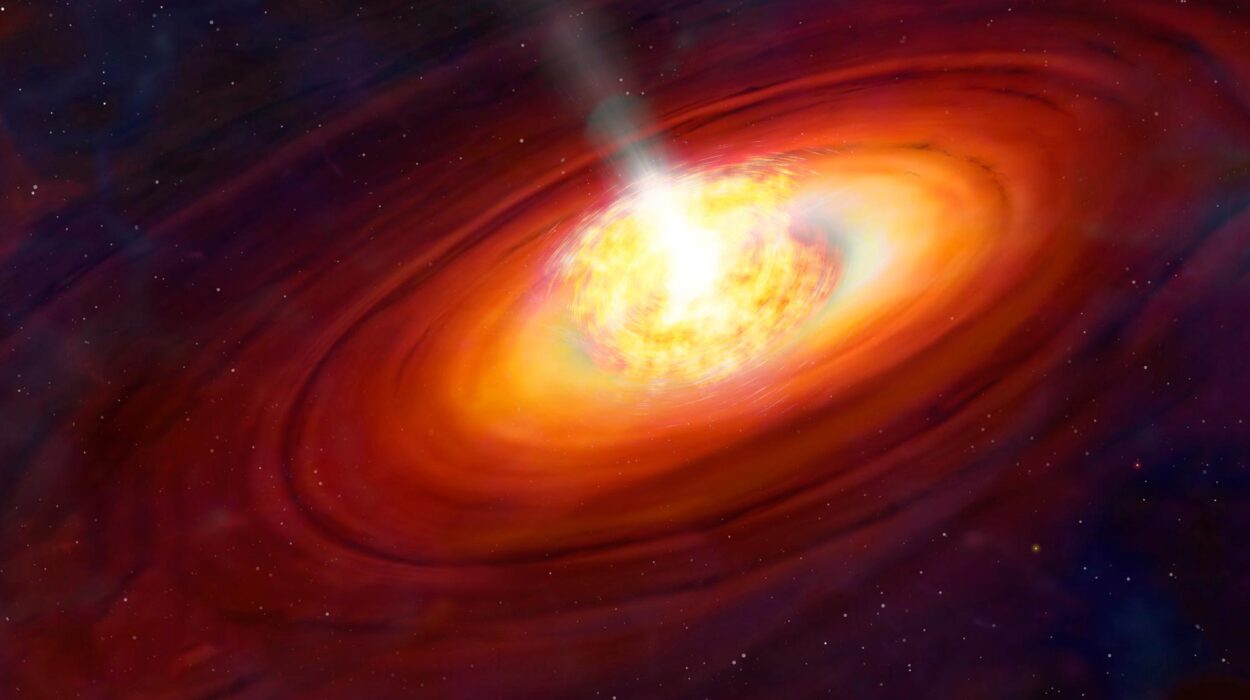
Material surrounding the newborn black hole spirals inward, creating an extremely hot disk.
Magnetic fields and rotational energy help launch powerful jets from the system’s poles.
These jets travel outward at nearly light speed.
Within the jets, particles collide and generate intense gamma radiation.
If one jet happens to be aimed toward Earth, detectors register a gamma-ray burst.
The entire process may unfold in only seconds or minutes, yet it represents the culmination of millions of years of stellar evolution.
Short Gamma-Ray Bursts and Cosmic Collisions
While long-duration bursts arise from collapsing stars, short-duration bursts have a different origin.
These events are generally associated with collisions between neutron stars.
Neutron stars are among the densest objects in the universe.
A single teaspoon of neutron star matter would weigh billions of tons on Earth.
When two neutron stars orbit one another, they gradually lose energy through gravitational wave emission.
Over time, they spiral closer together.
Eventually, they collide.
The merger releases enormous amounts of energy.
Powerful jets emerge.
Gamma rays erupt into space.
The resulting burst may last less than two seconds, yet it can release astonishing power.
These collisions also create heavy elements such as gold, platinum, and uranium.
Remarkably, much of the gold found on Earth may ultimately trace its origins to ancient neutron star mergers.
Black Holes and Gamma-Ray Bursts
Black holes play a central role in many gamma-ray burst scenarios.
A black hole forms when matter becomes so densely compressed that gravity overwhelms everything else.
Not even light can escape from within its event horizon.
Yet paradoxically, some of the brightest events in the universe occur during black hole formation.
The black hole itself emits no light.
However, the material falling into it becomes incredibly hot and energetic.
Magnetic fields can channel part of this energy into narrow jets moving at relativistic speeds.
These jets become the engines powering gamma-ray bursts.
Studying GRBs therefore provides indirect insight into how black holes form and behave.
Relativistic Jets: Nature’s Cosmic Blowtorches
One of the defining features of gamma-ray bursts is the presence of relativistic jets.
These are streams of particles traveling at speeds extremely close to the speed of light.
Einstein’s theory of relativity becomes crucial under such conditions.
As particles approach light speed, their energy increases dramatically.
The jets become extraordinarily powerful.
Rather than radiating energy equally in all directions, much of the burst’s energy becomes concentrated into these narrow beams.
This concentration makes gamma-ray bursts appear even brighter when viewed along the jet’s path.
Without relativistic jets, many GRBs would likely remain undetectable across cosmic distances.
The Afterglow
The gamma-ray burst itself often lasts only moments.
However, the event usually leaves behind a fading afterglow.
As the jet plows through surrounding gas, shock waves form.
These shocks accelerate particles and generate radiation across the electromagnetic spectrum.
Astronomers may observe X-ray afterglows within minutes.
Optical afterglows can remain visible for days.
Radio emissions may persist for months or even years.
The afterglow acts like a cosmic fingerprint.
By studying it, researchers can determine the burst’s distance, environment, and physical properties.
Many of the major breakthroughs in gamma-ray burst research came from analyzing afterglows.
Measuring Distances Across the Universe
One of the greatest discoveries in gamma-ray burst research was realizing just how far away these events occur.
Many GRBs originate billions of light-years from Earth.
Some are among the most distant objects ever observed.
When astronomers detect a burst, they often measure its redshift.
Redshift occurs because the universe is expanding.
Light traveling across vast distances becomes stretched toward longer wavelengths.
The greater the redshift, the farther away the source.
Some gamma-ray bursts originated when the universe was only a small fraction of its current age.
They provide glimpses into cosmic history that would otherwise be impossible.
Looking Back in Time
Because light requires time to travel, observing distant objects means observing the past.
A gamma-ray burst occurring 10 billion light-years away is seen as it existed 10 billion years ago.
In this sense, gamma-ray bursts function as time machines.
They illuminate regions of the early universe.
They reveal conditions that existed shortly after the first generations of stars formed.
Some bursts have helped astronomers study galaxies too faint to observe directly.
The burst briefly lights up its surroundings, allowing scientists to analyze material that would otherwise remain invisible.
This makes gamma-ray bursts valuable tools for understanding cosmic evolution.
The Brightest Explosions Ever Seen
Certain gamma-ray bursts are so luminous that they challenge comprehension.
One famous event occurred in 2022 and was nicknamed the “Brightest Of All Time,” or BOAT.
The burst was so powerful that it overwhelmed detectors and became the focus of intense scientific investigation.
Although many GRBs are incredibly bright, rare events like this demonstrate just how extreme nature can become.
The energy released during such bursts dwarfs most other known astrophysical phenomena.
For a brief period, a single dying star or neutron star merger can outshine entire galaxies.
These events remind us that the universe operates on scales far beyond everyday human experience.
How Astronomers Detect Gamma-Ray Bursts
Detecting gamma-ray bursts requires specialized instruments.
Since Earth’s atmosphere blocks gamma rays, observations must occur in space.
Satellites constantly monitor the sky for sudden bursts of high-energy radiation.
When a burst is detected, automated systems immediately alert observatories around the world.
Within seconds or minutes, telescopes begin searching for the afterglow.
This rapid response is crucial because afterglows fade quickly.
Modern networks allow scientists to coordinate observations across multiple wavelengths.
Together, these instruments provide a detailed picture of each event.
Famous Gamma-Ray Observatories
Several space missions have revolutionized GRB research.
The Compton Gamma Ray Observatory greatly expanded the known population of gamma-ray bursts during the 1990s.
Later, the Swift Observatory transformed the field by rapidly locating bursts and observing their afterglows.
The Fermi Gamma-ray Space Telescope continues studying high-energy cosmic events today.
These missions have helped solve many mysteries while uncovering new questions.
Each burst detected adds another chapter to our understanding of the universe.
Gamma-Ray Bursts and Supernovae
One of the most important discoveries in modern astronomy was establishing the connection between certain gamma-ray bursts and supernova explosions.
For years, scientists suspected a relationship.
Eventually, observations confirmed it.
In several cases, astronomers observed a gamma-ray burst followed by a supernova emerging from the same location.
This provided strong evidence that at least some GRBs represent the deaths of massive stars.
The connection linked two of the most dramatic phenomena in the cosmos.
A supernova marks the explosive end of a star.
A gamma-ray burst represents an even more focused release of energy associated with that death.
Together, they reveal the final moments of stellar giants.
Could a Gamma-Ray Burst Affect Earth?
The immense power of gamma-ray bursts naturally raises an unsettling question.
What would happen if one occurred close to Earth?
Fortunately, most observed GRBs occur billions of light-years away.
Distance protects us.
However, a nearby burst directed toward Earth could potentially cause significant damage.
High-energy radiation might disrupt the atmosphere, deplete portions of the ozone layer, and increase harmful ultraviolet exposure at the surface.
Some scientists have even explored whether ancient mass extinctions could have been influenced by such events.
There is currently no evidence that a nearby gamma-ray burst poses an immediate threat.
The probability is extremely low.
Nevertheless, the possibility highlights just how powerful these explosions truly are.
The Role of Gamma-Ray Bursts in Cosmic Chemistry
Gamma-ray bursts are not merely destructive events.
They also contribute to the ongoing evolution of the universe.
The stellar explosions associated with long-duration GRBs help distribute heavy elements into space.
Neutron star mergers produce some of the heaviest elements known.
These elements eventually become incorporated into new stars, planets, and potentially living organisms.
Every atom of gold in a wedding ring, every atom of platinum in industrial equipment, and many other heavy elements may owe their existence to ancient cosmic catastrophes.
In this way, gamma-ray bursts are connected to the chemical enrichment of the universe.
Mysteries That Remain Unsolved
Despite decades of progress, gamma-ray bursts continue to pose important questions.
Scientists are still investigating exactly how relativistic jets form.
The details of magnetic field interactions remain uncertain.
Researchers seek better understanding of how black holes launch such powerful outflows.
Some bursts display unusual properties that do not fit neatly into existing categories.
Others occur in environments that challenge current models.
As new instruments improve observational capabilities, fresh mysteries continue to emerge.
Gamma-ray bursts remain an active frontier of astrophysical research.
What Gamma-Ray Bursts Teach Us About Extreme Physics
Few natural laboratories allow scientists to study matter and energy under such extreme conditions.
Temperatures reach extraordinary levels.
Magnetic fields become unimaginably strong.
Gravity approaches its most intense forms.
Particles accelerate to near-light speeds.
These environments cannot be recreated on Earth.
By observing gamma-ray bursts, researchers test theories of relativity, plasma physics, high-energy particle interactions, and black hole formation.
Each burst provides a glimpse into realms where the laws of nature operate at their limits.
Humanity’s Fascination with Cosmic Violence
There is something strangely captivating about gamma-ray bursts.
Perhaps it is because they reveal a side of the universe that contrasts sharply with the calm appearance of the night sky.
When we look upward, the stars seem peaceful and eternal.
Yet hidden among them are events of unimaginable violence.
Stars collapse.
Black holes form.
Neutron stars collide.
Immense jets of radiation blast across intergalactic space.
Gamma-ray bursts expose the dynamic and often turbulent nature of the cosmos.
They remind us that the universe is not static.
It is constantly evolving, creating, destroying, and transforming on scales almost impossible to imagine.
Conclusion
Gamma-ray bursts are the most powerful explosions known since the Big Bang, releasing astonishing amounts of energy in mere seconds. Discovered accidentally during the Cold War, these mysterious flashes of gamma radiation have become one of the most important subjects in modern astronomy. Scientists now know that many long-duration bursts arise from the deaths of massive stars, while short-duration bursts often result from collisions between neutron stars.
These extraordinary events illuminate black hole formation, stellar evolution, heavy element production, and the history of the early universe. Their brilliant afterglows allow astronomers to study galaxies billions of light-years away and peer back into cosmic history. Although much has been learned, gamma-ray bursts continue to challenge researchers with new questions about the nature of matter, energy, gravity, and space itself.
More than just explosions, gamma-ray bursts are cosmic beacons. They reveal the universe at its most extreme and dramatic. In their brief flashes, they tell stories of creation and destruction, of stars ending their lives and black holes being born. They remind us that even in the vast darkness of space, nature is capable of producing displays of power so immense that they can be seen across the entire observable universe.