Look up at the night sky on a clear evening, and the stars may seem calm, constant, and unchanging. For thousands of years, people believed the stars were fixed lights hanging in the heavens, shining with unwavering brightness night after night. While planets wandered across the sky, stars appeared reliable and eternal.
But the universe often hides remarkable secrets behind familiar appearances.
Many stars are not constant at all. They brighten and dim, pulse and swell, eclipse one another, erupt in giant outbursts, and sometimes even explode. Some change over days, others over months, years, or centuries. Their variations can be subtle or dramatic. To astronomers, these changing stars are known as variable stars.
Variable stars are among the most fascinating objects in the cosmos. They behave like cosmic heartbeats, pulsing with rhythms that reveal their internal structures and life stories. By studying these stellar variations, scientists have measured the size of the Milky Way, determined distances to faraway galaxies, discovered hidden companions around stars, and gained deeper insight into how stars live and die.
Far from being astronomical curiosities, variable stars have played a central role in humanity’s understanding of the universe. Their changing brightness has become one of astronomy’s most powerful tools.
To understand variable stars is to understand that the universe is alive with motion, change, and rhythm. Every pulse tells a story. Every fluctuation carries information. Every changing star reminds us that even the seemingly permanent lights of the night sky are dynamic worlds undergoing constant transformation.
What Is a Variable Star?
A variable star is a star whose brightness changes over time when observed from Earth.
These changes can occur for many reasons. In some cases, the star itself physically changes. It may expand and contract, causing its brightness to rise and fall. In other cases, the star remains relatively stable, but something blocks part of its light. A companion star, planet, or cloud of material may periodically pass in front of it.
The key feature is that the star’s apparent brightness varies.
Some variable stars change by only a tiny fraction of a percent. Others can become hundreds or even thousands of times brighter than normal before fading again.
Astronomers measure these changes using a system called magnitude. By recording how a star’s brightness changes over time, they create a graph known as a light curve. This light curve acts like a fingerprint, helping scientists identify the type of variable star and understand the physical processes behind its behavior.
Today, hundreds of thousands of variable stars are known, and new ones continue to be discovered.
The Discovery of Changing Stars
The idea that stars could change was once considered surprising.
Ancient astronomers generally viewed the heavens as perfect and unchanging. The stars seemed fixed, reinforcing this belief.
Yet occasionally, observers noticed something unusual.
One of the earliest known examples occurred in 1596 when the German astronomer David Fabricius observed a star that appeared and disappeared. This star would later become known as Mira.
Its name comes from the Latin word for “wonderful” or “astonishing,” an appropriate description for a star that seemed to vanish and then return.
Later observations revealed that Mira was not unique. Other stars also changed brightness over time.
These discoveries challenged traditional ideas about the heavens and opened an entirely new field of astronomical research.
Today, variable stars are recognized as a natural and widespread part of the universe.
Why Stars Change Brightness
The reasons behind stellar variability are surprisingly diverse.
Some stars change because their physical properties fluctuate. Their outer layers expand and contract, causing temperature and brightness changes.
Others vary because of interactions with nearby companion stars.
Some experience massive eruptions that temporarily increase their luminosity.
In certain systems, brightness changes occur because one object periodically blocks another.
To astronomers, variable stars are generally divided into two broad categories: intrinsic variables and extrinsic variables.
Intrinsic variables change because of processes occurring within the stars themselves.
Extrinsic variables change because of external factors affecting how we see them.
This distinction helps scientists understand the underlying mechanisms responsible for stellar variability.
Intrinsic Variable Stars
Intrinsic variable stars physically change over time.
The variations originate inside the stars themselves.
These changes may involve pulsations, eruptions, magnetic activity, or other internal processes.
When astronomers observe intrinsic variables, they are effectively watching stars respond to forces operating deep within their interiors.
These stars provide valuable information about stellar structure and evolution.
Because the brightness changes reflect real physical transformations, intrinsic variables often act like laboratories for studying the physics of stars.
Pulsating Stars: The Beating Hearts of the Cosmos
Among all variable stars, pulsating stars are perhaps the most captivating.
These stars rhythmically expand and contract.
As they swell outward, their surfaces cool slightly and their brightness changes.
As they contract, temperatures rise and brightness shifts again.
The process resembles breathing or a heartbeat.
Although the movements occur over enormous scales, the underlying rhythm can be remarkably regular.
A pulsating star may increase and decrease in brightness with clock-like precision.
Some complete a cycle within hours.
Others take days, weeks, or even years.
These stellar pulsations occur because forces within the star constantly seek balance.
Gravity pulls inward, attempting to compress the star.
Pressure generated by hot gases pushes outward.
When these forces temporarily fall out of equilibrium, the star begins to pulsate.
The resulting cycles create some of the most important variable stars known to science.
Cepheid Variables: Cosmic Distance Markers
Few stars have had a greater impact on astronomy than Cepheid variables.
Named after Delta Cephei, these pulsating stars exhibit highly regular brightness changes.
Their importance comes from a remarkable relationship discovered by Henrietta Swan Leavitt in the early twentieth century.
Leavitt found that a Cepheid’s pulsation period is directly related to its true brightness.
The longer the period, the brighter the star actually is.
This discovery transformed astronomy.
By measuring a Cepheid’s pulsation period, astronomers can determine its intrinsic luminosity. Comparing that value to how bright it appears from Earth allows them to calculate its distance.
This method became one of the first reliable tools for measuring vast cosmic distances.
Using Cepheid variables, astronomers discovered that the universe extends far beyond the Milky Way.
They remain essential tools in modern cosmology.
How Cepheids Changed Our View of the Universe
Before the twentieth century, astronomers debated the scale of the cosmos.
Many believed the Milky Way represented the entire universe.
Then astronomers began studying Cepheid variables in distant spiral nebulae.
By calculating their distances, they discovered these objects lay far beyond our galaxy.
The implication was revolutionary.
The spiral nebulae were actually separate galaxies.
The universe was vastly larger than previously imagined.
This breakthrough helped transform modern astronomy and reshaped humanity’s understanding of its place in the cosmos.
The humble pulsations of variable stars had revealed the true scale of the universe.
RR Lyrae Stars
Another important class of pulsating variables is RR Lyrae stars.
These stars are generally older and less massive than Cepheids.
They pulsate with shorter periods, often completing cycles within a day.
Although they are not as luminous as Cepheids, RR Lyrae stars serve as valuable distance indicators within our galaxy.
They are especially common in globular clusters—dense collections of ancient stars orbiting the Milky Way.
By studying RR Lyrae variables, astronomers have mapped the structure of our galaxy and gained insight into its history.
These stars act as signposts pointing toward some of the oldest stellar populations in existence.
Mira Variables: Giants with Long Rhythms
Mira variables represent a very different kind of pulsating star.
These are aging red giant stars nearing the end of their lives.
They often exhibit dramatic brightness changes over periods lasting hundreds of days.
A Mira variable can brighten by factors of hundreds or even thousands before gradually fading again.
Their enormous size contributes to their unusual behavior.
Some are so large that if placed at the center of our Solar System, they would extend beyond the orbit of Mars.
As these giant stars pulsate, they lose vast amounts of material into space.
This expelled gas and dust eventually contributes to future generations of stars and planets.
In a sense, Mira variables help recycle matter throughout the galaxy.
The Physics Behind Stellar Pulsations
What causes stars to pulse in the first place?
The answer lies deep within their interiors.
Many pulsating stars experience what astronomers call the kappa mechanism.
Certain layers inside the star become more opaque when compressed.
As opacity increases, energy becomes temporarily trapped.
This trapped energy causes the layer to heat and expand.
Once expanded, the layer becomes more transparent.
Energy escapes, cooling the region.
Gravity then pulls the layer inward again.
The cycle repeats.
This continuous interplay between gravity, pressure, temperature, and opacity creates rhythmic pulsations that can persist for millions of years.
The result is a cosmic heartbeat visible across vast distances.
Eruptive Variable Stars
Not all variable stars pulsate.
Some experience sudden eruptions that dramatically alter their brightness.
These stars can brighten unexpectedly and then slowly fade.
The causes vary widely.
Some eruptions occur because stars eject material into space.
Others result from violent interactions between stars in binary systems.
Eruptive variables often behave less predictably than pulsating stars.
Their light curves may contain surprises, making them exciting targets for astronomers.
These stars remind us that stellar evolution is not always a smooth process.
Sometimes it can be explosive.
Novae: Stellar Outbursts
A nova occurs in a binary star system where a white dwarf and a companion star orbit each other.
The white dwarf gradually pulls material from its companion.
Over time, hydrogen accumulates on the white dwarf’s surface.
Eventually, conditions become extreme enough to trigger a thermonuclear explosion.
The result is a dramatic increase in brightness.
A star that was previously faint may suddenly become visible to the naked eye.
Despite the violence of the event, the white dwarf survives.
The process can even repeat multiple times.
Novae provide valuable information about binary stars, nuclear reactions, and stellar evolution.
Supernovae: The Ultimate Variable Stars
Among the most spectacular variable stars are supernovae.
These events occur when stars explode with extraordinary force.
For a brief period, a supernova can outshine an entire galaxy.
The brightness increase is astonishing.
A star that spent millions of years evolving can release an immense amount of energy in just weeks or months.
Supernovae play a crucial role in the universe.
They create and distribute many of the heavy elements found throughout space.
The iron in human blood, the calcium in bones, and the gold in jewelry were forged in ancient stars and dispersed by stellar explosions.
In this sense, supernovae are cosmic creators as well as destroyers.
Extrinsic Variable Stars
Unlike intrinsic variables, extrinsic variables change brightness because of external circumstances.
The stars themselves may remain relatively stable.
Instead, something affects how their light reaches Earth.
These systems demonstrate that variability does not always originate within a star.
Sometimes the change occurs because of geometry, perspective, or interactions between multiple objects.
Eclipsing Binary Stars
One of the most common types of extrinsic variable stars is the eclipsing binary.
Many stars exist in pairs.
Two stars orbit a common center of gravity.
If the orbital plane happens to align with our line of sight, one star periodically passes in front of the other.
When this occurs, part of the system’s light is blocked.
The observed brightness decreases.
As the stars continue their orbit, brightness returns to normal.
This process repeats again and again.
The resulting light curve provides astronomers with a wealth of information.
By studying eclipsing binaries, scientists can measure stellar masses, sizes, temperatures, and orbital characteristics with remarkable precision.
Rotating Variable Stars
Some stars vary because they rotate.
Their surfaces may contain giant starspots, regions that are cooler and darker than surrounding areas.
As the star spins, these spots move into and out of view.
The changing visibility alters the star’s apparent brightness.
This effect is similar to observing a rotating lighthouse or a spinning object with dark markings.
Rotating variable stars help astronomers study stellar magnetic fields and surface activity.
They reveal that stars can have dynamic and complex environments.
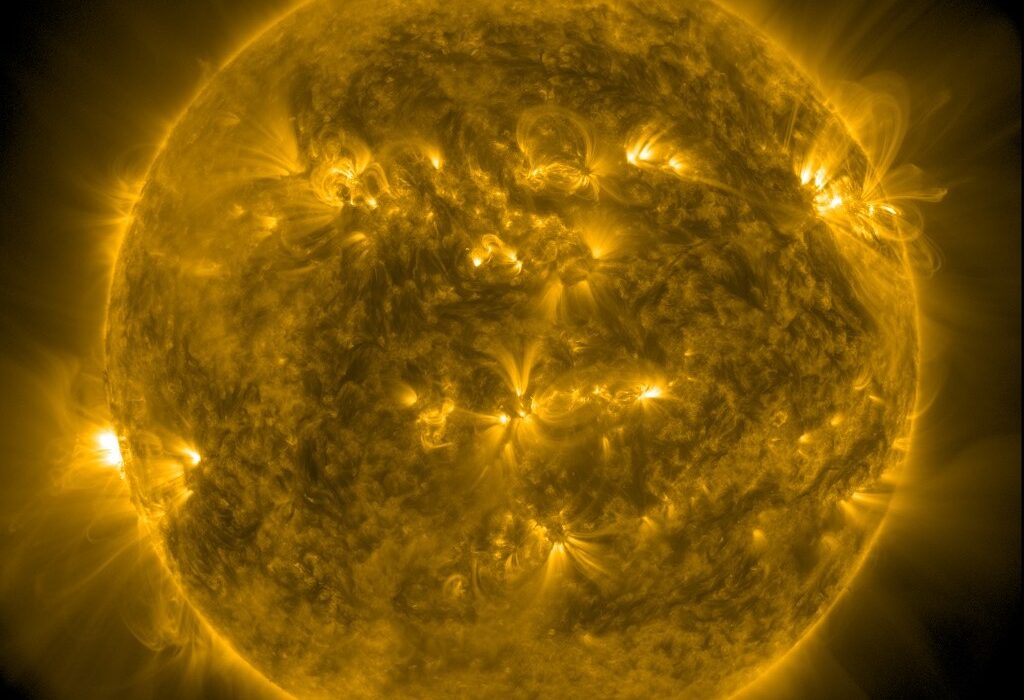
The Sun as a Variable Star
Even our own Sun exhibits variability.
Compared to many variable stars, its changes are modest.
However, the Sun’s brightness does fluctuate slightly over time.
These variations are linked to the approximately eleven-year solar cycle.
During periods of high solar activity, sunspots, solar flares, and magnetic disturbances become more common.
The Sun’s energy output changes by a small amount.
Although the variation is relatively minor, it demonstrates an important truth.
No star is perfectly constant.
Variability appears to be a natural aspect of stellar behavior.
How Astronomers Study Variable Stars
Studying variable stars requires patience and careful observation.
Astronomers repeatedly measure a star’s brightness over time.
These measurements are plotted to create a light curve.
The shape of the light curve often reveals the star’s identity.
A Cepheid produces one pattern.
An eclipsing binary produces another.
A nova creates a completely different signature.
Modern telescopes can monitor millions of stars simultaneously.
Automated surveys collect enormous amounts of data every night.
Computers then search for patterns indicating variability.
This approach has dramatically increased the number of known variable stars.
Today, astronomers have access to vast catalogs containing information on countless variable objects.
Amateur Astronomers and Variable Stars
One remarkable aspect of variable star research is the important role played by amateur astronomers.
Unlike many astronomical phenomena that require giant observatories, many variable stars can be observed with modest equipment.
Dedicated observers around the world regularly monitor variable stars and submit their measurements to scientific databases.
These observations help researchers track long-term changes that might otherwise go unnoticed.
In some cases, amateur astronomers have even discovered new variable stars or detected unusual behavior before professional observatories became aware of it.
Variable star astronomy remains one of the most accessible areas of scientific contribution.
What Variable Stars Reveal About Stellar Evolution
Every variable star tells a story about stellar evolution.
A young star may vary because of turbulent activity and surrounding dust.
A mature star may pulse as internal conditions shift.
An aging giant may experience dramatic expansions and contractions.
A dying star may erupt in a nova or explode as a supernova.
By studying variability, astronomers gain insight into the different stages of stellar life.
These stars act like living laboratories where physical processes can be observed in real time.
Instead of relying solely on theoretical models, scientists can watch evolution unfold before their eyes.
Variable Stars and the Search for Exoplanets
The techniques used to study variable stars have also contributed to the discovery of exoplanets.
When a planet passes in front of its host star, the star’s brightness decreases slightly.
This event is known as a transit.
Detecting these tiny dips requires methods similar to those used in variable star research.
Many exoplanet discoveries have relied on precise measurements of stellar brightness.
In this way, the study of variable stars has helped reveal thousands of worlds beyond our Solar System.
The Emotional Side of Variable Stars
There is something deeply moving about variable stars.
For centuries, people imagined stars as eternal and unchanging.
Yet these distant suns pulse, flicker, and transform.
They remind us that change is woven into the fabric of the universe.
Nothing remains static forever.
Stars are born, evolve, and eventually die.
Even across unimaginable distances, their rhythms can be detected.
Some pulse with extraordinary regularity, like cosmic clocks.
Others flare unexpectedly, like celestial fireworks.
Together they create a universe filled with motion and life.
When astronomers observe a variable star, they are witnessing a story unfolding across space and time.
The light reaching Earth today may have begun its journey decades, centuries, or even millennia ago.
Each pulse carries information from a distant world.
Each fluctuation represents physical processes occurring within a star many trillions of kilometers away.
The Future of Variable Star Research
The future of variable star astronomy is extraordinarily promising.
New observatories are collecting more data than ever before.
Advanced space telescopes monitor stars with unprecedented precision.
Artificial intelligence systems analyze massive datasets, identifying patterns that human observers might miss.
Astronomers expect to discover millions of additional variable stars in coming years.
These discoveries will deepen our understanding of stellar physics, galactic structure, and cosmic evolution.
Variable stars may even help answer some of astronomy’s biggest questions.
Their rhythms continue to provide clues about the nature of the universe.
Conclusion
Variable stars are far more than stars that simply brighten and dim. They are dynamic, evolving suns whose changing light reveals the hidden workings of the cosmos. Some pulse like giant beating hearts, expanding and contracting in rhythmic cycles. Others erupt in spectacular outbursts or participate in intricate dances with companion stars.
Through their variability, astronomers have measured cosmic distances, mapped the Milky Way, discovered other galaxies, explored stellar evolution, and advanced the search for planets beyond our Solar System. These stars have transformed our understanding of the universe.
Perhaps most importantly, variable stars remind us that the night sky is not a static backdrop. It is a living, changing realm filled with motion, energy, and transformation. Every pulse, every eclipse, and every eruption tells a story written in starlight.
When we look up and see the stars shining above, we are not merely seeing distant points of light. We are witnessing countless cosmic rhythms unfolding across space and time. And among those rhythms, the variable stars stand out as some of the universe’s most beautiful and revealing voices, quietly pulsing their secrets into the darkness for anyone willing to listen.