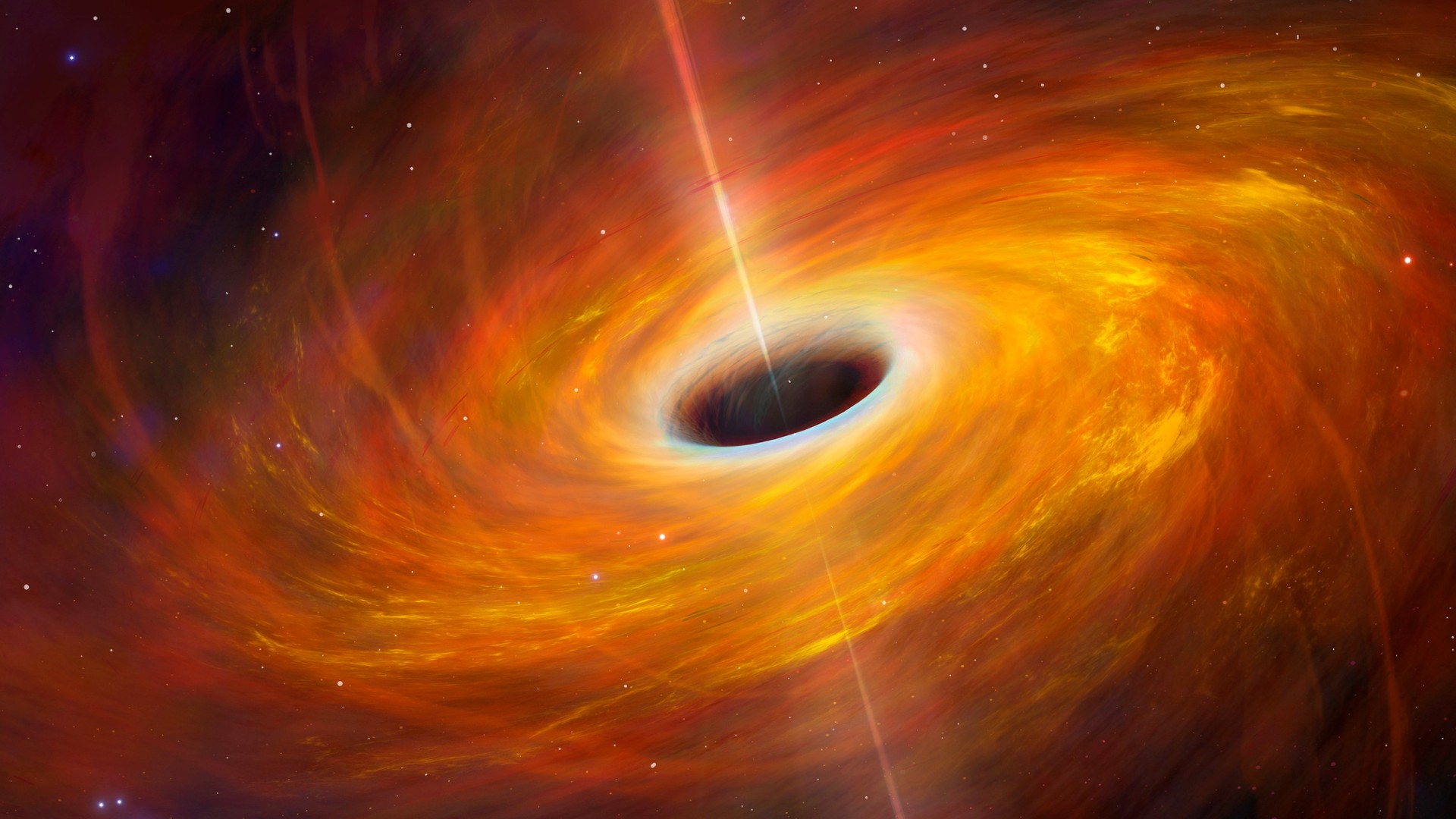
There are few objects in the universe that inspire as much awe, mystery, and imagination as black holes. They are invisible giants, regions of space where gravity becomes so powerful that nothing—not even light—can escape. For decades, black holes existed mostly in the realm of theory, appearing in scientific equations and the minds of physicists. Today, however, astronomers know that black holes are very real, and some of them are far larger than anyone once imagined.
Hidden in the centers of most large galaxies are cosmic monsters known as supermassive black holes. These extraordinary objects can contain millions or even billions of times the mass of the Sun. They sit deep within galactic hearts, influencing the fate of entire star systems and shaping the evolution of galaxies across billions of years.
What makes these titans so fascinating is not simply their enormous size. It is the fact that they challenge our understanding of nature itself. They occupy the boundary between what we know and what we still struggle to comprehend. They are simultaneously destroyers and creators, invisible yet enormously influential, quiet for millions of years and then suddenly among the brightest objects in the universe.
The story of supermassive black holes is one of the most remarkable chapters in modern astronomy. It is a story that stretches from the birth of galaxies to the future of the cosmos itself.
Understanding Black Holes
To understand supermassive black holes, we first need to understand what a black hole actually is.
A black hole forms when a large amount of mass becomes compressed into an incredibly small region of space. Gravity depends on mass, and when enough mass is packed tightly together, the gravitational pull becomes extraordinarily strong.
At a certain point, gravity becomes so intense that escape is impossible. Even light, the fastest thing in the universe, cannot move away once it crosses a critical boundary called the event horizon.
The event horizon is often described as the point of no return. Anything that passes beyond this boundary becomes trapped.
It is important to understand that a black hole is not a giant cosmic vacuum cleaner sucking everything around it into oblivion. If the Sun were magically replaced by a black hole of the same mass, Earth would continue orbiting normally because gravity depends on mass rather than the physical appearance of an object.
The difference is that black holes concentrate enormous amounts of matter into extremely small volumes, creating some of the most extreme environments in existence.
The Different Types of Black Holes
Astronomers generally classify black holes according to their mass.
Stellar-mass black holes form when massive stars exhaust their fuel and collapse under their own gravity. These black holes usually contain several times to several dozen times the mass of the Sun.
Intermediate-mass black holes occupy a middle range and remain somewhat mysterious. Evidence for them exists, but they are much harder to find.
Then there are supermassive black holes.
These giants occupy an entirely different category. While stellar black holes may contain ten or twenty solar masses, supermassive black holes can contain millions or billions of solar masses.
The difference is so vast that comparing them is like comparing a mountain to a grain of sand.
What Makes a Black Hole Supermassive?
A supermassive black hole is a black hole whose mass ranges from millions to billions of times that of the Sun.
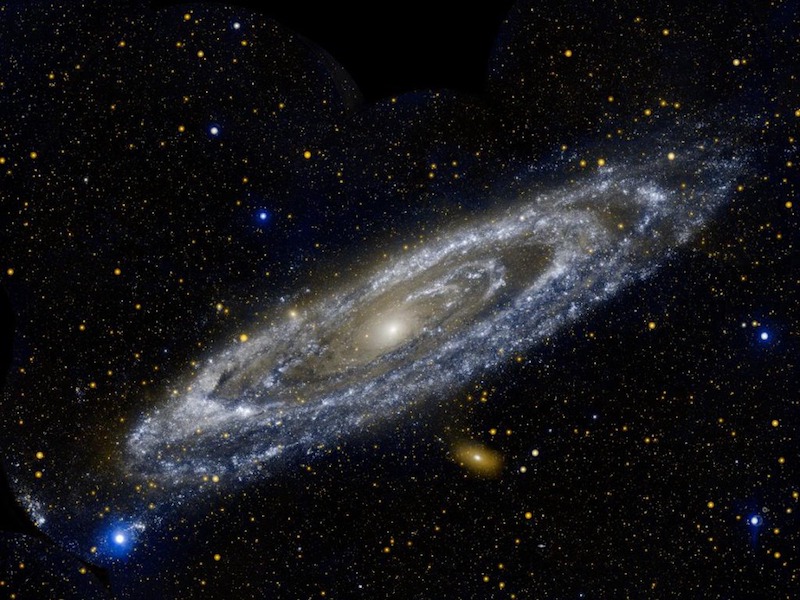
These objects are found at the centers of galaxies throughout the universe.
Unlike stellar black holes, which originate from dying stars, supermassive black holes appear to have a more complex and mysterious origin.
Their enormous size presents one of astronomy’s biggest puzzles.
How can something grow so massive?
How did these giants form so early in cosmic history?
Some supermassive black holes already existed less than a billion years after the Big Bang. This means they had relatively little time to accumulate their incredible mass.
Scientists continue investigating this mystery, and several competing theories seek to explain it.
The Discovery of Galactic Giants
For much of the twentieth century, supermassive black holes were little more than a theoretical possibility.
Astronomers suspected that something unusual lurked at the centers of galaxies. They observed stars moving at unexpectedly high speeds around invisible regions.
The motions suggested that enormous masses were concentrated within tiny areas.
Yet direct proof remained elusive.
The situation changed dramatically as telescopes improved.
By tracking the movements of stars near the center of the Milky Way, astronomers found compelling evidence for an invisible object containing about four million solar masses.
This object became known as Sagittarius A*.
The discovery provided some of the strongest evidence that supermassive black holes truly exist.
Since then, similar objects have been found in galaxies throughout the observable universe.
The Heart of the Milky Way
Deep within the Milky Way lies Sagittarius A*, often abbreviated as Sgr A*.
Located approximately 26,000 light-years from Earth, it sits at the very center of our galaxy.
Although enormous by human standards, Sagittarius A* is relatively modest compared to some other supermassive black holes.
Its mass is roughly four million times that of the Sun.
Astronomers cannot see the black hole directly because black holes emit no light. Instead, they study its influence on nearby stars.
Some stars orbit Sagittarius A* at astonishing speeds, completing orbits in just a few years.
Their movements reveal the presence of an incredibly massive object confined to a tiny region.
The evidence is so strong that alternative explanations have largely been ruled out.
At the center of our galactic home sits a genuine supermassive black hole.
The First Image of a Black Hole
For generations, black holes were invisible objects known only through indirect evidence.
That changed in 2019.
The Event Horizon Telescope Collaboration released the first-ever image of a black hole’s shadow.
The target was the supermassive black hole at the center of the galaxy Messier 87, commonly called M87.
The image showed a glowing ring of hot gas surrounding a dark central region.
Although the black hole itself remained invisible, the shadow it cast against surrounding material matched theoretical predictions remarkably well.
For many people, it was a historic moment.
Something that had once existed only in equations and imagination suddenly became visible to humanity.
How Big Are Supermassive Black Holes?
The word “supermassive” hardly captures their true scale.
Sagittarius A* contains four million solar masses.
The black hole in M87 contains billions of solar masses.
Some known supermassive black holes are even larger.
Certain giants may possess tens of billions of times the Sun’s mass.
If placed at the center of our Solar System, the event horizons of the largest supermassive black holes could extend beyond the orbit of planets.
Their gravitational influence reaches across enormous regions of space.
Yet despite their immense masses, black holes remain surprisingly compact compared to galaxies.
A galaxy may span hundreds of thousands of light-years while its central black hole occupies a tiny fraction of that distance.
This contrast makes their power even more astonishing.
How Supermassive Black Holes Form
One of the greatest unsolved mysteries in astronomy concerns the origins of supermassive black holes.
Scientists have proposed several possibilities.
One idea suggests they began as ordinary stellar black holes that gradually grew by consuming gas, dust, stars, and smaller black holes.
Another possibility involves the direct collapse of enormous clouds of primordial gas early in cosmic history.
A third hypothesis proposes that massive star clusters merged repeatedly until a giant black hole emerged.
Each explanation has strengths and weaknesses.
The challenge arises because some supermassive black holes appeared very early in the universe.
Growing from a small stellar black hole to billions of solar masses in such a short time seems difficult.
Astronomers continue searching for clues that may reveal how these cosmic titans were born.
Feeding the Monster
Black holes grow by accumulating matter.
Gas clouds, dust, stars, and even other black holes can eventually fall toward a supermassive black hole.
However, material rarely plunges directly inward.
Instead, it often forms an accretion disk—a rotating disk of matter spiraling around the black hole.
As particles within the disk collide, friction heats the material to extraordinary temperatures.
The gas becomes so hot that it emits enormous amounts of radiation.
Ironically, black holes themselves are dark, but the material surrounding them can become among the brightest objects in the universe.
This process transforms otherwise invisible black holes into spectacular cosmic beacons.
Quasars: The Brightest Objects in the Universe
When a supermassive black hole actively consumes large amounts of matter, the resulting energy output can be astonishing.
These active systems are known as quasars.
A quasar can outshine an entire galaxy containing hundreds of billions of stars.
The light originates not from the black hole itself but from the intensely heated accretion disk surrounding it.
Quasars are visible across billions of light-years.
Some are so distant that their light began traveling toward Earth when the universe was still very young.
Observations of quasars provide valuable information about early cosmic history and the growth of supermassive black holes.
They demonstrate that these objects are not merely passive residents of galaxies but can profoundly affect their environments.
Active Galactic Nuclei
Quasars belong to a broader category known as active galactic nuclei.
An active galactic nucleus forms when a supermassive black hole actively feeds on surrounding matter.
As gas falls inward, tremendous energy is released.
The central region may emit radiation across the electromagnetic spectrum, including radio waves, visible light, X-rays, and gamma rays.
Some active galactic nuclei produce powerful jets of particles moving near the speed of light.
These jets can extend for thousands or even millions of light-years.
The energy involved is almost unimaginable.
A region smaller than the Solar System can generate more power than an entire galaxy.
The Incredible Jets of Black Holes
One of the most dramatic features associated with certain supermassive black holes is the formation of relativistic jets.
These narrow streams of charged particles emerge from regions near the black hole and travel vast distances through space.
The exact mechanisms remain complex, involving magnetic fields, rotation, and extreme gravitational effects.
Jets can influence entire galaxies.
As they move outward, they interact with surrounding gas, heating it and sometimes preventing future star formation.
In this way, a supermassive black hole can regulate the growth of its host galaxy.
This discovery transformed how astronomers think about galaxies and black holes.
Rather than existing independently, they appear deeply connected.
The Relationship Between Galaxies and Black Holes
One of modern astronomy’s most surprising discoveries is that supermassive black holes and galaxies seem to evolve together.
The mass of a galaxy’s central black hole often correlates closely with properties of the galaxy itself.
Larger galaxies tend to host larger black holes.
This relationship suggests an intimate connection between the growth of galaxies and the growth of their central black holes.
Astronomers now believe black holes play an important role in shaping galactic evolution.
By influencing gas supplies and star formation, they help determine how galaxies develop over billions of years.
The connection is so strong that understanding galaxies requires understanding their black holes.
Can a Black Hole Destroy a Galaxy?
Given their immense power, it is natural to wonder whether supermassive black holes can destroy galaxies.
The answer is both yes and no.
Black holes do not typically consume entire galaxies. Their event horizons remain relatively small compared to galactic scales.
However, they can dramatically affect galactic evolution.
Powerful radiation and jets can heat surrounding gas and prevent it from collapsing into new stars.
Over time, this can slow or even halt star formation.
In this sense, supermassive black holes can influence the future of entire galaxies without physically swallowing them.
They act more like cosmic regulators than cosmic vacuum cleaners.
Stars Near a Supermassive Black Hole
The regions surrounding supermassive black holes are among the most extreme environments in the universe.
Stars orbiting close to these giants experience intense gravitational forces.
Some follow elongated paths that carry them astonishingly near the black hole.
Others may be torn apart entirely.
When a star ventures too close, tidal forces can stretch and shred it in a process called a tidal disruption event.
The stellar material forms an accretion disk and emits brilliant radiation before disappearing beyond the event horizon.
These rare events provide valuable opportunities to observe black holes in action.
Time Near a Supermassive Black Hole
According to Einstein’s theory of general relativity, gravity affects time itself.
Near a supermassive black hole, gravitational fields become extraordinarily strong.
As a result, time passes more slowly relative to distant observers.
This effect, known as gravitational time dilation, has been confirmed experimentally in weaker gravitational fields and is predicted to become dramatic near black holes.
An observer far from the black hole would see clocks near the event horizon ticking more slowly.
The closer one approaches the black hole, the stronger the effect becomes.
This phenomenon reveals how black holes challenge our everyday understanding of reality.
What Lies Inside?
Perhaps the most intriguing question about black holes concerns their interiors.
What exists beyond the event horizon?
Current physics provides only partial answers.
According to general relativity, matter collapsing into a black hole eventually reaches a point called a singularity, where density becomes effectively infinite.
However, most physicists suspect that our understanding is incomplete.
The laws of quantum mechanics and gravity remain difficult to reconcile under such extreme conditions.
A future theory of quantum gravity may reveal what truly happens inside black holes.
For now, the interiors of black holes remain among the greatest mysteries in science.
Black Hole Mergers
Galaxies frequently collide and merge over cosmic timescales.
When this happens, their central supermassive black holes may eventually encounter one another.
The two giants begin orbiting together.
Over time, they spiral inward and merge into a single larger black hole.
These events release enormous amounts of energy in the form of gravitational waves—ripples in spacetime predicted by Einstein.
Although supermassive black hole mergers are difficult to observe directly, astronomers expect future observatories to detect many such events.
These mergers contribute to the growth of the largest black holes in the universe.
Supermassive Black Holes in the Early Universe
One of astronomy’s biggest surprises has been the discovery of giant black holes in the young universe.
Some quasars observed today already contained billion-solar-mass black holes less than a billion years after the Big Bang.
This creates a major puzzle.
How did they grow so quickly?
Either the original seeds were much larger than expected, or growth occurred far more efficiently than current models suggest.
New observations from advanced telescopes continue revealing ancient black holes that challenge existing theories.
Each discovery pushes scientists closer to understanding cosmic origins.
The Future of Supermassive Black Hole Research
The study of supermassive black holes is entering an exciting era.
Powerful observatories are providing unprecedented views of galactic centers.
Radio telescopes continue improving images of event horizons.
Space telescopes reveal distant quasars from the early universe.
Gravitational-wave detectors promise entirely new ways to observe black hole mergers.
Future discoveries may answer longstanding questions about black hole formation, galaxy evolution, dark matter, and the fundamental nature of spacetime.
Many astronomers believe some of the most important breakthroughs in physics may emerge from studying these extraordinary objects.
Why Supermassive Black Holes Fascinate Us
There is something uniquely captivating about supermassive black holes.
Part of their appeal comes from their extremes.
They represent the strongest gravity, the most energetic environments, and some of the deepest mysteries known to science.
Yet their fascination goes beyond physics.
Supermassive black holes remind us how strange and surprising the universe can be.
At the centers of galaxies filled with hundreds of billions of stars lurk invisible giants capable of shaping cosmic history.
These objects challenge our intuition and expand our imagination.
They force us to confront questions about space, time, matter, and reality itself.
Conclusion
Supermassive black holes are among the most extraordinary objects in the universe. Hidden within the centers of galaxies, these cosmic titans contain millions or billions of times the mass of the Sun and exert a profound influence on their surroundings. They power quasars, generate enormous jets of energy, regulate star formation, and help shape the evolution of galaxies across billions of years.
Although astronomers have made remarkable progress in understanding them, many mysteries remain. Scientists still seek to explain how these giants formed, how they grew so rapidly in the early universe, and what truly exists beyond their event horizons. Every new observation reveals both answers and deeper questions.
Far from being mere cosmic curiosities, supermassive black holes occupy a central role in the story of the universe. They are silent architects of galaxies, engines of unimaginable power, and gateways to some of the deepest mysteries in modern science. As humanity continues exploring the cosmos, these hidden giants will remain among the most compelling and important subjects of astronomical discovery.