On a clear night, far from city lights, the sky can feel timeless.
Thousands of stars shimmer above, forming patterns that humans have admired for countless generations. Long before telescopes, satellites, or modern science, people looked upward and searched for meaning in those distant lights. The night sky became a map, a calendar, a storybook, and sometimes even a guide for survival.
Among all the celestial patterns recognized by ancient civilizations, few have had a greater influence on human culture than the zodiac.
Today, many people encounter the zodiac through horoscopes, personality descriptions, and astrology columns. For some, zodiac signs are a source of entertainment. For others, they carry spiritual or cultural significance. Yet behind the modern fascination lies a much older and far more remarkable story.
The zodiac was originally connected not to predicting personalities or fortunes, but to understanding time itself. It emerged from humanity’s effort to track the changing seasons, monitor the movements of the Sun, and make sense of the orderly rhythms of the heavens.
The zodiac represents one of the earliest and most successful attempts to connect the sky above with life on Earth below.
Its history stretches back thousands of years, linking astronomy, agriculture, mythology, navigation, religion, and science in a fascinating journey across human civilization.
Understanding the Meaning of the Zodiac
The word “zodiac” comes from the Greek phrase meaning “circle of animals.”
This name reflects the fact that many zodiac constellations are represented by animals, including the Ram, the Bull, the Lion, the Scorpion, and the Fish.
In its simplest scientific sense, the zodiac is a band of sky that extends around the Earth along the apparent path of the Sun.
From our perspective on Earth, the Sun appears to travel across the sky throughout the year, moving through different regions among the background stars.
This apparent path is called the ecliptic.
The zodiac consists of the constellations located along or near this path.
Because the Moon and planets also move close to the ecliptic, they frequently appear within the zodiac constellations as well.
For ancient observers, this region of the sky was especially important because it contained the movements of the Sun, Moon, and visible planets—the celestial objects that most directly influenced daily life and seasonal change.
The Ancient Human Relationship with the Sky
To understand why the zodiac became so important, it helps to imagine life thousands of years ago.
There were no clocks.
No calendars hanging on walls.
No weather forecasts.
No satellite images.
Agricultural societies depended on knowing when to plant crops, when to harvest, when floods might arrive, and when seasons would change.
Mistiming these events could mean hunger, hardship, or even disaster.
The sky provided reliable information.
The Sun’s position changed throughout the year.
Certain stars appeared during particular seasons.
Constellations rose and set at predictable times.
Ancient people discovered that the heavens operated with remarkable regularity.
The sky became nature’s calendar.
By carefully observing celestial cycles, civilizations could organize their lives around the rhythms of the natural world.
The zodiac emerged from this practical need to measure time.
The Birth of the Zodiac in Ancient Mesopotamia
The origins of the zodiac can be traced to ancient Mesopotamia, particularly among the Babylonians.
Thousands of years ago, Babylonian astronomers systematically observed the night sky and recorded celestial events.
They noticed that the Sun appeared to move through a particular band of constellations during the year.
To simplify their observations, they divided this celestial pathway into sections.
Over time, these divisions evolved into a recognizable zodiac system.
The Babylonians were extraordinary sky-watchers.
Without telescopes, they tracked planetary movements, eclipses, and seasonal changes with impressive accuracy.
Their observations formed one of the foundations of both astronomy and astrology.
The zodiac they developed was not merely a collection of star patterns. It was a sophisticated framework for understanding the passage of time.
Why Twelve Zodiac Signs?
One question naturally arises: Why are there twelve zodiac signs?
The answer lies partly in mathematics and partly in astronomy.
The Sun takes approximately one year to complete its apparent journey around the sky.
Ancient astronomers divided this path into twelve sections.
Each section corresponded roughly to one month.
The number twelve worked well because it divides evenly into several smaller numbers and was already important in many ancient counting systems.
As a result, twelve zodiac constellations became associated with the annual cycle of seasons.
This division allowed ancient observers to track the Sun’s progress throughout the year with relative ease.
It transformed the sky into a giant celestial calendar.
The Zodiac Constellations
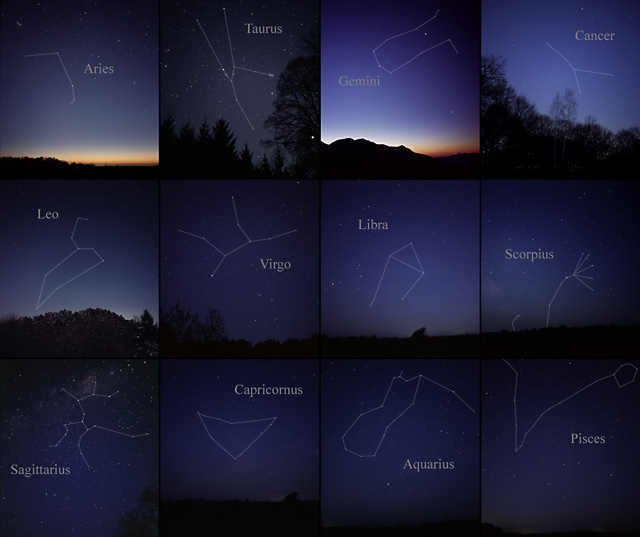
The traditional zodiac includes twelve famous constellations.
These are Aries, Taurus, Gemini, Cancer, Leo, Virgo, Libra, Scorpio, Sagittarius, Capricorn, Aquarius, and Pisces.
Each constellation occupies a region along the ecliptic.
When the Sun appears in front of one of these constellations during its yearly journey, that period corresponds to a particular zodiac sign.
The constellations themselves vary greatly.
Some are bright and easy to recognize.
Others require darker skies and more careful observation.
Many represent figures from mythology, reflecting the stories and beliefs of ancient cultures.
Although modern astronomy views them as arbitrary patterns formed by unrelated stars, they remain culturally significant and historically important.
The Zodiac as a Seasonal Calendar
One of the zodiac’s most important original functions was marking the seasons.
Ancient farmers closely monitored the Sun’s position among the zodiac constellations.
As the Sun moved from one region of the sky to another, seasonal changes followed.
The arrival of spring, summer, autumn, and winter could be anticipated through celestial observations.
For example, the appearance of certain constellations before sunrise signaled approaching agricultural events.
Planting, harvesting, and religious festivals were often linked to these celestial markers.
The zodiac helped transform unpredictable nature into a manageable calendar system.
It provided structure to life in an uncertain world.
The Connection Between the Sun and the Zodiac
The zodiac is fundamentally connected to the Sun.
Although stars dominate the nighttime sky, the Sun governs Earth’s seasons.
As Earth orbits the Sun, our viewpoint changes throughout the year.
This causes the Sun to appear against different background constellations over time.
The zodiac tracks this apparent movement.
Each zodiac sign corresponds to a section of the sky occupied by the Sun during a particular period.
Ancient astronomers carefully followed this progression.
By observing where the Sun appeared relative to known constellations, they could determine the time of year.
The zodiac became a celestial clock powered by Earth’s orbit around the Sun.
Earth’s Orbit and the Changing Seasons
Modern science provides a deeper understanding of why the zodiac became associated with seasonal cycles.
Earth revolves around the Sun once every year.
At the same time, Earth’s axis is tilted.
This tilt causes different parts of the planet to receive varying amounts of sunlight throughout the year.
The result is the cycle of seasons.
As Earth moves through its orbit, the Sun appears to shift position against the distant stars.
The zodiac serves as a backdrop for this apparent motion.
Ancient observers did not know about Earth’s orbital mechanics, yet they accurately recognized the relationship between the Sun’s position and seasonal change.
Their observations laid the groundwork for later scientific discoveries.
The Zodiac and Ancient Agriculture
For farming societies, the zodiac was more than an astronomical curiosity.
It was a practical tool.
Agriculture depends heavily on timing.
Seeds planted too early may freeze.
Seeds planted too late may fail to mature before winter.
Ancient farmers used celestial observations to guide their activities.
The appearance of particular zodiac constellations often coincided with seasonal transitions.
Generations of observations revealed patterns linking the sky and the land.
The zodiac helped people anticipate environmental changes before they occurred.
In many regions, successful harvests depended partly on understanding these celestial rhythms.
Mythology and the Zodiac
Human beings rarely separate facts from stories.
As civilizations developed zodiac systems, they attached myths and legends to the constellations.
The stars became characters in cosmic narratives.
Heroes, animals, gods, and mythical creatures were imagined among the celestial patterns.
These stories made the sky easier to remember and understand.
A group of stars became a lion.
Another became a scorpion.
Another became twin brothers.
Mythology transformed astronomy into something deeply human.
The zodiac was not merely a scientific framework; it was also a cultural and imaginative one.
These stories have survived for thousands of years and continue to influence modern culture.
The Zodiac in Ancient Egypt
The ancient Egyptians also developed a strong connection between astronomy and seasonal cycles.
The annual flooding of the Nile River was crucial to Egyptian agriculture.
Predicting these floods had enormous practical value.
Egyptian astronomers observed the stars carefully and incorporated celestial knowledge into their calendars and religious traditions.
Although their zodiac system differed somewhat from the Babylonian version, astronomical observations played a similar role in tracking seasonal changes.
The heavens served as a guide for organizing society and understanding the natural world.
The Zodiac in Ancient Greece
The Greeks inherited much astronomical knowledge from earlier civilizations.
They expanded and refined zodiac concepts, combining Babylonian observations with Greek mathematics and philosophy.
Greek scholars played a major role in spreading zodiac traditions throughout the Mediterranean world.
Many constellation names used today come from Greek mythology.
The stories associated with the zodiac became deeply embedded in Western culture.
Greek astronomers also sought rational explanations for celestial movements.
Their work helped bridge the gap between mythology and scientific inquiry.
The Rise of Astrology
Over time, the zodiac became closely associated with astrology.
Astrology is the belief that celestial bodies influence human affairs and personalities.
Ancient astrologers observed the movements of the Sun, Moon, and planets within the zodiac and attempted to interpret their significance.
Astrology spread widely throughout many civilizations.
Kings consulted astrologers.
Empires incorporated astrological traditions into political and religious life.
The zodiac became more than a calendar.
It evolved into a symbolic system linking human experiences to celestial events.
Although astrology remains culturally influential today, it differs fundamentally from modern scientific astronomy.
Astronomy and Astrology: An Important Difference
The zodiac occupies an unusual position because it belongs to both astronomy and astrology.
Astronomy is a scientific discipline that studies celestial objects and physical processes in the universe.
Astrology is a belief system that interprets celestial positions as influences on human lives.
Historically, these fields were closely connected.
Ancient astronomers often practiced astrology.
Over time, however, science developed methods based on observation, experimentation, and evidence.
Modern astronomy has found no scientific evidence that zodiac signs determine personality traits or predict future events.
Yet the zodiac remains historically important because it helped drive centuries of careful astronomical observation.
In a sense, astrology helped preserve and expand humanity’s knowledge of the sky.
The Real Constellations Behind the Zodiac
Many people assume zodiac signs are simply symbolic concepts.
In reality, they are based on actual constellations.
These constellations consist of stars visible in the night sky.
However, the stars within a constellation are usually not physically related.
They may be separated by vast distances.
From Earth’s perspective, they appear close together, creating recognizable patterns.
Constellations are therefore visual groupings rather than true physical structures.
The zodiac constellations represent some of the most famous examples of these celestial patterns.
The Hidden Thirteenth Constellation
An interesting fact about the zodiac is that the Sun actually passes through thirteen constellations, not twelve.
The additional constellation is known as Ophiuchus.
Ophiuchus lies along the ecliptic between Scorpio and Sagittarius.
Ancient astrologers largely ignored it when establishing the traditional twelve-sign zodiac.
This decision helped maintain the neat division of the year into twelve equal parts.
Modern astronomers recognize Ophiuchus as a legitimate constellation crossed by the Sun’s apparent path.
Its existence highlights the difference between astronomical reality and traditional zodiac systems.
The Problem of Precession
One of the most fascinating discoveries in astronomy involves a phenomenon called precession.
Earth does not spin perfectly upright.
Its axis slowly wobbles over thousands of years, similar to a spinning top.
This wobble gradually shifts the positions of the equinoxes relative to the stars.
As a result, the zodiac signs used in traditional astrology no longer align precisely with the constellations that originally inspired them.
Thousands of years ago, the Sun occupied different positions relative to the zodiac signs.
Today, those positions have shifted significantly.
This means that astronomical constellations and astrological signs are no longer identical.
The zodiac’s connection to the stars has slowly drifted over time.
The Zodiac in Modern Astronomy
Although astronomy no longer uses zodiac signs for scientific purposes, the zodiac region remains important.
The ecliptic continues to define the apparent path of the Sun.
The planets still move through the zodiac constellations.
Astronomers studying planetary motion regularly observe objects within this band of sky.
The zodiac serves as a useful reference framework for locating celestial objects.
Its scientific significance survives even as its original practical role has diminished.
Modern calendars no longer depend on zodiac observations, but the celestial pathway itself remains a fundamental feature of the heavens.
Why Humans Are Drawn to the Zodiac
The enduring popularity of the zodiac reveals something profound about human nature.
People naturally seek patterns.
We look for connections between ourselves and the larger universe.
The zodiac offers a sense of order within the vastness of space.
It transforms distant stars into familiar symbols.
It connects individual lives to cosmic cycles.
Whether viewed scientifically, culturally, or spiritually, the zodiac satisfies a deep human desire to find meaning in the sky.
Its survival across thousands of years speaks to the power of that desire.
The Zodiac as a Cultural Legacy
Even in an age of space telescopes and planetary probes, the zodiac remains part of everyday life.
Its symbols appear in books, jewelry, artwork, literature, and popular culture.
Millions of people know their zodiac signs.
Many recognize the names of zodiac constellations even if they know little astronomy.
The zodiac serves as a bridge connecting modern society with ancient civilizations.
It reminds us that people living thousands of years ago shared the same sky we see today.
Their efforts to understand that sky helped lay the foundations of astronomy and scientific thought.
Looking at the Zodiac with Modern Eyes
When we view the zodiac today, we can appreciate it in multiple ways.
Scientifically, it represents a region of the sky associated with Earth’s orbit and the apparent movement of the Sun.
Historically, it reflects humanity’s earliest attempts to create calendars and understand seasonal cycles.
Culturally, it preserves myths, stories, and traditions passed down across millennia.
Emotionally, it connects us to generations of sky-watchers who stood beneath the stars and wondered about their place in the universe.
The zodiac is not merely a collection of constellations.
It is a record of humanity’s relationship with the cosmos.
Conclusion
The zodiac began as a practical tool for understanding the changing seasons and tracking the Sun’s movement across the sky. Ancient civilizations carefully observed the heavens, discovering that the Sun followed a predictable path through a series of constellations. By linking these celestial patterns to seasonal cycles, they created one of humanity’s earliest and most influential astronomical systems.
Over thousands of years, the zodiac evolved into something far greater than a calendar. It became intertwined with mythology, agriculture, religion, navigation, astrology, and cultural identity. Although modern science distinguishes astronomy from astrological beliefs, the zodiac remains a powerful reminder of humanity’s long fascination with the stars.
At its heart, the zodiac tells a story about observation, curiosity, and connection. It reflects our ancestors’ determination to understand the rhythms of nature and their place within the universe. The stars themselves may be unimaginably distant, but through the zodiac, generations of people found a way to connect the movements of the heavens with the changing seasons of life on Earth.