On a quiet night beneath a dark sky, the stars appear peaceful and eternal. They twinkle softly, seemingly unchanged from one night to the next. Yet hidden behind that calm appearance lies a universe of unimaginable violence. Stars are not eternal. They are born, they live, and eventually they die. Most fade away quietly. Some shrink into dim stellar remnants. But a few end their lives in an explosion so powerful that it can briefly outshine an entire galaxy.
This extraordinary event is called a supernova.
A supernova is one of the most energetic and dramatic phenomena in the cosmos. It marks the death of a star, but it is also the beginning of something new. In a single moment, a supernova can release more energy than the Sun will emit during its entire lifetime. The explosion can hurl stellar material across space at millions of kilometers per hour, creating shock waves that travel for centuries.
Yet supernovae are not merely cosmic disasters. They are also cosmic creators. The calcium in your bones, the iron in your blood, the oxygen you breathe, and many other elements essential to life were forged inside stars and scattered across the universe by supernova explosions.
In a very real sense, every person on Earth carries within them the ashes of ancient supernovae.
This is the story of one of nature’s most violent yet beautiful creations.
Understanding What a Supernova Really Is
A supernova is the explosive death of a star.
The word itself comes from Latin and means “new star.” Ancient observers who witnessed these explosions saw a brilliant point of light suddenly appear where no star had been visible before. Because they did not understand what had happened, they believed a new star had been born.
Today we know the opposite is true.
A supernova is not the birth of a star but its spectacular end.
When a star reaches the final stage of its life, it may become unstable. Under the right conditions, that instability can trigger an enormous explosion that tears the star apart or causes its core to collapse.
For a short time, the dying star becomes extraordinarily bright. It may shine billions of times brighter than the Sun. In some cases, a single supernova can outshine all the other stars in its host galaxy combined.
The explosion releases vast amounts of light, heat, radiation, and matter into space.
Although the event itself may last only seconds or minutes, the visible glow can persist for weeks or months, while the expanding debris cloud may remain observable for thousands of years.
The Life of a Star Before the Explosion
To understand supernovae, it helps to understand how stars live.
Stars are enormous spheres of hot gas, primarily hydrogen and helium. They form inside giant clouds of gas and dust known as nebulae.
Gravity pulls the material together until the pressure and temperature become so extreme that nuclear fusion begins.
Fusion is the process that powers stars.
Inside a star’s core, hydrogen atoms combine to form helium. This reaction releases enormous amounts of energy. That energy pushes outward, balancing the inward pull of gravity.
For millions or billions of years, the star remains stable because these opposing forces stay in equilibrium.
This balance is like a cosmic tug-of-war.
Gravity tries to crush the star inward.
Fusion energy pushes outward.
As long as the two forces remain balanced, the star survives.
But nothing lasts forever.
Eventually, the star begins to run out of nuclear fuel.
When that happens, the delicate balance starts to break down.
Why Massive Stars Live Fast and Die Young
Not all stars are the same.
Some stars, like our Sun, are relatively average. Others are much larger and far more massive.
Massive stars burn through their fuel at astonishing rates.
Although they contain more fuel than smaller stars, they consume it much faster.
Imagine two candles.
One burns slowly and lasts all night.
The other burns intensely and disappears within an hour.
Massive stars are like the second candle.
They live brilliant but relatively short lives.
While the Sun is expected to survive for roughly ten billion years, some massive stars may live only a few million years before reaching the end of their existence.
Their rapid consumption of fuel ultimately leads them toward one of the universe’s most spectacular finales.
The Fusion Factory Inside a Star
As a star ages, its core changes.
Hydrogen fusion gradually produces helium.
When enough hydrogen is exhausted, the core contracts and heats up.
If the star is massive enough, it can begin fusing helium into heavier elements.
Later, it may fuse carbon, oxygen, neon, silicon, and other elements.
The star becomes a giant cosmic factory.
Layer upon layer of fusion reactions occur deep inside its interior.
Each stage produces increasingly heavier elements.
Eventually, the process reaches iron.
This is where the story changes dramatically.
Why Iron Is the Beginning of the End
Iron is special in stellar physics.
Fusion reactions involving lighter elements release energy.
Iron does not.
Fusing iron consumes energy rather than producing it.
For a star, this creates a serious problem.
The outward pressure generated by fusion begins to weaken.
Without enough energy to resist gravity, the core becomes unstable.
Gravity suddenly gains the upper hand.
The core collapses inward at incredible speed.
What follows is one of the most violent events in the universe.
The Moment a Supernova Explodes
When the core collapses, conditions become almost unimaginable.
Temperatures soar into the billions of degrees.
Matter is compressed to extraordinary densities.
The core shrinks dramatically in a fraction of a second.
Meanwhile, the outer layers of the star continue falling inward.
Eventually, the collapsing material rebounds off the incredibly dense core.
A powerful shock wave forms.
That shock wave races outward through the star.
Within moments, the star explodes.
The explosion releases a tremendous amount of energy.
The outer layers are blasted into space.
Radiation floods the surrounding region.
The dying star becomes visible across enormous cosmic distances.
For a brief time, it shines with extraordinary brilliance.
This is a core-collapse supernova.
It is among the most energetic events known in nature.
The Incredible Power of a Supernova
The scale of a supernova is difficult to comprehend.
The Sun produces an enormous amount of energy every second.
Yet a supernova can release more energy in a few moments than the Sun will emit during its entire ten-billion-year lifespan.
The explosion may radiate as much energy as billions of ordinary stars combined.
The shock wave can travel through space for thousands of years.
Material expelled from the star may move at speeds exceeding ten thousand kilometers per second.
The energy involved is so immense that scientists often struggle to find comparisons that ordinary people can easily understand.
A supernova is essentially nature demonstrating the extreme power hidden within matter and gravity.
The Different Types of Supernovae
Although all supernovae are spectacular, they do not all occur in the same way.
Astronomers classify supernovae into different categories based on how they form and what their spectra reveal.
The two major families are core-collapse supernovae and Type Ia supernovae.
Core-collapse supernovae occur when massive stars exhaust their fuel and experience gravitational collapse.
Type Ia supernovae arise through a different mechanism involving white dwarfs.
Both produce brilliant explosions, but their origins are quite different.
Understanding these distinctions has become crucial for modern astronomy.
The Strange Story of Type Ia Supernovae
A Type Ia supernova begins with a white dwarf.
A white dwarf is the dense remnant left behind after a Sun-like star reaches the end of its life.
Normally, a white dwarf remains stable.
However, problems can arise if it has a nearby companion star.
The white dwarf’s gravity may pull material away from its companion.
As more matter accumulates, the white dwarf grows heavier.
Eventually, it may reach a critical mass.
At that point, conditions become unstable.
A runaway nuclear reaction begins.
The entire star detonates.
Unlike many core-collapse supernovae, a Type Ia explosion often completely destroys the white dwarf.
Nothing substantial remains behind.
The star is effectively erased.
Why Type Ia Supernovae Changed Astronomy
Type Ia supernovae possess an unusual property.
They tend to reach nearly the same peak brightness.
This consistency makes them extremely valuable to astronomers.
By comparing how bright a Type Ia supernova appears with how bright it should be, scientists can estimate its distance.
These explosions serve as cosmic measuring tools.
In the late twentieth century, observations of distant Type Ia supernovae led to a stunning discovery.
Astronomers found evidence that the universe’s expansion is accelerating.
This unexpected result suggested the existence of a mysterious phenomenon now called dark energy.
The discovery transformed modern cosmology and earned the 2011 Nobel Prize in Physics.
What Remains After a Supernova
Not every supernova completely destroys its star.
Sometimes an incredibly dense remnant survives.
The nature of that remnant depends largely on the original star’s mass.
Some supernovae leave behind neutron stars.
Others create black holes.
These objects are among the most fascinating entities in the universe.
Their existence reveals just how extreme nature can become.
The Birth of a Neutron Star
A neutron star forms when the collapsed core survives the explosion.
Although only about twenty kilometers across, a neutron star may contain more mass than the Sun.
Its density is astonishing.
A teaspoon of neutron star material would weigh billions of tons on Earth.
The matter inside a neutron star is compressed to such an extent that electrons and protons combine to form neutrons.
The result is an object unlike anything found naturally on our planet.
Neutron stars can rotate rapidly and generate powerful magnetic fields.
Some emit beams of radiation that sweep across space like lighthouse beams.
These objects are known as pulsars.
When a Supernova Creates a Black Hole
If the original star is extremely massive, even neutron-star formation may not halt the collapse.
Gravity continues crushing the core inward.
Eventually, a black hole forms.
A black hole is a region where gravity becomes so strong that not even light can escape.
The boundary surrounding it is called the event horizon.
Anything crossing this boundary is effectively trapped forever.
Many black holes throughout the universe likely originated from ancient supernova explosions.
In death, these stars create some of the strangest objects known to science.
Supernovae as Cosmic Element Factories
One of the most important roles of supernovae involves chemical enrichment.
The early universe contained mostly hydrogen and helium.
Many heavier elements did not yet exist.
Stars gradually produced some of these elements through fusion.
However, creating elements heavier than iron requires additional processes.
Supernovae provide the necessary conditions.
During the explosion, temperatures and pressures become extreme enough to forge many heavy elements.
Gold, silver, uranium, and numerous other elements owe their existence partly to stellar explosions.
Without supernovae, the universe would be chemically impoverished.
Planets like Earth could not form in their present state.
Life as we know it would likely be impossible.
We Are Made of Star Stuff
Perhaps the most beautiful implication of supernova science is its connection to human existence.
Every atom in your body has a story.
Hydrogen originated shortly after the Big Bang.
Carbon was forged inside ancient stars.
Oxygen emerged through stellar fusion.
Iron formed in massive stars and was dispersed by stellar explosions.
The material that eventually became Earth was once scattered through interstellar space by long-dead stars.
Over billions of years, that material gathered into new stars, planets, oceans, plants, animals, and people.
When scientists say we are made of star stuff, they are not speaking poetically.
They are describing a literal physical reality.
The atoms within you were forged in cosmic furnaces long before Earth existed.
Famous Supernovae in Human History
Throughout history, several supernovae have been visible to the naked eye.
Ancient observers carefully recorded these events.
One of the most famous occurred in 1054.
Chinese astronomers documented a brilliant “guest star” that remained visible during daylight for weeks.
Today, scientists know this explosion created the Crab Nebula.
The expanding cloud of gas remains visible nearly a thousand years later.
Another famous event occurred in 1604.
It became known as Kepler’s Supernova because it was extensively studied by Johannes Kepler.
Such observations helped reshape humanity’s understanding of the heavens.
Supernova Remnants: The Ghosts of Exploded Stars
Long after the explosion fades, evidence remains.
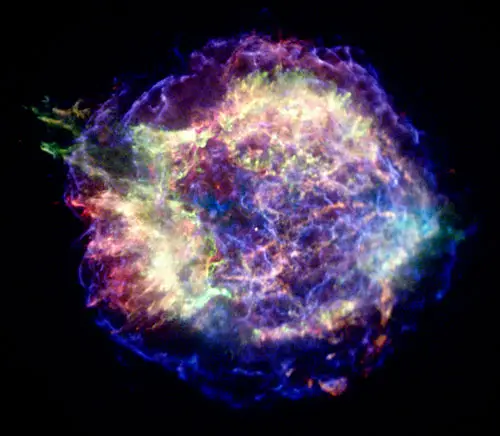
The expanding debris cloud is called a supernova remnant.
These remnants often appear breathtakingly beautiful.
Colorful filaments twist through space.
Shock waves interact with surrounding gas.
Complex structures emerge over centuries and millennia.
Despite their beauty, these glowing clouds are reminders of catastrophic destruction.
Astronomers study supernova remnants to understand how explosions evolve and how elements spread throughout galaxies.
They are cosmic archaeological sites preserving clues about ancient stellar deaths.
Can a Supernova Threaten Earth?
The idea of a nearby supernova sometimes raises concerns.
Could such an explosion harm life on Earth?
The answer depends on distance.
Most supernovae occur far enough away that they pose no danger.
However, a supernova occurring relatively close to our solar system could potentially affect Earth’s atmosphere.
High-energy radiation might damage the ozone layer and increase surface exposure to ultraviolet radiation.
Fortunately, astronomers know of no nearby stars likely to explode soon enough to pose an immediate threat.
The universe is vast.
Most supernovae remain spectacular celestial events rather than direct hazards.
Could Our Sun Become a Supernova?
Many people wonder whether the Sun will eventually explode.
The answer is no.
The Sun simply lacks the necessary mass.
Only much larger stars undergo the core-collapse process that produces traditional supernovae.
Instead, the Sun will evolve into a red giant billions of years from now.
Eventually, it will shed its outer layers and leave behind a white dwarf.
Its death will be dramatic by human standards but relatively gentle compared with a supernova.
Earth’s parent star will fade quietly rather than explode violently.
How Astronomers Discover Supernovae
Modern technology has transformed supernova detection.
Automated telescopes constantly monitor the sky.
Computer systems compare new images with older observations.
When a new bright object appears, astronomers investigate.
Many supernovae are discovered every year.
Professional observatories and amateur astronomers often work together.
Once a supernova is identified, telescopes around the world focus on it.
Scientists gather data across multiple wavelengths, including visible light, radio waves, X-rays, and gamma rays.
Each observation reveals different aspects of the explosion.
Supernovae and the Future of Astronomy
Supernova research remains one of the most active fields in astronomy.
New telescopes are allowing scientists to observe explosions in unprecedented detail.
Researchers hope to answer lingering questions about how supernovae begin, how they evolve, and how they influence galactic ecosystems.
Future observatories may detect supernovae from the earliest generations of stars.
These observations could reveal how the first heavy elements formed after the Big Bang.
Each new discovery brings humanity closer to understanding our cosmic origins.
The Emotional Power of a Dying Star
There is something profoundly moving about a supernova.
It represents destruction on an unimaginable scale.
A star that may have shone for millions of years suddenly reaches its end.
Yet that destruction is not meaningless.
The explosion enriches the galaxy with new elements.
It creates conditions for future stars and planets.
It helps build the raw materials necessary for life.
In nature, endings often become beginnings.
A supernova embodies that truth more dramatically than almost any other phenomenon.
The death of a star becomes an act of creation.
The ashes of one generation of stars become the foundation of the next.
Conclusion
A supernova is far more than an astronomical explosion. It is one of the universe’s most important creative forces. These extraordinary events occur when stars reach the end of their lives and release unimaginable amounts of energy into space. For a brief period, a supernova can outshine entire galaxies, becoming one of the brightest phenomena in the cosmos.
Yet the significance of supernovae extends beyond their spectacular appearance. They forge and distribute the heavy elements that make planets, oceans, mountains, and living creatures possible. The atoms that form our bodies were created in stars and scattered through space by ancient stellar explosions.
Every supernova tells a story about life, death, transformation, and renewal on a cosmic scale. It reminds us that the universe is not static but constantly evolving. Stars are born, stars die, and from their remains new worlds emerge.
In that sense, a supernova is the perfect symbol of the cosmos itself—violent yet beautiful, destructive yet creative, fleeting yet profoundly important. It is one of the grandest demonstrations of nature’s power and one of the clearest reminders that our own existence is connected to events that occurred among the stars long before humanity ever looked up at the night sky.