Look up at the night sky on any clear evening and almost every star you see belongs to a single, remarkable family. These stars are not newborns wrapped in glowing clouds, nor dying giants shedding their outer layers in dramatic farewell. They are steady, patient, and enduring. They are main sequence stars, and they represent the longest, most stable chapter in the life story of stars—and, by extension, of galaxies, planets, and life itself.
Main sequence stars are the quiet engines of the universe. They burn for millions to trillions of years, holding themselves together against gravity’s relentless pull while lighting up space with nuclear fire. Our own Sun is one of them, and because of that simple fact, Earth exists as a warm, living world rather than a frozen rock drifting through darkness. To understand main sequence stars is to understand the cosmic conditions that make stars reliable, planets possible, and time meaningful on astronomical scales.
What Defines a Main Sequence Star
A main sequence star is defined not by its appearance alone, but by what is happening deep within its core. At the heart of every main sequence star, hydrogen nuclei are being fused into helium. This nuclear fusion releases enormous amounts of energy, which flows outward as light and heat. That energy creates an outward pressure that balances the inward pull of gravity. As long as this balance holds, the star remains on the main sequence.
This balance is not static but dynamic, a constant negotiation between collapse and explosion. Gravity tries to compress the star, raising temperatures and pressures in the core. Fusion responds by producing more energy, pushing outward and stabilizing the star. The result is a long-lived equilibrium that can last far longer than any other stage of stellar evolution.
In astronomical terms, the “main sequence” is also a specific band on the Hertzsprung–Russell diagram, a chart that plots stars by their brightness and surface temperature. Most stars lie along a diagonal line on this diagram, ranging from hot, massive, blue stars at one end to cool, small, red stars at the other. This line is the main sequence, and it represents stars that are all doing the same fundamental thing—burning hydrogen in their cores—but doing it in very different ways.
Birth: How Stars Arrive on the Main Sequence
Main sequence stars are not born instantly into their stable lives. Their story begins inside cold, dark clouds of gas and dust scattered throughout galaxies. These molecular clouds are mostly hydrogen, with traces of helium and heavier elements. Over time, gravity causes denser regions within these clouds to collapse.
As a collapsing clump of gas shrinks, it heats up. Eventually, it becomes a protostar, a glowing object powered not by fusion but by gravitational energy. Material continues to fall inward, raising the temperature and pressure in the core. When the core becomes hot enough—millions of degrees—hydrogen fusion ignites.
This moment marks a star’s true birth. The ignition of sustained hydrogen fusion halts the collapse and establishes the delicate balance that defines the main sequence. From this point onward, the star settles into a long period of relative stability. The exact properties of the star—its mass, brightness, temperature, and lifespan—are largely determined at this moment by how much material it has accumulated.
Mass: The Master Variable of Main Sequence Stars
Among all the properties of a main sequence star, mass is the most important. It dictates almost everything about the star’s behavior and fate. Two stars can be made of nearly the same material and form in similar environments, yet if their masses differ, their lives will unfold in dramatically different ways.
Massive main sequence stars have enormous gravitational pressure at their cores. This leads to extremely high temperatures, which in turn drive fusion reactions at a furious pace. These stars shine brilliantly, often tens of thousands of times brighter than the Sun, and appear blue or white due to their high surface temperatures. But their brilliance comes at a cost. They burn through their hydrogen fuel quickly, sometimes in just a few million years.
Low-mass main sequence stars, by contrast, are models of patience. Their cores are cooler, fusion proceeds slowly, and they shine dimly with a reddish glow. Some of these stars can remain on the main sequence for hundreds of billions or even trillions of years—far longer than the current age of the universe.
The Sun sits comfortably between these extremes, a medium-mass main sequence star with a lifespan of about ten billion years. This moderate pace has proven ideal for the slow emergence and evolution of life on Earth.
Energy Production in Main Sequence Stars
The fusion of hydrogen into helium is the defining process of the main sequence, but the details of that fusion depend on the star’s mass. In stars with masses similar to or smaller than the Sun, energy is produced mainly through a process known as the proton–proton chain. In this sequence of reactions, hydrogen nuclei gradually combine to form helium, releasing energy in small, steady amounts.
In more massive stars, a different process dominates: the carbon–nitrogen–oxygen cycle. Here, heavier elements act as catalysts, speeding up fusion and dramatically increasing energy output. This process is highly sensitive to temperature, which is why massive stars are so luminous and why small increases in mass lead to huge increases in brightness.
Regardless of the specific mechanism, the outcome is the same. Energy generated in the core makes its way outward through radiation and convection, eventually escaping into space as starlight. That light can travel for years, centuries, or millennia before reaching a planet or a telescope, carrying with it information about the star’s inner workings.
Structure and Layers of a Main Sequence Star
Though main sequence stars appear as simple points of light, their internal structures are complex. At the center lies the core, where fusion occurs. Surrounding the core is a region where energy is transported outward, either by radiation or convection, depending on temperature and composition.
In some stars, energy flows outward primarily through radiation, with photons gradually scattering their way toward the surface. In others, especially cooler stars, convection dominates, with hot material rising and cooler material sinking in slow, churning motions. These processes shape the star’s magnetic fields, surface activity, and long-term evolution.
The outermost layer, the photosphere, is the surface we see. It is here that light escapes into space. Above it lie thinner layers of atmosphere, which can produce stellar winds and flares. Even in their stability, main sequence stars are not perfectly calm. They can exhibit spots, eruptions, and cycles of activity, driven by the interplay of rotation and magnetism.
Color, Temperature, and Appearance
The color of a main sequence star is a direct reflection of its surface temperature. Hotter stars emit more blue and ultraviolet light, giving them a blue-white appearance. Cooler stars emit more red and infrared light, making them appear red or orange.
These colors are not merely aesthetic. They encode physical information about the star’s mass, energy output, and internal processes. By analyzing a star’s spectrum, astronomers can determine its temperature, composition, and motion, even from vast distances.
The main sequence spans a wide range of temperatures, from scorching blue stars with surface temperatures above 30,000 degrees to cool red stars with temperatures below 3,000 degrees. This diversity means that the main sequence includes stars that are wildly different in brightness and size, yet united by the same fundamental energy source.
Lifetimes on the Main Sequence
The time a star spends on the main sequence is essentially the time it takes to exhaust the hydrogen fuel in its core. Because fusion rates depend so strongly on mass, lifetimes vary enormously.
Massive main sequence stars live fast and die young. They burn through their hydrogen at an astonishing rate, shining brightly but briefly. In contrast, low-mass stars sip their fuel slowly, remaining stable for timescales that dwarf the age of galaxies.
This difference has profound consequences for the universe. The earliest stars formed were massive and short-lived, rapidly enriching space with heavier elements when they died. Later generations of stars, including long-lived main sequence stars like the Sun, formed from this enriched material, making rocky planets and complex chemistry possible.
The Sun as a Main Sequence Star
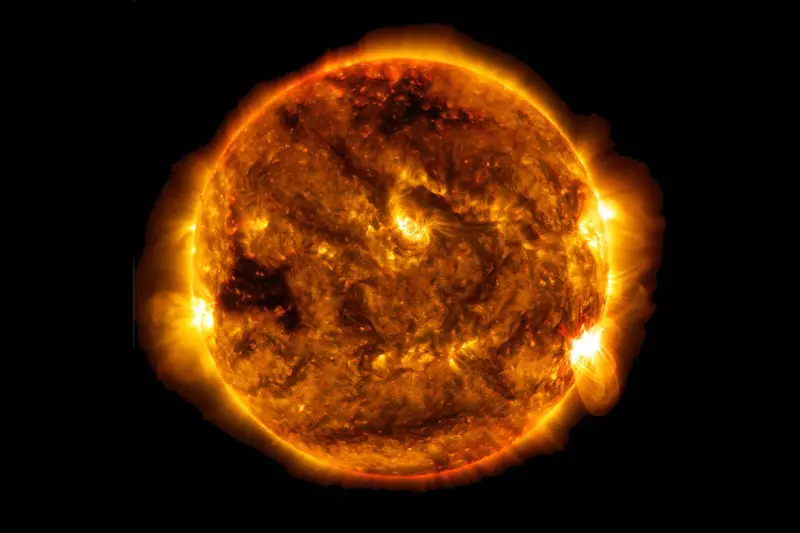
Our Sun is the most familiar example of a main sequence star, and yet it is easy to underestimate how extraordinary it is. For over four billion years, it has provided a steady flow of energy, maintaining Earth’s climate and powering life. Its stability is not accidental but a direct consequence of its place on the main sequence.
The Sun fuses about 600 million tons of hydrogen into helium every second, converting a small fraction of that mass into energy. This process has remained remarkably consistent over geological time. Small variations exist, but they are tiny compared to the dramatic changes that occur in other stages of stellar evolution.
By studying the Sun in detail, physicists and astronomers gain insights into main sequence stars across the universe. At the same time, observations of other stars place the Sun in context, showing it to be neither exceptional nor insignificant, but a representative member of a vast cosmic population.
Main Sequence Stars and Planetary Systems
Main sequence stars are the primary hosts of planetary systems. Their long-lived stability allows planets to form, cool, and evolve. Around many such stars, disks of gas and dust coalesce into worlds ranging from giant gas planets to rocky Earth-like bodies.
The properties of a main sequence star strongly influence its planets. A star’s mass and temperature determine where liquid water can exist, shaping the so-called habitable zone. The star’s activity level affects planetary atmospheres, while its lifespan sets the window of opportunity for biological evolution.
Red dwarf main sequence stars, the most common type in the galaxy, have drawn particular interest. Their long lifetimes and abundance make them promising targets in the search for life, even though their intense magnetic activity presents challenges. Sun-like stars offer a familiar template, while more massive stars evolve too quickly to be considered likely cradles of life.
Main Sequence Stars in Galactic Evolution
Galaxies are shaped by their stars, and main sequence stars dominate stellar populations for most of cosmic time. Their light determines the color and brightness of galaxies. Their deaths enrich interstellar space with heavy elements, seeding future generations of stars and planets.
In young galaxies, bright, massive main sequence stars dominate, making these galaxies appear blue. As time passes and massive stars die, longer-lived, lower-mass stars become more prominent, shifting galaxies toward redder hues. In this way, the main sequence stars within a galaxy act as a record of its history.
Star clusters provide especially clear views of this process. In older clusters, the most massive main sequence stars have already evolved away, leaving only lower-mass stars on the main sequence. By studying which stars remain, astronomers can estimate the cluster’s age with remarkable precision.
The End of the Main Sequence Phase
No star remains on the main sequence forever. Eventually, the hydrogen in the core becomes depleted. Fusion slows, the outward pressure weakens, and gravity begins to win. What happens next depends again on mass.
For stars like the Sun, the end of the main sequence marks the beginning of a transformation into a red giant. The core contracts and heats up, while the outer layers expand dramatically. For massive stars, the transition is more violent, leading ultimately to supernova explosions and the formation of neutron stars or black holes.
Yet the main sequence remains the longest and most defining chapter of a star’s life. Everything that follows is shaped by the mass, composition, and structure established during this stable phase.
Why Main Sequence Stars Matter to Us
Main sequence stars are not just objects of scientific curiosity. They are the reason the universe looks the way it does to human eyes. They provide the steady light that illuminates galaxies and the dependable warmth that makes planets habitable.
Emotionally, there is something profoundly reassuring about main sequence stars. In a universe filled with explosions, collapses, and extremes, they represent continuity and balance. They remind us that stability can emerge from opposing forces and that long-term harmony is possible even in a dynamic cosmos.
The Sun’s place on the main sequence connects human life to stellar physics in an intimate way. Every breath we take, every ecosystem on Earth, ultimately depends on hydrogen fusion happening quietly and reliably at the Sun’s core.
Main Sequence Stars and the Human Story
From ancient skywatchers to modern astronomers, main sequence stars have shaped human understanding of the universe. They were once seen as eternal, unchanging lights fixed to a celestial sphere. Today, we know them as dynamic systems with life stories measured in billions of years.
This shift in perspective has not diminished their wonder. If anything, it has deepened it. Knowing that stars are born, live, and die makes the night sky feel more alive, more connected to time and change.
Main sequence stars teach us humility and perspective. They show that the forces shaping our daily lives are part of much larger processes. They remind us that our planet is not isolated but embedded in a vast stellar ecosystem.
The Quiet Power of the Main Sequence
In the grand narrative of the universe, main sequence stars are not the loudest or most dramatic characters. They do not explode with the violence of supernovae or bend spacetime like black holes. Instead, they shine steadily, patiently converting matter into energy and sustaining the cosmic order.
Their power lies in endurance. Over immense spans of time, they shape galaxies, create the elements of life, and provide stable environments where complexity can arise. They are the backbone of the visible universe.
To understand main sequence stars is to appreciate the beauty of balance and the significance of longevity. They are proof that in a universe governed by physical laws, stability can be as important as change.
A Universe Written in Starlight
Main sequence stars are, quite literally, the universe written in starlight. Their spectra reveal the laws of physics, their lifetimes mark the passage of cosmic time, and their energy fuels the processes that lead to planets, chemistry, and life.
When we study them, we are not just learning about distant objects. We are learning about the conditions that made our own existence possible. In every main sequence star, there is a story of gravity and fusion, of balance and persistence, repeating across the cosmos.
In their quiet, enduring glow, main sequence stars remind us that the universe is not only a place of extremes but also a place of remarkable stability. They stand as long-burning beacons, lighting the way through cosmic history and anchoring our understanding of the stars, the galaxies, and ourselves.