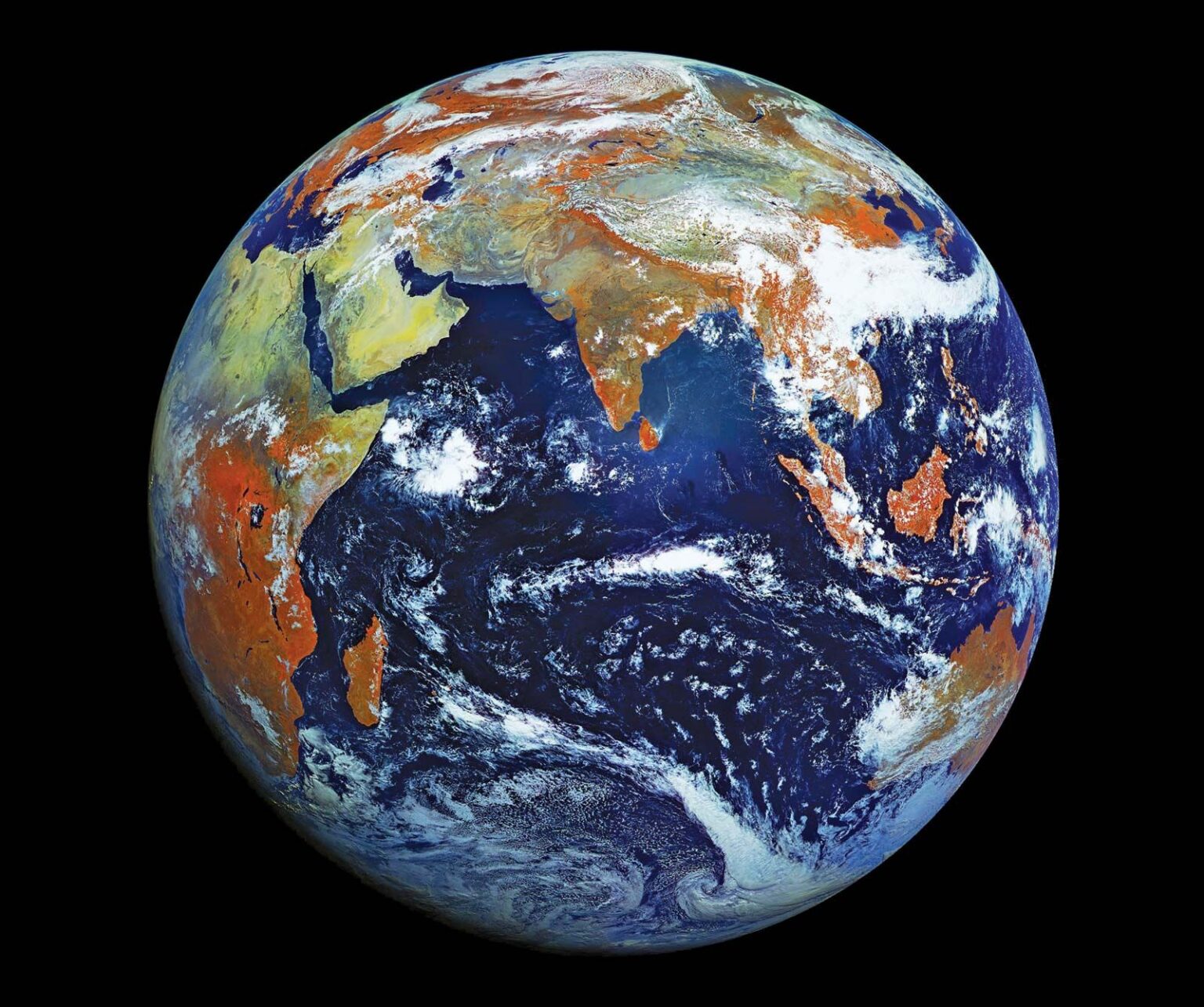
Every day, we wake beneath a blue sky, breathe air without thinking, drink liquid water, and walk across a world teeming with life. These experiences feel so ordinary that we rarely stop to consider how astonishing they really are. From our perspective, Earth seems normal. It is, after all, the only home we have ever known.
But the deeper scientists explore the Solar System and the wider universe, the more remarkable our planet appears.
Mercury is a scorched world where daytime temperatures soar above 400°C (750°F). Venus is wrapped in a crushing atmosphere of carbon dioxide, with surface temperatures hot enough to melt lead. Mars is an icy desert with an atmosphere too thin for humans to breathe. The giant planets have no solid surfaces at all, while countless exoplanets orbiting distant stars reveal environments ranging from lava worlds to gas giants larger than Jupiter.
Against this cosmic backdrop, Earth stands apart.
It is the only world known to host life. It possesses vast liquid oceans, a breathable atmosphere, active plate tectonics, a powerful magnetic field, and a climate that has remained suitable for billions of years despite dramatic geological and astronomical changes.
Scientists continue searching for another planet like Earth. Thousands of exoplanets have now been discovered, and some may eventually prove to be habitable. Yet as of today, no other known world matches the extraordinary combination of characteristics that make Earth what it is.
Our planet is not unique because of any single feature. Rather, it is the rare convergence of many conditions working together over immense spans of time.
Here are ten scientifically established reasons why Earth remains unlike any other planet currently known.
1. Earth Is the Only Known Planet That Supports Life
The most profound distinction between Earth and every other known planet is astonishingly simple.
Earth is alive.
Every environment on our planet—from tropical rainforests and coral reefs to polar ice sheets and deep underground rock formations—contains living organisms. Life exists in deserts receiving almost no rainfall, beneath kilometers of Antarctic ice, near boiling hydrothermal vents, and inside acidic lakes once thought completely inhospitable.
Scientists estimate that millions of species inhabit Earth, although many remain undiscovered.
More remarkable still is the diversity of life.
Microscopic bacteria thrive alongside giant blue whales. Towering redwood trees coexist with tiny insects. Complex ecosystems link predators, plants, fungi, microbes, and countless other organisms into interconnected webs that span the entire globe.
Despite decades of exploration across the Solar System, no confirmed evidence of life has been found elsewhere.
Mars may once have possessed conditions favorable for microbial life billions of years ago.
Some icy moons, such as Europa and Enceladus, contain subsurface oceans that could potentially support microorganisms.
Several exoplanets orbit within regions where liquid water might exist.
Yet every confirmed living organism known to science comes from one planet.
Earth.
The origin of life itself remains one of science’s greatest unsolved questions.
Researchers continue investigating how chemistry transitioned into biology more than 3.5 billion years ago.
Whatever the answer ultimately proves to be, Earth’s ability to sustain life for billions of years remains unparalleled.
2. Earth Has Vast Oceans of Liquid Water on Its Surface
Water exists throughout the Solar System.
Ice covers the poles of Mars.
Frozen water fills countless comets.
Subsurface oceans likely exist beneath the icy crusts of several moons.
Water vapor drifts through planetary atmospheres.
Yet Earth is unique because enormous quantities of liquid water exist directly on its surface.
Approximately 71 percent of Earth’s surface is covered by oceans.
These oceans regulate global climate by storing and transporting heat.
They absorb carbon dioxide from the atmosphere.
They generate much of the oxygen humans breathe through photosynthetic marine organisms.
They shape weather patterns across entire continents.
They support extraordinary biodiversity ranging from microscopic plankton to the largest animals ever known.
Liquid water also plays a central role in geology.
Rivers carve valleys.
Rain erodes mountains.
Groundwater transports minerals.
Glaciers reshape landscapes.
The water cycle continuously moves moisture between oceans, atmosphere, rivers, lakes, and underground reservoirs.
Scientists often summarize the search for extraterrestrial life with a simple phrase:
“Follow the water.”
That is because every known living organism depends upon liquid water.
Earth remains the only confirmed planet where stable surface oceans have persisted over immense geological timescales.
3. Earth Has a Breathable, Life-Sustaining Atmosphere
Earth’s atmosphere is neither too thick nor too thin.
It contains approximately 78 percent nitrogen, 21 percent oxygen, and small amounts of argon, carbon dioxide, water vapor, and trace gases.
This mixture did not always exist.
Early Earth’s atmosphere contained little or no free oxygen.
The transformation began when ancient photosynthetic microorganisms evolved the ability to release oxygen during photosynthesis.
Over hundreds of millions of years, oxygen accumulated in the atmosphere, fundamentally changing the chemistry of the planet.
This event, known as the Great Oxidation Event, made complex multicellular life possible.
Today, oxygen supports animal respiration while atmospheric carbon dioxide helps plants perform photosynthesis.
Nitrogen provides atmospheric stability.
Water vapor drives weather.
The ozone layer absorbs much of the Sun’s harmful ultraviolet radiation.
Earth’s atmosphere also acts as an insulating blanket.
Without natural greenhouse gases, Earth’s average surface temperature would be roughly -18°C (0°F), far too cold for most current life.
Instead, the natural greenhouse effect maintains an average temperature near 15°C (59°F).
The atmosphere protects, warms, nourishes, and connects every ecosystem on Earth.
No other known planetary atmosphere combines these characteristics in the same way.
4. Earth Lies Within the Sun’s Habitable Zone
Distance from the Sun matters enormously.
If Earth orbited much closer, rising temperatures could trigger runaway greenhouse warming similar to Venus.
If it orbited much farther away, global freezing might resemble conditions on Mars.
Earth occupies what astronomers call the habitable zone—the range of distances around a star where temperatures can allow liquid water to exist on a planet’s surface under appropriate atmospheric conditions.
This concept is sometimes called the “Goldilocks Zone” because conditions are neither too hot nor too cold.
However, location alone does not guarantee habitability.
Venus also lies near the inner edge of the Sun’s habitable zone but possesses an atmosphere so dense that surface temperatures exceed 460°C (860°F).
Mars lies near the outer edge but has lost much of its atmosphere, leaving its surface cold and dry.
Earth’s position is only one ingredient among many.
Combined with its atmosphere, oceans, geology, and magnetic field, however, this orbital location creates remarkably stable conditions for life.
5. Earth’s Powerful Magnetic Field Protects the Planet
Invisible yet essential, Earth’s magnetic field forms a protective shield extending far into space.
This magnetic field originates within Earth’s liquid outer core, where moving molten iron generates electric currents through a process known as the geodynamo.
The resulting magnetic field deflects much of the charged particle radiation streaming outward from the Sun.
Without this protection, solar wind could gradually strip away the atmosphere, as appears to have happened on Mars after its magnetic field weakened billions of years ago.
The magnetosphere also helps reduce radiation reaching Earth’s surface.
Although energetic particles occasionally penetrate near the poles to create spectacular auroras, most are diverted safely around the planet.
This invisible shield has likely played a crucial role in preserving Earth’s atmosphere and maintaining conditions favorable for life over geological time.
6. Earth Has Active Plate Tectonics
Earth is the only known planet where modern plate tectonics unquestionably operates on a global scale.
The planet’s outer shell is divided into massive tectonic plates that slowly move across the underlying mantle.
These movements create mountains, earthquakes, volcanoes, ocean basins, and continents.
Plate tectonics continually recycles Earth’s crust.
Old oceanic crust sinks into the mantle at subduction zones.
New crust forms along mid-ocean ridges.
Continents collide, separate, and rearrange over millions of years.
This process also plays an important role in regulating Earth’s climate.
The long-term carbon cycle transfers carbon between rocks, oceans, atmosphere, and Earth’s interior.
Volcanoes release carbon dioxide.
Weathering removes it.
Subduction carries carbon deep underground.
These interactions help stabilize atmospheric carbon dioxide over immense timescales.
Scientists suspect that plate tectonics may be one reason Earth has remained habitable for billions of years.
No other planet currently provides clear evidence of an equally active global tectonic system.
7. Earth Maintains a Stable Climate Over Billions of Years
Earth’s climate has never been perfectly constant.
Ice ages have come and gone.
Sea levels have risen and fallen.
Mass extinctions have reshaped ecosystems.
Asteroid impacts, volcanic eruptions, and changing continental positions have altered environmental conditions repeatedly.
Yet despite these dramatic changes, Earth has remained habitable continuously for more than 3.5 billion years.
This remarkable stability reflects multiple interacting feedback systems.
The oceans store enormous amounts of heat.
Clouds influence planetary reflectivity.
The carbon cycle regulates greenhouse gases.
Living organisms themselves modify atmospheric composition.
These processes help prevent extreme climatic swings that might otherwise render the planet permanently uninhabitable.
Modern human-caused climate change demonstrates that Earth’s climate can change rapidly under certain conditions.
Even so, the planet’s long-term ability to support life across billions of years remains extraordinary.
8. Earth Has an Exceptionally Large Moon
Earth’s Moon is unusually large compared with the size of its parent planet.
Most scientists believe it formed after a Mars-sized object collided with the young Earth approximately 4.5 billion years ago.
The Moon influences Earth in numerous ways.
Its gravitational pull generates ocean tides.
Tidal interactions gradually slow Earth’s rotation while causing the Moon to slowly move farther away.
Perhaps most importantly, the Moon helps stabilize Earth’s axial tilt.
Without this stabilizing influence, Earth’s rotational axis might vary much more dramatically over time, producing far greater climatic instability.
Although some degree of variation still occurs, Earth’s relatively stable tilt contributes to long-term seasonal regularity.
The Moon has also influenced human civilization.
It shaped calendars, navigation, mythology, and scientific discovery.
It is the only extraterrestrial world humans have visited.
Its existence represents one of Earth’s defining characteristics.
9. Earth Possesses Incredible Biodiversity
Life exists not merely as isolated organisms but as astonishing ecological complexity.
Earth’s biodiversity is unparalleled.
Tropical rainforests contain thousands of plant species within relatively small areas.
Coral reefs support immense marine diversity despite occupying tiny fractions of the ocean floor.
Microorganisms inhabit nearly every environment scientists have examined.
Evolution through natural selection has generated extraordinary biological innovation over billions of years.
Eyes evolved independently multiple times.
Flight developed in insects, birds, and bats.
Photosynthesis transformed the atmosphere.
Complex nervous systems produced intelligence capable of studying the universe itself.
Every ecosystem depends upon intricate interactions among species.
Pollinators sustain flowering plants.
Predators regulate prey populations.
Fungi recycle nutrients.
Microbes maintain soil fertility.
This interconnected web of life has no known equivalent anywhere else.
10. Earth Produced a Civilization Capable of Understanding the Universe
Perhaps Earth’s most remarkable feature is not geological.
It is biological.
On this planet, evolution produced a species capable of asking questions about its own existence.
Humans developed language, mathematics, science, philosophy, engineering, art, and technology.
We built telescopes that observe galaxies billions of light-years away.
We decoded DNA.
We landed spacecraft on Mars.
We measured gravitational waves produced by colliding black holes.
We discovered thousands of planets orbiting distant stars.
Earth is not merely inhabited.
It is understood by one of its own inhabitants.
That may be the rarest phenomenon of all.
The atoms forged inside ancient stars eventually became living cells.
Those cells evolved into organisms capable of contemplating the very universe that created them.
As far as science currently knows, Earth is the only place where the cosmos has become self-aware through intelligent life.
Why Earth’s Uniqueness Matters
Scientists often caution against assuming Earth is unique forever.
The universe contains hundreds of billions of galaxies.
Each galaxy contains billions of stars.
Many stars possess planetary systems.
Statistically, other habitable worlds almost certainly exist somewhere in the cosmos.
Yet probability is not evidence.
As of today, Earth remains the only confirmed inhabited planet.
Its uniqueness is therefore an observed scientific fact, not merely an emotional sentiment.
Studying Earth’s special characteristics helps researchers search for life elsewhere.
Every new exoplanet discovered is compared against the conditions that make Earth habitable.
Every Mars rover investigates whether similar environments once existed there.
Every mission to Europa or Enceladus seeks ingredients known to sustain life on our own world.
Earth serves as the benchmark against which all potentially habitable planets are measured.
A Planet Worth Protecting
Looking outward into space changes how we see home.
From orbit, national borders disappear.
Clouds drift across oceans without regard for politics.
Forests, deserts, mountains, and rivers merge into one interconnected planetary system.
Earth is not simply where humanity lives.
It is the only known place where forests grow naturally, birds migrate across continents, whales communicate through oceans, flowers bloom after rain, children laugh beneath blue skies, and intelligent beings wonder whether they are alone in the universe.
Its atmosphere is thin.
Its biosphere is fragile.
Its resources, though immense, are finite.
The more scientists learn about other worlds, the more extraordinary Earth appears.
Among scorching planets, frozen moons, gas giants, barren deserts, and distant exoplanets, one small blue world has become an oasis of life in the vast cosmic darkness.
For now, there is nowhere else quite like it.
And that makes Earth not only scientifically exceptional—but one of the most precious worlds we know.