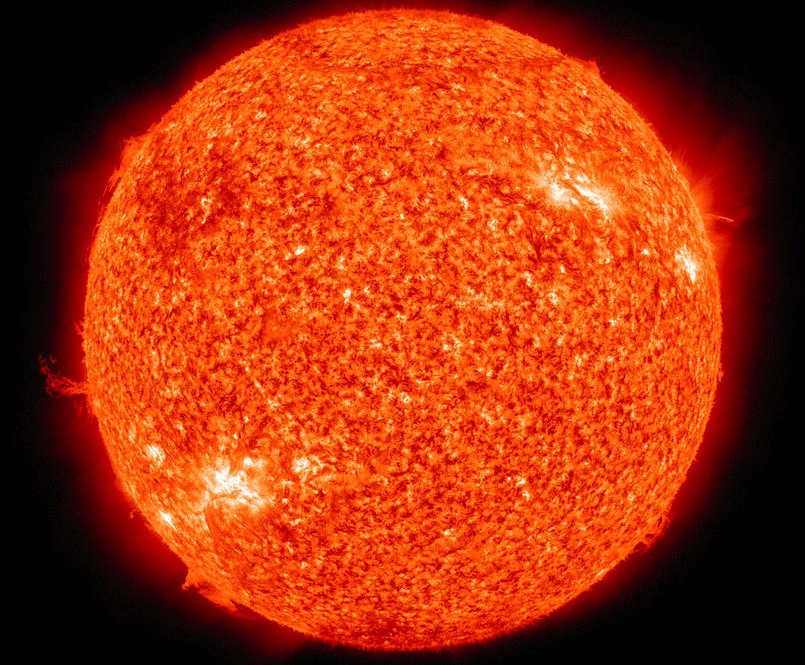
The Solar System is often introduced through familiar names: the Sun, eight planets, a handful of moons, and perhaps a few asteroids. But these names alone cannot convey the staggering scale of our cosmic neighborhood. The Solar System is not simply a collection of worlds orbiting a star—it is an immense family of objects that vary dramatically in size, composition, and history.
Some are so large that they dominate everything around them. Others are small by planetary standards yet enormous compared to most known asteroids and comets. These colossal objects have shaped the evolution of the Solar System for more than 4.5 billion years. Their gravity has sculpted planetary orbits, captured moons, triggered impacts, and even influenced the conditions that eventually allowed life to emerge on Earth.
When astronomers compare objects in the Solar System, they usually measure size by diameter—the distance from one side of an object to the other through its center. While mass and volume are also important, diameter provides an intuitive way to appreciate just how immense these worlds truly are.
The list below ranks the largest known natural objects in the Solar System by approximate mean diameter. Together, they reveal an extraordinary progression, from dwarf planets hidden beyond Neptune to the overwhelming giant that contains nearly all the Solar System’s mass.
1. The Sun
At the center of everything lies the Sun, by far the largest object in the Solar System.
With a diameter of approximately 1,391,400 kilometers (864,000 miles), the Sun is so enormous that about 109 Earths could fit side by side across its width. Even more astonishing, roughly 1.3 million Earths could fit inside its volume.
The Sun contains about 99.86% of the total mass of the Solar System. Every planet, moon, asteroid, comet, and grain of cosmic dust together account for only a tiny fraction of what remains.
This immense sphere of hot plasma is powered by nuclear fusion deep within its core. Every second, around 600 million tons of hydrogen are converted into helium, releasing enormous amounts of energy in accordance with Einstein’s equation, E = mc². That energy eventually reaches Earth as sunlight, driving weather, photosynthesis, and nearly every ecosystem on our planet.
Without the Sun, there would be no Solar System as we know it.
2. Jupiter
The largest planet in the Solar System is the gas giant Jupiter.
Its mean diameter is approximately 139,820 kilometers (86,881 miles), making it more than 11 times wider than Earth.
Jupiter is so massive that it contains more than twice the combined mass of every other planet.
Unlike Earth, Jupiter has no solid surface. Its visible clouds consist primarily of hydrogen and helium, with traces of ammonia, water vapor, and other compounds. Beneath those clouds, pressure increases dramatically, eventually compressing hydrogen into an exotic metallic state capable of conducting electricity.
The planet’s Great Red Spot—a gigantic storm larger than Earth—has persisted for centuries, demonstrating the extraordinary dynamics of Jupiter’s atmosphere.
Its immense gravity has also shaped the Solar System by influencing asteroid populations and helping redirect countless small bodies over billions of years.
3. Saturn
Saturn, famous for its spectacular ring system, ranks as the second-largest planet.
Its average diameter measures approximately 116,460 kilometers (72,367 miles).
Although smaller than Jupiter, Saturn is remarkable for another reason: it is the least dense planet in the Solar System. Its average density is lower than that of liquid water.
Like Jupiter, Saturn is composed primarily of hydrogen and helium. Powerful winds sweep through its atmosphere at speeds exceeding 1,800 kilometers per hour.
Its rings consist mostly of countless particles of water ice ranging from microscopic grains to chunks larger than houses.
Saturn also possesses an extraordinary family of moons, including Titan, the second-largest moon in the Solar System.
4. Uranus
The ice giant Uranus has a mean diameter of approximately 50,724 kilometers (31,518 miles).
Unlike the gas giants, Uranus contains much larger amounts of water, ammonia, and methane in its interior.
Methane absorbs red wavelengths of sunlight, giving Uranus its characteristic pale blue-green color.
Perhaps its most unusual feature is its extreme axial tilt. Uranus rotates almost completely on its side, with an axis tilted by about 98 degrees.
As a result, each pole experiences decades of continuous sunlight followed by decades of darkness.
Scientists believe this remarkable orientation likely resulted from a massive collision early in the Solar System’s history.
5. Neptune
Slightly smaller in diameter than Uranus but more massive, Neptune measures approximately 49,244 kilometers (30,598 miles) across.
Despite receiving only about one nine-hundredth of the sunlight Earth receives, Neptune possesses some of the strongest winds ever measured in the Solar System, exceeding 2,000 kilometers per hour in certain regions.
Its deep blue color also results partly from atmospheric methane, although additional atmospheric processes likely contribute to its richer hue.
Neptune’s gravity strongly influences the distant Kuiper Belt and helped shape the architecture of the outer Solar System.
6. Earth
Our home planet has a mean diameter of approximately 12,742 kilometers (7,918 miles).
Earth is the largest rocky planet in the Solar System.
Its layered interior consists of a solid inner core, liquid outer core, rocky mantle, and relatively thin crust. The movement of molten iron within the outer core generates Earth’s magnetic field, protecting the atmosphere from much of the solar wind.
About 71 percent of Earth’s surface is covered by liquid water, making it unique among known planets.
Its stable climate, active geology, protective atmosphere, and abundant water created conditions that allowed life to emerge more than 3.5 billion years ago.
7. Venus
Venus is often called Earth’s twin because of its remarkably similar size.
Its diameter measures approximately 12,104 kilometers (7,521 miles), only about five percent smaller than Earth’s.
However, the similarities end there.
Venus possesses an extraordinarily dense atmosphere composed mainly of carbon dioxide, producing an extreme greenhouse effect.
Surface temperatures average around 465 degrees Celsius (869 degrees Fahrenheit)—hot enough to melt lead.
Atmospheric pressure at the surface is roughly ninety times greater than Earth’s.
Despite these harsh conditions, Venus provides scientists with valuable insights into planetary evolution and climate processes.
8. Mars
Mars has a mean diameter of approximately 6,779 kilometers (4,212 miles).
Although only about half Earth’s diameter, Mars contains some of the largest geological structures in the Solar System.
Olympus Mons, the tallest known volcano, rises about 22 kilometers above the surrounding plains.
Valles Marineris, an enormous canyon system, stretches over 4,000 kilometers across the planet.
Evidence from orbiters and rovers indicates that liquid water once flowed across Mars billions of years ago.
Today, water survives mainly as ice at the poles and beneath parts of the surface.
Mars remains one of the primary targets in the search for evidence of ancient extraterrestrial life.
9. Ganymede
Jupiter’s moon Ganymede is the largest moon in the Solar System.
Its diameter reaches approximately 5,268 kilometers (3,273 miles).
Remarkably, Ganymede is larger than the planet Mercury.
It is also the only known moon with its own intrinsic magnetic field.
Beneath its icy crust likely lies a deep subsurface ocean containing more water than all Earth’s oceans combined.
Scientists consider Ganymede one of the most promising places to study potentially habitable environments beyond Earth.
10. Titan
Saturn’s moon Titan has a diameter of approximately 5,149 kilometers (3,199 miles).
It is the only moon in the Solar System with a dense atmosphere.
Nitrogen dominates Titan’s atmosphere, much like Earth’s, although methane plays a major role in its weather system.
Titan features rivers, lakes, seas, clouds, and rainfall—not of water, but of liquid methane and ethane.
Its complex organic chemistry makes Titan one of the most scientifically important worlds in planetary science.
Future missions aim to explore its surface and atmosphere in greater detail.
11. Mercury
Mercury, the closest planet to the Sun, has a diameter of approximately 4,879 kilometers (3,032 miles).
Although relatively small, Mercury possesses an unusually large metallic core, occupying much of its interior.
Because it lacks a substantial atmosphere, temperatures vary dramatically.
Daytime temperatures can exceed 430 degrees Celsius, while nighttime temperatures fall below −180 degrees Celsius.
Its heavily cratered surface preserves billions of years of Solar System history.
12. Callisto
Callisto, another of Jupiter’s major moons, measures approximately 4,821 kilometers (2,996 miles) in diameter.
Unlike many large moons, Callisto shows relatively little internal geological activity.
Its surface is among the oldest and most heavily cratered anywhere in the Solar System.
Scientists believe Callisto may also harbor a buried subsurface ocean beneath its icy shell.
Because it experiences lower radiation than other large Jovian moons, Callisto has been considered as a possible location for future human exploration.
13. Io
Jupiter’s moon Io has a diameter of approximately 3,643 kilometers (2,263 miles).
It is the most volcanically active object known.
Powerful gravitational interactions with Jupiter and neighboring moons continually flex Io’s interior, generating enormous heat through tidal forces.
Hundreds of active volcanoes reshape its surface, ejecting sulfur-rich material hundreds of kilometers into space.
Unlike most large moons, Io contains very little surface ice.
Its colorful appearance results from sulfur compounds deposited by constant volcanic activity.
14. Earth’s Moon
Earth’s Moon has a diameter of approximately 3,475 kilometers (2,159 miles).
It is unusually large relative to its parent planet compared with most other planetary moon systems.
The leading scientific explanation for its origin is the giant-impact hypothesis.
According to this model, a Mars-sized protoplanet collided with the young Earth around 4.5 billion years ago. Debris from that impact eventually coalesced to form the Moon.
The Moon has profoundly influenced Earth’s evolution by stabilizing the planet’s axial tilt and generating ocean tides.
Its surface preserves a detailed record of ancient impacts that have long since been erased from Earth’s active geology.
15. Europa
Europa, another of Jupiter’s Galilean moons, measures approximately 3,122 kilometers (1,940 miles) in diameter.
Although smaller than Earth’s Moon, Europa ranks among the most scientifically exciting worlds in the Solar System.
Its smooth, icy surface is crossed by countless fractures and ridges.
Beneath the ice likely lies a global liquid ocean in direct contact with a rocky seafloor.
This combination of liquid water, chemical nutrients, and possible hydrothermal activity makes Europa one of the strongest candidates for extraterrestrial habitability.
Several current and upcoming missions aim to investigate whether this hidden ocean could support microbial life.
Honorable Mentions: Other Giant Worlds
Many other impressive objects narrowly miss the top fifteen.
The dwarf planet Pluto measures about 2,377 kilometers in diameter and remains one of the largest known Kuiper Belt objects.
Another dwarf planet, Eris, is nearly the same size as Pluto but significantly more massive.
Triton, Neptune’s largest moon, spans approximately 2,707 kilometers and likely originated as a captured Kuiper Belt object.
Titania, Oberon, Rhea, Iapetus, Charon, and numerous other moons each contribute to the extraordinary diversity of the Solar System.
Together, they demonstrate that planetary systems contain far more than just planets.
What These Giant Objects Teach Us
The largest objects in the Solar System tell the story of planetary formation.
The Sun formed first as a collapsing cloud of gas and dust. Around it, a rotating disk gave birth to planets, moons, asteroids, and comets.
Closer to the Sun, rocky planets emerged where temperatures were too high for volatile compounds to condense.
Farther away, abundant ice allowed growing worlds to become massive enough to capture enormous envelopes of hydrogen and helium, creating the giant planets.
Their moons formed through multiple pathways—some within disks surrounding giant planets, others through violent impacts or gravitational capture.
Each giant object preserves evidence of these ancient processes.
A Solar System Built on Astonishing Scale
Numbers alone cannot fully capture the immensity of these worlds.
Imagine standing on Earth and looking toward Jupiter. More than 1,300 Earths could fit inside it.
Now imagine placing Jupiter inside the Sun. Over a thousand Jupiters would fit within our star.
Yet even the Sun is only an average-sized star among the hundreds of billions in the Milky Way.
The largest objects in our Solar System are reminders of both our significance and our humility. Earth, though modest in size, is the only known world that supports life. Around it orbit moons larger than planets, gas giants wrapped in storms, frozen ocean worlds, volcanic infernos, and distant icy bodies at the edge of the Sun’s influence.
Together, these fifteen giants reveal a Solar System that is far richer, more diverse, and more awe-inspiring than the simple planetary diagrams found in textbooks. They are the great architects of our cosmic neighborhood—ancient worlds whose immense gravity, dynamic geology, and extraordinary histories continue to shape the story of the Solar System today.