On a clear night, the stars above us appear peaceful and eternal. Their gentle light travels across space, creating a sky that has inspired wonder for thousands of years. Yet hidden far beyond the reach of the naked eye are objects so powerful that they outshine entire galaxies. They blaze across the cosmos with unimaginable energy, visible from billions of light-years away. These extraordinary cosmic beacons are known as quasars.
At first glance, the idea sounds impossible. How could a single object shine brighter than hundreds of billions of stars combined? What kind of cosmic engine could generate such enormous amounts of energy?
The answer leads us to one of the most fascinating discoveries in modern astronomy. A quasar is not a star. It is not a galaxy. It is not a giant explosion. Instead, it is the brilliant glow produced by matter falling into a supermassive black hole.
Black holes are often described as dark cosmic monsters that swallow everything around them. Yet paradoxically, some of the brightest objects in the universe are powered by black holes. Quasars reveal this surprising truth. They show us that black holes are not merely destroyers. Under the right conditions, they can become the engines behind some of the most luminous phenomena ever observed.
The story of quasars is a story of mystery, discovery, extreme physics, and cosmic evolution. It is a journey that takes us from the birth of galaxies to the edge of the observable universe, where ancient light still carries messages from a time when the cosmos was young.
The Meaning of the Word Quasar
The word “quasar” comes from the phrase “quasi-stellar radio source.”
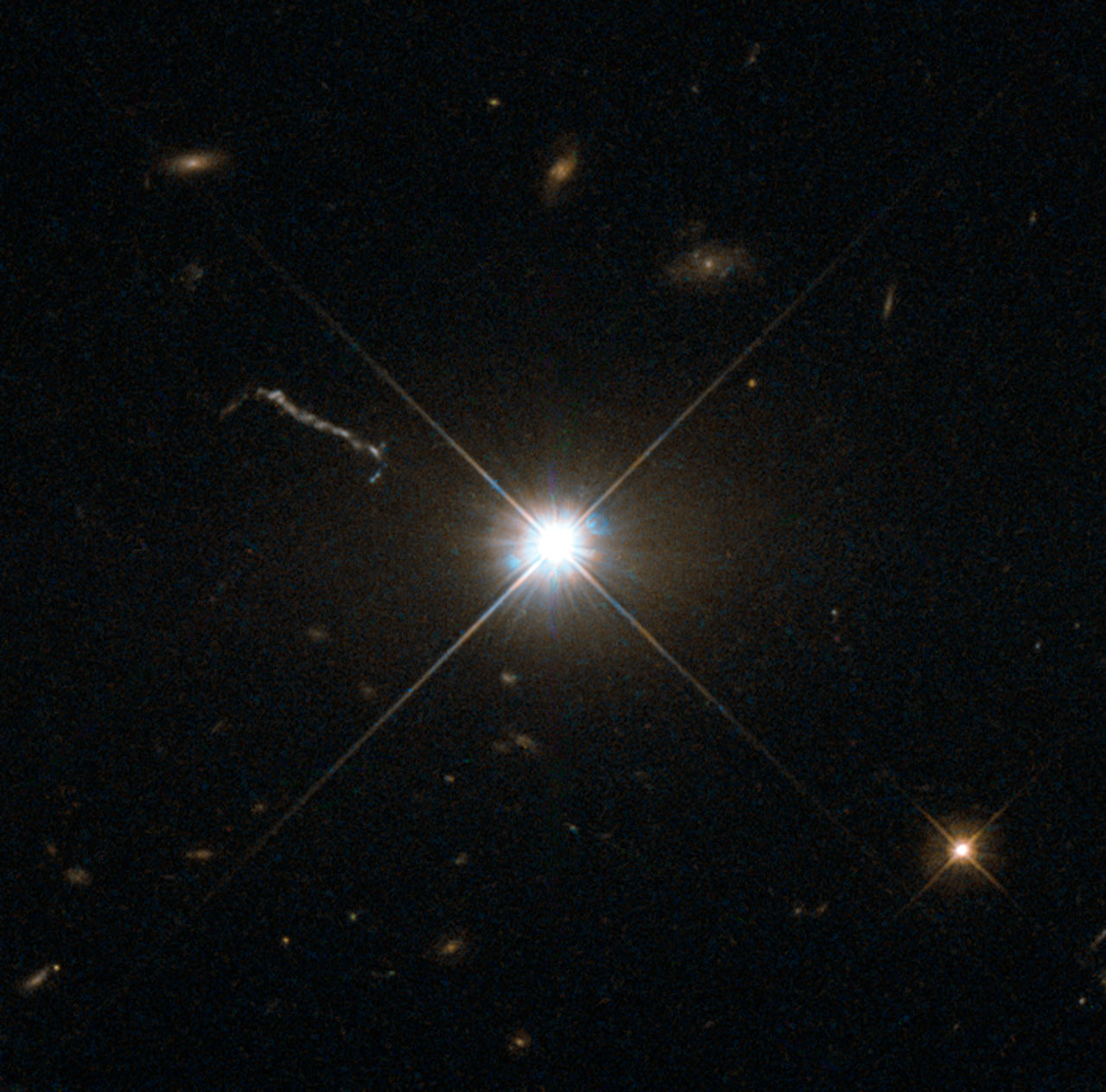
When astronomers first discovered these objects, they appeared star-like through telescopes. Unlike galaxies, which often show visible structures, quasars looked like tiny points of light.
However, something strange quickly became apparent.
Although they looked like stars, they behaved nothing like stars. Many emitted powerful radio waves and possessed unusual properties that did not fit any known category of celestial object.
To describe them, astronomers began using the term “quasi-stellar,” meaning “star-like.”
Eventually, this lengthy description was shortened to the much more convenient word “quasar.”
Today, the name remains even though scientists now understand that quasars are not stars at all.
The Discovery That Shocked Astronomy
The discovery of quasars ranks among the greatest surprises in twentieth-century astronomy.
During the 1950s and early 1960s, radio telescopes were identifying powerful sources of radio emissions scattered throughout the sky. Astronomers attempted to match these radio sources with visible objects.
One source in particular attracted attention.
Known as 3C 273, it appeared as an ordinary point of light. Yet when scientists studied its spectrum, they encountered a puzzling mystery.
The spectral lines did not match any known pattern.
For a time, nobody could understand what they were seeing.
Then astronomer Maarten Schmidt realized the answer.
The spectral lines were actually familiar hydrogen lines shifted enormously toward the red end of the spectrum.
This phenomenon, known as redshift, occurs when objects move away from us or when the universe expands.
The implication was astonishing.
3C 273 was not nearby at all. It was incredibly distant.
And if it was that distant while still appearing so bright, it had to be producing an unimaginable amount of energy.
Astronomy had discovered something entirely new.
Understanding Supermassive Black Holes
To understand quasars, we must first understand supermassive black holes.
Most galaxies contain black holes at their centers. These are not ordinary black holes formed from dying stars.
Instead, they are giants.
Some contain millions of times the mass of the Sun.
Others contain billions of solar masses.
The supermassive black hole at the center of our own Milky Way is called Sagittarius A*. It contains about four million times the Sun’s mass.
While that sounds enormous, some quasars are powered by black holes thousands of times more massive.
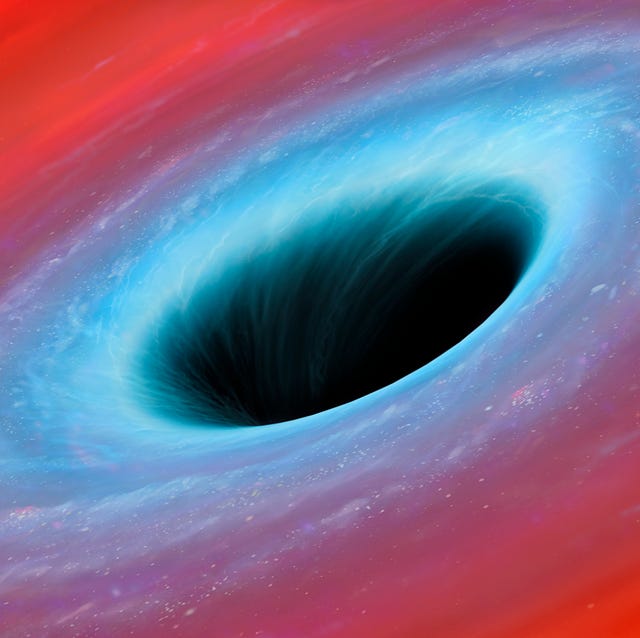
Despite their immense gravity, black holes themselves do not emit visible light. By definition, light cannot escape from inside the event horizon.
So if black holes are dark, where does a quasar’s brilliant light come from?
The answer lies in what happens around the black hole.
The Accretion Disk: The Real Source of Light
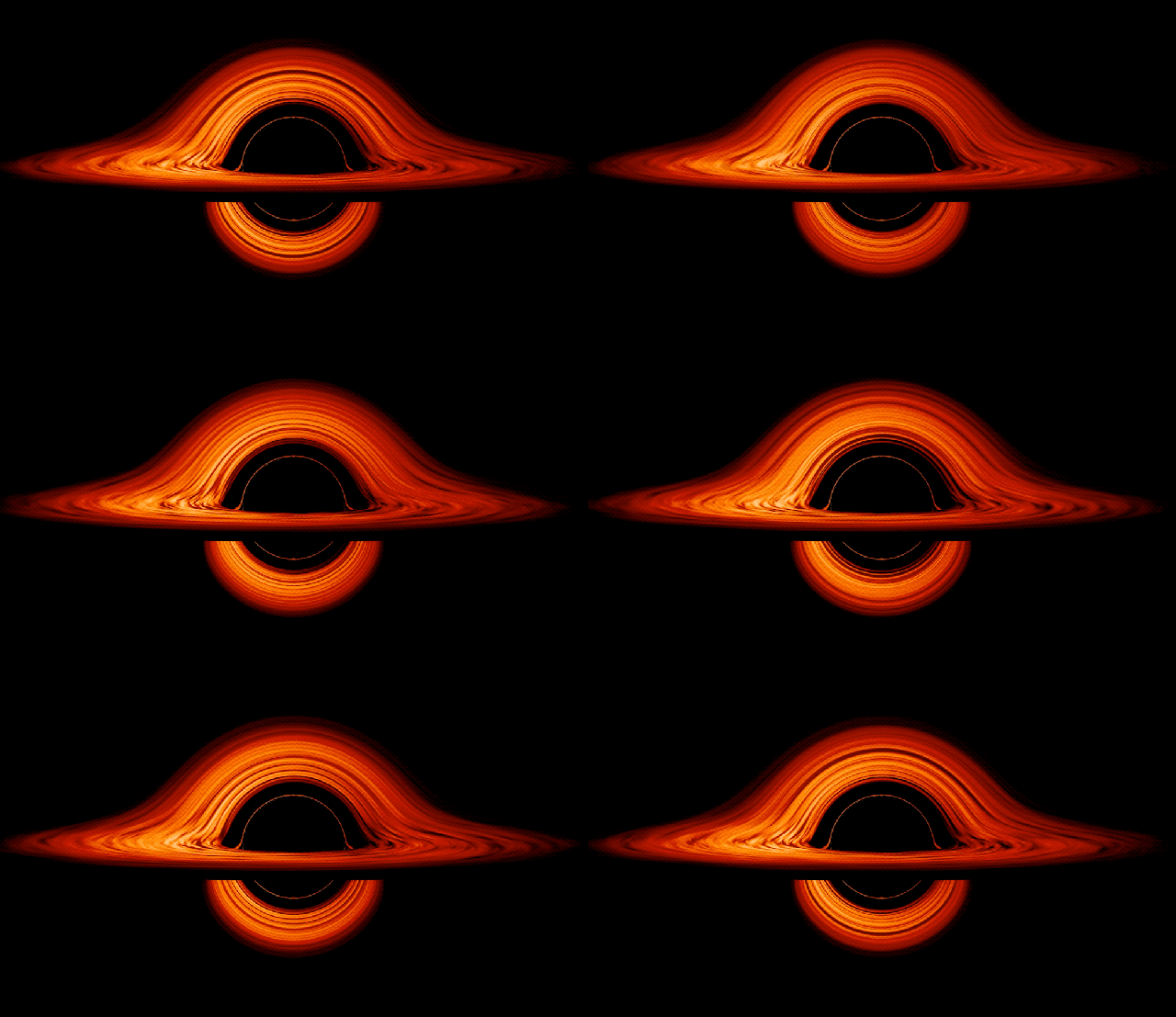
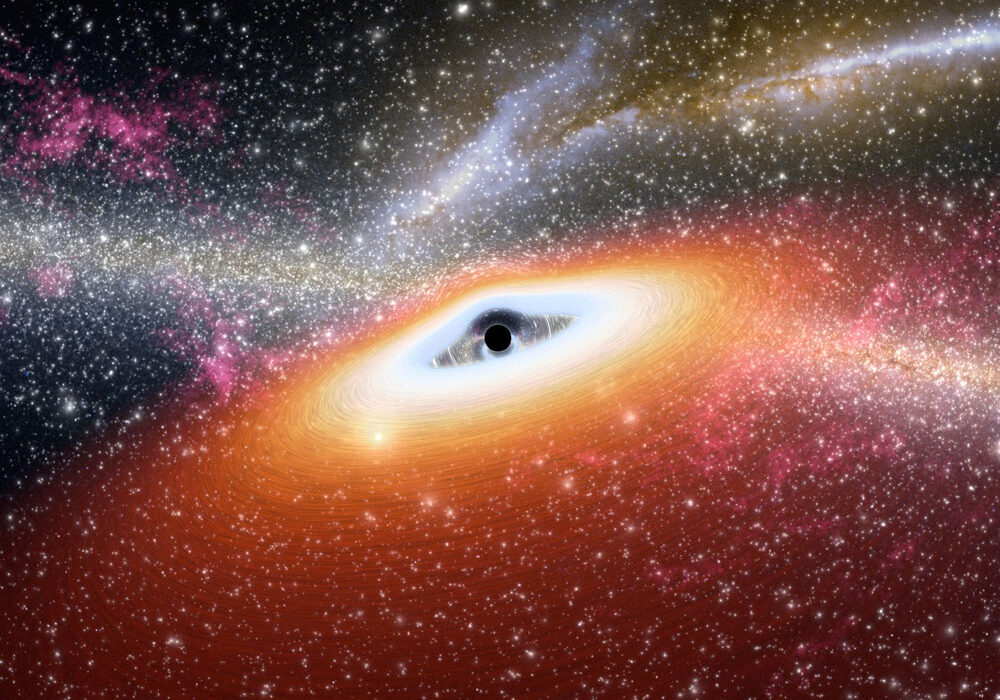
A quasar’s extraordinary brightness comes from a structure known as an accretion disk.
Gas, dust, and other material surrounding the black hole gradually spiral inward.
As this matter falls toward the black hole, it forms a rotating disk.
The situation is somewhat similar to water swirling around a drain, although on a vastly larger scale.
Friction within the disk causes particles to collide and interact.
These collisions generate enormous amounts of heat.
Temperatures can rise to millions of degrees.
The heated material begins emitting tremendous amounts of radiation across many wavelengths, including visible light, ultraviolet light, X-rays, and more.
This glowing disk becomes one of the brightest objects in the universe.
Remarkably, the light comes not from the black hole itself but from matter on its final journey toward destruction.
Why Quasars Are So Bright
Stars generate energy through nuclear fusion.
Even the most massive stars have limits to how much energy they can produce.
Accretion onto a black hole is far more efficient.
When matter falls toward a black hole, a significant fraction of its mass can be converted directly into energy.
This process is astonishingly powerful.
A quasar can release more energy than an entire galaxy containing hundreds of billions of stars.
Some quasars are hundreds or even thousands of times brighter than the Milky Way.
Imagine trying to spot a flashlight from thousands of kilometers away.
Now imagine that flashlight shining brighter than an entire city.
That comparison barely begins to capture the incredible luminosity of quasars.
Their light crosses billions of light-years of space and still remains detectable by our telescopes.
Looking Back in Time
One of the most fascinating aspects of quasars is that they allow us to look into the distant past.
Light travels at a finite speed.
The light we receive from the Sun left its surface about eight minutes ago.
The light from nearby stars may have begun its journey years or centuries ago.
Quasar light often started traveling toward Earth billions of years in the past.
When astronomers observe a quasar located ten billion light-years away, they are seeing it as it existed ten billion years ago.
This makes quasars powerful time machines.
They reveal what the universe looked like during its youth.
Many quasars formed when the cosmos was only a fraction of its current age.
Studying them helps scientists understand how galaxies and black holes evolved over cosmic history.
The Early Universe Was Full of Quasars
Interestingly, quasars were much more common in the distant past than they are today.
Astronomers have discovered that the peak era of quasar activity occurred billions of years ago.
During this period, galaxies frequently collided and merged.
These cosmic interactions disturbed enormous quantities of gas.
The gas flowed toward galactic centers, feeding supermassive black holes.
As black holes consumed this material, they became active quasars.
Over time, much of the available fuel was exhausted.
As a result, many quasars gradually faded.
Today, truly bright quasars are relatively rare.
The universe appears much calmer than it once was.
By studying ancient quasars, astronomers gain valuable insights into this dramatic period of cosmic history.
The Relationship Between Quasars and Galaxies
Quasars and galaxies are deeply connected.
Every known quasar exists within a galaxy.
The quasar represents an active phase in the life of a galaxy’s central black hole.
When sufficient matter reaches the black hole, the system becomes highly luminous.
When the fuel supply diminishes, the quasar fades.
Scientists now believe many galaxies likely experienced quasar phases in the past.
Even our own Milky Way may have hosted quasar-like activity long ago.
This realization changed how astronomers view galaxy evolution.
Rather than treating galaxies and black holes as separate entities, researchers now see them as interconnected systems that influence one another.
How Quasars Affect Their Host Galaxies
A quasar does more than simply shine.
It can dramatically influence its surrounding galaxy.
The immense energy released by the accretion disk can generate powerful winds and radiation.
These outflows may push gas away from the galactic center.
Since gas serves as the raw material for new stars, removing it can slow future star formation.
This process is known as feedback.
Feedback helps explain why galaxies and their central black holes appear to grow together.
The black hole influences the galaxy, and the galaxy influences the black hole.
This cosmic relationship remains one of the most important areas of modern astrophysical research.
The Powerful Jets of Quasars
Some quasars produce gigantic jets of charged particles.
These jets emerge from regions near the black hole and travel at speeds approaching that of light.
They extend far beyond their host galaxies.
In some cases, jets stretch for hundreds of thousands or even millions of light-years.
Their exact formation mechanism remains an active area of research.
Magnetic fields likely play a crucial role.
The combination of a rotating black hole, an accretion disk, and intense magnetic fields appears capable of launching these extraordinary structures.
The jets carry enormous amounts of energy across intergalactic space.
They are among the largest and most powerful features in the known universe.
The Challenge of Understanding Quasars
When quasars were first discovered, they created major challenges for astronomers.
Their brightness seemed almost impossible.
No known process appeared capable of generating such energy.
Various explanations were proposed.
Some scientists suggested entirely new forms of matter or unknown physical processes.
Others speculated that the objects might be much closer than their redshifts implied.
Eventually, the black hole model emerged as the most convincing explanation.
As evidence accumulated, the theory gained widespread acceptance.
Today, supermassive black holes powering accretion disks form the foundation of quasar research.
Yet many details remain uncertain.
Scientists continue investigating how black holes grow, how jets form, and how quasars evolve over time.
The Most Distant Quasars Ever Found
One of the most exciting areas of astronomy involves searching for extremely distant quasars.
Some have been discovered from periods when the universe was less than a billion years old.
These ancient objects present a fascinating puzzle.
How did black holes become so massive so quickly?
Growing a black hole to billions of solar masses requires enormous amounts of matter.
Yet the early universe may not have provided enough time for conventional growth processes.
Researchers continue exploring possible explanations.
Perhaps the first black holes formed unusually large.
Perhaps growth occurred more rapidly than expected.
Perhaps entirely new mechanisms were involved.
The answer remains one of modern astronomy’s biggest mysteries.
Quasars as Cosmic Beacons
Because quasars are so bright, they serve as valuable tools for studying the universe.
Their light passes through vast regions of intergalactic space before reaching Earth.
Along the way, it encounters gas clouds and other material.
These interactions leave fingerprints within the quasar’s spectrum.
By analyzing these fingerprints, astronomers can investigate regions of space that would otherwise be invisible.
Quasars therefore function as cosmic backlights.
They illuminate the structure and composition of the universe between galaxies.
This technique has provided important insights into the distribution of matter across cosmic distances.
The Role of Quasars in Understanding Cosmic Evolution
Quasars offer clues about some of the most important events in cosmic history.
One such event is known as the Epoch of Reionization.
After the Big Bang, the universe eventually cooled enough for neutral hydrogen atoms to form.
Later, intense radiation from early stars, galaxies, and quasars ionized much of this hydrogen.
Understanding exactly how and when this happened remains a major scientific goal.
Distant quasars help researchers investigate this transformative period.
Their ancient light contains information about the state of the universe during those early times.
Every newly discovered quasar adds another piece to this cosmic puzzle.
Can a Quasar Be Dangerous?
If a quasar were located near Earth, it could potentially pose serious hazards.
The intense radiation produced by a nearby quasar could affect planetary environments.
Fortunately, there is no reason for concern.
The Milky Way’s central black hole is currently relatively quiet.
It lacks the enormous inflow of matter needed to create a bright quasar.
Furthermore, known quasars are located at immense distances.
Their light may be spectacular, but they are far too distant to threaten Earth.
Instead, they provide opportunities for scientific exploration and discovery.
What Would It Look Like Up Close?
Imagine traveling near a quasar.
The experience would be unlike anything humans have ever encountered.
The accretion disk would glow with extraordinary brilliance.
Its light could outshine every star in the surrounding galaxy.
Radiation levels would be extreme.
Nearby gas clouds would shine intensely.
Jets of energetic particles might stretch across vast distances.
The environment would be violent, dynamic, and breathtakingly beautiful.
Yet it would also be deadly.
The immense gravity and radiation make quasars among the most hostile places in the universe.
Their beauty exists alongside extraordinary power.
Quasars and the Limits of Human Imagination
Quasars challenge our ability to comprehend scale.
The energies involved exceed anything encountered in everyday life.
Their black holes contain millions or billions of solar masses.
Their light travels across billions of years.
Their jets span distances larger than entire galaxies.
Human intuition evolved to understand forests, rivers, mountains, and weather.
It did not evolve to grasp phenomena operating across cosmic scales.
Quasars remind us that reality can be far stranger and grander than ordinary experience suggests.
Modern Telescopes and Quasar Research
The study of quasars continues advancing through increasingly sophisticated instruments.
Ground-based observatories examine their spectra in remarkable detail.
Space telescopes observe wavelengths blocked by Earth’s atmosphere.
New facilities are discovering quasars at greater distances than ever before.
Each observation contributes to a deeper understanding of black holes, galaxies, and cosmic evolution.
Future observatories will likely uncover thousands more quasars, including some from the earliest epochs of the universe.
These discoveries may answer long-standing questions while revealing entirely new mysteries.
That pattern has characterized astronomy throughout its history.
Every major breakthrough opens new frontiers of curiosity.
Common Misconceptions About Quasars
Many people mistakenly imagine quasars as giant stars.
Others think they are individual explosions.
Some assume they are separate from black holes.
In reality, quasars are powered by supermassive black holes actively consuming matter.
The black hole itself remains dark.
The extraordinary brightness comes from the heated material surrounding it.
Another misconception is that quasars are permanent.
They are not.
A quasar phase depends on the availability of fuel.
When the supply of gas decreases, the object’s luminosity can decline dramatically.
Thus, quasars represent a stage in a galaxy’s life rather than a permanent feature.
Why Quasars Matter
At first glance, quasars may seem like distant curiosities with little connection to everyday life.
Yet they address some of humanity’s deepest scientific questions.
How did galaxies form?
How do black holes grow?
What was the early universe like?
How did cosmic structures evolve over billions of years?
Quasars help answer these questions.
They provide direct evidence about processes occurring across immense spans of time and space.
Studying them expands our understanding of the cosmos and our place within it.
Every quasar observed is a message from the ancient universe.
The Future of Quasar Discoveries
The coming decades promise remarkable advances.
New telescopes will peer deeper into cosmic history than ever before.
Astronomers may discover quasars that formed only a few hundred million years after the Big Bang.
Researchers hope to uncover how the first supermassive black holes emerged.
They aim to understand why some galaxies become quasars while others remain quiet.
Artificial intelligence and advanced computing techniques will help analyze enormous datasets, revealing patterns that might otherwise remain hidden.
The story of quasars is far from complete.
In many ways, we are only beginning to understand these extraordinary objects.
Conclusion
Quasars are among the most magnificent and powerful phenomena in the universe. Though they appear as tiny points of light in telescopes, they are actually the blazing hearts of distant galaxies, powered by supermassive black holes consuming vast amounts of matter. Their brilliance can exceed that of entire galaxies, making them visible across billions of light-years of space.
The discovery of quasars transformed astronomy. It revealed that black holes, despite being regions from which light cannot escape, can indirectly generate some of the brightest displays in the cosmos. Through their immense luminosity, quasars allow scientists to explore the early universe, investigate galaxy evolution, and study the growth of supermassive black holes.
More than just astronomical objects, quasars are cosmic time capsules. Their ancient light carries stories from an era when the universe was young, chaotic, and rapidly changing. Every observation helps scientists reconstruct the history of the cosmos and understand the forces that shaped it.
Perhaps the most inspiring aspect of quasars is what they represent. They remind us that even in the darkest places imaginable—near the edge of a black hole—nature can create astonishing beauty and brilliance. Across billions of years and unimaginable distances, these celestial beacons continue to shine, inviting humanity to look deeper into the universe and uncover its greatest secrets.