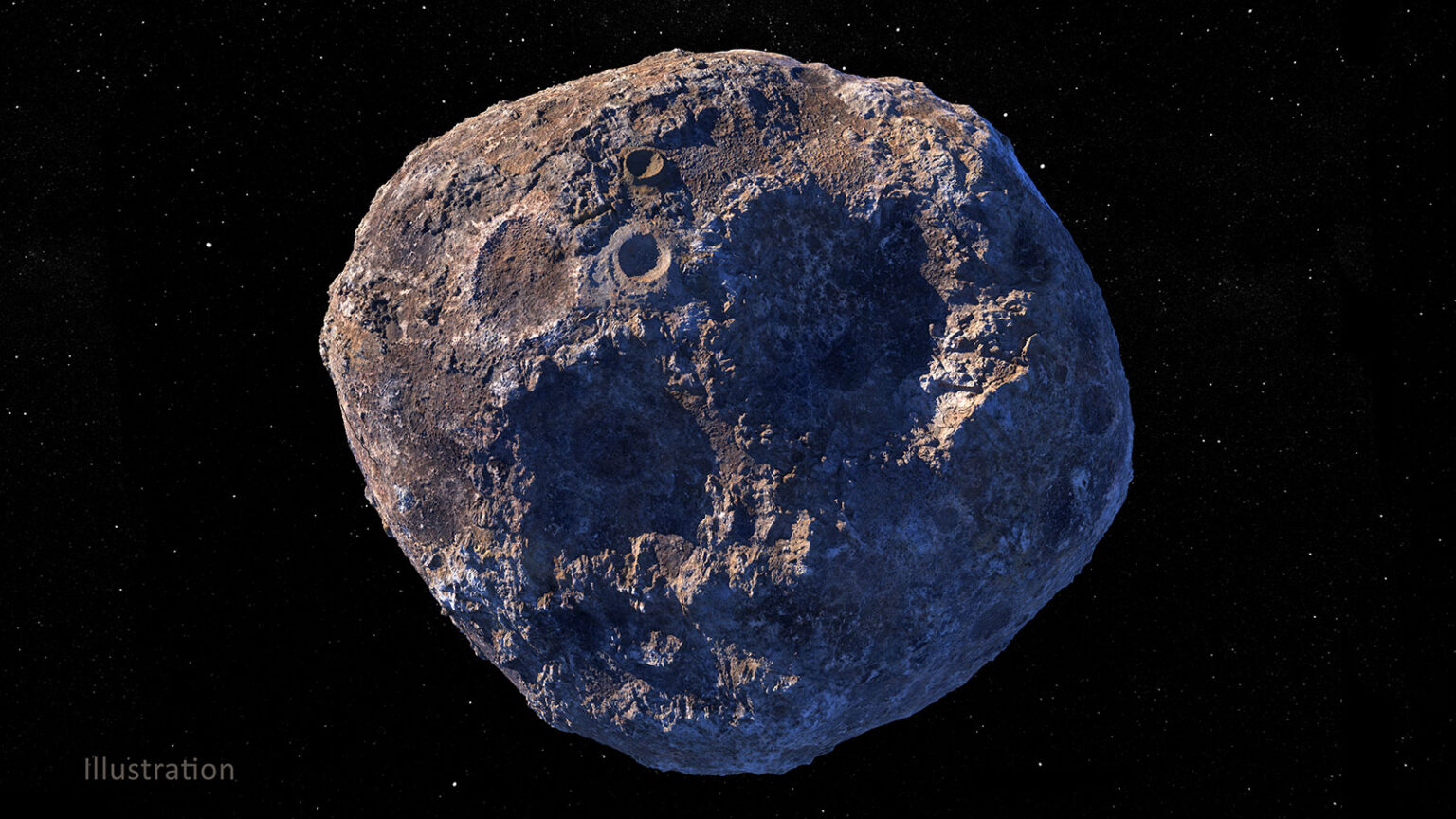
An asteroid is a small rocky or metallic object that orbits the Sun. Most asteroids are remnants of the material that formed the planets about 4.6 billion years ago. They are generally smaller than planets and dwarf planets, and unlike planets, they have not cleared most other objects from their orbital neighborhoods.
Asteroids vary enormously in size, shape, composition, and motion. Some are little more than irregular chunks of rock, while others are hundreds of miles across. Most travel around the Sun in the region between Mars and Jupiter, but some follow paths that bring them close to Earth. By studying these objects, scientists can learn how the solar system formed, what materials existed in its early history, and how objects move through space.
Understanding asteroids begins with three basic characteristics: what they are made of, how large they are, and how their orbits carry them through the solar system.
What makes an object an asteroid?
Asteroids are small solar system bodies composed primarily of rock, metal, or a mixture of these materials. They formed during the early development of the solar system, when dust and rocky particles gathered together under gravity and collisions. Many survived as relatively unchanged remnants of that process.
Unlike stars, asteroids do not produce their own visible light. They reflect sunlight, which is why astronomers observe them as points of light against the darker background of space. Their brightness depends on several factors, including their size, distance from Earth, distance from the Sun, and surface reflectivity.
Asteroids also differ from planets in their physical structure and gravitational influence. Most are too small for their gravity to overcome the strength of their own material and reshape them into nearly spherical objects. Instead, they retain irregular forms, although the largest asteroids can become rounded by gravity.
The distinction between an asteroid and other small solar system bodies can sometimes be complicated. Asteroids are generally rocky or metallic, while comets contain substantial amounts of ice and can develop glowing comas and tails when solar heating releases gas and dust. However, the categories overlap. Some asteroids contain water-bearing minerals or ice beneath their surfaces, and some objects display characteristics associated with both asteroids and comets.
The term small solar system body is a broader classification that includes most asteroids, comets, and other minor objects that orbit the Sun but do not qualify as planets or dwarf planets.
How big are asteroids?
Asteroids range from tiny fragments to enormous bodies hundreds of miles across. Their sizes help determine their gravity, internal structure, ability to retain heat, and potential consequences if they collide with another object.
The smallest asteroids are difficult to distinguish from the countless smaller pieces of debris in space. Astronomers generally use the term meteoroid for smaller natural objects traveling through space, although the boundaries between these categories are not universally fixed. At the other end of the size range, the largest asteroids are substantial worlds with complex geological histories.
Ceres, the largest object in the main asteroid belt, is about 590 miles (940 kilometers) across. It is classified as a dwarf planet rather than simply an asteroid because its gravity has shaped it into a nearly spherical body. Vesta, another major object in the belt, measures roughly 330 miles (530 kilometers) across and is large enough to have undergone extensive internal differentiation, a process in which materials separate according to density.
Most asteroids are much smaller than either of these objects. Many are irregular because their gravity is too weak to pull their material into a rounded shape. Their appearances can resemble boulders, elongated rocks, or collections of fragments held loosely together by gravity.
Size alone does not tell scientists everything about an asteroid. Two objects with similar diameters can have different masses because their materials differ in density or because one contains substantial internal gaps. An asteroid made largely of metal can be much more massive than a similarly sized asteroid composed of porous rock.
Size also affects the consequences of a collision with Earth. Small fragments commonly enter Earth’s atmosphere and burn up or break apart, while larger objects can survive atmospheric passage and reach the ground. The energy released by an impact depends on the object’s mass and speed, so even a relatively small asteroid can cause serious damage under the right circumstances.
What are asteroids made of?
Asteroids are composed mainly of silicate rock, iron-nickel metal, carbon-rich material, or mixtures of these substances. Their compositions reflect the conditions under which they formed and the changes they experienced over billions of years.
Astronomers study asteroid composition by examining the sunlight reflected from their surfaces. Different minerals and compounds absorb and reflect different wavelengths of light, producing distinctive patterns called spectra. Comparing these patterns with laboratory measurements helps scientists identify likely surface materials.
Asteroids are often grouped into broad compositional categories, although real objects can be more complex than these classifications suggest.
Carbon-rich asteroids contain abundant carbon-bearing compounds and may include water-bearing minerals. Many have dark surfaces that reflect relatively little sunlight. Their materials can preserve clues about the chemical ingredients present in the early solar system, including substances relevant to the development of water and organic chemistry on Earth. Organic compounds are carbon-containing chemicals; their presence does not, by itself, indicate life.
Silicate-rich asteroids contain rocky minerals similar to those found in Earth’s crust and mantle. These objects are often associated with the inner part of the asteroid belt, where temperatures during the solar system’s formation were generally higher than in more distant regions. Their surfaces can contain minerals such as olivine and pyroxene.
Metal-rich asteroids contain substantial amounts of iron and nickel. Some may be exposed portions of the metallic cores of larger bodies that were broken apart by collisions. In the early solar system, certain planetesimals—small bodies that formed the building blocks of planets—became hot enough for dense metal to sink toward their centers while lighter rocky material remained above. Later impacts sometimes disrupted these bodies, exposing material that would otherwise have been buried deep inside.
These categories are useful but not absolute. An asteroid’s observed surface may differ from its interior, and weathering by solar radiation and microscopic impacts can alter its appearance over time. Some objects also contain mixtures of materials that do not fit neatly into a single group.
Where do asteroids orbit?
Most known asteroids occupy the main asteroid belt, a broad region of space between the orbits of Mars and Jupiter. This belt contains enormous numbers of objects distributed across a wide range of orbital paths. Despite illustrations that show asteroids crowded together, the region is mostly empty space, and individual objects are generally separated by large distances.
The asteroid belt is a remnant of the early solar system. Dust and rocky material in this region could gather through collisions and gravity, but Jupiter’s strong gravitational influence disrupted the process of building a planet. As a result, the material did not combine into a single large world. Collisions instead fragmented some objects, while gravitational interactions changed the paths of others.
Asteroids are not confined to the main belt. Their orbits can extend into different parts of the solar system, and some cross Earth’s orbital path.
Near-Earth asteroids are objects whose orbits bring them relatively close to the Sun’s neighborhood around Earth. Some pass near Earth’s orbit without crossing it, while others cross that orbit and may occasionally approach the planet. Being classified as a near-Earth asteroid does not automatically mean an object poses a danger. Risk depends on its specific orbit, size, and probability of colliding with Earth.
Other asteroid populations occupy gravitationally distinctive regions. The Trojan asteroids, for example, share a planet’s orbit while clustering around stable gravitational regions ahead of or behind it. Large populations of these objects accompany Jupiter, and smaller populations are associated with other planets.
Asteroids can also move between populations. Gravitational encounters with planets, along with interactions within the asteroid belt, can gradually alter their orbits. An object that formed in one region may eventually be displaced into another, including an orbit that brings it near Earth.
How do asteroid orbits work?
An asteroid’s orbit is the curved path it follows around the Sun under the influence of gravity. Most asteroids travel in elliptical orbits, meaning their paths resemble elongated circles rather than perfect circles. The Sun lies at one focus of the ellipse, not necessarily at its center.
Several orbital characteristics describe how an asteroid moves. The most important include its orbital size, eccentricity, inclination, and period.
The semimajor axis describes the overall size of an elliptical orbit and is commonly used to estimate an asteroid’s average distance from the Sun. A larger semimajor axis generally means a longer orbital period because the object travels around the Sun more slowly on average.
Eccentricity measures how stretched an orbit is. An orbit with an eccentricity near zero is almost circular, while a more eccentric orbit is more elongated. In an elliptical orbit, an asteroid is closest to the Sun at perihelion and farthest away at aphelion.
Inclination describes the tilt of an asteroid’s orbital plane relative to a reference plane, commonly the plane of Earth’s orbit. Many asteroids travel on paths that remain relatively close to this plane, but others follow more steeply tilted orbits.
The orbital period is the time required to complete one revolution around the Sun. Asteroids closer to the Sun generally complete their orbits more quickly than objects farther away.
These relationships follow Kepler’s laws of planetary motion. For an object orbiting the Sun, the orbital period increases with the size of the orbit. In a simplified form, when the period is measured in Earth years and the semimajor axis in astronomical units, the relationship is:
P² ≈ a³
Here, P is the orbital period and a is the semimajor axis. One astronomical unit is approximately the average distance between Earth and the Sun.
This relationship explains why an asteroid in the main belt usually takes several Earth years to complete an orbit, while one on a smaller orbit can circle the Sun much more quickly.
An asteroid also changes speed along its orbit. It moves fastest when closest to the Sun and slowest when farthest away. The Sun’s gravity continuously changes the object’s direction and speed, keeping it on its curved path.
Why do asteroid orbits change?
Asteroid orbits are not always fixed over millions of years. Although an object’s motion is governed primarily by the Sun’s gravity, the gravitational influence of planets and other bodies can gradually alter its trajectory.
Jupiter plays a particularly important role because of its enormous mass. When an asteroid repeatedly encounters a particular orbital configuration with Jupiter, gravitational interactions can increase the asteroid’s orbital eccentricity or inclination. Certain orbital arrangements, called resonances, occur when the orbital periods of two objects have a simple numerical relationship. These resonances can destabilize asteroid orbits and help move objects out of parts of the main belt.
Asteroids can also experience the Yarkovsky effect, a small but significant force caused by the way an object absorbs sunlight and releases heat. The warmer surface emits infrared radiation, which carries momentum. Because an asteroid rotates, its heat emission is not necessarily distributed symmetrically around its surface. The resulting force can slowly change the asteroid’s orbit over long periods.
The effect depends on factors such as the object’s size, rotation, surface properties, and orientation. It is especially important for smaller asteroids, whose motions can shift gradually over millions of years.
Collisions provide another source of orbital change. An impact can break an asteroid into fragments, change its rotation, or alter the trajectories of the resulting pieces. Some fragments remain in the asteroid belt, while others may eventually enter Earth-crossing orbits.
These processes explain how near-Earth asteroids can originate in the main belt. Their movement is not random, but it can be complex, shaped by repeated gravitational encounters, subtle forces, and collisions over immense periods.
How do scientists determine an asteroid’s size and composition?
Scientists use several complementary techniques to study asteroids, including telescopic observations, radar measurements, spacecraft visits, and analysis of meteorites.
From Earth, astronomers can measure an asteroid’s brightness and track its position against the background stars. These observations help establish its orbit and reveal how its motion changes over time. However, brightness alone does not determine size because a small, reflective asteroid can appear as bright as a larger, darker one.
Thermal observations help resolve this ambiguity. By measuring the heat an asteroid emits, scientists can estimate its size and surface properties. Combining reflected sunlight with thermal measurements produces more reliable estimates than visible brightness alone.
Radar observations can provide information about an asteroid’s distance, rotation, shape, and surface features. Radar data are particularly useful for studying objects that approach Earth closely, although the method cannot be applied equally well to every asteroid.
Spacecraft provide a much more detailed view. A spacecraft can photograph an asteroid’s surface, map its shape, measure its mass and gravity, and investigate its mineral composition. Some missions have also collected samples or studied material displaced by deliberate impacts.
Meteorites offer another source of evidence. These are fragments of space rocks that survive passage through Earth’s atmosphere and reach the ground. Some meteorites are known to originate from asteroids because their mineral compositions and other characteristics match materials observed on particular bodies or fit the history of asteroid collisions. Meteorites do not represent every type of asteroid equally, however, because the likelihood that a fragment reaches Earth depends on its composition, strength, and orbital history.
By combining these methods, scientists can distinguish between asteroids that are dense and metallic, those that are rocky, and those that are porous or rich in carbon-bearing material. They can also investigate whether an object is a solid body or a loose collection of fragments held together mainly by gravity.
Are asteroids solid rocks or loose collections of debris?
An asteroid’s internal structure depends on its size, composition, formation history, and exposure to collisions. Some are relatively coherent bodies, while others are rubble piles: collections of broken rocks and smaller fragments bound together by their mutual gravity.
A rubble-pile asteroid may have formed when a larger object shattered in a collision and some of the fragments later gathered together. Such an object can contain substantial empty space between its components. Its overall density may therefore be lower than that of the solid minerals making up its individual pieces.
This structure influences how an asteroid responds to impacts. A compact body and a loosely assembled rubble pile may react differently when struck by another object, even if their sizes are similar. Some impact energy can go into breaking rock, while other energy is absorbed by movement and rearrangement among fragments.
Rotation also matters. Many asteroids spin, and their rates of rotation can provide clues about their internal strength. A rapidly rotating, loosely bound object may be unable to remain intact if centrifugal effects become too strong relative to its gravity and internal cohesion.
Small asteroids can have highly irregular shapes because gravity is weak compared with the forces holding rock together. Larger bodies are more likely to be rounded, although the transition depends on composition and internal structure rather than a single universal size threshold.
These differences matter not only for understanding asteroid formation but also for planning spacecraft operations and evaluating possible methods of asteroid deflection.
What happens when an asteroid approaches Earth?
An asteroid approaching Earth is not necessarily on a collision course. Scientists distinguish between an object’s proximity to Earth and the actual probability that it will strike the planet. Both depend on precise measurements of its orbit and how that orbit may evolve.
When an asteroid enters Earth’s atmosphere, it encounters increasing amounts of air as it descends. Atmospheric pressure and aerodynamic forces heat its surface, while the surrounding air is compressed and heated. Many small objects break apart or lose most of their material before reaching the ground. The visible streak of light produced by an object passing through the atmosphere is called a meteor.
If fragments survive and reach the ground, they are called meteorites. Larger incoming objects may release substantial energy in the atmosphere or at the surface. The resulting damage depends on the object’s size, composition, speed, entry angle, and the location of the event.
An impact over the ocean may produce different consequences from one over a populated area. A sufficiently large impact can excavate a crater, generate powerful shock waves, and throw material into the surrounding environment. Very large impacts can also affect climate by injecting dust and other material into the atmosphere.
Scientists monitor near-Earth objects because identifying a potential impactor early can provide time to assess the risk and, if necessary, consider ways to change its trajectory. The most important information is not simply how close an asteroid will pass but how accurately its future position can be predicted.
A small uncertainty in an orbit can grow over time, particularly when an asteroid experiences gravitational encounters with planets. Additional observations help narrow that uncertainty and determine whether an apparent future collision remains possible or can be ruled out.
Why asteroids matter to science
Asteroids preserve evidence about the early solar system that has been altered or erased on many planets. Earth, for example, has undergone extensive geological activity, including erosion, volcanism, and plate tectonics. These processes continually reshape its surface and can obscure its earliest history.
Many asteroids have experienced less extensive geological change. Their minerals, chemical compounds, and internal structures can therefore preserve clues about the materials from which the planets formed.
Studying asteroids also helps scientists understand how water and carbon-bearing compounds were distributed throughout the early solar system. Some asteroids contain hydrated minerals that formed when water interacted with rock. Others preserve primitive materials that have undergone relatively little alteration since their formation.
Asteroids reveal the role of collisions in shaping planetary systems. Impacts can break bodies apart, combine fragments, expose internal layers, and redistribute material. Some meteorites provide direct samples of these processes, allowing laboratory measurements to complement remote observations.
There is also a practical reason to study these objects: understanding their orbits and physical properties helps assess impact hazards. Effective planetary defense requires knowing not only where an asteroid is going but also how its structure and composition may influence a response to a potential threat.
Asteroids are therefore more than leftover rocks orbiting the Sun. They are records of planetary formation, examples of how gravity and collisions shape small worlds, and natural objects whose movements can be predicted using the laws of physics. Their size, composition, and orbit together provide the foundation for understanding what they are, where they came from, and why they remain important today.