On a clear night, far from city lights, the sky becomes a window into something vast and humbling. Thousands of stars shimmer overhead, planets wander silently among them, and the pale band of the Milky Way stretches across the darkness like a cosmic river. It is easy to feel small beneath such an immense sky. Yet among all those distant wonders, one region of space is especially important to us. It is our home. It is the place where Earth exists, where life emerged, and where humanity first began to ask questions about the universe.
This place is the Solar System.
The Solar System is much more than a collection of planets orbiting the Sun. It is a dynamic, interconnected cosmic neighborhood filled with worlds of astonishing variety. There are rocky planets scorched by heat, giant worlds wrapped in storms larger than Earth, icy moons hiding underground oceans, countless asteroids drifting through space, and comets carrying ancient material from the dawn of the universe.
For centuries, people believed Earth stood at the center of everything. Today, we know our planet is just one small world orbiting an ordinary star in a galaxy containing hundreds of billions of stars. Yet the Solar System remains extraordinary because it is the only place we know that harbors life.
Understanding the Solar System is not simply about learning where planets are located. It is about discovering how gravity shapes cosmic architecture, how worlds form and evolve, and how our own existence is connected to events that began billions of years ago.
What Exactly Is the Solar System?
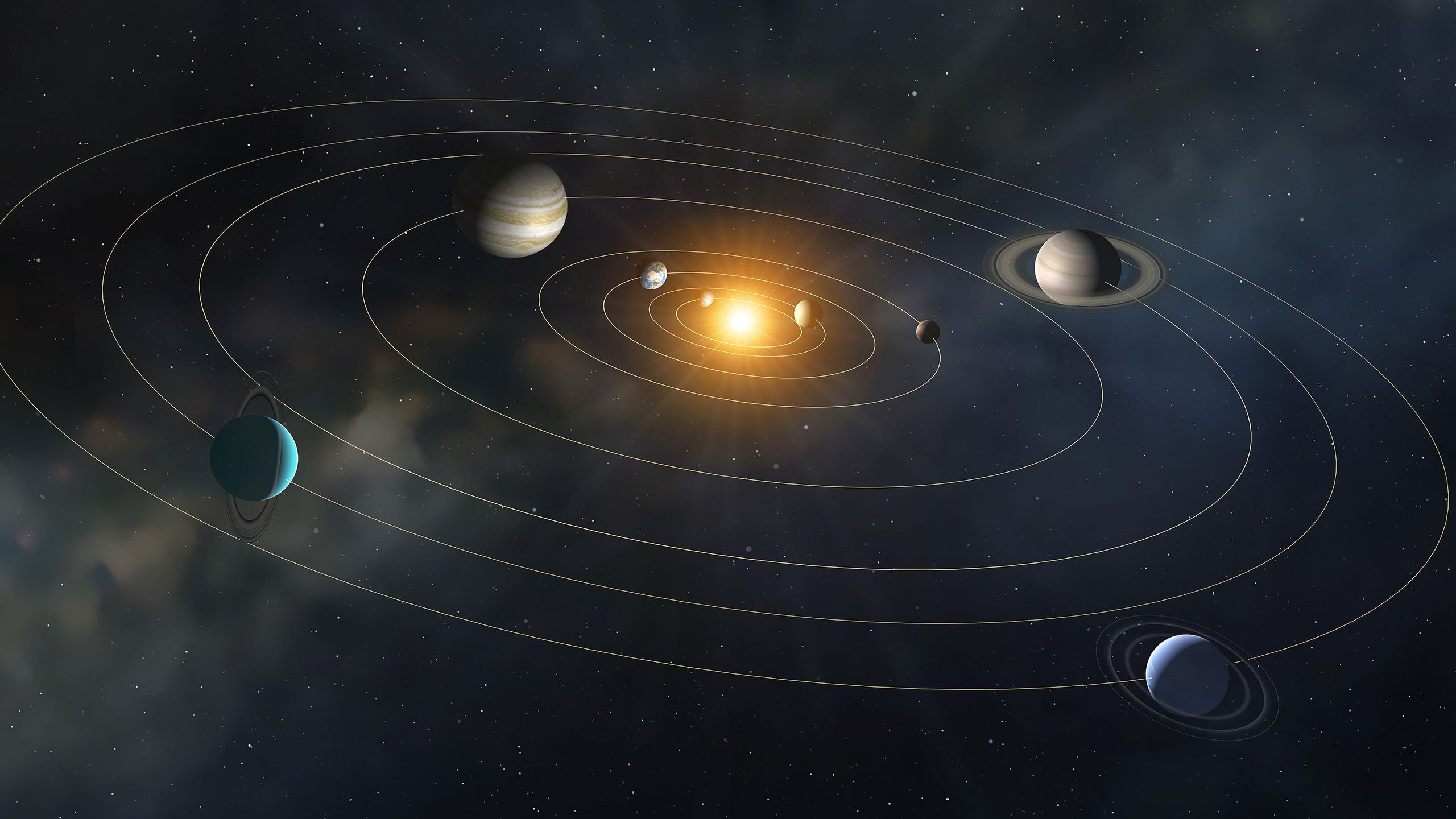
The Solar System consists of the Sun and everything bound to it by gravity.
This includes the eight major planets, their moons, dwarf planets, asteroids, comets, meteoroids, dust, gas, and countless smaller objects. All these bodies travel through space under the influence of the Sun’s immense gravitational pull.
The word “solar” comes from the Latin word sol, meaning Sun. The Solar System is therefore literally the system of objects associated with the Sun.
At its heart lies the Sun itself, containing more than 99 percent of the Solar System’s total mass. Everything else, from the largest planet to the tiniest grain of cosmic dust, orbits this central star.
The Solar System stretches far beyond the orbit of the outermost planet. Its influence extends into distant regions populated by icy objects, reaching trillions of kilometers from the Sun.
Although it may seem enormous from our perspective, the Solar System occupies only a tiny corner of the vast Milky Way galaxy.
The Birth of the Solar System
To understand the Solar System, we must travel back approximately 4.6 billion years.
At that time, neither Earth nor the Sun existed. Instead, there was a vast cloud of gas and dust floating through space. This cloud, known as a solar nebula, contained mostly hydrogen and helium along with heavier elements created inside earlier generations of stars.
Something triggered the cloud to collapse under its own gravity. Perhaps a nearby supernova explosion sent shockwaves through the region. Whatever the cause, the cloud began shrinking and spinning.
As it contracted, the material became denser and hotter.
Most of the matter gathered in the center, eventually forming the young Sun.
The remaining material flattened into a rotating disk surrounding the newborn star. Within this disk, tiny particles collided and stuck together. Over millions of years, these particles grew into larger and larger bodies.
Pebbles became rocks.
Rocks became planetesimals.
Planetesimals became protoplanets.
Eventually, the planets we know today emerged.
The Solar System was born from a process of accumulation, collision, and gravitational shaping that unfolded over millions of years.
The Sun: The Heart of the Solar System
The Sun dominates every aspect of the Solar System.
Without it, the Solar System would not exist.
This enormous sphere of hot plasma contains enough mass to hold all the planets in orbit through its gravitational pull. It also provides the light and heat that make life possible on Earth.
The Sun is a star, just like countless others scattered across the galaxy. Yet because it is relatively close to us, it appears far brighter than any other star in the sky.
Deep within the Sun’s core, temperatures reach about 15 million degrees Celsius. Under these extreme conditions, hydrogen atoms fuse together to form helium.
This process, known as nuclear fusion, releases tremendous amounts of energy.
Every second, the Sun converts millions of tons of matter into energy.
That energy travels outward and eventually reaches Earth as sunlight.
The sunlight warming your face today began its journey in the Sun’s core thousands or even hundreds of thousands of years ago before finally escaping into space.
Gravity: The Invisible Architect
If the Sun is the heart of the Solar System, gravity is its architect.
Gravity is the force that holds everything together.
Every object with mass exerts gravitational attraction on other objects. The more massive an object is, the stronger its gravitational pull.
Because the Sun contains so much mass, it dominates the Solar System gravitationally.
Planets orbit the Sun because they are constantly falling toward it while simultaneously moving sideways through space. The result is a stable orbit.
This delicate balance between motion and gravity creates the elegant dance of celestial bodies.
Gravity also governs the movement of moons around planets, rings around giant worlds, and even the trajectories of comets and asteroids.
Without gravity, the Solar System would instantly fall apart.
The Inner Rocky Planets
Closest to the Sun are the terrestrial planets, also known as the rocky planets.
These worlds are relatively small compared to the giant planets farther out.
Mercury is the nearest planet to the Sun. Its surface is covered with craters, resembling Earth’s Moon. Without a substantial atmosphere to regulate temperature, Mercury experiences extreme heat during the day and intense cold at night.
Venus is often called Earth’s twin because of its similar size. Yet Venus is a world of hellish conditions. Thick clouds trap heat through a runaway greenhouse effect, making it the hottest planet in the Solar System.
Earth is unique among known planets. Liquid water covers much of its surface, and a protective atmosphere supports a rich diversity of life.
Mars, the Red Planet, has captivated human imagination for centuries. Ancient river valleys, polar ice caps, and evidence of past water suggest it was once more hospitable than it is today.
These four rocky planets formed in the hotter inner region of the early Solar System, where lighter gases could not easily remain.
The Asteroid Belt
Between Mars and Jupiter lies a region known as the asteroid belt.
This vast area contains millions of rocky bodies ranging from tiny fragments to objects hundreds of kilometers across.
Contrary to popular science fiction portrayals, the asteroid belt is not densely packed. Most asteroids are separated by enormous distances.
Scientists believe these objects are leftovers from the Solar System’s formation. Jupiter’s powerful gravity prevented them from combining into a full-sized planet.
Asteroids provide valuable clues about the Solar System’s earliest history because many have changed little over billions of years.
In a sense, they are time capsules preserving ancient material from the birth of our celestial neighborhood.
The Giant Planets
Beyond the asteroid belt lie the giant planets.
These worlds dwarf the rocky planets in both size and mass.
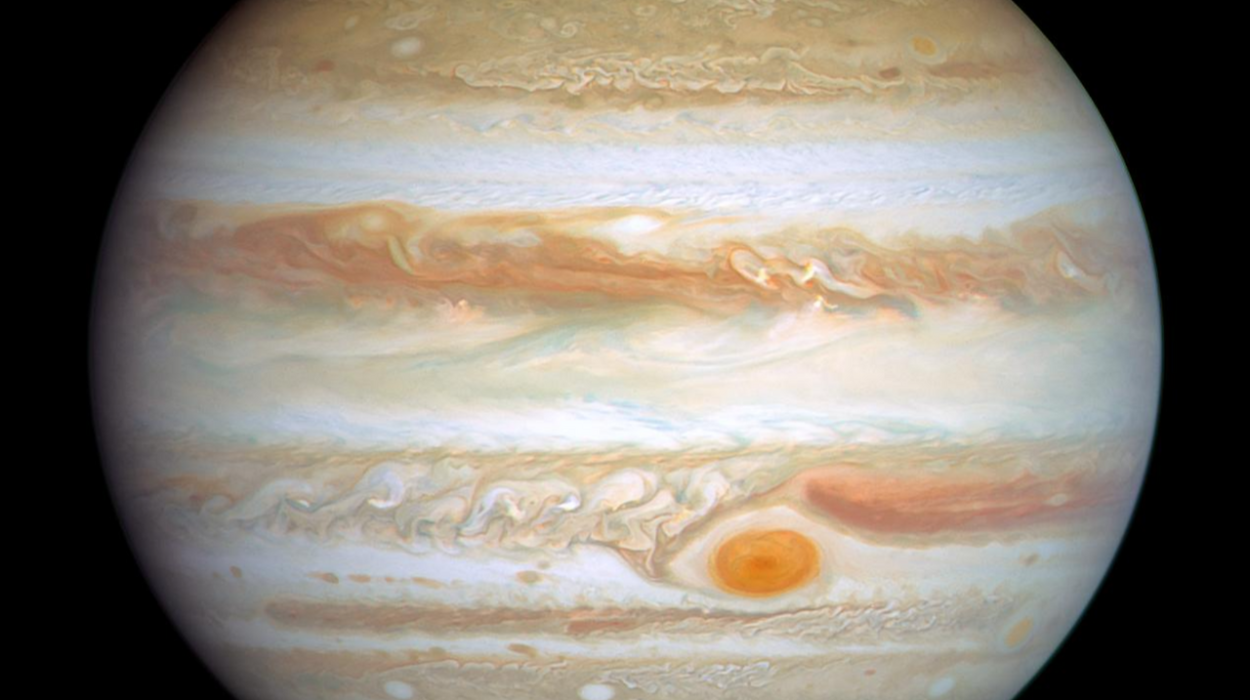
Jupiter is the largest planet in the Solar System. More than 1,300 Earths could fit inside it. Its atmosphere contains colorful cloud bands and enormous storms, including the famous Great Red Spot, which has persisted for centuries.
Saturn is best known for its magnificent ring system. Although other giant planets also possess rings, Saturn’s are by far the most spectacular.
Uranus presents a unique appearance because it rotates on its side. Scientists believe a massive collision early in its history may have tipped it over.
Neptune, the outermost major planet, is a world of deep blue color and powerful winds. Some of the fastest winds in the Solar System rage through its atmosphere.
These giant planets contain large amounts of hydrogen, helium, and other volatile substances, reflecting the colder conditions in which they formed.
Why the Planets Orbit in the Same Direction
One of the most fascinating features of the Solar System is its overall organization.
Most planets orbit the Sun in the same direction.
Most also rotate in the same general direction.
This pattern is not a coincidence.
It reflects the Solar System’s origin within a spinning disk of gas and dust.
As the solar nebula collapsed, its rotation became faster due to the conservation of angular momentum. The resulting disk established a preferred direction of motion.
The planets inherited this motion as they formed.
Today, billions of years later, they still carry the signature of their birth.
The Solar System remembers its origins through the motions of its worlds.
Moons: Worlds Within Worlds
Many planets possess natural satellites known as moons.
Some moons are small and irregular, resembling captured asteroids.
Others are remarkable worlds in their own right.
Earth’s Moon has profoundly influenced our planet’s evolution. It stabilizes Earth’s axial tilt and contributes to ocean tides.
Jupiter’s moon Io is the most volcanically active body in the Solar System.
Europa hides a global ocean beneath an icy crust, making it one of the most promising places to search for extraterrestrial life.
Saturn’s moon Titan possesses lakes and rivers, though they are composed of liquid methane and ethane rather than water.
Enceladus, another moon of Saturn, ejects plumes of water vapor into space from an underground ocean.
These moons demonstrate that planets are not the only interesting destinations in the Solar System.
Some may even be more promising for life than certain planets.
Rings: Nature’s Cosmic Artwork
Planetary rings are among the most beautiful structures in the Solar System.
Saturn’s rings are the most famous, but Jupiter, Uranus, and Neptune also possess ring systems.
These rings consist of countless particles ranging in size from microscopic dust grains to large chunks of ice and rock.
Although they appear solid from a distance, they are actually vast collections of orbiting debris.
The exact origins of rings vary.
Some may be remnants of destroyed moons.
Others may consist of material that never formed into larger bodies.
Their delicate appearance masks a complex gravitational environment shaped by interactions with nearby moons.
Comets: Messengers from the Outer Darkness
Comets are among the most dramatic objects in the Solar System.
Often described as dirty snowballs, they consist of ice, dust, and rocky material.
Most comets spend the majority of their existence in distant, cold regions far from the Sun.
When a comet approaches the inner Solar System, solar heat causes its ice to vaporize.
This creates a glowing coma and sometimes spectacular tails stretching millions of kilometers.
For ancient civilizations, comets often seemed like mysterious omens.
Today, scientists view them as invaluable relics from the Solar System’s formation.
Many comets contain material that has remained largely unchanged for billions of years.
Studying them helps researchers understand conditions that existed before the planets formed.
The Kuiper Belt and Beyond
Past Neptune lies a vast region known as the Kuiper Belt.
This area contains countless icy bodies left over from the Solar System’s formation.
Many dwarf planets reside here, including Pluto.
For decades, Pluto was considered the ninth planet.
However, discoveries of similar objects beyond Neptune prompted astronomers to redefine what constitutes a planet.
In 2006, Pluto was reclassified as a dwarf planet.
Although this decision sparked debate, Pluto remains one of the most fascinating worlds ever explored.
Far beyond the Kuiper Belt may lie the Oort Cloud, a hypothetical spherical region containing trillions of icy objects.
This distant reservoir likely serves as the source of many long-period comets.
The Mechanics of Planetary Motion
Planetary motion follows precise mathematical rules.
In the early seventeenth century, astronomers discovered that planets move in elliptical rather than perfectly circular orbits.
This insight transformed our understanding of celestial mechanics.
Later, the laws of motion and gravity provided a framework for explaining why planets move as they do.
Today, scientists can predict planetary positions with extraordinary accuracy.
Spacecraft navigate millions of kilometers through space by relying on these principles.
The mechanics of planetary motion reveal that the Solar System operates according to consistent natural laws.
Its apparent complexity emerges from simple physical principles acting over immense scales.
Seasons and Planetary Tilts
The changing seasons on Earth result from the planet’s axial tilt.
As Earth orbits the Sun, different regions receive varying amounts of sunlight throughout the year.
This creates the familiar cycle of spring, summer, autumn, and winter.
Other planets experience seasons as well.
Mars has seasons similar to Earth’s, though they last longer because of its longer year.
Uranus experiences particularly extreme seasonal changes because of its unusual tilt.
These variations demonstrate how planetary orientation can dramatically influence climate and environmental conditions.
The Solar Wind and Space Weather
The Sun constantly releases streams of charged particles known as the solar wind.
These particles flow outward through the Solar System at tremendous speeds.
Earth’s magnetic field protects the planet from much of this radiation.
When solar particles interact with Earth’s atmosphere, they produce beautiful auroras near the poles.
Occasionally, intense solar storms can disrupt satellites, communication systems, and power grids.
Understanding space weather has become increasingly important as modern civilization grows more dependent on space-based technology.
The Sun is not merely a passive source of light. It actively influences conditions throughout the Solar System.
Earth’s Place in the Habitable Zone
One reason life flourished on Earth is its location relative to the Sun.
Earth orbits within a region often called the habitable zone.
In this zone, temperatures allow liquid water to exist on a planet’s surface.
Water is essential for all known forms of life.
If Earth were significantly closer to the Sun, conditions might resemble Venus.
If it were much farther away, it could resemble Mars.
The habitable zone does not guarantee life, but it provides favorable conditions.
Earth’s position highlights how delicate the balance can be between environmental stability and planetary extremes.
Space Exploration and the Solar System
For most of history, the Solar System could only be observed from afar.
That changed during the twentieth century.
Humanity began sending spacecraft beyond Earth.
Robotic explorers visited every major planet.
Orbiters mapped distant worlds.
Landers touched alien surfaces.
Rovers traversed Martian landscapes.
Space probes journeyed to the edge of the Solar System.
These missions transformed our understanding.
Worlds once seen as tiny points of light became complex and diverse places.
Each mission revealed new surprises and new mysteries.
Space exploration turned the Solar System from a collection of distant objects into a richly detailed cosmic neighborhood.
Could There Be Life Elsewhere in the Solar System?
One of the most exciting questions in science concerns the possibility of life beyond Earth.
Several locations within the Solar System are considered promising candidates.
Mars shows evidence of ancient environments that may have supported microbial life.
Europa contains a vast ocean beneath its icy shell.
Enceladus possesses liquid water and organic compounds.
Titan hosts complex chemistry unlike anything on Earth.
Scientists continue investigating these worlds.
No definitive evidence of extraterrestrial life has yet been discovered.
However, the search remains one of the most important scientific endeavors of our time.
Finding even simple microbial life elsewhere would fundamentally change humanity’s understanding of its place in the universe.
The Future of the Solar System
The Solar System is not static.
It continues evolving.
Planets shift slowly in their orbits.
Asteroids collide.
Comets appear and disappear.
Stars age.
Billions of years from now, the Sun will exhaust much of its hydrogen fuel.
It will expand into a red giant star.
Its outer layers may engulf Mercury and Venus and possibly affect Earth dramatically.
Eventually, the Sun will shed its outer material and leave behind a dense stellar remnant known as a white dwarf.
The Solar System will survive, but it will be transformed.
The future reminds us that cosmic structures, like living things, experience birth, change, and eventual decline.
Why the Solar System Matters
The Solar System is more than a scientific subject.
It is our origin story.
Every atom in our bodies was shaped by cosmic processes that occurred long before Earth formed.
The planets preserve clues about the early history of the universe.
The Sun provides the energy sustaining life.
The Moon influences Earth’s environment.
Asteroids and comets carry ancient records of planetary formation.
Studying the Solar System helps us understand where we came from and where we might go.
It connects everyday life to events unfolding across billions of kilometers and billions of years.
Conclusion
The Solar System is a magnificent celestial neighborhood shaped by gravity, motion, and time. Born from a cloud of gas and dust approximately 4.6 billion years ago, it grew into a complex system centered on the Sun and populated by planets, moons, asteroids, comets, and countless smaller objects.
Its mechanics are governed by elegant physical laws that keep worlds in motion and maintain cosmic order. Yet within that order exists extraordinary diversity. From the blazing surface of Mercury to the icy depths beyond Neptune, every region of the Solar System tells a different chapter of an ancient story.
The Solar System is not merely the backdrop of human existence. It is the environment that made our existence possible. It is the stage upon which Earth formed, life emerged, and intelligence evolved. Every exploration mission, every telescope observation, and every scientific discovery deepens our understanding of this remarkable cosmic home.
When we look up at the night sky, we are not simply gazing into space. We are looking into our own neighborhood—a vast, beautiful, and ever-changing celestial community that continues to inspire wonder, curiosity, and the timeless human desire to explore.