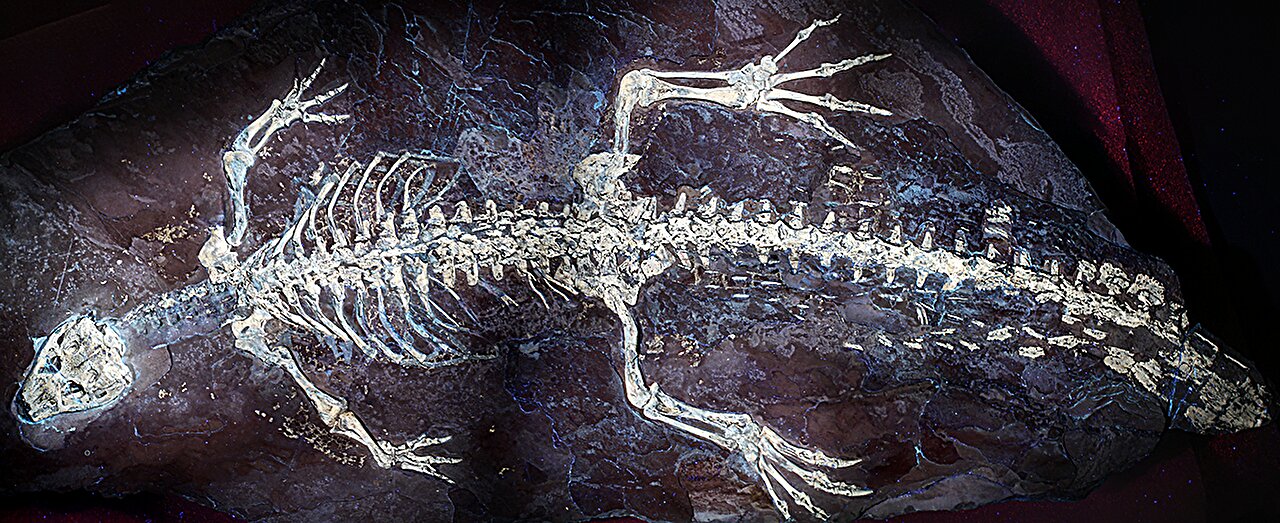
Hidden details locked inside a 125-million-year-old crocodile fossil have come to light under ultraviolet illumination, revealing preserved skin, sensory structures, respiratory anatomy, and what may be the oldest known coloration pattern in a crocodylomorph. The discovery offers an unprecedented look at how some early crocodile relatives looked, breathed, and adapted to life in the water.
For more than a century, a small fossil crocodile from northeastern Spain sat in museum collections, its most remarkable secrets concealed within stone. Now, researchers have uncovered evidence that transforms scientists’ understanding of this ancient animal, exposing delicate soft tissues that rarely survive the fossilization process.
The findings, published in the Zoological Journal of the Linnean Society, provide the first detailed description of preserved soft tissues in Montsecosuchus depereti, a small crocodylomorph that lived approximately 125 million years ago during the Early Cretaceous.
Ancient Fossil Preserved in Exceptional Conditions
The fossil belongs to a crocodile-like animal measuring about 50 centimeters (20 inches) in length. It died in a karstic lake near the coast of what is now the Catalan Pre-Pyrenees region of Spain.
Its remains were buried within fine lake sediments that later became the lithographic limestones of the Pedrera de Meià site, an area renowned for exceptional fossil preservation. The specimen, cataloged as MGB-512, is housed at the Museum of Natural Sciences of Barcelona.
Although the fossil was discovered more than 100 years ago and received partial scientific attention in the 1990s, researchers recently identified previously overlooked features while building a database of fossils from the Montsec limestones.
Ultraviolet Light Exposed Hidden Soft Tissues
The breakthrough came when paleontologists Oscar Castillo and Jesús Serrano noticed unusual structures on the fossil that became visible under ultraviolet (UV) light.
Unlike ordinary lighting, UV illumination causes fossilized tissues to stand out from the surrounding rock, making hidden anatomical details easier to detect.
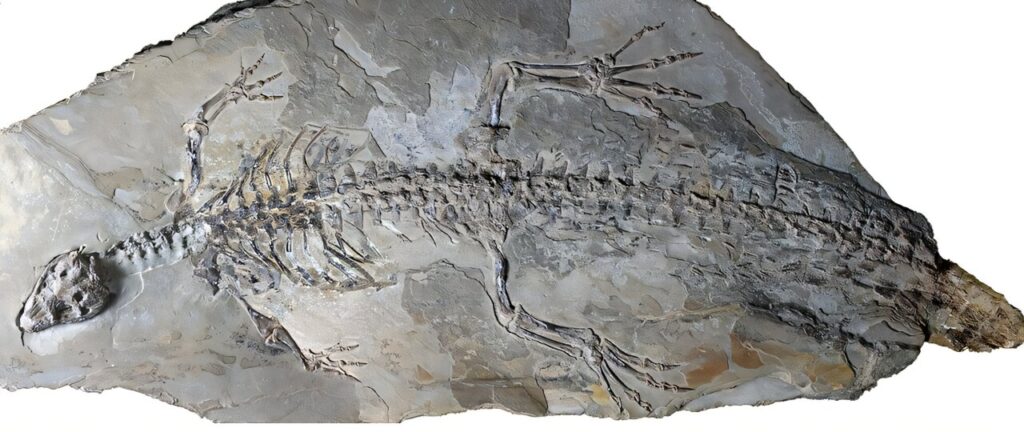
According to lead author Oscar Castillo-Visa, UV light allows researchers to observe details that would otherwise remain completely concealed within the stone.
Using this technique, the team documented several types of preserved soft tissue, opening a rare window into the biology of an ancient crocodylomorph.
First Detailed Look at the Animal’s Skin
One of the most important discoveries involved the fossilized skin.
Researchers identified preserved epidermal scales, allowing them to describe the skin of Montsecosuchus depereti in detail for the first time. The scales displayed substantial variation in shape and size across different parts of the body.
The analysis also revealed the absence of the prominent high tail fin seen in modern crocodiles. This difference provides new information about how body structures evolved within the crocodylomorph lineage.
Because soft tissues almost never survive over such vast spans of time, the preserved skin offers a unique opportunity to study external features that are usually lost from the fossil record.
Clues to the Evolution of Sensory Organs
The fossil may also preserve evidence of specialized sensory structures embedded within the skin.
Researchers observed possible sensory organs associated with some scales, particularly around the neck, limbs, and the outer margins of the trunk and tail.
In living crocodiles, these organs function as receptors that detect touch, water pressure changes, temperature variations, and chemical signals. Their distribution in Montsecosuchus appears different from that of modern species.
Scientists suggest that the concentration of these structures in smaller, peripheral scales may indicate an early evolutionary stage, when such sensory systems were restricted to localized regions before becoming more widespread across the body in later crocodylomorphs.
Evidence of an Advanced Respiratory System
The UV analysis also uncovered preserved cartilaginous structures within the thoracic region.
These remains indicate that Montsecosuchus depereti possessed an efficient respiratory system sharing important similarities with that of modern crocodiles.
The finding suggests that sophisticated thoracic anatomy evolved relatively early within the crocodylomorph lineage. Despite being considered a primitive member of the group, the animal appears to have already possessed adaptations associated with effective breathing and a semiaquatic lifestyle.
Researchers conclude that these anatomical traits demonstrate the species was well adapted to living both in water and on land.
Possible Original Color Pattern Preserved on the Tail
Perhaps the most surprising discovery emerged from the tail.
Under ultraviolet light, researchers observed alternating light and dark bands preserved within some tail scales. These transverse markings are interpreted as a potential record of the animal’s original coloration pattern.
The banding may have served a camouflage function by helping disrupt the outline of the body.
Scientists emphasize that they cannot yet determine the exact colors of the tail. However, if the interpretation proves correct, Montsecosuchus depereti would represent the oldest known crocodylomorph with preserved coloration.
Co-author Albert G. Sellés noted that while the precise colors remain uncertain, they may not have differed dramatically from the patterns seen in modern crocodilian species.
Why the Pedrera de Meià Site Is So Important
The fossil comes from Pedrera de Meià, a site classified as a Konservat-Lagerstätte, a rare type of fossil deposit known for preserving delicate soft tissues in addition to bones.
This exceptional preservation has made the locality a major resource for studying Early Cretaceous ecosystems. More than 8,000 fossil specimens have been recovered from the site, including fish, amphibians, reptiles, plants, crustaceans, and numerous insects.
Its extraordinary fossil record continues to provide researchers with insights that would be impossible to obtain from skeletal remains alone.
Why This Matters
The discovery dramatically expands what scientists know about the biology of early crocodylomorphs. Instead of relying solely on bones, researchers can now examine preserved skin, potential sensory organs, respiratory structures, and even traces of external appearance.
These findings help clarify how key features related to skin evolution, sensory systems, respiration, and body coloration developed over time. They also demonstrate the scientific value of exceptionally preserved fossils, which can preserve details of ancient life that are normally lost forever.
By revealing hidden anatomical information inside a fossil discovered more than a century ago, the study shows that even long-known specimens can still transform our understanding of vertebrate evolution when examined with new techniques.