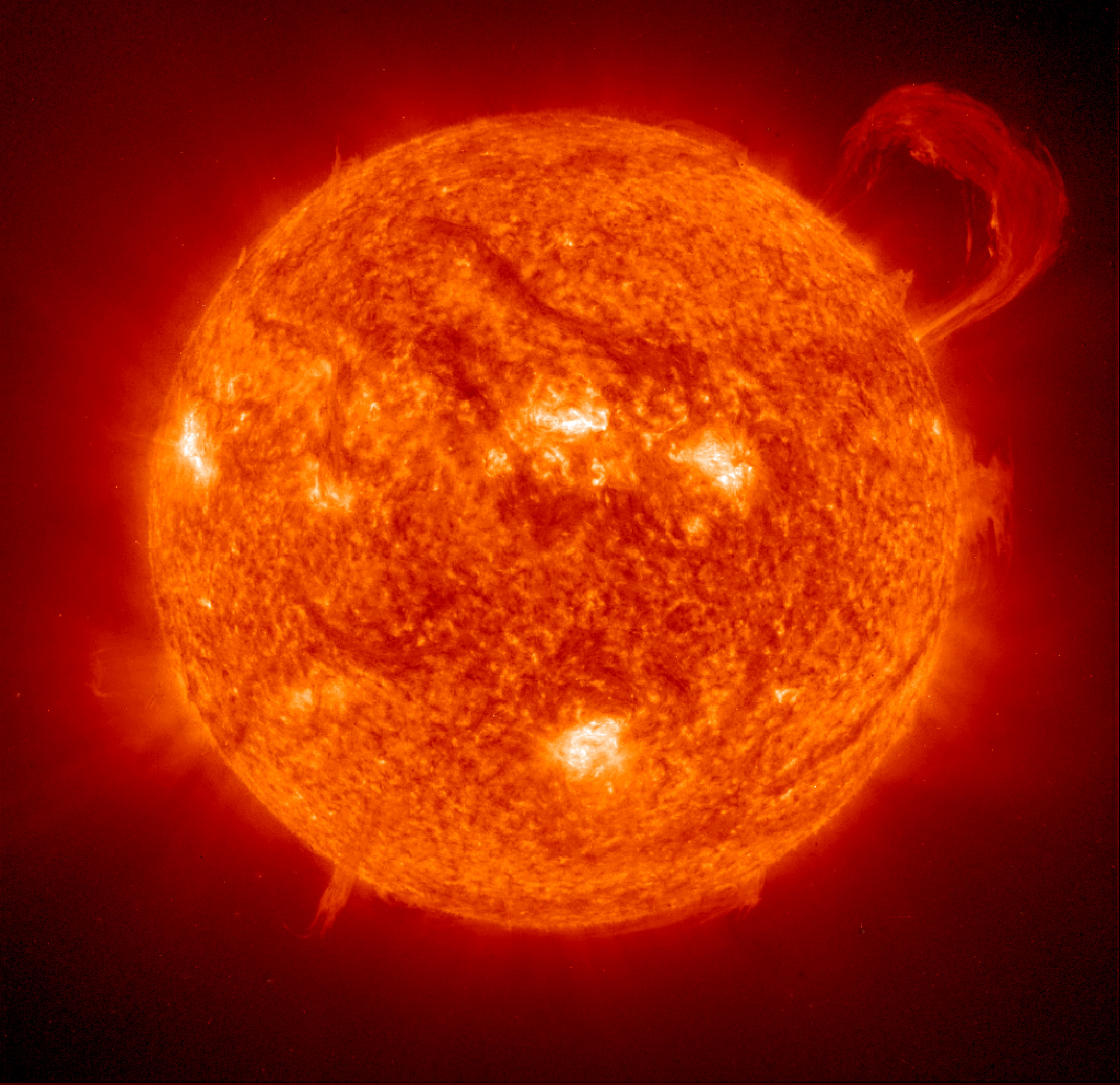
Every morning, the Sun rises above the horizon and fills the world with light. Its warmth touches forests, oceans, deserts, cities, and mountains. Plants begin photosynthesis, animals become active, and human civilization powers forward under its glow. For billions of years, the Sun has been the engine of life on Earth.
Yet one question has fascinated humanity for centuries: how does the Sun produce so much energy?
The answer is one of the greatest scientific discoveries ever made. Deep inside the Sun, a process known as nuclear fusion transforms matter into energy on a colossal scale. At its core, the Sun is essentially a gigantic fusion reactor, converting hydrogen into helium and releasing unimaginable amounts of energy every second.
This process powers everything we see when we look at the Sun. It creates sunlight, generates heat, drives space weather, and makes life on Earth possible. Without solar fusion, our planet would become a frozen, lifeless world drifting through darkness.
Understanding how the Sun produces energy required generations of scientists, astronomers, and physicists to unravel one of nature’s greatest secrets. The story involves extreme temperatures, crushing pressures, subatomic particles, and one of the most famous equations in science.
Today, we know more about the Sun than ever before. Yet the deeper we look into its fiery heart, the more astonishing it becomes.
The Sun Is a Star
To understand how the Sun generates energy, we must first understand what the Sun actually is.
The Sun is not a burning ball of fire in the ordinary sense. It is a star.
Stars are enormous spheres of hot gas held together by gravity. The Sun contains about 99.8 percent of all the mass in our solar system. If you could place more than one million Earths inside the Sun, there would still be room left over.
Most of the Sun consists of hydrogen, the simplest and most abundant element in the universe. Hydrogen atoms contain only one proton and one electron. The Sun also contains helium along with small amounts of heavier elements such as oxygen, carbon, neon, and iron.
The Sun formed approximately 4.6 billion years ago from a giant cloud of gas and dust. Gravity gradually pulled this material together, creating a growing sphere that became increasingly hot and dense.
Eventually, conditions in the center became so extreme that nuclear fusion began.
At that moment, a star was born.
Why Gravity Matters
Gravity is the hidden force that makes solar fusion possible.
Every part of the Sun is constantly being pulled toward the center by gravity. Because the Sun contains such enormous mass, this inward pull is incredibly strong.
Imagine stacking mountains upon mountains on top of each other. The pressure at the bottom would become immense. Now imagine doing this with a sphere containing nearly two octillion tons of material.
The Sun’s core experiences pressures that are almost impossible to comprehend.
Gravity squeezes the central regions so tightly that temperatures soar to about 15 million degrees Celsius (27 million degrees Fahrenheit).
These extreme conditions create the environment needed for fusion.
Without gravity, fusion could never occur.
Without fusion, the Sun would not shine.
The Mystery That Puzzled Scientists
For centuries, scientists struggled to explain the Sun’s energy source.
In the nineteenth century, researchers knew the Sun emitted enormous amounts of light and heat. However, they had no idea how it sustained this output.
Some proposed that the Sun was burning like a giant fire.
This explanation quickly failed.
Ordinary combustion requires oxygen and fuel. More importantly, calculations showed that a fire-powered Sun would burn out after only a few thousand years.
Others suggested the Sun generated energy through gravitational contraction. As the Sun slowly shrank, gravitational energy could be converted into heat.
This idea was closer to the truth but still inadequate.
Calculations showed that contraction could power the Sun for only tens of millions of years.
Geologists were already finding evidence that Earth was much older.
A new explanation was needed.
The mystery remained unsolved until scientists began exploring the strange world of atoms and nuclear physics.
The Discovery of Nuclear Energy
The twentieth century revolutionized our understanding of matter.
Scientists discovered that atoms were not indivisible particles as once believed. Instead, atoms contained smaller components, including protons, neutrons, and electrons.
Researchers also learned that enormous amounts of energy were hidden within atomic nuclei.
One of the most important breakthroughs came from Albert Einstein.
In 1905, Einstein published the famous equation:
E = mc²
This simple equation revealed something extraordinary.
Mass and energy are different forms of the same thing.
A tiny amount of mass can be converted into a tremendous amount of energy because it is multiplied by the speed of light squared, an enormous number.
Suddenly, scientists realized the Sun might be powered by nuclear processes rather than ordinary chemical reactions.
The challenge was determining exactly what those processes were.
The Birth of the Fusion Theory
During the 1920s and 1930s, scientists gradually pieced together the answer.
Astronomers knew the Sun consisted primarily of hydrogen.
Physicists began investigating what might happen under the extreme temperatures and pressures inside stellar cores.
The solution emerged through the work of researchers such as Arthur Eddington and Hans Bethe.
They proposed that hydrogen nuclei could combine to form helium.
This process became known as nuclear fusion.
Unlike nuclear fission, which splits heavy atoms apart, fusion joins light atoms together.
When hydrogen nuclei merge into helium, a small amount of mass disappears.
That missing mass becomes energy.
This energy is what powers the Sun.
The mystery of solar energy had finally been solved.
What Is Nuclear Fusion?
Nuclear fusion occurs when two or more atomic nuclei combine to form a heavier nucleus.
At first glance, this sounds simple.
In reality, fusion is extremely difficult.
Atomic nuclei carry positive electric charges. Like charges repel each other.
Imagine trying to force two powerful magnets together when their matching poles push apart.
Hydrogen nuclei experience a similar repulsion.
To overcome this barrier, particles must move at incredibly high speeds.
That requires extremely high temperatures.
Inside the Sun’s core, particles move so rapidly that collisions become violent enough to allow fusion to occur.
When fusion succeeds, energy is released.
This energy powers stars throughout the universe.
The Proton-Proton Chain
The primary fusion process inside the Sun is called the proton-proton chain.
This sequence of reactions transforms hydrogen into helium.
Everything begins with protons, which are simply hydrogen nuclei.
In the Sun’s core, enormous numbers of protons are constantly colliding.
Most collisions achieve nothing.
The particles bounce apart.
However, on rare occasions, conditions are just right.
Two protons collide and undergo a reaction that produces a deuterium nucleus, a positron, and a neutrino.
Deuterium is a form of hydrogen containing one proton and one neutron.
This newly formed deuterium nucleus then collides with another proton.
The result is helium-3, a lightweight form of helium.
Finally, two helium-3 nuclei collide.
They combine to create helium-4 while releasing two protons back into the system.
The overall result is remarkable.
Four hydrogen nuclei become one helium nucleus.
A small amount of mass disappears.
That missing mass becomes energy.
This process occurs countless trillions of times every second inside the Sun.
Why Fusion Releases Energy
One of the most fascinating aspects of fusion is that the products weigh slightly less than the ingredients.
If you carefully measure the mass of four hydrogen nuclei and compare it to the mass of one helium nucleus, you find a tiny difference.
The helium nucleus weighs slightly less.
The missing mass has not vanished.
It has been converted into energy according to Einstein’s equation.
Although the amount lost in each reaction is tiny, the Sun performs an unimaginable number of reactions every second.
The combined effect is enormous.
Every second, the Sun converts approximately 600 million tons of hydrogen into helium.
Around 4 million tons of mass become pure energy every second.
This energy radiates into space and eventually reaches Earth.
Conditions in the Solar Core
The Sun’s core is one of the most extreme environments in the solar system.
Temperatures reach approximately 15 million degrees Celsius.
Pressures are hundreds of billions of times greater than atmospheric pressure on Earth.
Matter exists as plasma rather than ordinary gas.
In plasma, electrons are stripped away from atomic nuclei.
The result is a superheated sea of charged particles.
Under these conditions, particles move at extraordinary speeds.
Constant collisions occur throughout the core.
Most collisions are unsuccessful.
However, because the Sun contains so many particles, enough successful collisions occur to sustain fusion continuously.
The core extends through roughly the inner quarter of the Sun.
This is where almost all solar energy originates.
The Incredible Power of the Sun
The amount of energy generated by the Sun is difficult to imagine.
Every second, the Sun releases approximately 384 septillion watts of power.
That number contains twenty-six zeros.
In one second, the Sun produces more energy than human civilization has consumed throughout all of recorded history.
Despite this enormous output, the Sun uses its fuel surprisingly slowly.
The reason is that fusion occurs only in the core.
Most of the Sun’s hydrogen remains untouched.
As a result, the Sun can continue shining for billions of years.
Its vast size provides an enormous reservoir of fuel.
The Long Journey of Solar Energy
Energy created in the Sun’s core does not immediately escape into space.
The journey is surprisingly slow.
Fusion reactions generate high-energy photons, which are particles of light.
These photons begin moving outward from the core.
However, the Sun’s interior is extremely dense.
Photons constantly collide with particles.
Each collision changes their direction.
Instead of traveling straight outward, photons bounce around randomly.
Scientists estimate that a photon may require tens of thousands to hundreds of thousands of years to reach the Sun’s surface.
The exact time remains uncertain, but the journey is extraordinarily long.
Only after reaching the outer layers can energy finally escape into space.
The Radiative Zone
Surrounding the core is the radiative zone.
In this region, energy moves primarily through radiation.
Photons repeatedly interact with charged particles, gradually transferring energy outward.
The radiative zone occupies a substantial portion of the Sun’s interior.
Conditions remain incredibly hot and dense.
Although energy steadily moves outward, the process is slow because photons experience countless interactions.
This region acts like a giant obstacle course for light.
Every step forward is interrupted by another collision.
Yet over immense timescales, energy continues its outward migration.
The Convective Zone
Above the radiative zone lies the convective zone.
Here, temperatures are lower and matter behaves differently.
Hot plasma rises toward the surface.
As it cools, it sinks back down.
This creates enormous convection currents similar to the circulation of boiling water in a pot.
Energy is transported by the movement of matter itself rather than primarily by radiation.
These convection cells help bring energy toward the visible surface.
They also contribute to many of the dynamic features observed on the Sun.
The Photosphere: The Visible Surface
The photosphere is the layer we normally think of as the Sun’s surface.
This is where sunlight finally escapes into space.
Temperatures here are around 5,500 degrees Celsius.
Compared to the core, the photosphere is relatively cool.
Yet it remains hot enough to glow brilliantly.
The sunlight reaching your eyes today began its journey in fusion reactions deep within the core.
That energy may have spent thousands or even hundreds of thousands of years moving through the Sun before finally escaping.
After leaving the photosphere, it takes only about eight minutes to travel the 150 million kilometers between the Sun and Earth.
Sunlight and Life on Earth
Virtually all life on Earth depends on solar fusion.
Plants capture sunlight through photosynthesis.
They convert solar energy into chemical energy.
Animals depend directly or indirectly on plants for food.
Entire ecosystems rely on energy that originated in the Sun’s core.
Even fossil fuels represent ancient solar energy stored by organisms millions of years ago.
The water cycle depends on solar heating.
Weather patterns depend on solar energy.
Ocean currents are influenced by solar heating.
Without fusion inside the Sun, life as we know it could not exist.
Every meal we eat and every breath we take are connected to nuclear reactions occurring millions of kilometers away.
Solar Neutrinos: Messengers from the Core
One of the most remarkable products of fusion is the neutrino.
Neutrinos are tiny subatomic particles with extremely small masses.
Unlike photons, neutrinos interact very weakly with matter.
As a result, they pass through the Sun almost unhindered.
A neutrino produced in the core reaches space in just a few seconds.
Many continue traveling through Earth.
In fact, trillions of solar neutrinos pass through your body every second.
You never notice them.
Detecting neutrinos is extremely difficult because they rarely interact with anything.
Yet scientists have developed sophisticated detectors capable of capturing a small number.
These observations provide direct evidence that fusion is occurring inside the Sun.
The Solar Neutrino Mystery
For decades, scientists faced a puzzling problem.
Experiments detected fewer solar neutrinos than theoretical models predicted.
This discrepancy became known as the solar neutrino problem.
Some researchers wondered whether our understanding of the Sun might be incomplete.
Eventually, the mystery was solved.
Scientists discovered that neutrinos can change between different types during their journey.
Early detectors were sensitive to only one type.
Many neutrinos were effectively hiding from observation.
Once this behavior was understood, measurements aligned with theoretical predictions.
The solution confirmed our understanding of solar fusion and revealed new insights into particle physics.
Balancing Gravity and Fusion
The Sun exists in a delicate balance.
Gravity constantly pulls inward.
Fusion-generated pressure pushes outward.
These opposing forces create stability.
If fusion weakened significantly, gravity would compress the core.
Compression would raise temperatures and increase fusion rates.
If fusion became too intense, the core would expand.
Expansion would lower temperatures and reduce fusion.
This natural feedback mechanism keeps the Sun relatively stable over long periods.
Without this balance, stars could not survive for billions of years.
What Happens When Hydrogen Runs Out?
The Sun will not shine forever.
Eventually, the hydrogen fuel in the core will become depleted.
Fortunately, this will not happen anytime soon.
The Sun is currently about halfway through its main life stage.
It still has roughly five billion years of hydrogen-burning activity remaining.
As hydrogen decreases, the core will contract.
Temperatures will rise.
Fusion will eventually begin in surrounding layers.
The Sun will expand dramatically and become a red giant.
Its outer layers may engulf the inner planets.
Earth’s future during this phase remains uncertain, but conditions will become hostile long before any direct engulfment occurs.
Fusion Beyond the Sun
The Sun is not unique.
Fusion powers nearly every star in the universe.
Massive stars generate energy through increasingly complex fusion reactions.
They can fuse helium into carbon, carbon into heavier elements, and eventually produce iron.
These stellar processes create many of the elements found throughout the cosmos.
The carbon in your body, the oxygen you breathe, and the calcium in your bones were forged inside ancient stars.
When massive stars die, they scatter these elements into space.
New stars and planets form from this enriched material.
In a very real sense, we are made of star matter.
Humanity’s Quest to Recreate Solar Fusion
Scientists have long dreamed of reproducing fusion on Earth.
Fusion offers extraordinary potential as an energy source.
Hydrogen fuel is abundant.
Fusion produces no carbon emissions during operation.
It generates far less long-lived radioactive waste than conventional nuclear fission.
The challenge is creating and maintaining the extreme conditions required for fusion.
Researchers have built sophisticated experimental reactors designed to heat plasma to temperatures even hotter than the Sun’s core.
Progress has been significant, but practical fusion power remains a major scientific and engineering challenge.
If successful, fusion could transform humanity’s energy future.
What the Sun Teaches Us
The Sun teaches us that nature often hides profound truths beneath familiar appearances.
For most of human history, people simply saw the Sun as a bright object crossing the sky.
Today we know it is a colossal nuclear reactor powered by the conversion of matter into energy.
Its light carries information about atomic physics, gravity, thermodynamics, electromagnetism, and quantum mechanics.
The Sun connects the smallest scales of particle physics with the largest scales of astronomy.
Its existence demonstrates the remarkable power of natural laws.
By studying the Sun, scientists have unlocked insights that extend far beyond our solar system.
Conclusion
The Sun produces energy through the extraordinary process of nuclear fusion. Deep within its core, immense gravity creates temperatures and pressures high enough for hydrogen nuclei to overcome their mutual repulsion and fuse together. Through the proton-proton chain, hydrogen is transformed into helium, and a small amount of mass is converted into vast quantities of energy.
This energy begins an incredible journey. It may spend thousands of years traveling through the Sun before finally escaping as sunlight. Once released, it crosses space in just eight minutes and reaches Earth, where it powers ecosystems, drives weather, fuels photosynthesis, and supports nearly all life.
Solar fusion is one of the universe’s most elegant processes. It explains why stars shine, how elements are created, and why our planet remains warm and habitable. It reveals the deep connection between matter and energy and showcases the extraordinary power hidden within the atomic nucleus.
Every ray of sunlight that touches your skin began as a fusion reaction in the heart of the Sun. That light is a message from a stellar furnace 150 million kilometers away, a reminder that the universe is far more remarkable than it first appears. For billions of years, solar fusion has illuminated our world, and for billions more, it will continue to tell the story of the star that makes life on Earth possible.